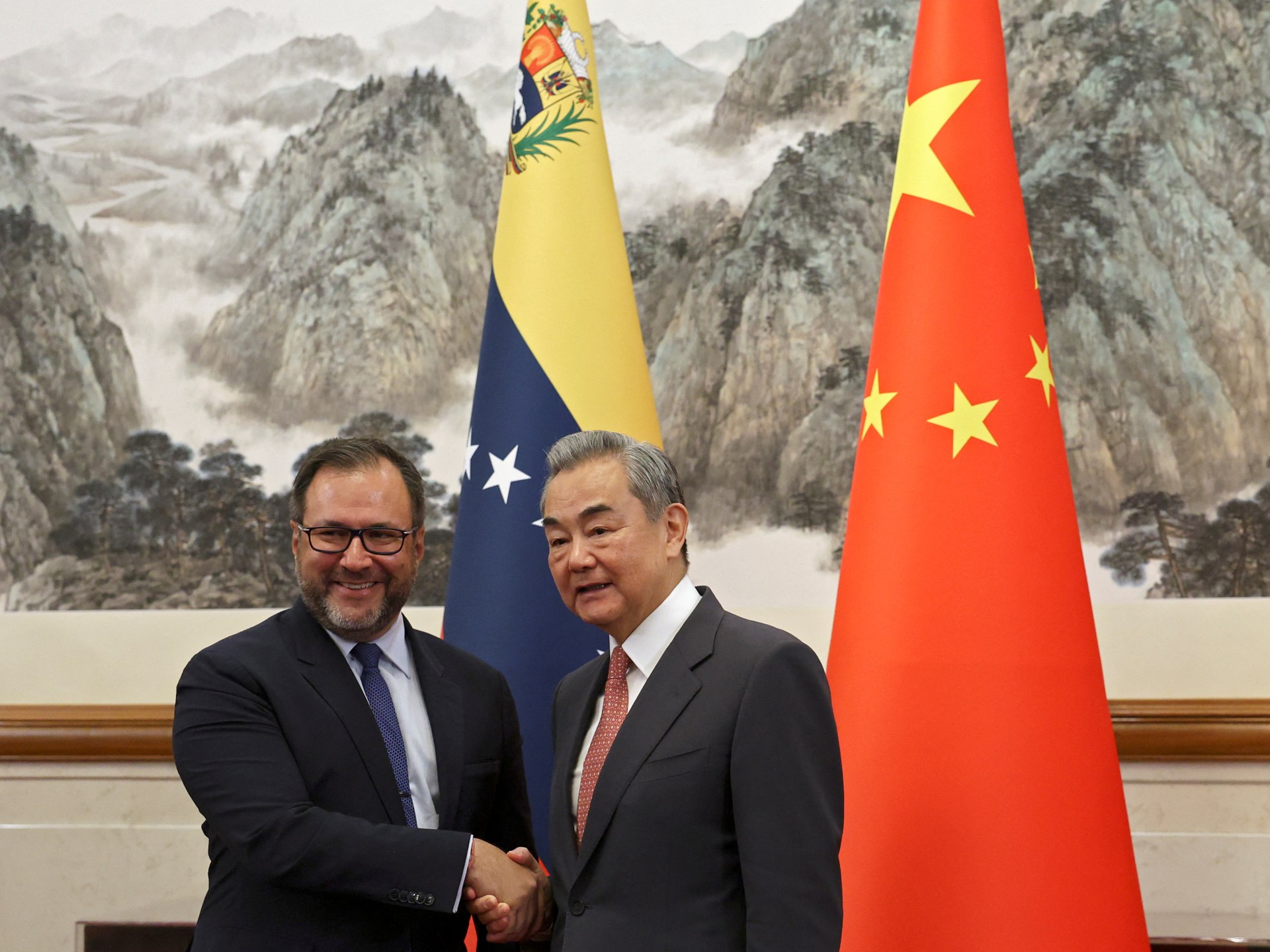
China has spoken out strongly against US actions as Venezuela and the United States teeter on the brink of war. According to Beijing, Washington’s escalation, which includes seizing Venezuelan oil tankers, striking alleged drug-smuggling boats, and imposing a blockade off the Venezuelan coast, is a textbook example of unilateral American behavior that violates the UN Charter and infringes on its own.
Chinese Foreign Minister Wang Yi criticized the US for “unilateral bullying” and praised Venezuela’s right to “defend its sovereignty and national dignity” during a December 17 call with his Venezuelan counterpart.
Beijing hasn’t, however, offered anything besides rhetoric to Caracas. China’s inaction demonstrates how limited its influence in Latin America is, and it is undoubtedly wary of falling into a geopolitical trap.
Engagement with Latin America
China has been expanding its economic ties with Latin American nations for more than 20 years. In consequence, it is now South America’s top trading partner, and it is also Mexico’s second-largest trading partner, one of the US’s closest allies in the area.
The high degree of complementarity between their economies encourages China’s engagement with Latin American nations. During its trade dispute with the US, especially soya beans from Brazil, Argentina, and Uruguay have improved China’s food security. In addition, Chile, Argentina, and Bolivia’s rapidly expanding electric vehicle (EV) industry has a need for minerals like lithium carbonate.
Exports of Chinese electric vehicles to Latin America have increased significantly in recent years, rising by 55% in 2023 alone. The region has opened a market for Chinese telecom technology, such as Huawei’s 5G  , which has long been criticized by Western nations, in addition to easing China’s overcapacity problem. Most Latin American nations are currently using Huawei’s 5G equipment.
Latin America has traditionally been seen as its home by the US, which is naturally suspicious and hostile toward China’s growing influence there. US Secretary of State Marco Rubio, an outspoken China hawk who has previously referred to the Communist Party of China as an “evil, genocidal regime,” launched a diplomatic blitz in the area in February. He stated that he was attempting to “counter the]CPC’s] influence in the Western Hemisphere” and that he was working with several Latin American nations to reduce ties to China.
Washington still has the upper hand in this influence fight despite not being able to provide a compelling alternative model of economic cooperation and opting for extortion tactics through tariffs. For instance, the region continues to be the last bastion of diplomatic support for Taiwan despite the fact that the majority of the nations in the region have been economically enthralled by Taiwan’s recognition that it is an unalienable part of China. Seven nations in Latin America and the Caribbean have established formal diplomatic relations with Taiwan over China.
When Trump-backed conservative candidate Nasry Asfura won the presidential election in Honduras this week, he pledged to end diplomatic ties with China and rekindle diplomatic ties with Taiwan.
Under the Trump administration, several Latin American nations have benefited from US pressure to stifle economic ties with China over the past year.
Panama formally withdrew from China’s Belt and Road Initiative in February. The Panama Canal’s Hong Kong-based operator announced in March that it would be selling the majority of its stakes to a group of American companies, in response to Trump’s claim that China was in charge of the crucial waterway. Mexico announced in December that starting on January 1, it would start imposing tariffs of up to , 50%, on Chinese goods.
More than anything else, US pressure on Venezuela has to do with US domestic politics: Rubio is attempting to fulfill a long-held political agenda to win over opposition-minded Venezuelan and Cuban American constituencies.
However, any changes to the Caracasi regime would undoubtedly harm China’s interests. China has a vested interest in preserving Venezuela’s stability and peace because it is its biggest customer of Venezuelan crude oil. Venezuela is not even listed among its top 10 crude suppliers, which is why China itself is not dependent on Venezuelan oil. However, the US’s interception of Venezuelan oil tankers undermines China’s energy strategy, which aims to avoid becoming overly dependent on any one energy supplier.
A trap or a Monroe Doctrine 2.0?
China views Venezuela’s escalation from both a geopolitical and economic perspective. Important is the larger picture of the US’s projection of global power.
The Trump administration argued in the recently released National Security Strategy that the US should no longer serve as the world’s policeman and that it should follow the principles of the Monroe Doctrine, a 19th-century foreign policy strategy that aimed to stop any foreign interference in American interests.
The US government will maintain a military capable of deterring Chinese ambitions on Taiwan, according to the NSS, despite the fact that it does not identify China as the country’s greatest threat.
This document has sparked conflict between China and the US-Venezuela tensions in the process. On the one hand, the US appears to be avoiding competing with China and instead concentrate on regaining its hegemony over the Western Hemisphere.
On the other hand, it has not taken any significant actions to signal disengagement in Asia, keeping its military installations in South Korea and Japan operational.
Beijing continues to be cautious because it fears that Washington might use its rhetoric and ostensible geopolitical shift to try to condense a false sense of security.
China released a policy paper on Latin America and the Caribbean shortly after the release of the NSS. The paper, which is likely a response to recent events, reflects Beijing’s campaign to bring the conflict to the US.
However, the policies and strategies outlined in the document have the same shortcomings as Chinese foreign policy has always had: they provide more symbolic than substantive support. When confronted by American military might, China seriously falls short of its goal of uniting the Global South by promoting grievance-based unity and opposing US hegemony.
Given Venezuela’s low economic value to China and its distance from other countries, the Chinese government would not invest any resources in its defense.
China would likely use it to advance its vision of a multipolar world and establish itself as a champion of international law and the UN Charter in the event of a US invasion. China would almost certainly not intervene to help Venezuela, despite the fact that it would view the US’s prolonged war as a positive development.
However, a US-toppling of Venezuela’s government would reveal the region’s limits to Chinese influence. Given that the aggressive US is so close by, such a scenario would undoubtedly make many Latin American nations reconsider whether partnering with China is a wise choice.
Source: Aljazeera

Leave a Reply