Days after opposing elements of the multilayered structure that Washington has proposed to govern the Palestinian territory, Israeli Prime Minister Benjamin Netanyahu has agreed to join US President Donald Trump’s “Board of Peace” for the future of Gaza.
Given that the Israeli leader has played a significant part in the genocidal war in Gaza since October 2023, in which over 71, 450 people have died, the idea of Netanyahu serving on the board sparked criticism from many Palestinians and their supporters. The International Criminal Court (ICC) has issued an arrest warrant for Netanyahu over alleged war crimes committed in Palestinian territory.
However, many analysts think that what appears to be changing Israeli positions may have been a deliberate decision.
Netanyahu criticized the Gaza “executive board” just days before he accepted a seat on the multi-national board, claiming that its makeup “was not in line with Israel and goes against its policy.”
The US-led board, which includes representatives of nations close to Israel, former UK prime minister Tony Blair, US Secretary of State Marco Rubio, and Jared Kushner, has a defined portfolio that includes “governance capacity-building, regional relations, reconstruction, investment attraction, large-scale funding, and capital mobilization,” according to the White House.
The Israeli army is also preventing entry to the enclave by the very people charged with rebuilding it at the same time that Netanyahu prepares to sit alongside them on the board.
Therefore, the Israeli government’s decision to join may serve as a ploy to sabotage upcoming efforts to control Gaza’s governance, according to analysts.
Trump will be able to veto all of the board’s decisions, but as chairman, he may be able to do so, which could lead to “negotiations” by Israel regarding these decisions.
Trump has clearly shown that he will make deals, according to Rami Khouri, a fellow at the American University of Beirut. “Israel does not have a veto,” Khouri said.
Trump is “long-term Zionist planner” intent on buying time, according to Khouri, who is transactional and eager to close the Iran deal.
According to Israeli media reports, Israel has already criticized Trump’s inclusion of Turkiye and Qatar on the board.
Yair Lapid, the leader of the Israeli opposition, reportedly told Netanyahu that Trump had made the board’s announcement “without your knowledge” in the Knesset. He claimed that the prime minister was being abused and that Hamas members in Istanbul and Doha were being given the task of managing Gaza.
Netanyahu acknowledged a “disagreement” with Washington regarding the advisory council, saying “there will be no Turkish or Qatari soldiers in Gaza.”
A “disruption” strategy
Analysts claim that the real deadlock is operational, despite the fact that the board members have been the focus of the diplomatic row so far.
A 15-person committee of politically independent Palestinian experts tasked with rebuilding and under the control of the Board of Peace, according to a report from Haaretz on Tuesday, Israel is refusing to let them enter the Gaza Strip via the Rafah crossing. This week, these “technocrats” were scheduled to take over the Strip’s civil administration.
Therefore, there appear to be divergences between the US and Israel regarding Gaza and the second phase of the ceasefire agreement, which this committee is a part of. However, according to analysts, the allies’ relationships don’t actually break down despite the rhetoric.
Expert on Israeli affairs Mohannad Mustafa told Al Jazeera, “I do not call it a clash, but rather a divergence.”
Israel will use tools to obstruct the committee’s work, including limiting their movement and keeping the Rafah crossing closed, because “Netanyahu cannot say “no” to Trump directly.
In the end, Israel wants to break up the ceasefire’s second “humanitarian phase” with its subsequent “withdrawal phase.”
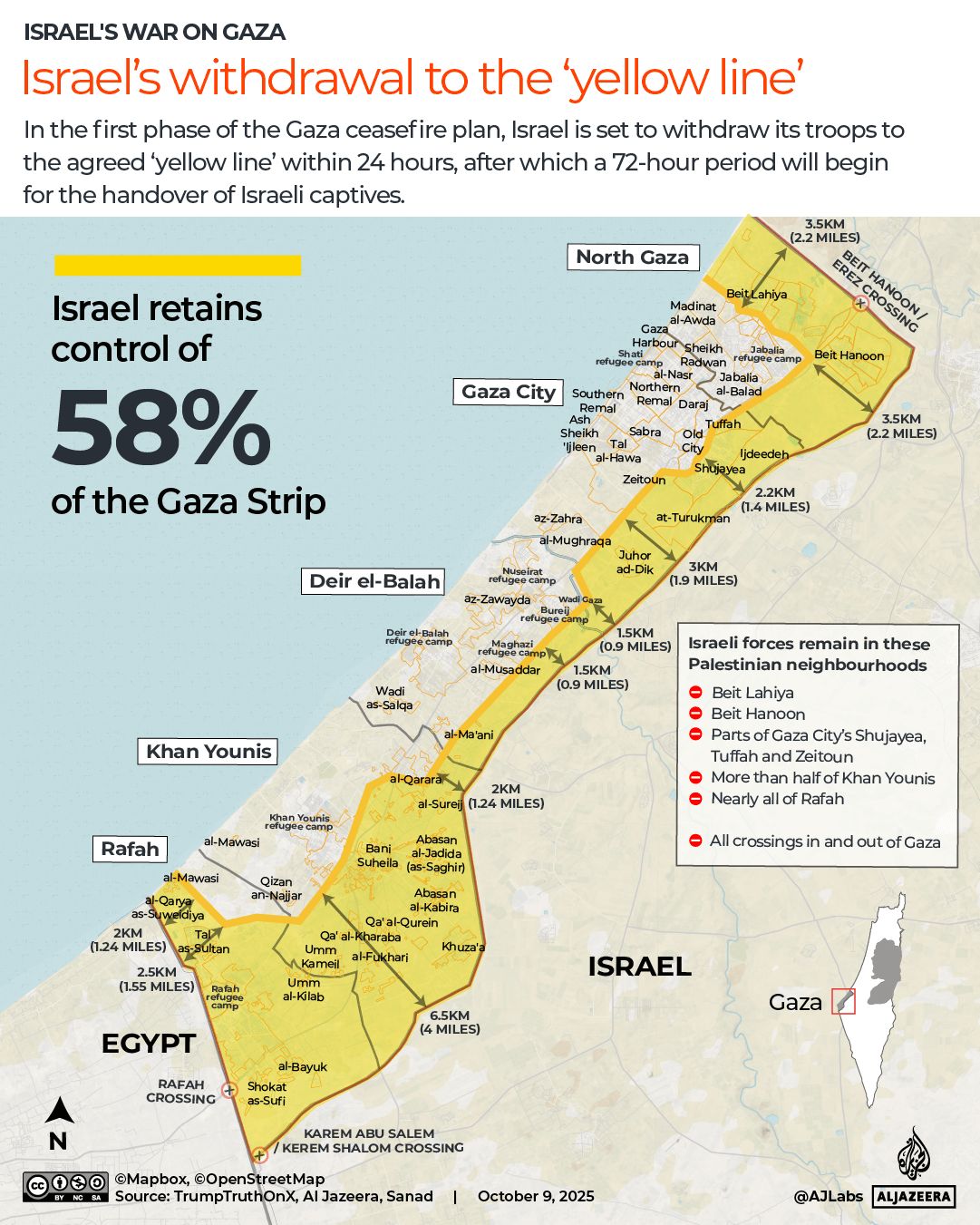
According to Mustafa, “Israel will tell everyone to keep working with your committees, but we won’t withdraw.” They are currently extending their control of the Gaza Strip to 55 to 60%.
Security versus reconstruction: The “high-rise” threat
The Israeli military is already raising the alarm over Gaza’s reconstruction, which is at the top of the peace plan’s agenda.
According to Haaretz, Israeli military officials are concerned about the proposed “high-rise towers” in a new Gaza, specifically the physical reconstruction plans. They claim this would “unacceptable” because they would have a view of southern Israeli military installations and settlements.
Israel effectively freezes reconstruction by citing security threats and demanding a distinct demilitarization process that no international organization is capable of implementing.
This demonstrates the absurdity of “the US vision clashing with Israeli reality,” according to Mustafa.
“Imagine creating residential clusters in a region that Israel still has military control over.” The committee may begin overseeing the locations with an Israeli security clearance.
A compensation compliance pattern
Khouri contends that Israel’s “brinkmanship” appears to be a 75-year-old historical game, in which it only concedes to US demands after receiving a significant amount of compensation.
According to Khouri, “it will try to get guarantees in return,” citing precedents like the 1979 and 2000 withdrawals from Lebanon. It obtained guarantees of unprecedented levels of aid, support from the UN, and strategic defense collaborations, according to the US.
In order to make the Board of Peace function, Netanyahu is likely positioning himself to demand new security guarantees or perhaps access to cutting-edge weaponry by creating a crisis through the inclusion of Turkiye and Qatar or the construction of high-rise apartment blocks.
A pressure cooker at home
Netanyahu is negotiating with Trump in addition to ensuring his country’s political future.
According to a recent poll conducted by Channel 13, 53% of Israelis consider the Board of Peace’s participation by the Turkish-Qatari to be an “Israeli failure.” The US plan was condemned by Finance Minister Bezalel Smotrich, who described it as “a bad plan for Israel.”
Smotrich also claimed that nations like the UK and Egypt are hostile to Israel’s security, according to the Israeli newspaper Ma’ariv. Instead of requesting Israel’s withdrawal, Motrich has continued to call for military rule over Gaza and the “voluntary migration” of its population.
According to Mustafa, “Netanyahu is in a political whirlwind.” He is being squeezed by the Americans, the settlers who want to return to Gaza, and the opposition.
The election is approaching.
The Israeli electoral calendar, which is likely to hold elections in October 2026, is the final variable.
This will be regarded as a failure, according to Mustafa, “if Israel withdraws from Gaza without Hamas being disarmed.” “Netanyahu will prefer to serve his own political goals to Trump’s approval.”
Despite Trump’s growing frustration, there hasn’t been a formal agreement on when Hamas’ disarmament will occur, despite the ceasefire agreement with Israel. He stated last week that he would push for the “comprehensive” demilitarization of Hamas, and he stated in a social media post that “they can do this the easy way or the hard way.”
Bottom line, according to Khouri is that Israel is terrified of losing “sole security control” of the Strip while US public opinion is shifting further into horror at the genocide in Gaza.
Source: Aljazeera

Leave a Reply