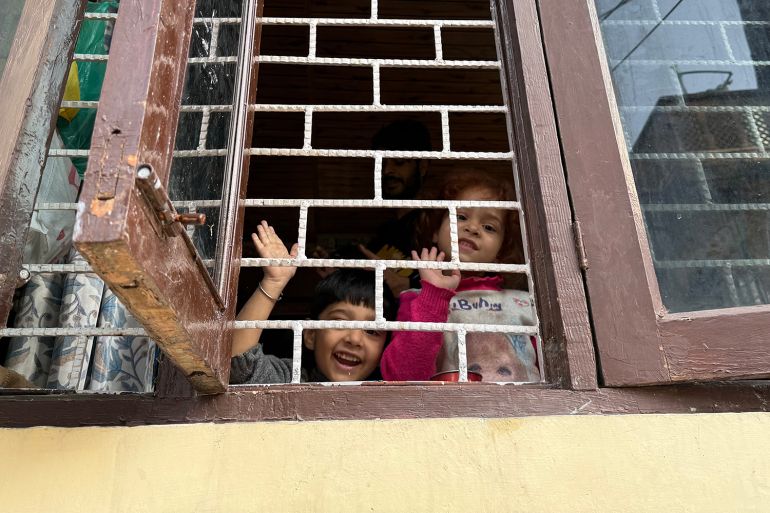
The rehearsed beckoning of street vendors and the restless cries of two young children break the silence of a narrow alley in Srinagar, the main city in Indian-administered Kashmir.
“Auntie, please take me to my mother, the police took her away”, shouts three-year-old Hussein, as he and his sister Noorie, a year younger than him, cling to the window of their one-room house, their faces pressed against rusted iron bars.
Recommended Stories
list of 4 itemsend of list
Since their mother, a Pakistani national, was forced to leave and was deported more than seven months ago, the pair have been yelling like that almost every passing by, according to their father, Majid*.
The family’s ordeal began a week after half a dozen gunmen, a couple of them alleged to be Pakistani nationals, stormed a scenic tourist spot in Indian-administered Kashmir’s Pahalgam area and shot 26 people dead on April 22, 2025 in one of the worst attacks in the disputed region.
India and Pakistan own a portion of Kashmir’s Muslim-majority region, but their nuclear-armed neighbors assert full control over the region, and regional superpower China also holds some of the landmass. Since India’s independence from British rule and its partition to create the state of Pakistan in 1947, the two countries have fought two of their three full-scale wars over Kashmir.
An armed uprising against New Delhi’s rule on the Indian side erupted in the late 1980s, which has since claimed tens of thousands of lives, most of them civilians. The rebellion saw the deployment of nearly a million Indian soldiers, making it one of the world’s most militarised regions. The rebels want to combine Kashmir with Pakistan, which has a Muslim majority, or to create an independent country.
The anti-India sentiments in Kashmir intensified in 2019 when Prime Minister Narendra Modi’s Hindu majoritarian government scrapped a law that granted the region partial autonomy in matters of land ownership and livelihoods, and split it into two “union territories” to be directly governed by New Delhi. Since then, suspected Kashmiri rebels have launched numerous attacks on Indian government employees and security personnel. India accuses Pakistan of training and financing the rebels, but Islamabad dismisses the charge, claiming it only provides diplomatic backing to Kashmir’s struggle.
India immediately put a key water treaty in abeyance, suspend bilateral trade, and put Pakistan on hold for the Pahalgam attack as well. Two weeks after the killings, in early May, India and Pakistan engaged in an intense four-day air war, each striking the other’s military bases. Before the neighbours agreed to a ceasefire, thousands of people were killed on both sides: India claims it only targeted “terrorists” in Pakistan, while Islamabad claims civilians are primarily the victims.
But seven months later, the pause in fighting has meant little for hundreds of families, like Majid’s and Samina’s, that were broken apart by one of India’s moves.
India revoked all visas issued to Pakistanis living in India, including those for medical and diplomatic purposes, giving them a May 1 deadline of April 29, 2025, and closing the Attari-Wagah border in Punjab province’s Amritsar district.
Nearly 800 Pakistanis – many of them married to Indian nationals in Kashmir and other parts of India – were deported.
The wait is awaited for relatives on both sides of the border because authorities don’t know whether those families will ever reunite.
‘ I think of ending my life ‘
Samina, his 38-year-old cousin from Pakistan, and Majid got married in 2018.
Despite tense relations between their countries, their marriage was not especially rare. Many Muslims and Hindus to India left behind relatives on both sides of the border when millions of them migrated to the newly formed Pakistan in 1947. Over the years, these blood ties gave rise to cross-border marriages between citizens of the two countries.
However, Samina was summoned to the Dalgate neighborhood of Srinagar on April 28. Noorie and Hussein slept on their laps as the couple met the police officer. When the children realized their mothers were gone, their father had brought them back home.
Samina was detained at the police station and informed that she would be deported to Pakistan — she is originally from Lahore — the next day.
Majid said he is still struggling to process the events that altered his life, which included his bedroom and kitchen, in a dimly lit room.
He used to work as a waiter for a nearby restaurant, where he made about $70 per month. But since his wife was taken away, he has not been able to leave his little children alone. He is currently unemployed.
“I have not slept properly for six months now. My entire time is spent tasked with raising the kids. I cannot think about doing anything else”, he told Al Jazeera.
Majid claims he can’t even go out and buy groceries because he is locked up in his room. “Sometimes, I think of ending my life”, he said. But as I go home, I stop and think about how they would care for them.
Majid’s children, Hussein and Noorie, also do not know when they will be able to see their mother.
They have been traumatized by their sudden separation from Samina. They call out to their mother in sleep”, Majid told Al Jazeera as he made a futile attempt to distract his children by showing them cartoons on his mobile phone.
They are only aware that the police removed her. Whenever they see any police or army officer, they ask them to bring their mother back”.
Samina is currently dealing with health issues in Pakistan after being forcibly separated from her children. Her blood pressure is unstable due to stress. She occasionally gets hospitalized. Her blood pressure isn’t normalising”, said Majid.
When questioned about the deportations, Bharatiya Janata Party (BJP) spokeswoman Shazia Ilmi claimed that the concerns about national security led to the decisions. Those deported were Pakistani nationals, she emphasised, and often were “married to those who have been found involved in terrorism and activities that are antinational”, she told Al Jazeera.
Therefore, Pakistanis cannot enter India and support these activities in this way. Why should India have Pakistani nationals”? she stated.
When pressed to present evidence in support of her allegation that deportees were often married to those involved in “terrorism”, Ilmi accused Al Jazeera , of having a “dubious agenda”. She said, “I believe you have a nasty agenda to find things against India and the Indian government, and it will not work.”
Reunited after years, separated again in 12 days
In the densely populated district of what is known as Old Delhi, Daryaganj, where Muhammad Shehbaz is a 32-year-old resident. In 2014, he married his maternal cousin from Pakistan, 27-year-old Erum. Erum had been living in India for a long time before moving to Pakistan to meet her family, who had just turned three.
That was in March 2020 – just 10 days before a lockdown and travel restrictions were imposed in the wake of the coronavirus pandemic. Her Indian visa expired while Rum was forced to extend her stay in Pakistan.
After the lockdown was lifted, Shehbaz tried hard to secure another Indian visa so that Erum could return. She received a final rejection in April of this year after five years of repeated rejections. After more than five years of separation, an elated Shehbaz was finally going to be reunited with his family.
On April 17, Erum arrived in New Delhi. Twelve days later, the Pahalgam attack happened. On April 29, she was returned to Pakistan.
“After so many years of separation, hard work and longing, she had finally come home. I had forgotten everything that had happened in my world. And then, in the blink of an eye, it all collapsed again. She was taken away, leaving me vulnerable and drowning in despair, Shehbaz told Al Jazeera.
“When the police came to our home and informed us about Erum’s deportation, I became numb. My son was groping uncontrollably. The struggles I faced all these years to reunite my family are beyond words. And now it seems like everything was lost.
Almeer, now nine, first grew up for years without his father and has now been torn away from his mother. Shehbaz, who owns a small jewelry store, worries about the future.
“He has grown frail and quiet, not expressing much, but I can see he is shattered inside”, Shehbaz told Al Jazeera. Why are regular citizens shoved to the wall when the two countries are at war with one another? What is our fault”?
Parveena hadn’t visited Pakistan in over 40 years.
Back in Indian-administered Kashmir, Fazl‑u‑Rehman, 62, does not know if he might be able to see his wife, Parveena, who was deported in April to Pakistan, a country she had not seen in more than four decades.
Parveena, 65, was born in Karachi, Pakistan. But she never went back after marrying Rehman in 1982, as she built a life with her husband and children in Baramulla district.
Rehman now fears that he might pass away without seeing her.  , “Our home has been divided. Everything is in disrepair. I don’t know how many years I will live”, he told Al Jazeera, his voice choking.

Rehman and Parveena have two daughters – the elder one, Afreen, is married, while Soliha, 27, is at home, looking after her ageing parents while also pursuing a master’s degree in political science.
She told Al Jazeera, “I managed to manage the household responsibilities alone while I missed my second semester midterm exams in July.” “I have to do it all alone – getting medicines, groceries and other household chores. I had to give up my education when I was left with no other choice.
Soliha said her mother has been undergoing treatment for heart disease in Kashmir. She also lacks financial support and immediate relatives in Pakistan, where she continues to receive treatment. She said her mother lives in Karachi with a distant relative, who is paralysed.
“She needs someone to look after her,” she said. If anything happens to my mother there, the Indian government would be responsible”, she said.
Why are we being punished for the crime that was committed by another person? My education and career are at stake. Because of my mother’s deportation, I have mental health issues.
Her father, Rehman, intervened. In Kashmir, there are between 700 and 800 armed forces. If they couldn’t prevent the]Pahalgam] attack, how are civilians being held responsible for it”? He yelled in rage.
Parveen urged the government to “stop punishing your own citizens” and demanded the return of their loved ones.
Never have I felt lifeless like this.
Abdullah* says he has been forced to rebuild his life that fell apart after his wife, Tamarah*, 25, was deported on April 29. He claims that his twins, Ayan and Atif, who are only 18 months old, no longer play, laugh, or eat as they once did. One of the twins was still breastfeeding when Tamarah was deported.
Tamarah and Abdullah, a 38-year-old public bank manager in Kashmir’s Kupwara district, wed in 2018. As she was driven to the Attari-Wagah border for deportation, Abdullah took his children and followed the police van in his car all the way from Kupwara to Amritsar, a distance of more than 500km (324 miles).
He told Al Jazeera, “I cried on the way, pleading helplessly with the police to at least let the children see their mother one last time.” “But they didn’t even allow us a proper goodbye”.
For the children, the first two months were “nothing short of hell.”
“After the sudden separation from their mother, their health began to deteriorate. He continued, “They had frequent fevers and nausea,” adding that he had not been to office in the last six months, and that one or both of the children needed hospitalization.
“Everything is disrupted. The world has changed. I have never felt so helpless in my life”, he said.
Even lawyers, according to Abdullah, declined to hear about the case of his children, who were separated from their mothers. He said the lawyers said no legal action could proceed without permission from the federal Ministry of Home Affairs. Abdullah claimed to have written to Prime Minister Modi and other New Delhi and Kashmir officials out of desperation, but was never received a reply.
‘ Because they are Pakistanis and Muslims ‘
Due to the tensions between India and Pakistan, human rights activists claim that there is no justification for punishing innocent civilians.
“Ordinary people hold no enmity towards each other. Why should political or diplomatic conflict cause them harm? said Shabnam Hashmi, a New Delhi-based activist. Civilians must never be the victims in a conflict. To separate a child from their mother is cruel, traumatic, and utterly inhuman – a clear violation of human rights”.
The deportation of Pakistanis is unjustified and unfortunate, according to Waheed Para, a Kashmiri lawmaker from the Peoples Democratic Party.
“After Kashmir’s conversion into a union territory, our ability to influence or resolve such issues has been severely limited. He told Al Jazeera, referring to the federal government in New Delhi, “We can raise our voices and try to intervene, but we remain largely powerless in the face of decisions made elsewhere.”
“In cross-border shelling, civilians lose lives and homes. Unfortunately, innocent people, children, and women continue to suffer as a result of India and Pakistan’s geopolitical conflict, Paragraph added.
Al Jazeera reached out to the Ministry of Home Affairs for their response, but did not receive any reply.
The deportation of Pakistanis has no logical connection to the Pahalgam attack, according to Colin Gonsalves, a rights activist and lawyer for the Supreme Court.
“Linking them to Pahalgam]attack] is simply an excuse and a deeply flawed one … The government may claim it is a fallout of Pahalgam, but that claim is not only misleading, it’s dangerous”, he told Al Jazeera.
They were deported simply because they were Muslims and Pakistanis, which shows a bias toward both.
Back in Kupwara, Abdullah wipes the tears rolling down his cheeks, struggling to speak as he recollects the months since his wife Tamarah was deported.
“What the Indian government did to us is comparable to what the attackers did in Pahalgam,” the statement read. They destroyed our families and homes too”, he said. Why are our children receiving punishment? What did they do”?
Source: Aljazeera

Leave a Reply