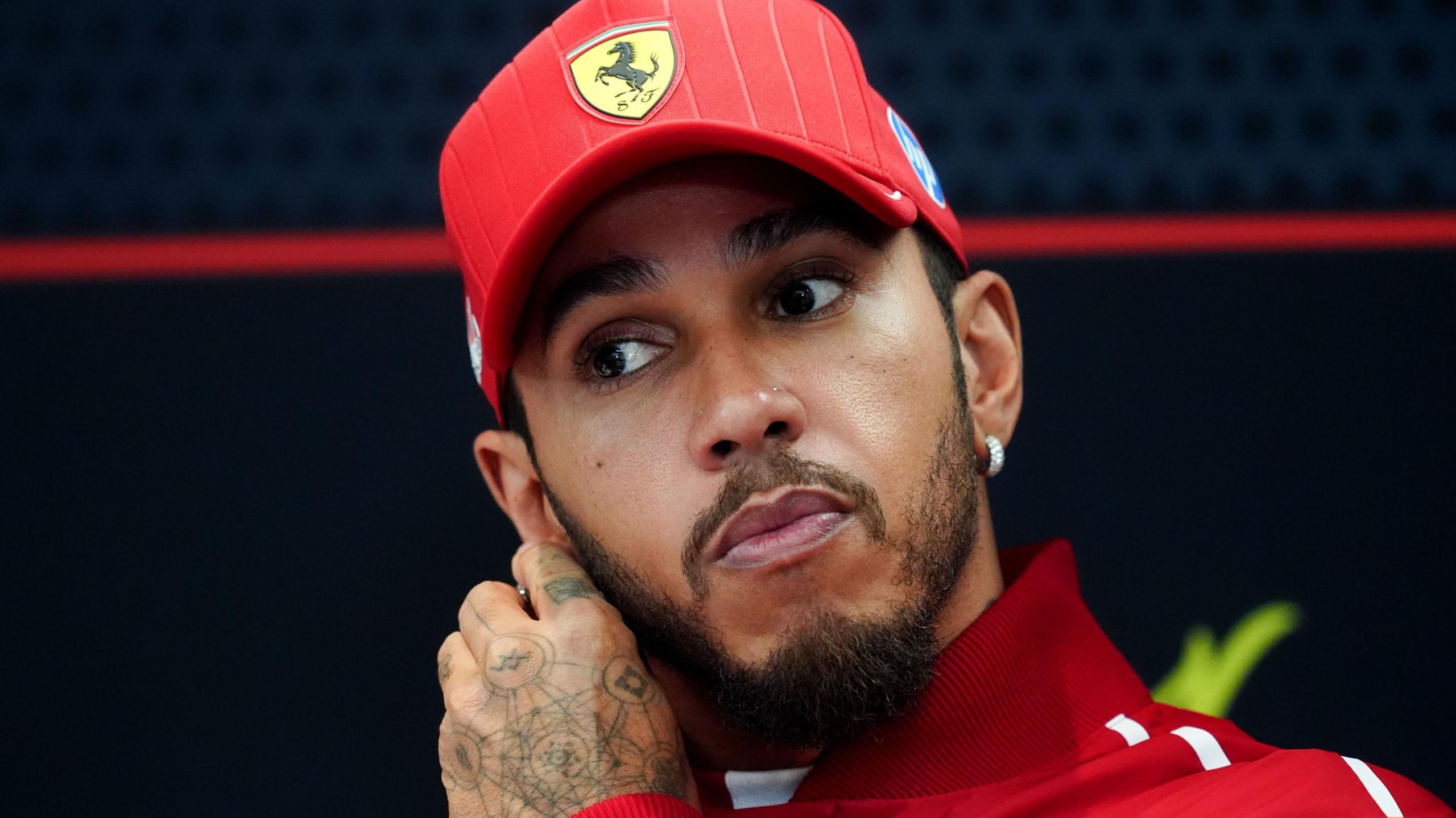
Lewis Hamilton said after the final race of what has been an annus horribilis for him at Ferrari that he wanted to shut off from the world over the winter.
“I’m already looking forward just to the break, just to disconnecting, not speaking to anyone,” the seven-time champion said, after the worst season of his career.
“No one’s going to be able to get hold of me this winter. I won’t have my phone with me and I’m looking forward to that. Just completely unplugged from the matrix.
“I’ve generally always had it around, but this time it’s going in the fricking bin.”
His remarks reflect the toll this season, his first in which he has scored not a single podium finish in a grand prix, has had on Hamilton.
The 40-year-old Briton joined Ferrari with the ambition of winning that elusive eighth world title, which he – and a good number of others – believes he should already have won in the controversial 2021 title decider.
It had been a long-time ambition, and the move created a sensation.
The sport’s most famous driver joining its most iconic team, right at a time when Ferrari seemed to be on an upward trajectory after ending 2024 narrowly missing out on the constructors’ championship at the final race of the year. It seemed set up perfectly.
But the script went off course. Ferrari’s car was not competitive at the start of the year, while Hamilton struggled to adapt to its characteristics, and had questions about the way the team worked.
Although a sprint-race victory for Hamilton at the second race of the season in China was a promising start, reality set in with a bump the following day, when both cars were disqualified from the grand prix.
In Hamilton’s case, the reason for the disqualification was an early indication of a problem that would blight much of Ferrari’s season.
He was disqualified for excessive skid wear. To be vaguely competitive, Ferrari had to run the car so low that it risked wearing out its skid plates. Run it higher, and it was slow.
Ferrari fell foul of this issue at least twice more in the season. In Spain, the Ferrari pace dropped off significantly in the final stages after a promising first two-thirds of the race as the team tried to manage skid wear, in this case by increasing their tyre pressures for the final stint.
In Hungary, his team-mate Charles Leclerc qualified on pole and appeared to be competing for the win with the McLarens for the first two-thirds of the race, only to slow significantly in the final stint as he limited his top speed to reduce the load on the car.
It was in Hungary that the first real signs of the strain on Hamilton showed.
He could manage only 12th on the grid, and the stark comparison between him and Leclerc resulted in him saying he was “just useless”, and suggesting the team “probably need to change driver”.
The second part of the season was littered with similarly downbeat comments, always uttered in the heat of the moment when the adrenaline was still pumping after a difficult time out on track.
Team principal Frederic Vasseur has been brushing them aside.
“I don’t pay attention to the reaction in the TV pen,” he said in Abu Dhabi last weekend. “Honestly. Or the reaction that sometimes they add on the microphone in the car, on the radio.
“In the TV pen, they are jumping out of the car five minutes after the session. Sometimes they have bad results for a couple of hundredths (of a second). And you are asking them questions.
“I can understand that sometimes the guy is a bit emotional and to say, ‘OK, yes, no.’ All he wants is to go back to the engineering office and to discuss with the engineer to understand why.”
In that answer Vasseur touched on another common theme he has used to downplay Hamilton’s difficulties.
When Hamilton has missed out in qualifying, Vasseur often points out that it’s usually by tiny margins. The field is so tight, he says, that any error, whether in driving or tyre preparation or whatever, is punished.
As Vasseur said after the race in Abu Dhabi: “We struggled all the season with details, because what we have to keep in mind is that yesterday in Q1, you moved from P6 to P16 for less than 0.1secs.”
The margin between sixth and 16th last Saturday was actually 0.216secs, but the fundamental point stands – Hamilton missed out on getting through by 0.009secs.
Nevertheless, it overlooks the fact that there are two Ferrari drivers, and Leclerc has not been as badly affected.
Inevitably, Ferrari’s first winless season since 2021, in combination with the added focus on the team created by Hamilton’s presence, has stoked tensions.
That was abundantly clear when Ferrari chairman John Elkann made an intervention after the Sao Paulo Grand Prix.
A day after Hamilton had said his season was “a nightmare and I’ve been living it for a while”, Elkann gave a rare interview and said his drivers needed to “focus on driving and talk less”.
Elkann’s comments have not had any noticeable effect on Hamilton’s desire to express his frustration publicly.
After a difficult Las Vegas weekend, he told BBC Sport he was “not looking forward to” next season.
Hamilton insists he is still motivated to continue into next season, when the introduction of new rules bolsters his hope that his and Ferrari’s form can turn around.
“It’s the love for what you do,” he says. “It’s the love for racing. I’ve got amazing support from people around me, my fans. It’s that constant keeping an eye on the dream. I still have a dream that I hold hope in my heart and that’s what I work towards.”
That dream remains to win his eighth world title with Ferrari. Any suggestions he should retire can clearly by ignored.
How realistic that dream might be remains to be seen. And the exact causes of Hamilton’s struggles in 2025 remain a point of conjecture.
Next year, F1 is going through a major upheaval with new rules for cars and engines. Ferrari are not alone in hoping that the inevitable reset of the competitive order that will create will benefit them.
That partly explains why Ferrari have not shown any significant progress this season. When the car was clearly uncompetitive early on in 2025, the team made a collective decision to focus even more heavily on the 2026 car, even earlier.
“I was a part of (that), I was one pushing for it,” Hamilton says. “You can’t fall behind the others in terms of that development for the new car because it’s a steep learning curve for all of us.
“So I supported it 100%. I still do. I think it was the right decision. Particularly where we were already with the car, we weren’t fighting for a championship.
“But it’s just meant that it’s been harder to maintain the performance, at least some of the performance we had at the beginning of the year.”
This season has provided Hamilton with plenty of examples of areas where he thinks the team can improve operationally, and it’s clear that Ferrari will be spending some time over the winter looking at where to plug the gaps that Vasseur, too, has repeatedly pointed out.
“We just need to analyse where we’ve been, what’s been good, areas that we can improve on,” Hamilton says. “I know where they all are. It’s sitting down with the team at the end of the year.”
But even if Ferrari end up competitive next season, there inevitably remain question marks about Hamilton.

And perhaps the most striking aspect of Hamilton’s season is that it has been unique in one noteworthy way.
Until this year, no matter how difficult a season had been, there were always reliably a handful of the sort of moments where Hamilton did something incredible – a qualifying lap that came out of nowhere, a race of consistently searing speed, a stunning overtaking move etc.
Aside from his sprint victory from pole in China, it’s hard to think of any similar moments in 2025.
Hamilton has made no secret of his distaste for the generation of cars that were created by the rules introduced in 2022. “There’s not a single thing I’ll miss about these cars,” he said. “Simple as that. I’ve not enjoyed it.”
The theory is that they do not mesh with Hamilton’s style of late braking and pitching the car into the corner.
Yet it remains a mystery how a driver who was long famed for his adaptability, and whose talent and status is unquestioned and unquestionable, has failed to adapt to them.
Equally, while next year’s cars return to an aerodynamic philosophy that is much more akin to those in which he had so much success until 2021, teams are already saying that the other changes being brought in for next year will require major levels of adaptation from the drivers – perhaps more than ever before between one year and another.
Many people in F1 wonder whether Hamilton’s struggles are more to do with the inevitable creep of age – he will be 41 in January – than anything else. And some have drawn parallels with Michael Schumacher’s unconvincing comeback from 2010-12.
Hamilton’s old rival Fernando Alonso, who is three years older than him, seems to be proving that racing into your fifth decade does not necessarily need to mean a competitive decline.
But human beings age in different ways and at varying rates.
Related topics
- Formula 1
- 1 day ago

- 2 days ago


Source: BBC

Leave a Reply