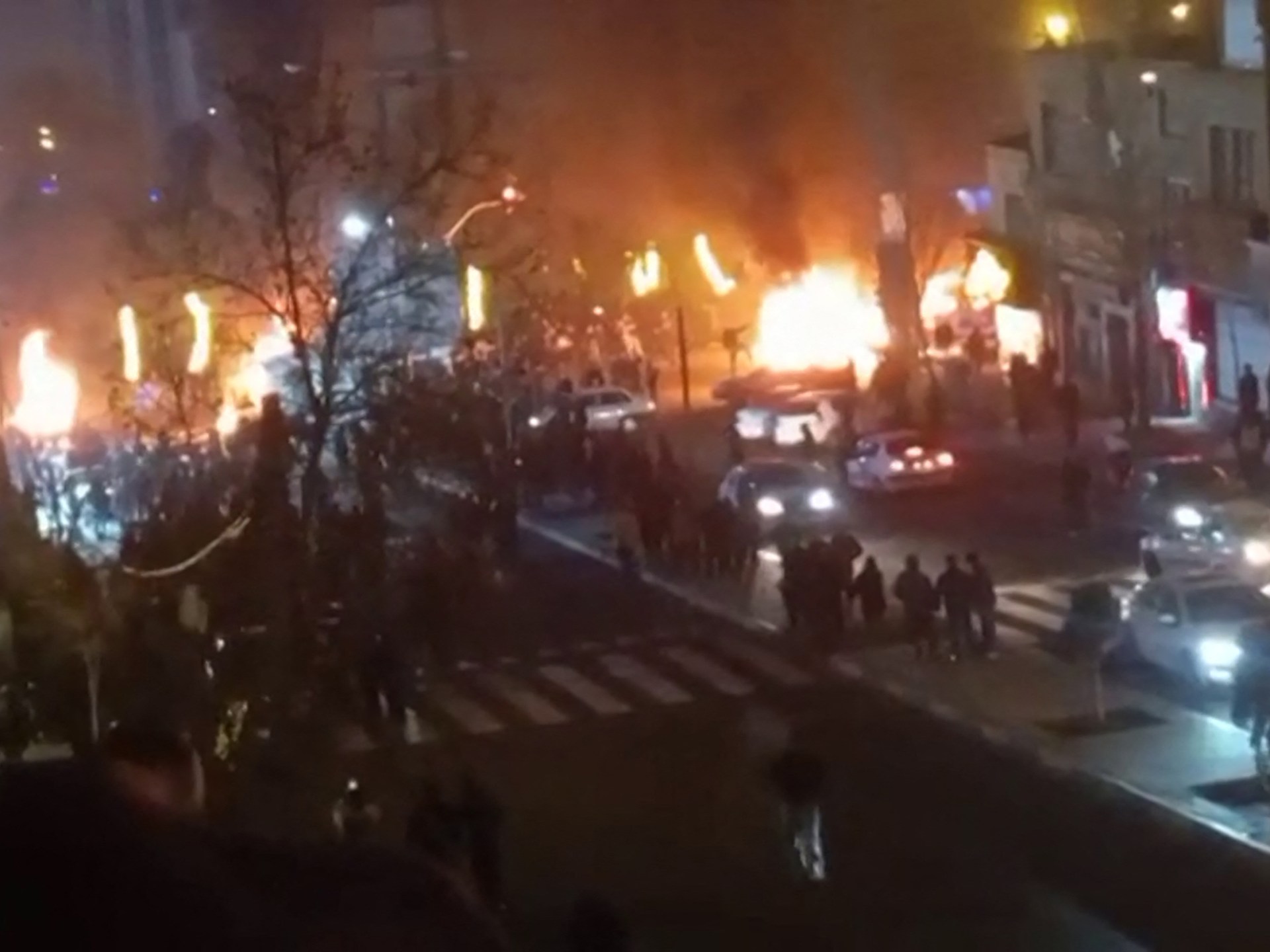
United States President Donald Trump has repeatedly threatened that Washington could intervene militarily in Iran if there is a violent crackdown on demonstrators amid ongoing protests.
On Wednesday, it emerged that some personnel have been advised to leave the United States military’s al-Udeid Air Base in Qatar by Wednesday evening, heightening fears of a US strike and potential Iranian retaliation.
Recommended Stories
list of 4 itemsend of list
Protests in Iran began in late December 2025 over Iran’s worsening economic conditions. Since then, however, they have escalated into a broader challenge to the country’s clerical leadership, which has been in power since the 1979 Islamic revolution.
On Tuesday, Trump took to social media to tell protesters in Iran that help was “on its way”, prompting speculation that US intervention in the country could be imminent.
But if Washington does intervene in Iran, what options does it have, and how feasible are they?
What has Trump said?
In a post on his Truth Social platform on Tuesday, Trump wrote: “Iranian Patriots, KEEP PROTESTING TAKE OVER YOUR INSTITUTIONS!!! Save the names of the killers and abusers. They will pay a big price. I have cancelled all meetings with Iranian Officials until the senseless killing of protesters STOPS. HELP IS ON ITS WAY. MIGA!!! PRESIDENT DONALD J. TRUMP”.
“MIGA” refers to “Make Iran Great Again” – a play on Trump’s “Make America Great Again” slogan.
The US president did not expand on what form this “help” would take.
However, on January 2, Trump wrote on Truth Social that if Iran “violently kills peaceful protesters, which is their custom, the United States of America will come to their rescue”. He added: “We are locked and loaded and ready to go.”
What has the Trump administration said?
On Monday, White House Press Secretary Karoline Leavitt told Fox News that while diplomacy remained Trump’s first option for Iran, he is “unafraid to use the lethal force and might of the United States military if and when he deems that necessary”.
“Air strikes would be one of the many, many options that are on the table for the commander-in-chief,” Leavitt said. As president of the US, Trump is the commander-in-chief of the armed forces.
“He’s made it quite clear he certainly doesn’t want to see people being killed in the streets of Tehran, and unfortunately, that’s something we’re seeing right now.”
Referring to Trump’s use of military force in Iran, Leavitt said: “Nobody knows that better than Iran.”
In June 2025, during Iran’s 12-day war with Israel, the US bombed three Iranian nuclear sites at Fordow, Natanz and Isfahan following more than a week of Israeli strikes on Tehran’s military and nuclear sites. The 12-day war between Iran and Israel lasted from June 13 to June 24.
However, the situation now is not the same as it was in June last year. The US military presence has since decreased in the Middle East.
Why has the US military presence decreased?
The USS Gerald Ford, the US Navy aircraft carrier and the world’s largest warship, left Norfolk, Virginia, on June 24 and was deployed to the Mediterranean near the Middle East, allowing Washington to showcase its military posture in the region during the 12-day war.
However, the USS Gerald Ford has now been sent to the Caribbean as part of US Southern Command (SOUTHCOM) for Operation Southern Spear, which has been building off the coast of Latin America since November.
US Defense Secretary Pete Hegseth said that operation was launched to target alleged “narco-terrorists” in Latin America. US strikes have been carried out at least 30 times on Venezuelan boats in the eastern Pacific and Caribbean, which the US alleges were carrying drugs, although it has provided no evidence of this.
On January 3, US forces abducted Venezuelan President Nicolas Maduro, whom the Trump administration describes as a narco-terrorist. He currently faces charges related to weapons and drug trafficking in New York.
It would take about 10 days for the USS Gerald Ford to travel between the Caribbean and the Mediterranean, according to estimates in an October 2025 analysis by the Center for Strategic and International Studies (CSIS) carried out before the warship’s deployment to Latin America. This is if it travels 20 knots on average, which is 37km/h (23mph).
Based on the CSIS numbers, it would likely take the Ford another week to travel from the Mediterranean Sea to the Gulf, and the coast of Iran.
Besides the Ford, the US has moved its associated strike group vessels out of the Mediterranean Sea, primarily to the Caribbean Sea as well. As a result, the US strike power in the Middle East is currently significantly smaller than it was in June.
What military presence does the US have in the Middle East?
Despite the relocation of its warships, the US does still operate a broad network of military sites, both permanent and temporary, in at least 19 locations in the Middle East. This has remained the same between June and now.
Of these, eight are permanent bases in Bahrain, Egypt, Iraq, Jordan, Kuwait, Qatar, Saudi Arabia and the United Arab Emirates.
According to unnamed diplomats quoted by the Reuters news agency, some personnel have been instructed to leave the US military’s Al Udeid Air Base in Qatar by Wednesday, but it is unclear for what reason. Al Udeid is the Middle East’s largest US base, and it houses 10,000 troops. During the 12-day war, Iran launched an attack on the Al Udeid base.
“It’s a posture change and not an ordered evacuation,” one of the diplomats told Reuters, adding he’s not aware of any specific reason for the move.
This was after US B‑2 stealth bombers dropped 14 “bunker buster” bombs on at least two Iranian nuclear sites. The US still has the military capacity to do this.
Could the US target the leadership in Iran?
“Trump favours short, sharp operations with minimal risk to US troops,” Shahram Akbarzadeh, a professor of Middle East and Central Asian politics at Australia’s Deakin University, told Al Jazeera.
He cited the recent abduction of Maduro from Venezuela and the US assassination of Qassem Soleimani, the head of Iran’s Islamic Revolutionary Guard Corps (IRGC) elite Quds Force, in a drone attack in Baghdad, Iraq, in 2020.
“We know exactly where the so-called ‘Supreme Leader’ is hiding,” Trump wrote in a Truth Social post back in June, referring to Iran’s Ayatollah Ali Khamenei.
“He is an easy target, but is safe there – We are not going to take him out (kill!), at least not for now. But we don’t want missiles shot at civilians, or American soldiers. Our patience is wearing thin.”
Akbarzadeh said since Trump has already suggested he could take out the Iranian supreme leader, that could be a possibility, but Trump will have to “be prepared for the inevitable backlash”.
“If the supreme leader is eliminated in a plan to decapitate the Islamic regime, the IRGC is the most likely player to step into the void and take control. That would not be a good outcome for the US, and I suspect the Trump administration is mindful of that possibility,” Akbarzadeh said. However, he added that the tide of support of the people would be unlikely to turn towards the leadership if the supreme leader is targeted, as the clerical regime is unpopular.
If the IRGC were to take control, Iran would likely move from a theocratic republic hybrid to overt military rule, Akbarzadeh said. It would likely be even more opposed to Washington than the current clerical leadership. The IRGC is also more likely to retaliate against a US strike.
Experts say it is unlikely the US will carry out an operation in Iran similar to the one in Venezuela, which resulted in the abduction of Maduro.
“The logistics of doing something like the operation in Venezuela are too difficult in Iran. The distance that US helicopters have to fly is much greater, and the Iranian security is already on alert – in case Trump attempts something like that,” said Akbarzadeh.
“Iran may think that the US may hope that a targeted strike would eliminate the supreme leader or a number of key leaders, and then the US would try to force what is left of the Islamic republic to do what the leader refuses to do on nuclear or missile issues,” said Vali Nasr, a professor of international affairs and Middle East studies at Johns Hopkins University.
“Their reading of Venezuela is that the US … wants to change the game in Iran, but that the US is not about to invade Iran with troops, and the US is not necessarily looking for regime change and nation-building of the kind we saw in Iraq or Afghanistan.”
Is a ground invasion possible?
Experts say it is unlikely that Washington would send troops to Iran.
“Trump is not a nation builder. He does not believe in long-term commitments or building democracy. Remember, he gave up on Afghanistan. So he is not going to commit to boots on the ground in Iran. It is simply too costly,” Akbarzadeh said.
Under Trump, the US has moved decisively towards ending its long war in Afghanistan, which began in 2001.
Source: Aljazeera

Leave a Reply