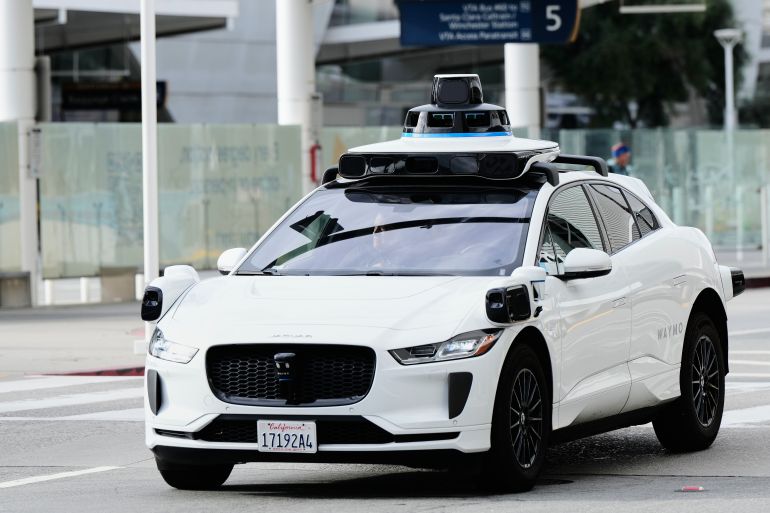
San Francisco, the United States: The sidewalk outside Majed Zeidan’s grocery store in San Francisco’s Mission District has stayed filled with flowers, candles, memorials and pictures since his cat was crushed under a Waymo in late October. A month later, a Waymo reportedly crushed a dog.
Amid the pictures of the cat, a visitor had placed a poster that said, “save the cat, kill the car”. That’s when Zeidan knew Kit Kat, his bodega cat, had become the face of the simmering discontent over San Francisco’s growing number of self-driving cars.
Recommended Stories
list of 4 itemsend of list
Two years since it got approved to ply its driverless cars, Waymo, owned by Google parent company Alphabet, has become a part of San Francisco’s landscape.
Residents became increasingly comfortable riding one, costumed Halloween parade goers clambered on its rooftops and danced, and pedestrians occasionally banged its bonnet to get it to give way to them.
In November, Waymo got approvals for its biggest expansions so far – to ply on the Bay Area’s freeways and pick up passengers from San Jose International Airport. Waymo also started, or is about to start, services in Dallas, Houston, Orlando, Miami and Washington, DC, in the last few weeks.
But the expansion comes with heightened safety concerns and new competition. Amazon’s Zoox driverless vehicle has begun running in the Mission, too. And Zeidan says the Kit Kat incident opened pent-up resentment over the melding of the new entrants into the city’s hilly, colourful streets.
Around Kit Kat’s memorials is a poster with a barcode to sign a petition, moved by Jackie Fielder, the area’s representative to the San Francisco Board of Supervisors, that autonomous vehicles should have oversight from city authorities and not just state authorities.
“Waymo is operating in something of a laissez-faire environment right now,” says California State Senator Dave Cortese, who chairs the state assembly’s transportation committee and whose district encompasses San Jose and other Silicon Valley cities where Waymo services recently began.
Currently, the California Public Utilities Commission (CPUC) and Department of Motor Vehicles (DMV) regulate the testing and approval process for autonomous vehicles.
“My sense is that Waymo’s ability to grow without legislation will not last too long. I just hope it doesn’t take a tragedy for it to happen,” says Cortese, who had also tabled a bill in the California State Assembly to bring autonomous vehicles under the ambit of local authorities, including firefighters and police.
Waymo’s website says its vehicles have been in 91 percent fewer accidents, and 92 percent less accidents involving pedestrian injuries than vehicles driven by people. Waymo did not respond to a request for comment for this story. Kit Kat, Waymo said in a statement at the time of the cat’s death, “darted under our vehicle as it was pulling away. We send our deepest sympathies to the cat’s owner and the community who knew and loved him.”
Steve Larson, a former executive director of the CPUC, says Waymo’s stellar safety record and successful rollout is at least partly because regulators “gave Waymo good advice and [the two organisations] took their time in getting things right”.
Karl Brauer, an automation writer and analyst with iSeeCars.com, says he was “sceptical” that before the end of the decade, self-driving cars would be as widespread as they are now. Better sensors and an improved ability to process information from videos have led to the success of Waymo, in particular, Brauer says.
But Waymo’s biggest expansion so far will be tested as more autonomous vehicles hit the road and Waymo itself drives further afield into uncharted territory.
‘No driver to scream at’
Zeidan had kept Kit Kat in his grocery store, Randa’s Market, for six years. “He recognised regular customers and followed them around,” Zeidan recalled. “They rubbed his tummy.” From his bed, Kit Kat kept an eye on the store’s entryway on busy 16th Street, with its independent movie theatre, bars and restaurants. He became known as “mayor of 16th Street”.
“I would rub his butt and his tail would go up,” recalled one regular customer, at Randa’s to buy beer on credit. “He would affectionately paw at us.”
On October 27, Zeidan got a call a little before midnight from a bartender at a neighbourhood bar saying Kit Kat had been in an accident. A Waymo had stopped outside his closed store and Kit Kat had crouched under it. A lady nearby spotted Kit Kat and called her to come out, but she didn’t. She tapped the car so it would not move.
“There was no driver to scream at,” Zeidan says. Soon, the car moved, crushing the cat underneath. On Thursday, Zeidan released security footage confirming how Kit Kat had died.
Scott Moura, professor and director of the Energy, Controls, & Applications Lab at the University of California, Berkeley, says the Kit Kat accident represents a challenge for autonomous vehicle software development.
“Perception, prediction and planning are the key aspects of this software, and the bodega cat incident is indicative of perception since the car could not make out the cat was there,” Moura says.
“The hardest part, though, might be predicting what to do when it does know.”
This may have been the case with the dog, since it was said to be unleashed and may have run onto the street, according to media reports, which said the dog had died.
Waymo said in a public statement, “Unfortunately, a Waymo vehicle made contact with a small, unleashed dog in the roadway. We are dedicated to learning from this situation and how we show up for our community as we continue improving road safety in the cities we serve.”
‘Driving is social’
Moura expects perception and prediction issues to come up more as more autonomous vehicles come onto city streets and freeways and more cities with different weather.
Brauer of iSeeCars.com says that while Waymo has been in San Francisco and expanded mostly to warmer cities such as Dallas and Miami, being in cities with snow could clog its sensors and make perception hard. “Weather will be a big factor for Waymo sensors and its expansion plans,” he says.

As for prediction, “driving is social”, Moura says, noting, “we want cars to anticipate and act accordingly”.
He has looked at what kinds of signals autonomous vehicles can give people, leading to better coordination between the two. This could include LED lights or voice announcements that the car is turning or dropping off passengers – signals that Moura found to be valuable.
This could lead self-driving cars to look and feel quite different from conventional cars. Some such unique features have been included in the Amazon-backed Zoox vehicle that is also running in a few San Francisco areas, including the Mission, since November. There is a waitlist of customers to try it. Zoox, which does not resemble a traditional car, does not have a steering wheel and can seamlessly move forward and backward.
Waymo is also adding custom-made vehicles from Zeekr, a Chinese carmaker, and Hyundai, along with its more than 1,500-car-strong fleet from Jaguar.
Cuts to public transport
But the entry of Zoox, along with the expansion of Waymo, has also raised concerns about the nature of San Francisco streets and the city itself.
“All the issues we’ve had will now be exacerbated,” says Claire Amable, director of advocacy at the San Francisco Bicycle Coalition, which pushes for the city to encourage sustainable transport.
In 2023, she wrote to the CPUC after an incident when she was leading a children’s cycling trip and a Waymo came up close to the children at the back of the group. The organisers had to bang on the roof of the car to stop it before it hit the children.
Even as self-driving cars become more common, public transport is underfunded and needs to be prioritised, Amable told Al Jazeera.
In August, for instance, city authorities allowed autonomous cars and ride-hailing services on Market Street, the city’s commercial hub, after three years of it being car free. At the same time, bus services have been reduced on the street due to budget cuts.
A spokesperson for the city’s transit authority declined a request to comment for this story.

Amable and others have pushed for a phased rollout of self-driving cars. But easy availability of Robotaxis may in fact hurt an already underfunded public transit system as well as sustainable transportation such as cycling.
Joel Smith had always cycled to work at a well-known city grocery store. But when he sent his bike for repairs last month, Smith downloaded the Waymo app and took his first ride. “It was such a comfortable ride and the best thing is I could play whatever music I want, at the volume I want.” He plans to mix Waymo rides with biking now that his bike is back.
Brauer says the rapid development of artificial intelligence to quickly process not just language but video in real time has led to the faster-than-expected success of self-driving cars. It meant Waymo could see incoming traffic or people very well and drive accordingly without mishaps. Cruise autonomous vehicles from General Motors – cars that launched along with Waymo – had been in an accident with a pedestrian in 2023 , and have since discontinued service. But Waymo’s safety record allowed it to expand, and it has done so in a measured way.
“They may be safer, but that doesn’t mean the government should not do its job,” says Senator Cortese, who is considering bringing back a version of a previous bill asking for more local regulation for Robotaxis. “Regulation helps companies to develop products safely and reduce liability.”
Brauer believes that constant improvement in the ability to see and process input from the road means that by 2028-2030, “we will be surprised to see the number of non-human cars across the US”, and “this will be the inflexion point where this became possible”.
Source: Aljazeera

Leave a Reply