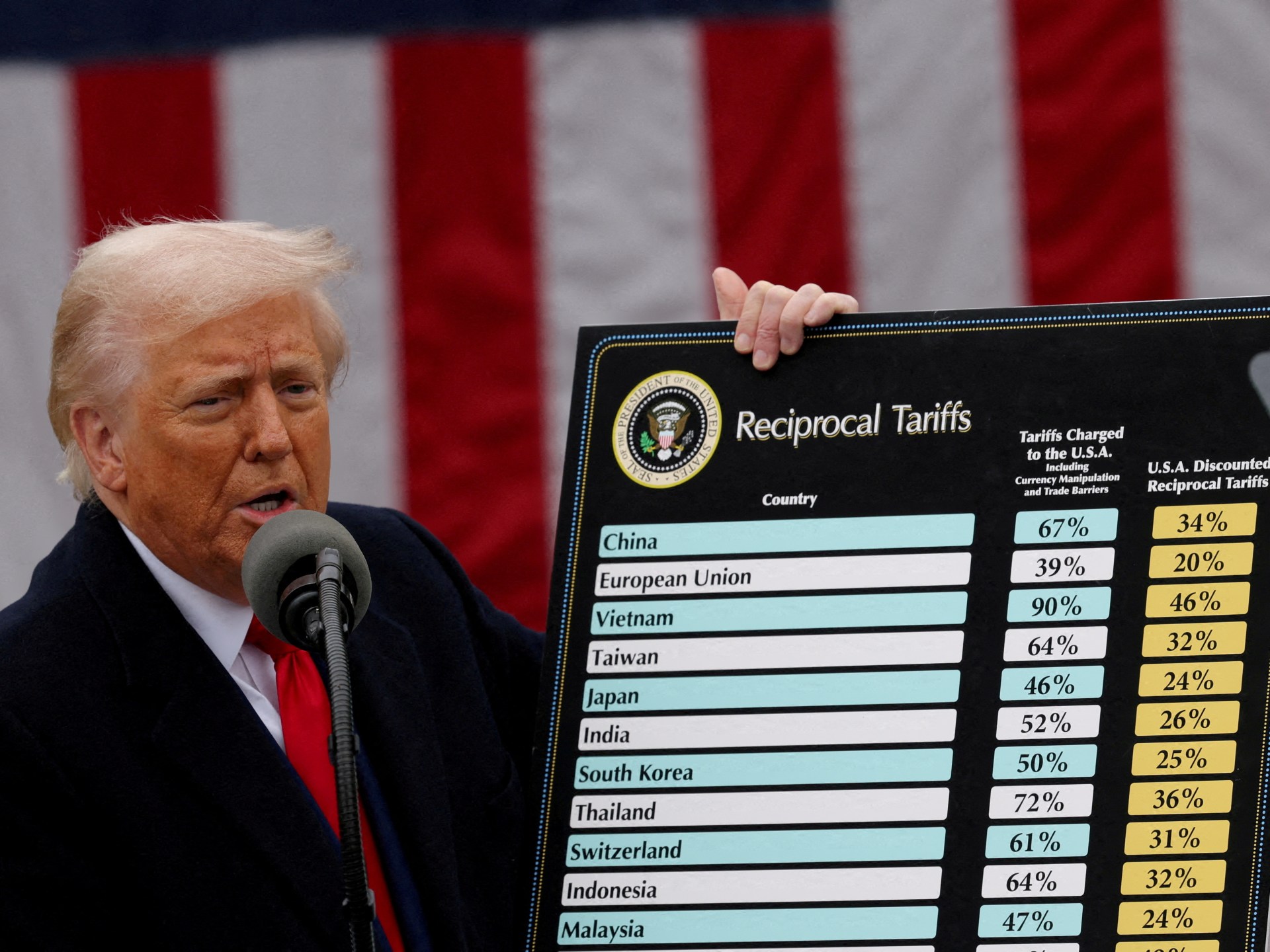
A case involving President Donald Trump’s tariffs is expected to be decided by the US Supreme Court.
The high court added a non-argument/conference date to its website on Tuesday, indicating that it may make its decision. The court does not specify which decisions it will publish in advance.
Recommended Stories
list of 4 itemsend of list
Given its wider impact on the global economy, Trump’s tariff challenge has been one of the court’s most closely watched cases.
Trump claimed in a social media post on Friday that a decision would be a “terrible blow” to the US.
Trump stated in a different post on Monday that “our country is financially, and from a NATIONAL SECURITY STANDPOINT, FAR STRONGER AND MORE RESPECTED THAN EVER BEFORE” and that this is because of tariffs.
However, this information is ambiguous. The third quarter of 2025 saw the largest increase in two years for the US’s gross domestic product (GDP). While US job growth has slowed, with sectors that are particularly vulnerable to tariffs seeing little to no job growth.
Jobs in industries with higher import exposure increased more slowly than jobs in those with lower import exposure, according to a study conducted in December by the Federal Reserve’s Kansas City branch’s senior economist, Johannes Matschke.
Arguments in court
In order to address what he called a national emergency relating to US trade deficits, Trump invoked the International Emergency Economic Powers Act (IEEPA) in February 2025.
In November, arguments began to challenge the decision’s legality. The liberal and some conservative justices on the court at the time were skeptical about the use of the 1977 Act.
Among those skeptical was Justice Neil Gorsuch, who Trump had appointed during his first term.
According to Gorsuch, “Congress can’t, in reality, give this power back once it’s been given to the president.”
According to Chief Justice John Roberts, the administration’s representative, “the main power of Congress has always been to impose tariffs and taxes.”
In the event of a national emergency, the act grants broad executive authority.
Following a lower court’s ruling, the Trump administration was able to appeal the ruling, finding that the use of the law constituted an overreach of the administration’s authority.
The Court of International Trade ruled in opposition to the White House. The New York court stated in May that Congress has “exclusive authority to regulate commerce,” rather than the executive branch. In August, an appeals court in Washington, D.C. upheld this ruling.
According to legal experts, lower court decisions are likely to be upheld by the high court.
According to Greg Shaffer, a law professor at Georgetown University, “my sense is that the Supreme Court will decide that IEEPA does not allow the Trump administration to adopt the tariffs,” he told Al Jazeera.
The US would need to pay some of the tariffs if the Trump administration lost the case.
The administration would be required to pay back those who paid illegal tariffs, according to the ruling. Shaffer continued, “I would assume that’s what would happen.”
On NBC’s Meet the Press in September, Treasury Secretary Scott Bessent claimed that the US would “must give a refund on about half the tariffs.”
Source: Aljazeera

Leave a Reply