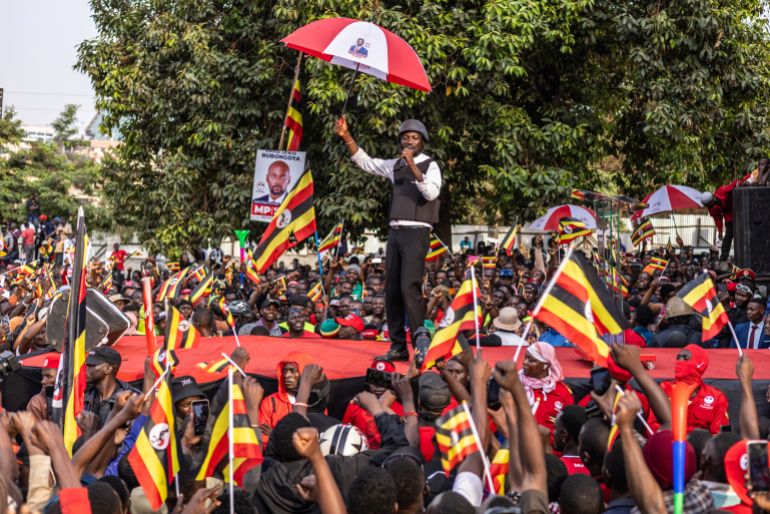
Kampala, Uganda – After millions of voters contested results in tense presidential and legislative elections in some regions of the nation.
President Yoweri Museveni, 81, was declared the winner on Saturday with 72 percent of total votes cast. Robert Kyagulanyi, a former musician known as Bobi Wine, received 25% of the vote.
The results were rejected by Bobi Wine’s National Unity Platform (NUP) party and two other presidential candidates, alleging irregularities that included ballot stuffing, intimidation, and blocking party employees’ offices. The United Nations also says Thursday’s vote was marred by “widespread repression and intimidation”.
Bobi Wine made an appearance on social media the day Museveni’s victory was announced by the country’s Electoral Commission, telling supporters that he had been forced into hiding after his home was searched by police and other unknown people.
“We reject whatever is being declared by Mr. Simon Byabakama [the chair of the Electoral Commission] because those so-called results that they are declaring are fake and don’t in any way reflect what happened at the polling stations,” he said on video. “I know they are looking for me, but even if they succeed and get me, and do whatever,” he said.
The opposition and its supporters say the government has violently cracked down on dissent, shutting down the internet , and arresting protesters.
Museveni has accused Bobi Wine’s party of trying to destabilize the nation.
Authorities in Uganda claimed the four-day internet shutdown was a security precaution and that it would stop misinformation from spreading to create fear and chaos.
The government also said seven people were killed in Butambala, with police stating that protesters attempted to attack a polling station and a police post. The NUP disputes this allegation, saying that at least 10 people were killed when police opened fire on a party official’s home, which Al Jazeera was unable to independently verify.
Bobi Wine criticized the government’s “crackdown to intimidate, silence, and subdue the forces of change” in an exclusive interview with Catherine Soi of Al Jazeera while she was a prisoner of war.
He also alleged he had “evidence” of fraud, videos showing “not the police, not the military, but electoral commission officials” ticking ballot papers in favour of Museveni.
Al Jazeera: How are you? How are you all doing?
Bobi Wine: I’m alive. I try to stay in touch with my wife despite not knowing how my family is. She is strong, and she is okay. ]The security forces are] still at my home. No one is permitted to enter the home.
Al Jazeera: The police spokesman informed us that you are not being detained, that you are reportedly at home. What do you say to them?
Bobi Wine: I noticed the police spokesperson confirming my residence. According to the same police officer, the people who were shot and killed in my deputy president’s residence were actually attacking the police station. And yet they were inside the house. You’re aware that so much is going on and that the Ugandan government’s impunity is now inruins. You’re aware that they will act obscenely and that they will lie.
Al Jazeera: You’re talking about the incident in Butambala? Tell us what transpired.
Bobi Wine: At my deputy president’s house in Butambala, ten people were killed. They were shot dead. Ten people were killed when the police opened fire on a garage and car storage space. However, Iganga also resulted in scores of fatalities. Many people were killed in Kawempe and many other places.
One of the reasons I was unable to stay at home was that I had to stay in touch with and provide guidance as a leader. I needed to be in touch with them to find out what’s going on. It was extremely dangerous for me. You’ve heard Muhoozi Kainerugaba, the military leader, promising to cut off my head, and we’ve been informed that they were going to harm me. I used a few of my old skills to escape during that conflict when they raided my home.
Al Jazeera: The president has referred to you as a “terrorist” and a traitor, along with other party officials. What do you have to say to that?
Bobi Wine: It is important to be aware that fighting a dictatorship means being a terrorist, a traitor, and everything else in every dictatorship, especially in this one in Africa. I mean, General Museveni was talking about a priest who had been detained and held incommunicado for more than two weeks after being questioned by a Catholic priest, Father [Deusdedit] Ssekabira, who had been detained. But I was not arrested. Young people are serving prison sentences for my and the party I lead. However, I’m not in custody along with the secretary-general and many others. This is a crackdown to intimidate, to silence and to completely subdue the forces of change, everybody that yearns for change and everybody that does not support General Museveni.
You have voted against the elections, Al Jazeera. You claimed that the election was rigged. What evidence do you have?
Bobi Wine: Before, during, and after the election, there is evidence.
The military picked up a number of our polling agents a day or two before the election. Some of them are still missing.
You’ve then watched videos. The internet was turned off by them. And this time, not the police, not the military, but electoral commission officials took part in ticking ballot papers in favour of General Museveni. We have an example of them. They are doing that in videos that we have started posting on social media. (Al Jazeera was unable to verify videos on social media purporting to show officials filling in ballot papers. This claim was made by an Electoral Commission spokesman, who declined to contact Al Jazeera.
Nobody knows where the results came from, according to the Electoral Commission chairperson. They were supposed to pick them from the declaration of results forms and the district tally sheets. Our agents were present, and the forms had various outcomes. However, the chair of the Electoral Commission was making a completely different declaration. So, we rejected.
This was going to be a protest vote, as we previously stated to the electorate. We have urged people to rise up in accordance with Article 29 of our constitution and reclaim their voice in the event that the dictatorship attempts to subvert the voice of the people. That is what we encourage them to do.
What does Al Jazeera mean, exactly? protests ?
Bobi Wine: That means nonviolent, legally accepted protests. It entails protesting, rejecting democratic abuse, and battling any forms of subversion within our democracy. According to Article 29 of our constitution, Ugandan citizens are free to protest and demonstrate peacefully. And that is exactly what we’ve encouraged them and continue to encourage them to do.
It might be taking to the streets to protest. By raising the national flag, some of us began to protest. Others can protest by staying at home. We refunded it so that Ugandan citizens could find a variety of creative ways to protest and to fight back as best as they could in terms of morality, constitution, and law.
Al Jazeera: Do you not want to go to the Supreme Court?
Bobi Wine: The judicial system in Uganda is not independent at all. The Supreme Court has mandated that specific reforms be implemented in the prior presidential election petitions, but they have been completely ignored. So, the Ugandan court system is not in our best interests. That’s why we’ve always encouraged the people of Uganda to be the ones to take back their voice.
Al Jazeera: You and your supporters were repeatedly accused of breaking electoral laws and of engaging in campaigning that was against the law, and this is why you have been targeted with such violence as tear gas and protests. What do you say in response?
Bobi Wine: That’s what they are saying. However, Uganda’s current law allows candidates to run for president wherever they are, and most importantly, it allows them. The Electoral Commission of Uganda endorsed and confirmed that campaign plan. However, I was not allowed to even drive on the main roads. Campaigning in densely populated cities or areas was prohibited for me. People always took me to the bushes, but they also came.
But also, the Electoral Commission was never in charge of this election, the military took charge of this election. I mean, I would have been apprehended a long time ago if there had been anything wrong with me or anything that went against the law.
Al Jazeera: There are some Ugandans who agree with what you’re saying, but there is a lot of resentment there. And they’re saying, OK, the election is now done, so let’s just move on.
Moving on, Bobi Wine, signifies abandoning slavery. We’ve said it before and often that 40 years of living in a military dictatorship is slavery. Ugandans don’t have a right, they don’t have a voice. By age, Uganda is the second-youngest nation in the world [by age], and its ruler is more than 80 years old.
Corruption is prevalent today. The country is in a mess. And as the parents of today and the nation to come after us, it is our responsibility and right to ensure that we control our own destiny.
Al Jazeera: Finally, are you unable to return home?
Bobi Wine: My reason for not being home is to be able to speak to the world. You wouldn’t be able to access me if I was inside my house.
I’d like to have a room in my home. I’ve not changed my clothes in days. I’d like to return home. I want to be at liberty. I want to take care of my people.
However, my home has been taken over by the police and the military. My gate has been vandalized by them. They’ve cut the padlocks. My home’s power has been cut. They have thus essentially colonized my home.
Unfortunately, there’s no rule of law in Uganda. I can’t contact the courts for redress. I can’t contact any state institution for help. I just have to fight back in my own crude, non-violent way.
Source: Aljazeera

Leave a Reply