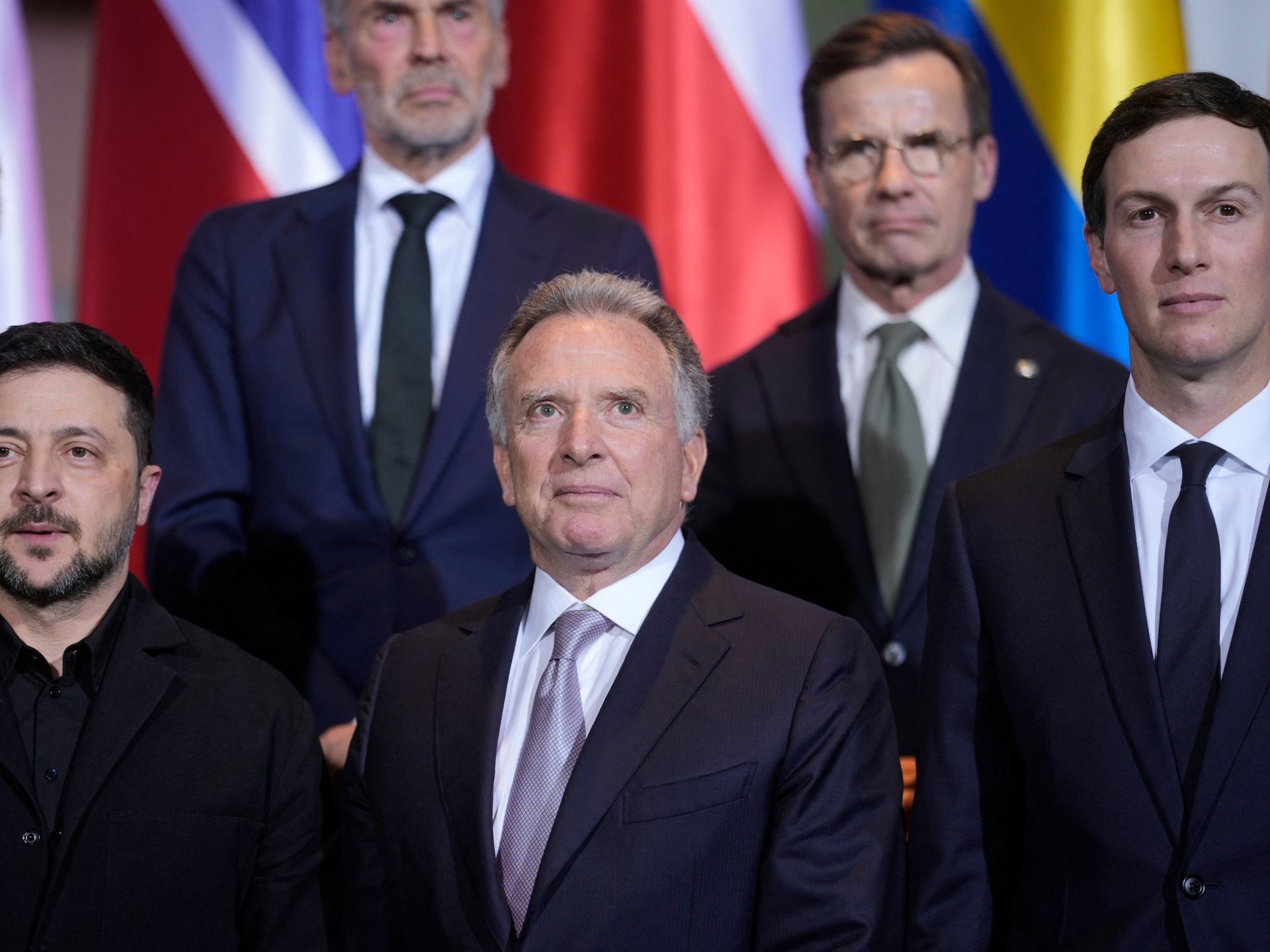
US President Donald Trump has said that an agreement to end Russia’s war on Ukraine is “closer than ever” after key leaders held talks in Berlin, but several officials said that significant differences remain over territorial issues.
Trump told reporters in the Oval Office on Monday that he had “very long and very good talks” with Ukrainian President Volodymyr Zelenskyy and the leaders of France, Germany, the United Kingdom and NATO.
Recommended Stories
list of 4 itemsend of list
“We’re having tremendous support from European leaders. They want to get it [the war] ended also,” he said.
“We had numerous conversations with President [Vladimir] Putin of Russia, and I think we’re closer now than we have been, ever, and we’ll see what we can do.”
Zelenskyy had earlier said that negotiations with US and European leaders were difficult but productive.
The high-level discussions, involving Zelenskyy, a US delegation led by envoy Steve Witkoff, Trump’s son-in-law, Jared Kushner, and European leaders, took place in Berlin over two days amid mounting pressure from Washington for Kyiv to make concessions to Moscow to end one of Europe’s deadliest conflicts since World War II.
In a statement following the talks, European leaders said they and the US were committed to working together to provide “robust security guarantees” to Ukraine, including a European-led “multinational force Ukraine” supported by the US.
They said the force’s work would include “operating inside Ukraine” as well as assisting in rebuilding Ukraine’s forces, securing its skies and supporting safer seas. They said that Ukrainian forces should remain at a peacetime level of 800,000.
Two US officials, speaking to the Reuters news agency, described the proposed protections as “Article 5-like”, a reference to NATO’s Article 5 mutual defence pledge.
Ukraine had earlier signalled it may be willing to abandon its ambition to join the NATO military alliance in exchange for firm Western security guarantees.
Speaking to reporters in Berlin, Zelenskyy said that Kyiv needed a clear understanding of the security guarantees on offer before making any decisions on territorial control under a potential peace settlement. He added that any guarantees must include effective ceasefire monitoring.
Ukrainian officials have been cautious about what form such guarantees could take. Ukraine received security assurances backed by the US and Europe after gaining independence in 1991, but those did not prevent Russia’s invasions in 2014 and 2022.
German Chancellor Friedrich Merz said Washington had offered “considerable” security guarantees during the Berlin talks.
“What the US has placed on the table here in Berlin, in terms of legal and material guarantees, is really considerable,” Merz said at a joint news conference with Zelenskyy.
“We now have the chance for a real peace process,” he said, adding that territorial arrangements remain a central issue. “Only Ukraine can decide about territorial concessions. No ifs or buts.”
Merz also said it was essential for the European Union to reach an agreement on using frozen Russian assets to support Ukraine to demonstrate to Moscow that continuing the war is futile. He warned that EU members must share the risks involved in appropriating those assets, or risk damaging the bloc’s reputation.
Meanwhile, the EU has adopted new sanctions targeting companies and individuals accused of helping Russia circumvent Western restrictions on oil exports that help finance the war.
In Moscow, Kremlin spokesperson Dmitry Peskov said that Putin was “open to peace and serious decisions” but opposed to what he described as “temporary respites and subterfuges”.
Reporting from Berlin, Al Jazeera’s Dominic Kane said the outcome of the talks remains unclear.
“We know American emissaries were speaking to Ukrainians here in Berlin yesterday and today. Talks between those two groups have finished, according to a statement by Zelenskyy’s office,” Kane said.
“What we don’t yet know is how much of the US-led 28-point plan – parts of which were acceptable to Moscow but strongly opposed by Kyiv and EU officials – remains intact.”
Kane added that the German government has presented a separate 10-point proposal focused on military and intelligence cooperation rather than a peace settlement. European leaders are expected to continue discussions on the remaining areas of disagreement.
Fighting continues
Meanwhile, Ukraine said on Monday that Russia launched 153 drones overnight, with 17 striking their targets.
Russia’s Ministry of Defence said its forces destroyed 130 Ukrainian drones over Russian territory.
Kyiv said its underwater drones struck a Russian submarine docked at the Black Sea port of Novorossiysk. Ukraine has stepped up naval attacks in recent weeks on what it has described as Russia-linked vessels in the Black Sea.
Russian forces have continued to target the Ukrainian port city of Odesa, with two Turkish cargo ships hit in recent days. Kyiv said the strikes were aimed at Russian targets.
Zelenskyy also accused Moscow of using its attacks as leverage in peace negotiations.
Source: Aljazeera

Leave a Reply