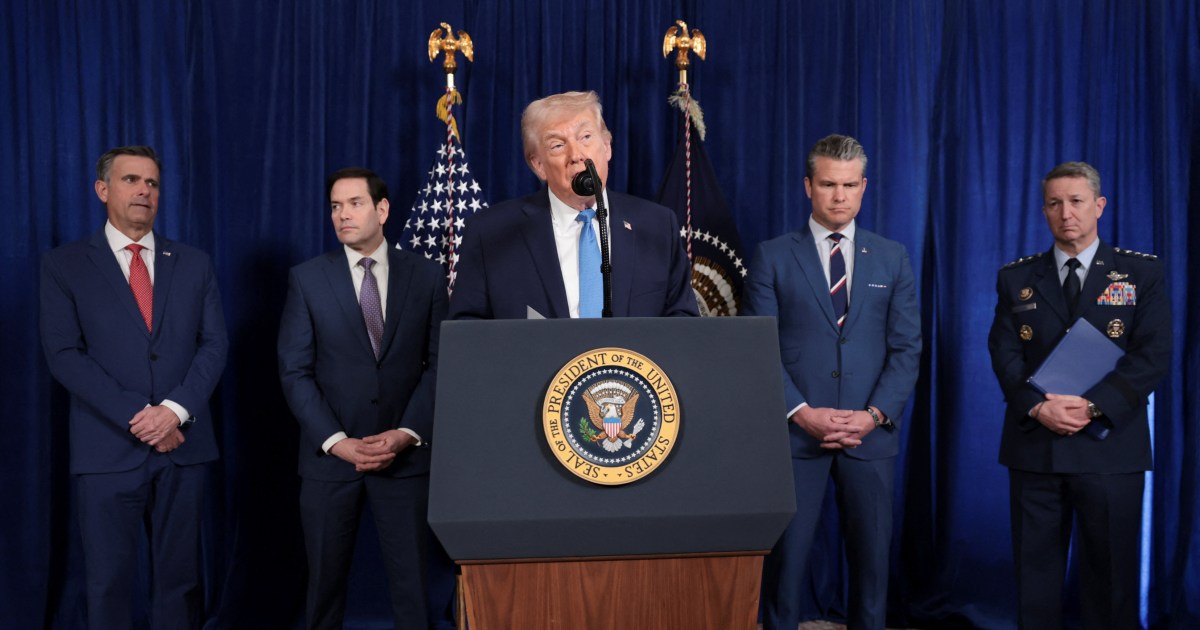
Donald Trump, the president of the United States, celebrated his “success” within hours of a massive regime change operation in Venezuela. He addressed the American audience by posting a photo of Venezuelan President Nicolas Maduro in handcuffs.
He praised the military for “one of the most stunning, effective, and powerful displays of American military might” in history, claiming Venezuelan forces were “powerless” and “powerless.” He claimed without providing any proof that US operations have reduced maritime drug trafficking by 97 percent and that Maduro and his wife will be charged with “narcoterrorism” in New York.
Trump went further, saying that until an unspecified transition could be made, before openly threatening a “second and much larger attack.” He explicitly invoked the 1823 Monroe Doctrine in order to frame these claims in a wider sense of US “domination over the Western Hemisphere.”
Venezuela’s military intervention is much more dangerous than just one violent act. It is the most recent instance of US interference that has left Latin America awash in history. The Trump administration’s continued support for this outdated policy of interventionism is evident from the regime change operation in Caracas. And that indicates a negative future for the area.
The situation is no less tragic because this attack targeted Maduro’s corrupt and oppressive government, which was to blame for many Venezuelans’ agonizing suffering. Any notion of moral authority is undermined by Washington’s long history of supporting brutal dictatorships in the area. Given that Trump is already embroiled in a significant political scandal and has a long history of support for Israel’s genocide in Gaza, he can hardly claim any moral support.
Venezuela is just one more example of the Trump administration’s catastrophic breach of international law. The entire body of international law becomes meaningless if the US unilaterally launches military strikes against sovereign nations at will. Every nation is told by this that power and might overshadow legality and sovereignty.
The implications are chilling, particularly for Latin America. One must take a close look at the attack’s history to understand why it has a so painful impact on the area. Surprisingly frequently, the US has orchestrated or supported coups and military dictatorships in the area.
The CIA overthrew Jacobo Arbenz’s democratically elected government in Guatemala in 1954. The US supported the coup that overthrew Augusto Pinochet’s rule in Chile in 1973, launching a period of unchecked political unrest. To overthrow Grenada’s socialist government, the US invaded and occupied the island nation in 1983. Washington provided training, funding, and political cover for military dictatorships that tortured dissidents and murdered civilians in Argentina, Brazil, Uruguay, and throughout Central America.
Who will be the next if the US successfully implemented a regime change in Venezuela? Gustavo Petro, the president of Colombia and the Trump administration, was quick to respond and is right to be concerned, as Trump threatened an intervention in December by saying “he’ll be next.” The area’s residents are also concerned.
Latin America now faces the potential regional instability that a regime change in Caracas is likely to cause, in addition to the looming threat of US intervention. Venezuelans fled poverty and repression, but the political crisis under Maduro already extended beyond its borders to neighboring Colombia and Brazil. The impact of the regime change brought about by the US is unfathomable.
Venezuelans are likely to be celebrating Maduro’s ouster. The political opposition in Venezuela is directly undermined by US intervention, though. It would diminish the legitimacy of the regime, which appears to be in control, by portraying the opposition as foreign agents.
Venezuela’s citizens deserve democracy, but they must do it themselves with international support in order for it to be enforced at gunpoint by a foreign power with a documented history of pragmatism and geopolitical dominance.
Latin Americans should not have to choose between domestic violence and imported authoritarianism. They don’t need American bombs, but they do need genuine self-determination respect.
Despite Maduro’s authoritarian tendencies, the US lacks moral authority to attack Venezuela. Both Maduro and his followers are correct in saying that US military intervention is an unlawful act of aggression that won’t solve Venezuela’s democracy crisis.
People themselves, who are free from the oppressive influence, must decide the region’s future.
Source: Aljazeera

Leave a Reply