Donald Trump, president of the United States, claimed that the US launched a land-based assault on Venezuela on Monday, prompting a sharp increase in its military assault on the South American country.
Trump said the operation had targeted a docking facility being used to load boats carrying narcotics. However, the incident has not yet been confirmed by Venezuelan authorities.
Recommended Stories
list of 3 itemsend of list
Since September, when the Trump administration launched a number of strikes on Venezuelan vessels in the Caribbean and eastern Pacific, which the US government claims are traffickers of drugs, have raised tensions between Washington and Caracas significantly.
However, the US has not provided any proof of drug trafficking despite the at least 100 fatalities caused by aerial strikes on more than two dozen boats.
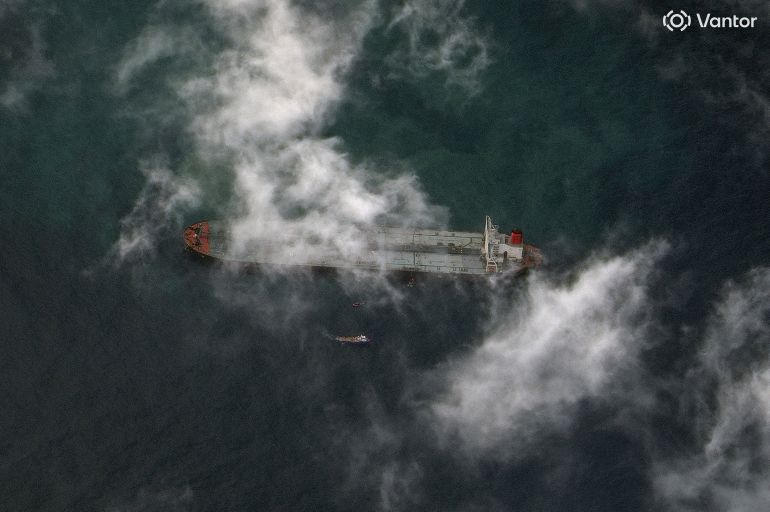
More recently, US forces have seized Venezuelan oil tankers, which it claims are carrying sanctioned oil and ordered a naval blockade on all sanctioned oil tankers near the coast.
Caracas has long accused Washington of using allegations of drug trafficking to stifle Venezuela’s regime change, raising questions about their legality and the possibility of a wider conflict. In fact, according to legal experts, targeting ships in international waters likely constitutes extrajudicial executions and violates US and international law.
So, what do we know about these strikes so far, and could it lead to an imminent war between the US and Venezuela?
What transpired?
Trump made the announcement that US forces had struck a Venezuelan dock during a press conference held on Monday alongside Israeli Prime Minister Benjamin Netanyahu at his Mar-a-Lago resort in Florida.
“There was a major explosion in the dock area where they load the boats up with drugs”, Trump said.
“They load the boats up with drugs, so we hit all of the boats, and we now hit the area. The implementation area is it. That’s where they implement. And that has vanished.
Trump did not specify the location or who carried out the strike.
“I know exactly who it was, but I don’t want to say who it was. However, the US president said, “You know, it was along the shore.”
Sources with knowledge of the operation who claimed the CIA carried out the strike were cited in US media.
Following Trump’s announcement, the US military also announced in a post on X that it had carried out another attack on a boat in the eastern Pacific, killing two more people. It did not specify the exact location of the strike.
Trump’s announcement has not yet been addressed by Venezuela’s government.
Why is Trump conducting a campaign against Venezuela?
A long history of US military intervention in Latin American nations has affected relations between Washington and Caracas for decades.
Under Venezuela’s left-wing president Hugo Chavez, tensions increased significantly as a result of the US’s claim that foreign-owned oil assets had been nationalized and built, and they increased even further as his popularity deteriorated in 2013 with Nicolas Maduro as his replacement.
Tensions have escalated in recent months as a result of a US military campaign targeting alleged Venezuelan drug smugglers. Although the Trump administration claims that the flow of drugs into the US constitutes a national emergency, numerous reports have demonstrated that Venezuela is not a significant destination for cross-border drugs.
Since September, Washington has carried out more than two dozen strikes in the Caribbean Sea and Pacific Ocean, killing more than 100 people, accusing the Maduro government of being involved in flooding the US with drugs.
The Trump administration has denied providing any legal justifications for the operations, leading to accusations that it is more concerned with controlling oil in the area and imposing regime change in Venezuela.
The largest US show of force in the area in decades has come along with the strikes, which include the deployment of the USS Gerald R. Ford, an F-35 jet fighter, and about 15, 000 soldiers. Trump has previously also warned of possible attacks “on land”.
Caracas has refuted US accusations of drug trafficking and criticized its actions as “illegal” in international law and a Venezuelan sovereignty violation.
The Venezuelan government claims that Washington is seizing the country’s oil wealth and using drugs as a pretext for regime change.
Moreover, United Nations human rights experts have condemned the partial naval blockade, finding it an illegal armed aggression against Venezuela, while urging the US Congress to intervene.
Will this attack cause Venezuela to declare war on the horizon?
If the US strikes Venezuelan territory, according to Caracas-based analyst Elias Ferrer of Orinoco Research, it has “certainly violated international law,” unless the Maduro government approves the attack, which could be made possible in light of recent conversations between the president of Venezuela and Trump in the past month.
Depending on the answer to that question, Ferrer said the incident could either “escalate, or actually de-escalate” the situation.
Trump needs a victory before de-escalation in Venezuela can begin, he said, citing the US’s use of Iran as an example during the 12-day Iran-Israeli conflict in June.
Iran responded by conducting a pre-warned strike on a US base in Qatar, which resulted in an Iranian-Israeli ceasefire within the next 24 hours.
If it was not pre-approved with Caracas, however, Alan McPherson, professor of Latin American studies at Temple University, said it represents a “serious escalation” by Washington as it is the first on Venezuelan territory.
According to McPherson, “This has all the characteristics of a military war … militarily unnecessary … against a sovereign nation.”
The US administration, he said, “politically, the] US administration wants to overthrow President Maduro, plain and simple.”
In addition, McPherson said, while the US “may also want to damage the drug business” coming from Venezuela, Trump has been clear that he mostly wants to “reverse the nationalisation of petroleum to the benefit of American corporations”.
Does the US oil campaign actually involve oil?
Questions have been raised by White House officials’ recent remarks regarding whether Venezuela’s substantial oil reserves, rather than drug smuggling, are the real cause of tension with Caracas.
Venezuela has the world’s largest proven oil reserves, and the US once partnered with the country to develop its oil fields. It joined OPEC in 1960 as a founding member, and it quickly rose to prominence as a major oil exporter, especially after PDVSA (Petroleos de Venezuela, SA) was established and all foreign oil companies underwent state control.
Venezuela, one of the largest foreign oil sources in the US, supplied roughly 1.5 to 2 million barrels per day to the country in the late 1990s and early 2000s. However, exports began to decline sharply after Hugo Chavez was elected president in 1998, as he reshaped the country’s oil sector, nationalising assets, restructuring PDVSA, and prioritising domestic and political objectives over traditional export markets.
Under President Nicolas Maduro, the administration’s successor, the situation deteriorated when they imposed oil sanctions in 2017 and then heightened them in 2019 before the Trump administration imposed them. Venezuela’s ability to export crude to the US was further hampered by these restrictions, which also limited access to international financial markets and further hampered Venezuela’s ability to export oil.
Today, Chevron is the only US oil company that continues to operate in Venezuela under a special licence granted by former US President Joe Biden, which allows it to operate despite oil sanctions.
President Donald Trump’s top adviser, Stephen Miller, claimed earlier this month that Venezuela’s oil belongs to Washington and that its nationalization of its oil industry is “theft” and that “American sweat, ingenuity, and toil created the oil industry in Venezuela.”
Venezuela’s oil projects were early developed by US and British companies, but international law firmly acknowledges Venezuela’s sovereignty over its own resources.

Can Trump go to war if the US Congress intervenes?
In the United States, there are two competing ages for control of the military. Congress is granted the power to declare war by the US Constitution, but the last time the US declared war was in World War II, in 1942. That means Congress hasn’t declared the longest wars the US has ever waged.
The Constitution gives the president the authority to direct the US military’s actions in the event of a declared war as well as giving him the authority to appoint countermeasures. It is from these powers that the executive branch has been able to deploy military force against countries in the absence of a congressionally declared war.
The President’s authority to deploy the military in these non-war activities was limited by the War Powers Resolution of 1974, which placed time restrictions on deployments without the approval of Congress, and other requirements. The president has a largely unfettered hand thanks to lackluster enforcement and broad executive interpretations of what does and doesn’t need authorisation as well as what is permitted by current Authorizations for the Use of Military Force (AUMFs).
Members of Congress have tried repeatedly to prevent Trump from taking military action against Venezuela.
A group of Democratic and Republican US Congress representatives pushed a vote earlier this month that would have prevented US military action against Venezuela without the consent of Congress.
However, the Republican-controlled Congress narrowly rejected the resolution by a vote of 216-210.
Academic McPherson said Congress can certainly refuse to declare war or to give the president “any authorisation to use force”.
Source: Aljazeera

Leave a Reply