Bangladesh’s capital city of Dhaka may interpret the lyrics of the fast-paced, rhythm-driven song as a reflection of rural Bangladesh.
The words go, “The days of boat, the sheaf of paddy, and the plough have come to an end, and Bangladesh will be built.”
The song, which went viral on Facebook, YouTube, Instagram, and TikTok in early November, is actually a political anthem in support of Bangladesh’s Jamaat-e-Islami party.
The boat is the Awami League (AL) of former prime minister Sheikh Hasina, who was ousted by a student-led uprising in August 2024, the paddy’s sheaf is the Bangladesh Nationalist Party (BNP), and the plough is the Jatiya Party’s Awami League, which was formerly led by a military ruler in the 1980s.
Scales serve as the Jamaat’s symbol.
In what is expected to be a direct contest between the BNP and a Jamaat-led alliance, the nation will cast its ballot on February 12. On-the-ground campaigning will begin on January 22. However, parties have been tampering with Gen Z voters online for months, trying to sway them to support the formation of the next government.
In a time when mass rallies are no longer the only way to appeal to millions of voters, social media is frequently just as effective a tool as the pro-Jamaat song’s online popularity, for instance, sparked a frenzied race among parties to start songs.
The pro-Jamaat song was originally produced for a single candidate in Dhaka, according to HAL Banna, a London-based director who wrote and sang it. Other candidates “found it connected with regular voters and began using it,” he said as others started using it.
The BNP wrote its campaign song, which suggests that the party, which is only marginally ahead of the Jamaat in polls, prioritizes the nation over itself. The lyrics to the song “Amar agey amra, amader agey desh, khomotar agey jonota, shobar agey Bangladesh]Us before ourselves, the nation before us, people before power, Bangladesh above all” are in the lyrics.
The song that went viral was also produced by the National Citizen Party, which was founded by students at the forefront of the anti-Hasina protests in 2024.
However, a wider digital push has included music as well.
Social media has also been flooded with short, dramatized videos, candidacies with voters, policy explainers, and satire.
The online conflict has grown this year beyond just a legislative debate.
A referendum on the interim interim government led by Nobel laureate Muhammad Yunus, which the electorate will choose on February 12th, will also be held on February 12. The interim government’s proposed reforms, which Nobel laureate Muhammad Yunus calls necessary, must be ratified in order to institutionalize changes in state institutions brought about by the uprising of 2024.
Why it matters online
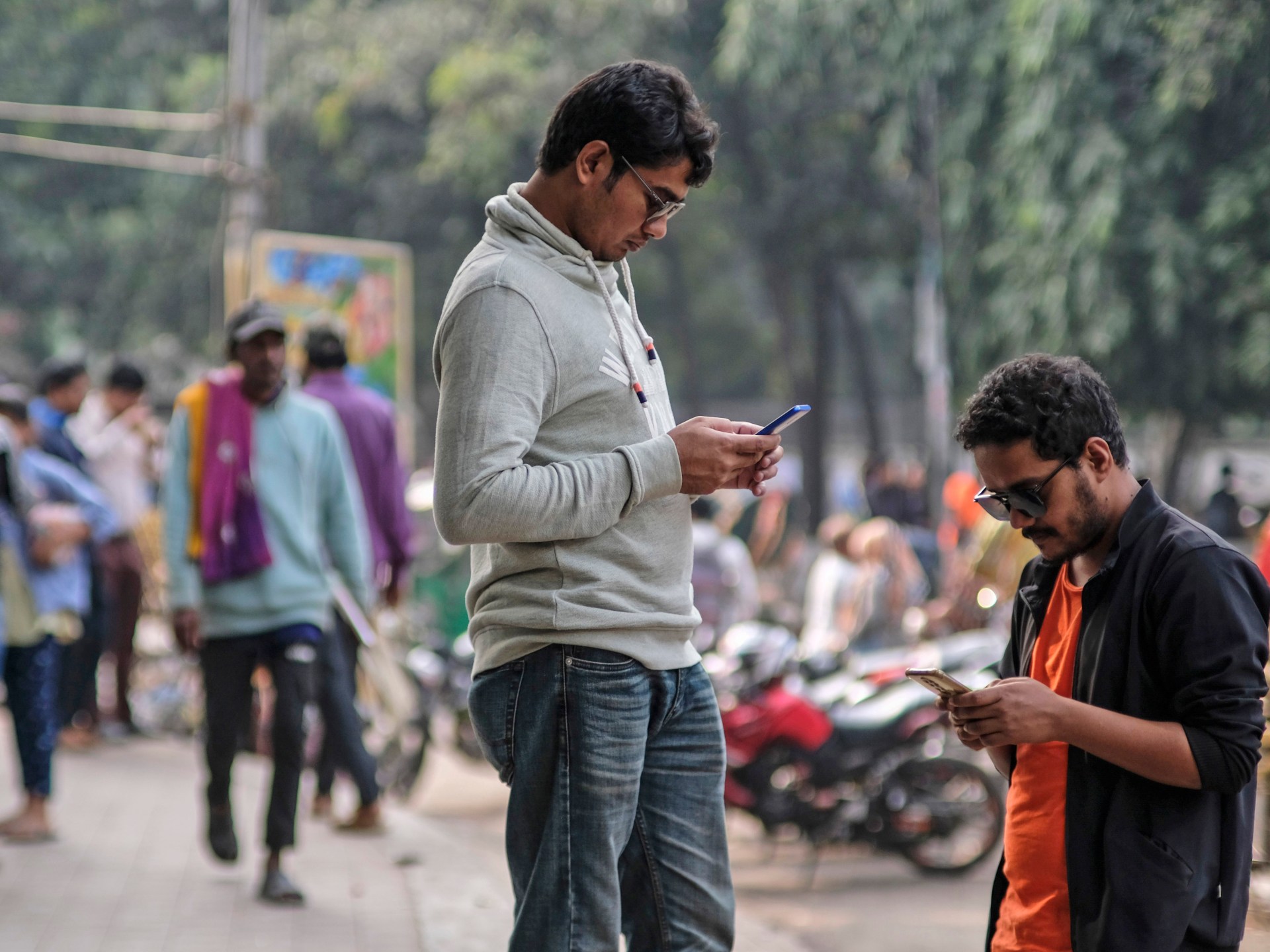
As of November 2025, Bangladesh had about 130 million internet users, or roughly 74 percent of its 176 million population, according to the Bangladesh Telecommunications Regulatory Commission.
The nation has roughly 64 million Facebook users, close to 50 million YouTube users, 9.15 million Instagram users, and more than 56 million TikTok users aged 18 and over, according to a report from DataReportal, a global digital research and analytics platform report, which was released in late 2025. X, in contrast, has about 1.79 million users and a relatively small footprint.
According to analysts, this digital reach contributes to political parties’ continued investment in online narratives.
According to election commission data, 43.56 percent of voters are between the ages of 18 and 37, with many of them first-time voters or young Bangladeshis who had a real sense of disenfranchising under Hasina. National elections in 2013 and 2018 were marred by irregularities, boycotts, and intimidation of opposition figures, turning them into fake votes. According to analysts, that has resulted in apprehension into a desire to vote later.
Digital tactics
The Awami League’s political activities, including voting in February’s elections, have been prohibited by Bangladeshi authorities.
The result of that is a bipolar election.
A BNP-led alliance, which claims to be the experienced governing body in place of the Awami League’s excesses, is on one side. Hasina’s government is accused of widespread murders, forced disappearances, and corruption. The BNP ruled Bangladesh between 1991 and 1996, and then again between 2001 and 2006.
A Jamaat-led alliance, which includes the NCP, is on the other side.
BNP leader Mahdi Amin stated to Al Jazeera that the party is concentrating on distributing policy proposals and collecting voter feedback. The BNP continues to be a political party with a proven track record of winning elections. He claimed that we have specific plans for each industry.
The BNP has created websites like MatchMyPolicy.com, where voters can express their disagreement with policy proposals that the party claims they will implement if elected, to increase online voter engagement.
The Jamaat-e-Islami has launched a website called Janatarishtehar, just like the BNP. – that it claims is aimed at gathering voter feedback in order to prepare the party’s election manifesto.
Jamaat leader Jubaer Ahmed claimed that the party’s online efforts were aimed at “sharing the narratives we believe in.” When asked about the actions of other parties, Ahmed responded, “We observe others, but we don’t follow.” Intellectual will be in the mix for us.
Is there a winner in the online conflict?
Analysts advise against declaring a win-or-lose scenario.
The campaigns’ objectives appear to be overlapping, according to Mubashar Hasan, an adjunct fellow at Western Sydney University’s Humanitarian and Development Research Initiative.
Hasan noted that BNP’s online content frequently condenses its main promises into brief, captioned videos and shareable cards. For instance, some positions promote a “Family Card” initiative whereby 5 million households and women would receive 2, 000, 2, 500 taka ($16-20) per month or essential goods if the BNP is elected. A “Farmer Card” plan is mentioned in other videos and graphics, along with incentives, easier loans, and insurance coverage for farmers. It promises fair prices for fertilizers, seeds, and pesticides.
On the other hand, he claimed, pro-Jamaat online content frequently targets the BNP as being “no different” from the Awami League.
Hasina fled India in August 2024, and New Delhi has refused to send her back despite numerous requests from Dhaka, according to Qadaruddin Shishir, editor of the fact-check outlet The Dissent.
He claimed that these themes are becoming more prevalent outside Jamaat’s core, including among young users, through memes and copied formats.
Referendum also becomes popular.
The online battle this year includes party-versus-party competition as well. A state-backed referendum on a number of broad-based reforms is also in the forefront of the debate, which is known as the July Charter, which is named in honor of the uprising that resulted in Hasina’s removal.
Using official websites and social media platforms, Bangladesh’s interim government has launched a digital campaign in favor of a “Yes” vote. Shafiqul Alam, the press secretary for interim Yunus, claimed the strategy reflects the media landscape, which has consistently lost readers.
Alam claimed that the use of “legacy media” was decreasing, adding that online campaigning was required to accredit the reforms in order to institutionalize them.
The charter recommends stronger security forces, greater restrictions on prime ministerial power, and safeguards against election rigging. Additionally, it calls for constitutional changes and judicial independence to end authoritarian rule.
The NCP, which emerged as a result of the uprising in July, has also campaigned online for a “Yes” vote in the referendum.
Offline campaigning, according to analysts and content creators, is still important. Physical campaigning still lacks the “reach and impact” of “research and impact,” according to Hal Banna, the composer of the pro-Jamaat song that sparked the trend of viral campaign songs online this election season.
Source: Aljazeera

Leave a Reply