The Arab coalition supporting the internationally recognized government in Yemen, led by Saudi Arabia, and the so-called “Southern Transitional Council,” supported by the United Arab Emirates, are now at an all-time high in violent clashes.
Many view these developments as a natural outcome of a long, cumulative trajectory of complexities the country has experienced since the civil war erupted in late 2014, and the humanitarian and economic repercussions that followed.
External factors significantly contributed to the political and administrative chaos that led to the breakdown of the legitimate state and the subsequent weakness of its most crucial sovereign tools, including territorial unity and decision-making. Yemen will not be spared from the effects of these events, which add complexity to an already complex picture.
On the other hand, others view the situation from another, less bleak angle. The Yemeni president’s (chairman of the Presidential Leadership Council, or PLC) and the Saudi-led Arab coalition are both leading a strong response to the STC’s actions, which is a novel and significant factor in comparison to the conventional course of events. Therefore, there is a chance that these occurrences and adjustments will inaugurate a new era of adjustment and imbalances that have followed the Arab coalition’s intervention for more than ten years.
Watching carefully are the Houthi rebels in northern Yemen, who have remained silent, apparently waiting to see what these events will produce as they continue to strike at the unity of the components of the Arab coalition’s leadership and undermine the legitimate government. In any case, they are aware that their final decision will be decided in their favor. According to multiple reports, the Houthis are currently redeploying and dispersing their forces along the theater of operations near the contact points on the fronts: the northeast (Marib) and the southwest (Taiz and Bab al-Mandeb), preparing for zero hour.
So, what is the nature and background of this bilateral conflict between allies? Where has Yemen been and where has the current situation led? And what impact will they have on the region’s and the nation’s future?
There is broad agreement that what is happening today is merely an initial result of a deep internal conflict of interests between the two main coalition states — Saudi Arabia and the UAE. Although the majority of this conflict was still hidden, its accumulations remained as a snowball.
We must first understand the causes of this rivalry and conflict in order to understand how things got to this point where there was an escalation of conflict between allies.
In late March 2015, Saudi Arabia led a coalition of 10 Arab and Muslim countries to intervene militarily in Yemen — later it was called the Coalition to Support Legitimacy in Yemen, with the aim of restoring the authority of Yemen’s former legitimate president, Abd-Rabbu Mansour Hadi, from the grip of the Houthi coup forces.
Prior to the conflict erupting between the two main allies, Saudi Arabia and the UAE, the coalition had significant, tangible successes on the ground.
The UAE’s involvement in this conflict was thought to have been motivated solely by geopolitical and strategic interests, according to widespread and well-established theory. Some argue, however, that this was not necessarily the case at the beginning, but that it may later have turned to exploiting weakness, vacuum, and internal divisions in order to redraw its strategy anew in light of that.
The UAE used local forces loyal to it to pursue its own goals away from the coalition and the legitimate government on the ground and through training and funding. Within two years of its intervention, it was able to impose control over all important maritime ports along southern and eastern Yemen, extending to the western coast of Taiz governorate in the southwest of the nation, where the crucial Bab al-Mandeb Strait is located, through its own local forces.
Over 10 years of the coalition’s intervention, the UAE established and built a hard-hitting army of its own militias, becoming the strongest force on the ground and the greatest threat to the interests of its ally (Saudi Arabia) in Yemen, including the system and the legitimate government that it had supported and sponsored from the outset. It can be argued that Riyadh made fatal strategic errors in handling these deviations, lying silent and failing to take decisive action on the ground to stop its allies’ overreach, perhaps settling for minor protective measures and frequently acting only as a “mediator” to settle disputes that occasionally flared up until the axe finally struck the head.
a militarized upheaval
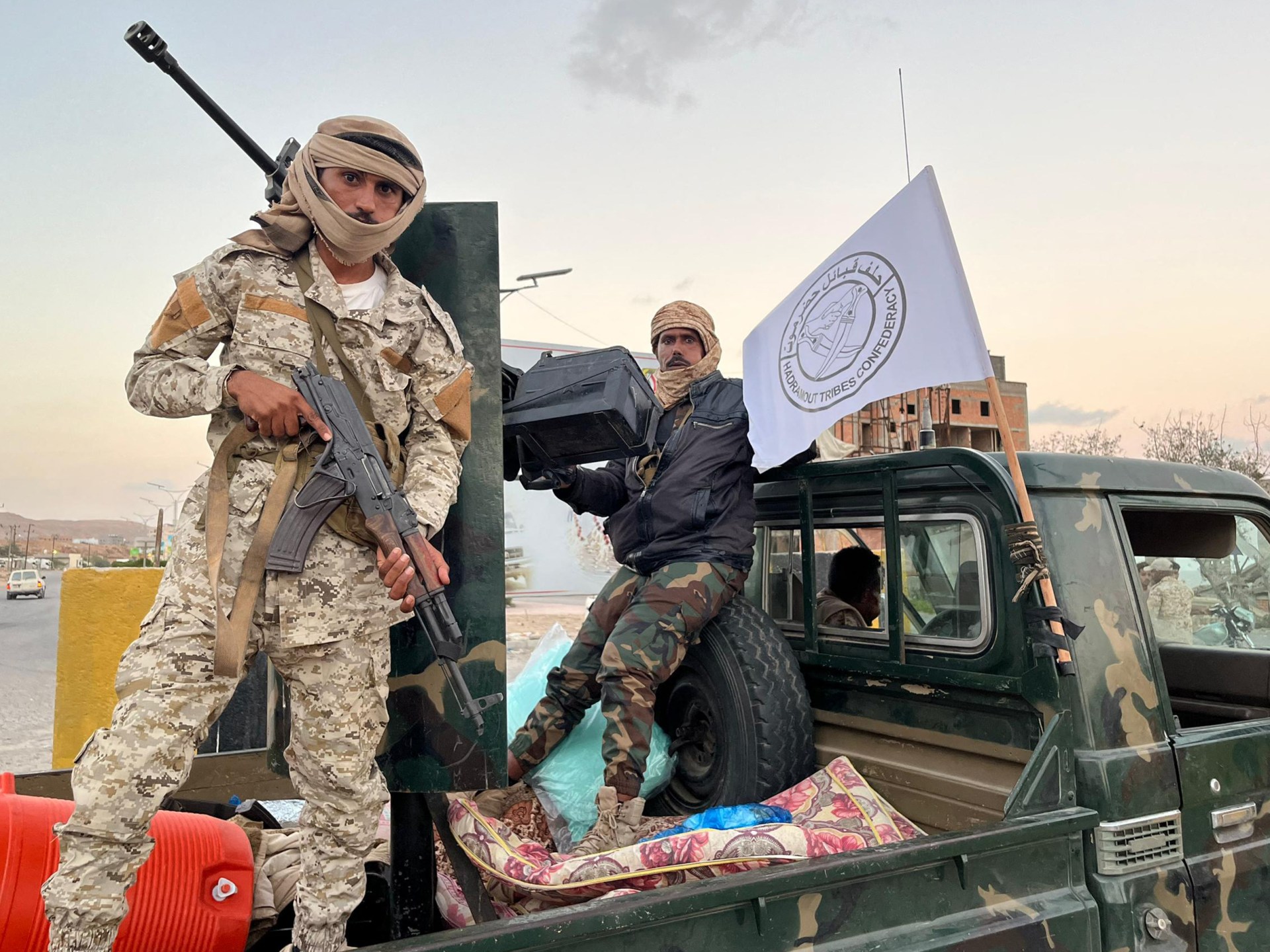
In early December, the STC, which was founded and backed by the UAE, triggered a military escalation by seizing control of the governorates of Hadramout and al-Mahra in eastern Yemen. Saudi Arabia was enraged by this, which forced it to abandon its customary diplomatic and tranquility. Many people believe that this significant change in its policy is a result of Riyadh’s understanding that these two eastern governorates bordering it are a geographic extension of its national security and that any compromise to these two eastern governorates poses a direct threat to that nation’s security, as it specifically stated in recent statements released in response to the crisis.
Accordingly, the head of the PLC dealt with these developments with great seriousness, describing them as unacceptable “unilateral measures”. He demanded a military intervention from the Saudi-led Arab coalition under the authority granted by the Power Transfer Declaration (April 2022).
Military equipment was being transported from the UAE’s Fujairah port to Mukalla in Hadramout by coalition aircraft the following day. In response, Yemeni President Rashad al-Alimi declared a state of emergency and called on the UAE to end its presence in Yemen. The UAE Ministry of Defense later announced the withdrawal of all of its forces from Yemen (the UAE had previously stated in October 2019 that it was pulling its forces out of Yemen).
Major, rapidly developing military and political repercussions resulted from the military escalation, particularly after the STC continued to refuse to acknowledge threats and calls from the Yemeni president to pull its forces out of the two governorates.
Someone could ask: Why does the STC refuse to withdraw its forces despite the threats and successive strikes? The answer is that doing so would severely harmed its separatist project. The council’s annexation of these two governorates, both of which reject its project, undoubtedly raised prospect for declaring their state, but Saudi Arabia’s decisive intervention (in the name of the Arab coalition) dealt a crushing blow to that project.
Escalation and repercussions
With the help of coalition aircraft and under the guise of “Homeland Shield,” which was established by the Yemeni president on January 27, 2023, the government ground forces moved to Hadramout and al-Mahra (east) to free them from STC forces, under air cover and support, and liberation and control operations started. In response, Giants Brigade forces from Taiz’s western coast made their way to Hadramout governorate to bolster and assist STC forces.
Amid the accelerating escalation and its repercussions, the head of the STC, Aidarous al-Zubaidi — also a member of the PLC — moved quickly to issue what he called a “constitutional declaration” (January 2, 2026), in which he announced what he termed the independent “State of the Arab South”, during a two-year transitional period.
Although this declaration has been ignored by the country’s official institutions at the national, regional, and international levels, many Yemenis have handled it ambivalently, each based on their political affiliations and beliefs.
The state’s announcement was a huge success for the Southern separatists, but their opponents criticized it as a leap over the top, an attempt to evade reality, and local and international laws and regulations. Some considered it merely a desperate attempt to rid the council of the pressure of promises it had made to those dreaming of secession, at a time when it became evident that secession was no longer easy after the recent events and developments.
Despite interpretations, this declaration will have no legal effect, even if it has no legal effect. Whether it will lead to deeper divisions between Yemen’s elite and the public (North-South), preserve the Yemeni state’s legal standing, or even ensure continuity with managing the fragile state will be difficult to predict.
Finally, and perhaps most importantly, what is the danger of the main conflict’s efforts to bring about the state’s restoration and relieve Yemenis from the effects of decades of hostility and state collapse.
Clearly, the Yemeni scene is becoming more complex, with events accelerating, positions erupting, and reactions escalating. No one is certain of the direction the Yemeni situation will take.
Source: Aljazeera

Leave a Reply