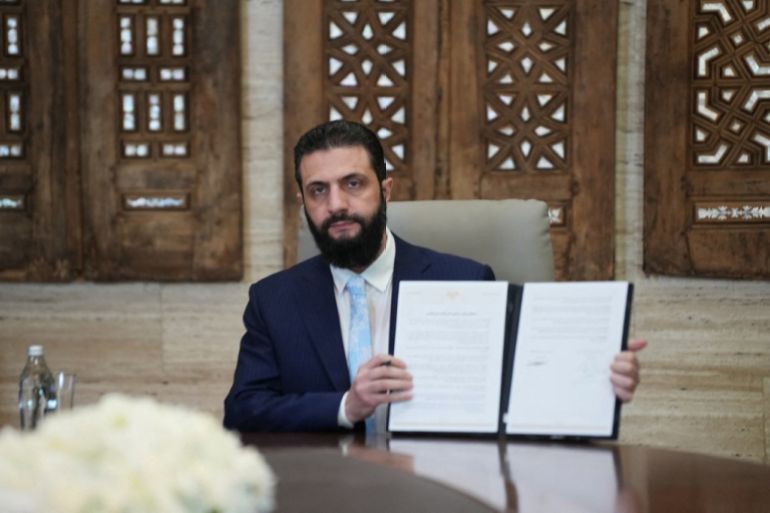
Syria’s President Ahmed al-Sharaa is set to meet Mazloum Abdi, the head of the Syrian Democratic Forces (SDF), to consolidate a ceasefire after days of battles that saw the army and government-allied tribal forces sweep across the north of the country from Aleppo to Raqqa.
The meeting on Monday, postponed from Sunday due to bad weather, follows a dramatic escalation that saw Syrian government forces retake large swathes of territory in the northeast, forcing the SDF to accept a truce and a wide-ranging agreement that brings Kurdish civilian and military authorities under central state control.
Recommended Stories
list of 3 itemsend of list
On Sunday, Abdi, also known as Mazloum Kobani, announced his acceptance of the ceasefire declared and signed on camera by al-Sharaa, stating in a televised address that the conflict had been imposed on the SDF and planned by several parties. He said he would outline the terms of the agreement after returning from Damascus.
Reporting from Damascus, Al Jazeera’s Ayman Oghanna said the ceasefire agreement triggered an outpouring of public joy in the capital.
“Last night, after the deal was struck, there were huge celebrations in the street – there were fireworks, there were cars honking, there were people dancing in the streets,” Oghanna said.
He added that many expressed “a sense of relief and cautious joy, but some were sceptical” after weeks of deadly fighting.
That scepticism reflects fears that the ceasefire may not hold, Oghanna noted, in a country that was racked by a ruinous civil war for nearly 14 years.
Despite doubts, exhaustion appears to dominate public sentiment. “Everyone we spoke to here in Damascus, including many Syrian Kurds, just wanted a peaceful solution,” he said, adding that Syrians are “exhausted by conflict and they wanted a diplomatic solution to the ongoing crisis in the north”.
Economic hardship now looms large. “Everyone we spoke to was worried about their pocket and the economy,” Oghanna said, noting that “90 percent of Syrians live below the poverty line” and hope that calm will allow a focus on recovery.
‘Turning military operation into civilian policing’
Abdi said the SDF’s withdrawal from Deir Az Zor and Raqqa to Hasakah was aimed at preventing further bloodshed and averting civil war.
He acknowledged that the SDF suffered heavy losses, but said it would defend what he described as its gains.
SDF commander and senior People’s Protection Units figure Sipan Hamo told Reuters that the group was not seeking separation from Syria and called for guarantees from the United States and other international actors. He denied receiving support from Iran or Russia but said he hoped Israel would intervene in favour of Syria’s Kurds.
The Syrian presidency said the ceasefire guarantees the integration of SDF fighters into state institutions and the deployment of government authorities to Raqqa, Deir Az Zor and Hasakah.
Al-Sharaa said the deal provides for the full integration of the SDF into the army and called on tribal forces to allow its implementation.
Asked by Al Jazeera about the timeline for implementation and the fate of a March agreement last year, al-Sharaa said the current deal reflects the spirit of that accord.
Reporting from Aleppo, Al Jazeera’s Zein Basravi said attention is now shifting from the ceasefire announcement to how the Syrian state governs areas newly brought back under its control.
Basravi said the meeting between al-Sharaa and Abdi is expected to clarify unresolved questions regarding “some of the ambiguities of this deal”, said Basravi.
But he stressed that the more immediate challenge lies on the ground. “In the next 24 hours to the next few days, there is a practical aspect that has to be addressed by the Syrian government. They have come out on the better side of this deal. They’ve gotten everything they wanted,” Basravi said.
With government forces now the dominant power, he said the burden has shifted. “Now they have the role of having to protect the minority groups here”, particularly as areas move “from front lines and now they have to go back to civilian spaces”.
Basravi said this requires “turning this military operation into a civilian policing” effort, resisting revenge and integrating the region economically with the rest of Syria now.
Syria gains resource revenue
Speaking from Beirut, Lebanon, Middle East geopolitical analyst Joe Macaron said Syria’s regaining of control over oil and gas resources could reshape the ceasefire dynamics and Damascus’s political leverage.
“This is a major source of revenue. It was for the SDF,” Macaron said, adding that while the assets are now under state control, gains will not come immediately. “They have to secure it. They have to prepare the necessary infrastructure,” he said, stressing that revenues could eventually support reconstruction and mark “a new phase somehow”.
However, Macaron warned that the ceasefire faces serious tests. The most difficult issue remains the integration of fighters from the SDF. “It’s widely known that those who fought in the ranks of the SDF are not just Kurds, but also foreign fighters,” he said, calling integration a big risk to the agreement.
He said negotiations have shifted decisively in favour of Damascus. “The negotiation dynamic has changed,” Macaron said, noting that al-Sharaa now insists fighters join “as individuals after we clear their status”.
Beyond Kurdish areas, Macaron said, Damascus now inherits complex tribal politics. “Now it’s their problem,” he said, warning that tribal demands could pose a long-term test. “I think they’re going to be tested moving forward.”
On Sunday, al-Sharaa met US special envoy Tom Barrack in Damascus. Barrack later said the agreement marked a turning point, writing on X that it paves the way for renewed dialogue and cooperation towards a unified Syria.
The US, which maintains forces in hundreds in northern Syria, is especially focused on combating any resurgence of ISIL (ISIS) in the area, following a deadly attack on US soldiers and civilian contractors in Palmyra in December.
The US carried out a new round of “large-scale” attacks last week against ISIL in Syria following the ambush that killed two US soldiers and a civilian interpreter.
The Syrian Ministry of Defence announced a ceasefire on all fronts, saying it would allow safe corridors for civilians to return home and enable state institutions to resume their work.
The agreement follows a two-day Syrian military operation that reclaimed key areas in the east and northeast after earlier understandings with the SDF collapsed.
Meanwhile, Turkish President Recep Tayyip Erdogan also discussed the latest developments in Syria with al-Sharaa during a phone call and said Ankara would continue to support Damascus.
Source: Aljazeera

Leave a Reply