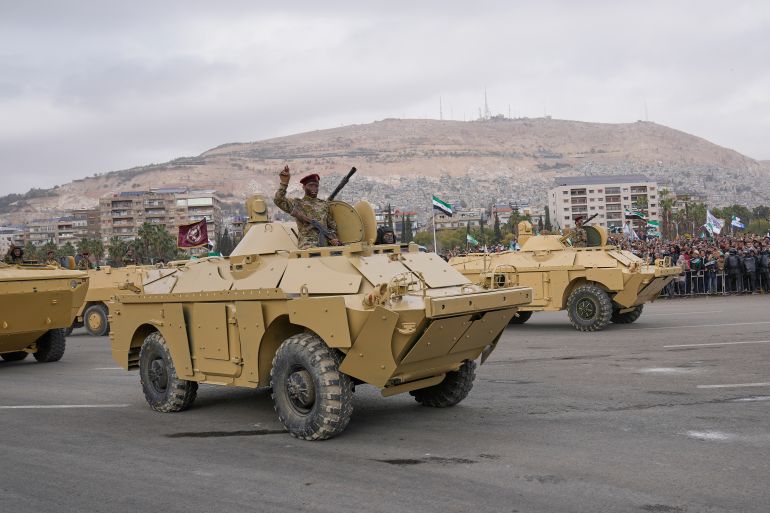
After Bashar al-Assad’s regime was overthrown last year, Syria is still dealing with numerous difficulties. Among the key priorities for the new government is rebuilding its national army and security forces.
Many people viewed Syria’s military and security apparatus as brutal forces designed to bolster the regime and repress dissent for decades.
The new interim government has begun the hiring and restructuring process, with an emphasis on reviving the military and adopting a new doctrine of country loyalty.
“We started the process of restructuring our military and army … and we are meeting the need of the moment by having an army that Syria deserves as a nation to building an army that represents Syria and is able to face the challenges, ‘ ‘ Defence Minister Murhaf Abu Qasra said during a ceremony for soldiers graduating from a military academy in the city of Aleppo.
We will strengthen our military’s capabilities and enhance our readiness to defend our country by developing all branches of the armed forces. And we already issued rules of conduct and discipline, “Abu Qasra said after attending a military march by newly graduating candidates showing off their camouflage uniform and military vehicles and rifles.
Given the difficulties that lie ahead, the rebuilding process may take time and effort, according to analysts, not least of which is changing the mindset of armed groups and making them a part of an organized, professional army.
And deciding whether to integrate forces from southern Syria and the Kurdish-led Syrian Democratic Forces (SDF) in the northeast, as well as vetting the large number of recruits to the country’s newly formed security forces, is one of the main issues. It also involves gaining the trust of the country’s numerous minority groups.
The success of the Syrian armed forces would go a long way to providing political stability in the country, and, with it, possible foreign investment and support for the government in Damascus.
Syria faces an existential challenge of fragmentation and disintegration, according to Caroline Rose, New Lines Institute director of military and national security priorities, Al Jazeera reported.
The country runs the risk of frequent security flashpoints, including infighting between various armed groups and its armed forces, without unification within its army and ongoing sectarian division, according to Rosen.
Vetting
When the al-Assad regime collapsed on December 8, 2024, so did its security apparatus and armed forces. Many renounced their positions and fanned to neighboring nations, others hid in their homes, and others turned in their military identification to the new authority.
Israel also launched numerous airstrikes throughout the country in the first hours after al-Assad fled. On December 10, the Israeli military said in a statement that it had destroyed 80 percent of Syria’s strategic military capabilities. Israel attacked Syria more than 600 times last year.
The new Syrian Army is, according to Rosen, starting from scratch because Israel destroyed a lot of Syria’s conventional land, aerial, and naval military equipment in the first days of al-Assad’s fall, along with the removal of many regime-era officers and soldiers from its ranks, Rosen said.
Syria’s President Ahmed al-Sharaa has dissolved the former army. About 40, 000 fighters make up his group, Hay’at Tahrir al-Sham (HTS), which for years ruled the province of Idlib during the Syrian revolution.
With those figures, Syria’s government would struggle to rule the country in its entirety.
President al-Sharaa appointed military commanders and merged several anti-Assad factions into the new security apparatus and military. The Syrian Armed Forces are now under the control of the Ministry of Defense, while General Security is under the control of the Ministry of Interior. Additionally, they made recruitment more accessible to the general public, resulting in tens of thousands of fresh faces, which analysts see as two major issues.
The first was the breakneck speed of recruitment, due to the need for manpower, which meant vetting was sidelined. After years of sanctions, open conflict, and state theft, thousands of young men in Syria’s 18-23-year-old demographic sought these positions, at least partially because they were among the few economic prospects.
According to Amy Akil, a nonresident fellow at the Tahrir Institute, “keeping Syria’s security glued together is a very delicate balance.”
” It’s not about recruiting only, it’s about the merger of so many factions and no proper vetting process. After the one- or two-year benchmark, I’m confident that they will be more selective in their hiring decisions.
Foreign fighters who participated actively in numerous rival factions’ campaigns against the al-Assad regime are a major issue for Syria’s new rulers.
Western powers, including the US, had issued clear warnings to Damascus: No room for foreign fighters in any key military positions. The fighters won’t take up positions in important positions and won’t “pose any threat” to their countries, according to President Ahmed al-Sharaa of Syria on numerous occasions.
Analysts believe that there are still tens of thousands of officers or noncommissioned officers (NCOs) with military training who are unlikely to be incorporated into Syria’s new security apparatus. This is another significant issue.
The Syrian defence minister has said that the army welcomed about 3000 regime-era soldiers back into its ranks after vetting. However, according to experts, there are still a few middle-level military officers with both conventional and unconventional battlefield experience.
A Syrian military official, who was quoted by a report from the Washington, DC-based Middle East Institute, claimed that under al-Assad, there were approximately 70 000 Alawite officers and NCOs and that their reinstatement was highly unlikely. Battle-hardened, military-capable men not serving in the country’s military could also pose a problem to Damascus.
According to a report released on December 5, the Reuters news agency reported that Kamal Hassan, a billionaire and al-Assad’s cousin, and Rami Makhlouf, a cousin of al-Assad, are “investing millions of dollars in competing efforts to form fighting forces that would create a revolt along Syria’s coast (al-Assad’s former stronghold). Additionally, reports in US media reported that Makhlouf is funding a revolt against the government that includes more than 160, 000 Alawite and former army personnel.
Russia or the US
Syria had become a distant country after al-Assad’s regime ended. Analysts claim that without them, al-Assad would not have been able to maintain his position of power for as long as he did. Russia and Iran were two of the few remaining allies.
But after al-Assad fled to Moscow in the early hours of December 8, Syria’s position in the international community quickly changed. As a result of the severed Iranian-Syrian relations, Syria under the auspices of countries like Saudi Arabia and Qatar, who had previously opposed al-Assad.
Al-Sharaa visited the White House in November, a first for the Syrian president, indicating a strengthening relationship between his country and the US. But despite Russia’s support of al-Assad and providing him refuge, relations with the new Syrian government are not completely shattered.
The SAA’s doctrine and equipment are essentially a Russian force, according to Rob Geist Pinfold, a King’s College London expert on international security, who spoke to Al Jazeera.
This means that Russian equipment is what they currently need whenever they need spare parts or more stock.
“This not only gives Russia some leverage over the government, it also creates problems for Syria-US relations, since the Trump administration wants to pry Damascus away from not just Tehran but Moscow as well”, Geist Pinfold added.

A number of regional and international actors are collaborating to strengthen the Syrian military’s capabilities, according to analysts.
“The US is most certainly playing a role in bolstering the Syrian Army’s intelligence, surveillance, and reconnaissance (ISR) abilities through frequent intelligence exchange”, Rose, from the New Lines Institute, said.
We should anticipate that the US will foster a closer security relationship by deploying advisers for training and guidance as Syria prepares to face an ISIS cell surge.
In order to provide the Syrian Armed Forces with training, advisory, and technical assistance, Turkiye also signed a bilateral defense agreement with the US in August. Under the deal, 49 Syrian cadets (10 army, 18 navy and 21 air force) started undergoing training in Turkish academies, according to reports in Turkish media.
Integration and minorities
Syria’s security forces must still establish domestic order and confidence, despite the support from other countries.
Security forces were reportedly involved in sectarian massacres along Syria’s coast and in the southern region of Suwayda. Although these incidents attracted international attention, many in the nation’s elites lost faith in the military.
“Most Sunni Arab Syrians still trust the army and the government, according to opinion polls. But minority communities do not”, Geist Pinfold said.
The SAA [Syrian Arab Army] is less of a military force and more of a sectarian militia, according to these groups, who believe it doesn’t protect them but actively seeks to undermine their own security and interests.
Source: Aljazeera

Leave a Reply