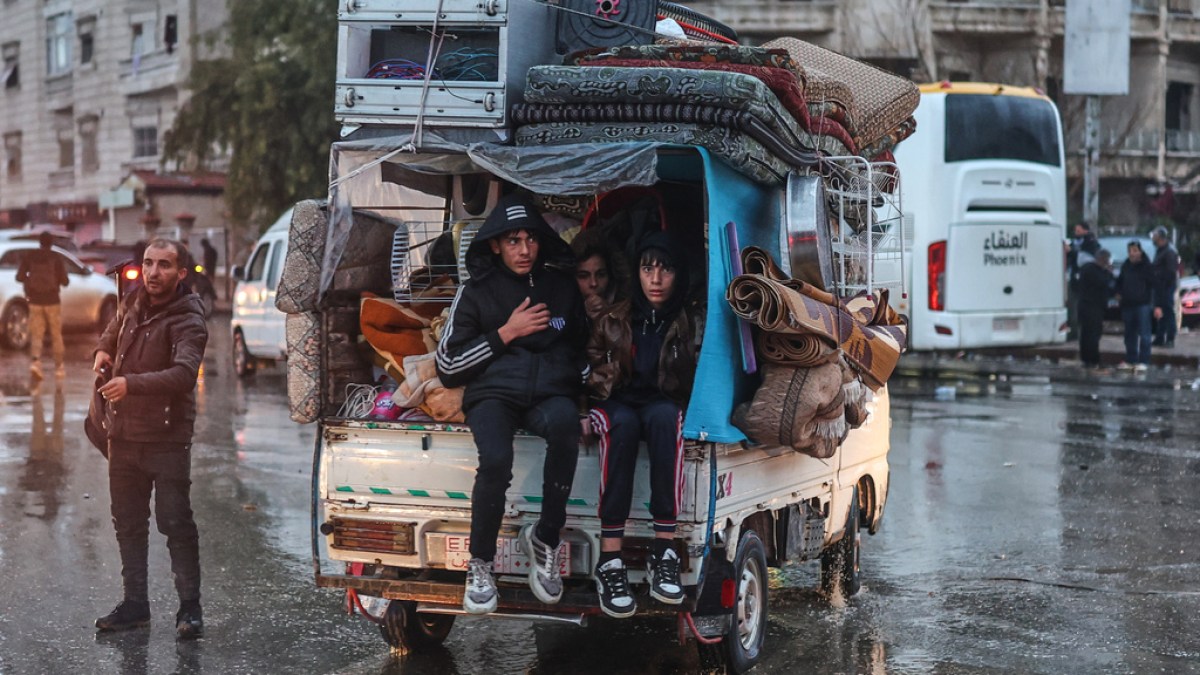
The Syrian army has launched new strikes on Kurdish-held areas in Aleppo after Kurdish fighters refused to withdraw under a ceasefire, as more civilians fled their homes to escape the violence in the northern Syrian city.
The Operations Command of the Syrian Arab Army announced the start of a military operation in the Sheikh Maqsoud neighbourhood of Aleppo on Friday evening after a deadline for Kurdish fighters to evacuate the area, imposed as part of its temporary ceasefire, expired.
Recommended Stories
list of 3 itemsend of list
Syria’s Ministry of Defence had declared the ceasefire earlier on Friday, following three days of clashes that erupted after the central government and the Kurdish-led Syrian Democratic Forces (SDF) failed to implement a deal to fold the latter into the state apparatus.
After some of the fiercest fighting seen since last year’s toppling of Bashar al-Assad, Damascus presented Kurdish fighters a six-hour window to withdraw to their semi-autonomous region in the northeast of the country in a bid to end their longstanding control over parts of Aleppo.
But Kurdish councils that run the city’s Sheikh Maqsoud and Ashrafieh districts rejected any “surrender” and pledged to defend areas that they have run since the early days of the Syria’s war, which erupted in 2011.
Syria’s army then warned it would renew strikes on Sheikh Maqsoud and urged residents to evacuate through a humanitarian corridor, publishing five maps highlighting targets, with strikes beginning roughly two hours later.
As violence flared, the SDF posted footage on X showing what it said was the aftermath of artillery and drone attacks on Khaled Fajr Hospital in Sheikh Maqsoud, accusing “factions and militias affiliated with the Damascus government” of “a clear war crime”.
A Defence Ministry statement cited by the state-run news agency SANA said the hospital was a weapons depot.
In another post on X, the SDF said that government militias were attempting to advance on the neighbourhood with tanks, encountering “fierce and ongoing resistance by our forces”.
Later, the Syrian army said three of its soldiers had been killed and 12 injured in SDF attacks on its positions in Aleppo.
It also claimed that Kurdish fighters in the neighbourhood had killed more than 10 Kurdish youths who refused to take up arms with them, then burned their bodies to intimidate other residents.
The SDF said on X that the claims were part of the Syrian government’s “policy of lies and disinformation”.
At least 22 people have been killed and 173 others wounded in Aleppo since the fighting broke out on Tuesday, the worst violence in the city since Syria’s new authorities took power after toppling Bashar al-Assad a year ago.
The director of Syria’s civil defence told state media that 159,000 people had been displaced by fighting in Aleppo.
Mutual distrust
The violence in Aleppo has brought into focus one of the main faultlines in Syria, with powerful Kurdish forces that control swaths of Syria’s oil-rich northeast resisting integration efforts by Syria’s President Ahmed al-Sharaa’s government.
The agreement between the SDF and Damascus was struck in March last year, with the former supposed to integrate with the Syrian Defence Ministry by the end of 2025, but Syrian authorities say there has been little progress since.
Sheikh Maqsoud and Ashrafieh have remained under the control of Kurdish units linked to the SDF, despite the group’s assertion that it withdrew its fighters from Aleppo last year, leaving Kurdish neighbourhoods in the hands of the Kurdish Asayish police.
Marwan Bishara, senior political analyst with Al Jazeera, said there were significant gaps between the two sides, particularly when it came to integrating the Kurdish fighters into the army as individuals or groups.
“What would you do with the thousands of female fighters that are now part and parcel, of the Kurdish forces? Would they join the Syrian army? How would that work out?” said Bishara.
“The Kurdish are sceptical of the army and how it is formed in Damascus, and of the central government and its intentions. While … the central government is, of course, wary of and sceptical that the Kurds want to join as Syrians in a strong united country,” he added.
Turkiye refrains from military action
In the midst of the clashes, Syria’s President al-Sharaa spoke by phone with Turkish leader Recep Tayyip Erdogan, saying he was determined to “end the illegal armed presence” in Aleppo, according to a Syrian presidency statement.
Turkiye, which shares a 900-kilometre (550-mile) border with Syria, views the SDF as an extension of the Kurdistan Workers’ Party (PKK), which waged a four-decade armed struggle against the Turkish state, and has warned of military action if the integration agreement is not honoured.
Turkiye’s Defence Minister Yasar Guler welcomed the Syrian government operation, saying that “we view Syria’s security as our own security and … we support Syria’s fight against terrorist organisations”.
Omer Ozkizilcik, nonresident senior fellow for the Syria Project in the Atlantic Council, told Al Jazeera that Turkiye had been intending to launch an operation against SDF forces in Syria months ago, but had refrained at the request of the Syrian government.
Elham Ahmad, a senior official in the Kurdish administration in Syria’s northeast, accused Syria’s authorities of “choosing the path of war” by attacking Kurdish districts in Aleppo and of trying to end deals between the two sides.
Alarm spreads
Al-Sharaa spoke with Iraqi Kurdish leader Masoud Barzani on Friday, affirming that the Kurds were “a fundamental part of the Syrian national fabric”, the Syrian presidency said.
The former al-Qaeda commander has repeatedly pledged to protect minorities, but government-aligned fighters have killed hundreds of Alawites and Druze over the last year, spreading alarm in minority communities.
A spokesperson for the United Nations Secretary-General Antonio Guterres expressed “grave concern” over the ongoing violence in Aleppo, despite efforts to de-escalate the situation.
“We call on all parties in Syria to show flexibility and return to negotiations to ensure the full implementation of the March 10 agreement,” said Stephane Dujarric.
France’s Ministry of Foreign Affairs said it was working with the United States, which has long been a key backer of the SDF, particularly during its fight to oust ISIL (ISIS) from Syria, to de-escalate.
Source: Aljazeera

Leave a Reply