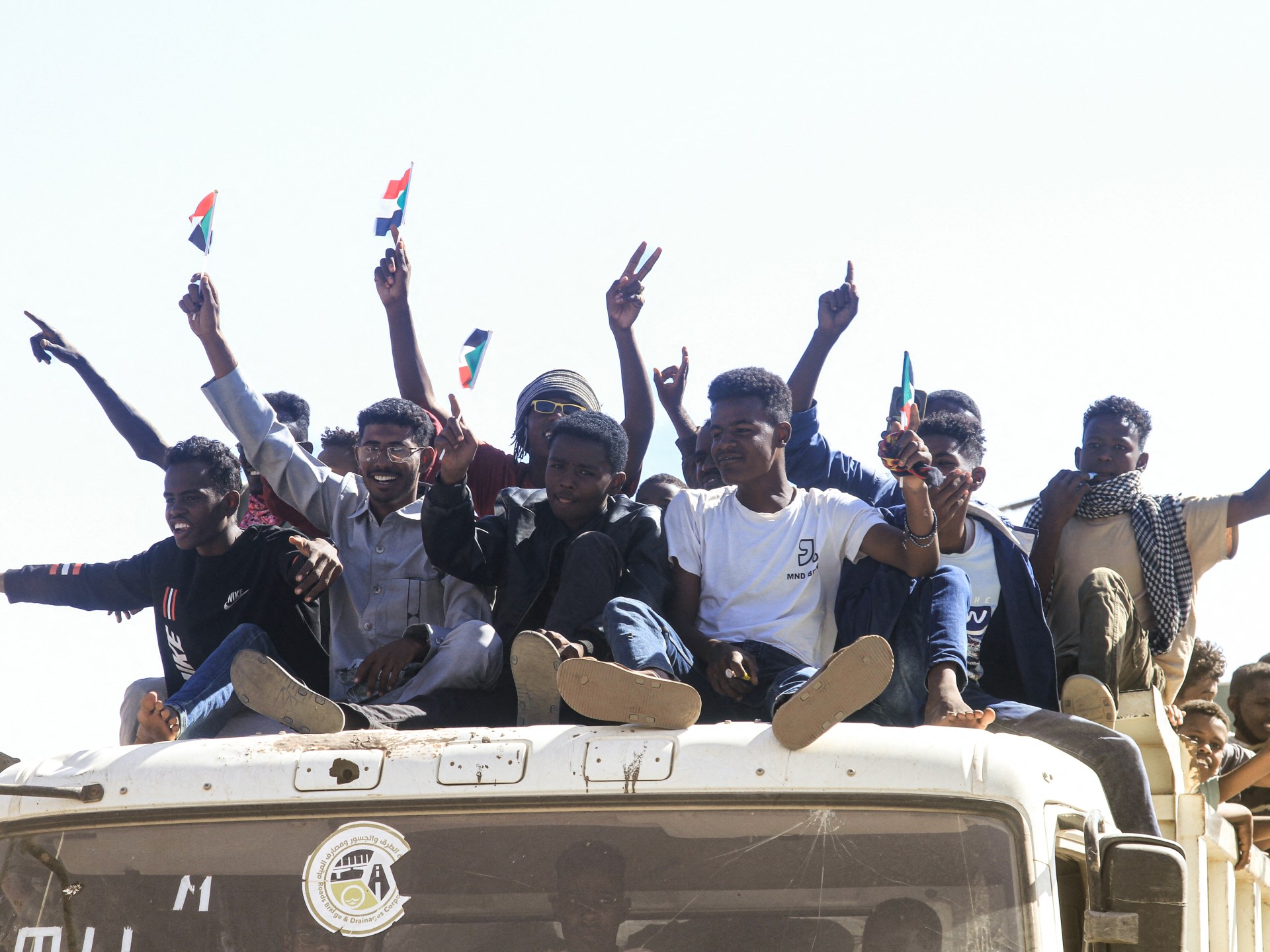
Sudan’s Prime Minister Kamil Idris has announced the government’s return to Khartoum, after nearly three years of operating from its wartime capital of Port Sudan.
In the early days of the civil war between the Sudanese Armed Forces (SAF) and the paramilitary Rapid Support Forces (RSF) in April 2023, the army-aligned government fled the capital, which was quickly overrun by rival troops.
Recommended Stories
list of 4 itemsend of list
The government has pursued a gradual return to Khartoum since the army recaptured the city last March.
“Today, we return, and the Government of Hope returns to the national capital,” Idris told reporters on Sunday in Khartoum, which has been ravaged by the war between SAF and RSF.
“We promise you better services, better healthcare and the reconstruction of hospitals, the development of educational services … and to improve electricity, water and sanitation services,” he said.
For close to two years, the Sudanese capital – comprised of the three cities of Khartoum, Omdurman and Khartoum North (Bahri) – was an active battlefield.
Entire neighbourhoods were besieged, rival fighters shot artillery across the Nile River, and millions of people were displaced from the city.
Between March and October, 1.2 million people returned to Khartoum, according to the United Nations.
Many found a city with barely functioning services, their homes destroyed and neighbourhoods pockmarked by makeshift cemeteries authorities are now exhuming.
The war is estimated to have killed tens of thousands of people in the capital alone, but the complete toll is unknown, as many families have been forced to bury their dead in makeshift graves.
According to the UN, the rehabilitation of the capital’s essential infrastructure would cost some $350m.
In recent months, the government has held some cabinet meetings in Khartoum and launched reconstruction efforts.
The city has witnessed relative calm, though the RSF has carried out drone strikes, particularly on infrastructure.
Army strikes RSF targets
Battles rage elsewhere across the vast country.
South of Khartoum, the RSF has pushed through the Kordofan region, after dislodging the army from its last stronghold in Darfur last year.
Sudan’s army on Friday said that it inflicted heavy losses on the RSF during a series of air and ground operations carried out over the past week in the Darfur and Kordofan regions.
In a statement, the military said its forces conducted strikes against RSF positions, destroying about 240 combat vehicles and killing hundreds of fighters.
It added that ground forces had succeeded in pushing RSF fighters out of wide areas in both Darfur and Kordofan, and that operations were ongoing to pursue remaining elements.
The RSF did not immediately comment on the army’s statement, and the information shared by the army could not be independently verified.
The conflict has left 11 million people displaced internally and across borders, and created the world’s largest displacement and hunger crises.
Recently, the UN described el-Fasher in North Darfur as a “crime scene” after gaining access to the largely deserted city for the first time since its takeover, marked by mass atrocities by the RSF in October.
International aid staff visited el-Fasher following weeks of negotiations, finding few people remaining in what was once a densely populated city with a large displaced population.
More than 100,000 residents fled el-Fasher for their lives after the RSF seized control on October 26 following an 18-month siege, with survivors reporting ethnically motivated mass killings and widespread detentions.
Source: Aljazeera

Leave a Reply