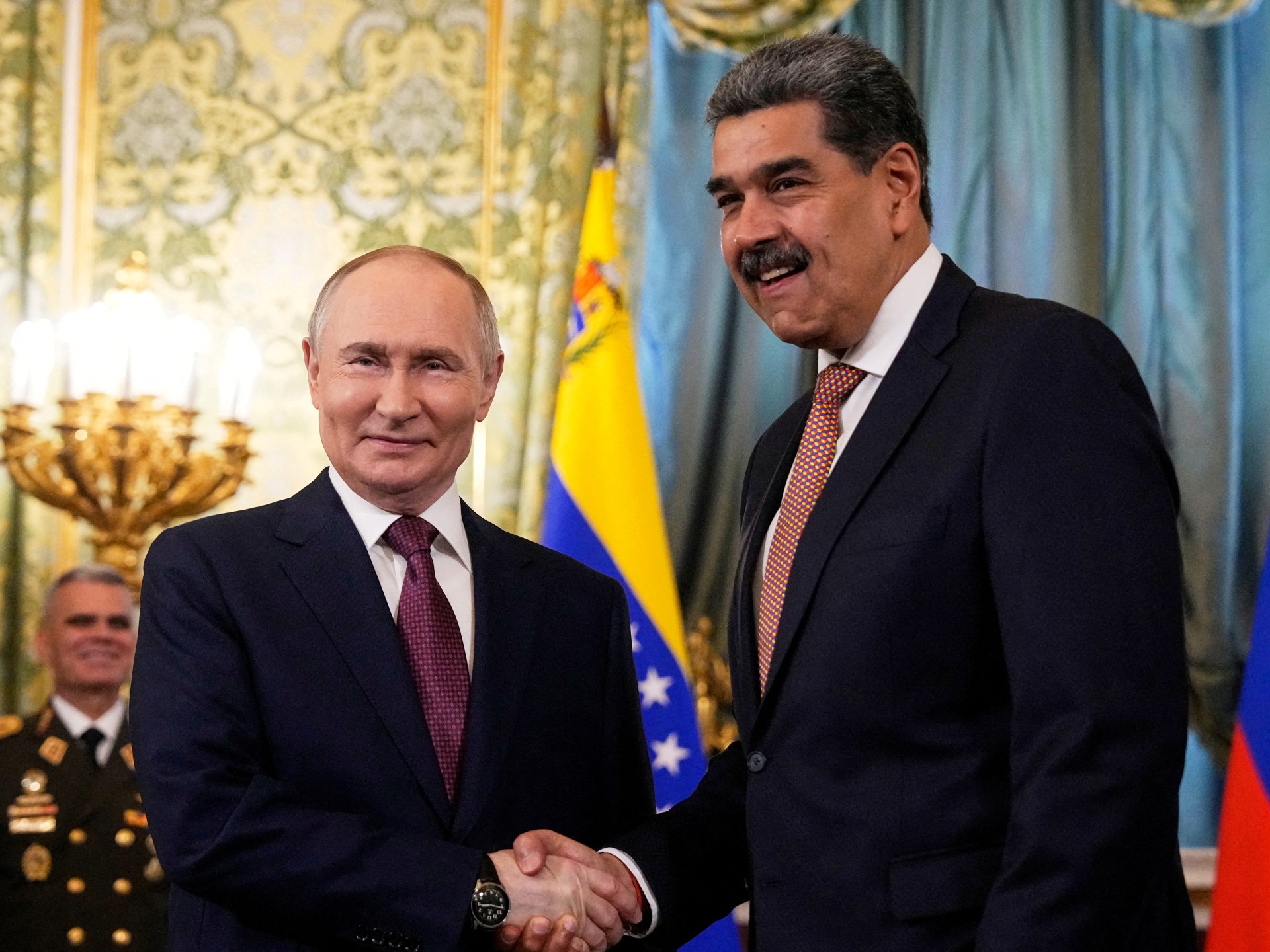
Donald Trump’s escalation of threats to Venezuela may be easy to overlook as one of his arbitrary whims, but it is too closely linked to major conflicts to be seen as a regional issue with little impact on the rest of the world.
Along with Ukraine, Venezuela is becoming a bargaining chip for the world’s superpowers.
Check out Antony Beevor’s history of World War II’s opening chapters to see how seemingly disparate conflagrations on different continents, such as the Nanjing massacre in China, Mussolini’s invasion of Abyssinia, and the Spanish Civil War, contributed to the preparation for the most heinous carnage in modern history.
Although there is always a threat of a third world war, this does not mean that the world is necessarily sluggish. A global agreement seems more likely than a global war as long as Trump and his Russian counterpart Vladimir Putin, the two main players in Russian-US relations, are currently more likely to engage in mutually beneficial transactions than engage in confrontation.
Venezuela, a country with the largest proven oil reserves in the world and a political ally of China, Iran, and Russia, which the US-led West views as its archrivals, still matter internationally. Russia is the one of these three that finds itself in Venezuela’s most delicate situation. The Kremlin faces risks as a result of the US-driven escalation, but it also has the potential to gain.
The unforeseen thaw that occurred in US-Russia relations during Trump’s second term as president is what caused most of it.
The Kremlin has seen the US as a shaky partner before becoming a full-fledged adversary with an ambition to divide and rule in the former Soviet Union neighbourhood since Putin’s ascent to power in 2000.
When Trump arrived in the White House at the beginning of 2025, things abruptly returned to a kind of partnership. Although it still provides crucial intelligence to the Ukrainian army, the US almost stopped providing aid to Ukraine and assumed a more neutral position. Russia was even removed from the list of “direct threats” in the most recent iteration of the US’s National Security Strategy.
Putin has good reasons to believe that the conflict is coming to an end on his terms as the peace negotiations with Ukraine start. The most punishing of Russian demands in negotiations has recently been suggested by Ukrainian President Volodymyr Zelenskyy that he would consent to his army’s withdrawal from the north of the Donbass region. In 2025, the Kremlin’s position on negotiating terms was reaffirmed by him as one more concession he suggested he might be open to.
In the meantime, the countries of the European Union have failed to reach an agreement regarding the loan, which could provide Ukraine with stable funding in the upcoming years. The story demonstrated how far the European commitment to Ukraine has come, despite the fact that a less expensive option was found in incessant negotiations.
Given all of the above, it’s unlikely that the Kremlin would want to ruin a challenging but ultimately fruitful working relationship with Trump’s administration over something as distant and unrelated to Venezuela’s core interests.
Russia would indeed produce all the desired sounds. Vassily Nebenzia, the US’s UN envoy, claimed that the US is “aggressive neocolonialism” by threatening Venezuela. He claimed that it is “cynically imposing its order” while “trying to maintain global dominance and the right to exploit other countries’ riches with impunity.”
This is in reference to Venezuela’s openly demanding that its oil companies, which dominated the nation’s oil industry prior to its gradual nationalization in the 1970s, be allowed to do business there.
Russian oil companies have joint ventures with PDVSA, a Venezuelan oil monopoly, despite their turbulent history, not least as a result of US sanctions, but it appears that Russia does not have any interest in Venezuela’s riches.
However, Russia would not give up on rescuing a welcoming government in Latin America. Venezuela’s support will always be in line with the US’s pressure on Russia in relation to Ukraine.
The Kremlin won’t want to see the government fall, but Nicolas Maduro’s might. Russia has a history of adapting to new political regimes, which have taken their place as allies in developed nations affected by the US’s obsession with regime change. Syria and Iraq both serve as good examples.
There is a component of cynical political calculation as well. The US’s military action on Venezuela could potentially result in more geopolitical benefits than the losses.
Because it would give Russia and the US the same moral weight when it talks about the Ukraine war. Why can’t Russia follow the US’s example in its own country if it can impose its will through military hostility in what Americans refer to as “their backyard”? In the eyes of many, particularly in the Global South, the US aggression in Venezuela would support Russian aggression in Ukraine. It would encourage further divisions between the US and Europe and, ironically, foster polarization within the US itself.
The situation would be ideal for the Kremlin if the Trump administration continued to pursue its irrational desire to occupy Greenland in addition to Venezuela. It might even open doors for a resemblance to the EU-led region of Europe, which is currently its biggest global enemy.
The Russians view themselves as the mainstays of the old order and the most conservatives in terms of foreign policy. They view the US-led West as a revisionist force that helped to reverse the post-World War II order, and they also see the Ukrainian conflict as a means of reversing that revision.
Let us negotiate a new order, one in which the US can go as it pleases in its Western hemisphere and Russia can control the ex-Soviet neighbourhood, if there is no return to the old order, which the West is to blame.
The US would likely become bogged down in Venezuela for years, which would be ideal. However, Maduro is also alright if he falls quickly. The outcome might appear to be a transaction, with a US-friendly Venezuela in exchange for the Ukrainian conflict terminating in accordance with Russian terms.
Source: Aljazeera

Leave a Reply