James Comey, the former director of the US Federal Bureau of Investigation (FBI), is accused of lying to Congress.
He is the first former senior government official to face charges related to the 2016 election investigation into Russian interference.
According to the Justice Department, Comey could spend five years in prison if found guilty.
What we know is as follows:
James Comey, who is he?
From 2013 to 2017, James Comey served as the FBI’s director under President Obama.
Donald Trump fired him in 2017 as president while he was looking into whether Trump or his campaign had influenced the 2016 election, which Trump, the Republican nominee, won against Democrat Hillary Clinton, had influenced the outcome.
Special Counsel Robert Mueller took over the Russia investigation after Comey was fired.
Russia made significant efforts to influence the 2016 election, according to the investigation, which spanned nearly two years. In the end, it did not establish whether Trump or his team had engaged in a criminal plot, but Trump repeatedly fought back and called the investigation a “witch-hunt.”
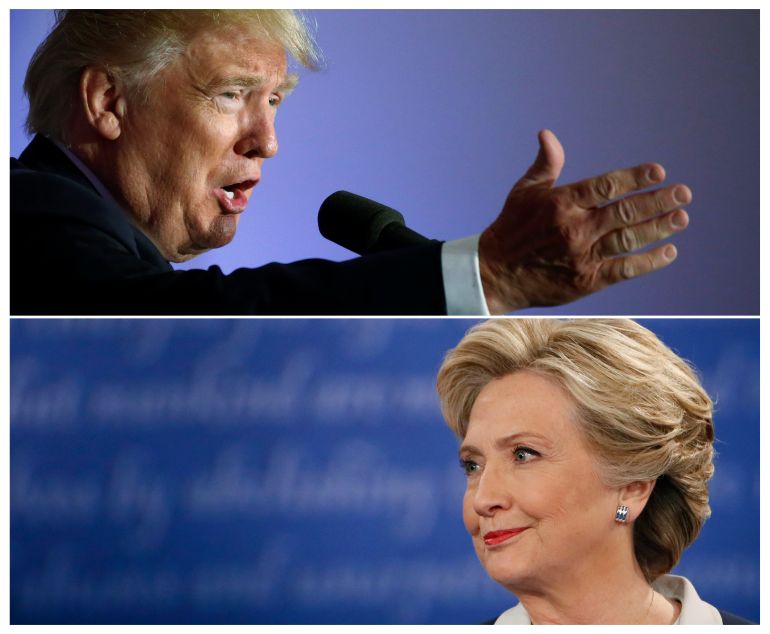
Donald Trump (top) addresses a campaign event in Washington, DC as Hillary Clinton listens during a town hall debate on October 26, 2016. [File: Carlo Allegri/Shannon Stapleton/Reuters]
What allegations surround Comey?
Comey’s case does not involve the specifics of the Russia investigation. Only his 2020 testimony to the Senate Judiciary Committee’s investigation into whether he lied to senators is the subject of the focus.
Republican Senator Ted Cruz questioned whether he had ever authorized anyone at the FBI to leak information to the press about Hillary Clinton’s emails and possible links to Russia at a hearing on September 30.
Comey claimed that he had never permitted anyone to use the bureau to provide an anonymous source for news reports. However, former FBI Deputy Director Andrew McCabe’s testimony, which claimed Comey had actually given such approval, conflicted with that statement.
Comey is charged with making false statements on the first count of the indictment, alleging that he knowingly lied while taking an oath at the time of the hearing.
He is charged with trying to obstruct the committee’s investigation by providing false and misleading testimony on the second count, which is obstruction of a congressional proceeding.
Overall, the Trump administration intends to use the Russia investigation as a tool to stifle the former president’s campaign-related efforts to stifle Russian alleged election interference and undermine Trump’s victory’s legitimacy.
What exactly did Comey testify about in 2020?
The FBI’s errors were being reviewed by the Republican-led Senate Judiciary Committee at the start of the Russia investigation.
Senators inquired about the FBI’s use of a dossier that contained unsubstantiated allegations about Trump’s ties to Moscow. The dossier was used to obtain a warrant to secretly watch a former Trump campaign adviser, whose reputation has since been largely discredited.
Comey acknowledged that the warrant’s errors were significant. He defended the investigation as being “in the main, conducted in the right way” throughout.
In response to this, inquiries about whether he had authorized anyone at the FBI to discuss the Russia investigation in secret surfaced.
During a hearing to review the Crossfire Hurricane Investigation, James Comey, former director of the FBI, testifies remotely before the Senate Judiciary Committee in Washington, DC, on September 30, 2020. [Ken Cedeno/Reuters]
An indictment is what?
In the majority of federal cases, a grand jury finds that there is sufficient proof that a crime has been committed.
An indictment is issued as part of a formal written notice that a person is suspected of a crime and facing legal challenges, according to the US Department of Justice.
The accused person is informed of the charges brought against them by the indictment itself.
A grand jury is what?
A grand jury is a group of citizens set up by law enforcement to evaluate the admissibility of the evidence before a prosecution can file a charge. In terms of law, it is responsible for determining whether a crime has been committed.
Grand juries don’t decide innocence or guilt.
What transpires following the arrest?
The case moves forward in the court case if an indictment is approved by a grand jury. A summons may be used to bring the defendant to court or to be detained.
A court hearing where the charges are formally read and a plea entered is held before the defendant makes an appearance. Following that, the case goes through pretrial proceedings, including filing motions and exchanging evidence, and may be settled by entering a plea deal (a contract between the defendant and the prosecutor).
If there isn’t a consensus, the case moves on to trial, where the jury will determine whether someone is innocent or guilty. The judge places a sentence on the defendant’s behalf, which could include imprisonment, fines, or probation.
When will Comey’s arrest take place?
In Virginia, Comey’s arraignment is scheduled for October 9 at 10am local time (14:00 GMT).
His attorney, Patrick J. Fitzgerald, stated in a statement following the indictment that Jim Comey “denies the charges filed today in their entirety.” In the courtroom, we anticipate voting him.
What did Trump say in response to the indictment?
Trump praised the action on Truth Social, saying, “JUSTICE IN AMERICA! James Comey, the former FBI corruption head, is one of the worst people exposed to any human beings in history.
The president continued, “He was indicted by a grand jury today on two felony counts for various unlawful and illegal behavior.”
. “JUSTICE IN AMERICA” @POTUS “pic. twitter.com/polaL0r6ky
No one is above the law, according to Attorney General Pam Bondi, who cited the indictment as evidence of the Justice Department’s commitment to holding those responsible for abuses of power.
What has Comey said?
Comey stated in a video that appeared on Instagram that “there are costs to standing up for Donald Trump.” But we were unable to imagine living in another way. You should not either. We won’t be on our knees forever.
I’m innocent and have a lot of confidence in the federal court system. So let’s take a test and practice faith, he continued.
What are Comey’s indictment’s critics’ opinions?
Concerns have been raised by the James Comey case that Trump is using to attack his political adversaries by Bondi’s Justice Department.
Critics claim that the White House blurs the line between law and politics.
Trump later criticized Comey for not being prosecuted after publicly pressing Bondi to bring charges against him. Additionally, he announced plans to nominate Lindsey Halligan, a devoted assistant with no prior experience prosecuting federal cases, for the position of chief prosecutor in Virginia.
After its chief prosecutor resigned in response to pressure from New York Attorney General Letitia James, Comey’s case was thrown into the Eastern District of Virginia. Despite being warned against by experienced prosecutors, Halligan moved the Comey case to a grand jury.
Democratic Virginian Senator Mark Warner called this interference a “dangerous abuse of power.”
Trump is undermining one of the most significant US by replacing him with a partisan loyalist and ousting a respected, independent prosecutor. the country’s attorneys’ offices and deteriorating the law itself.
Legal experts warn that this action could lead to a dangerous precedent.
Trump has made it clear that he wants to use his position as president to exact revenge on those who he believes are his political foes or those who he genuinely dislikes, according to Sahar Aziz, a Distinguished Professor of Law at Rutgers University.
Because Trump is threatening a former senior official’s liberty through the criminal justice system, she continued, “This is unprecedented.”
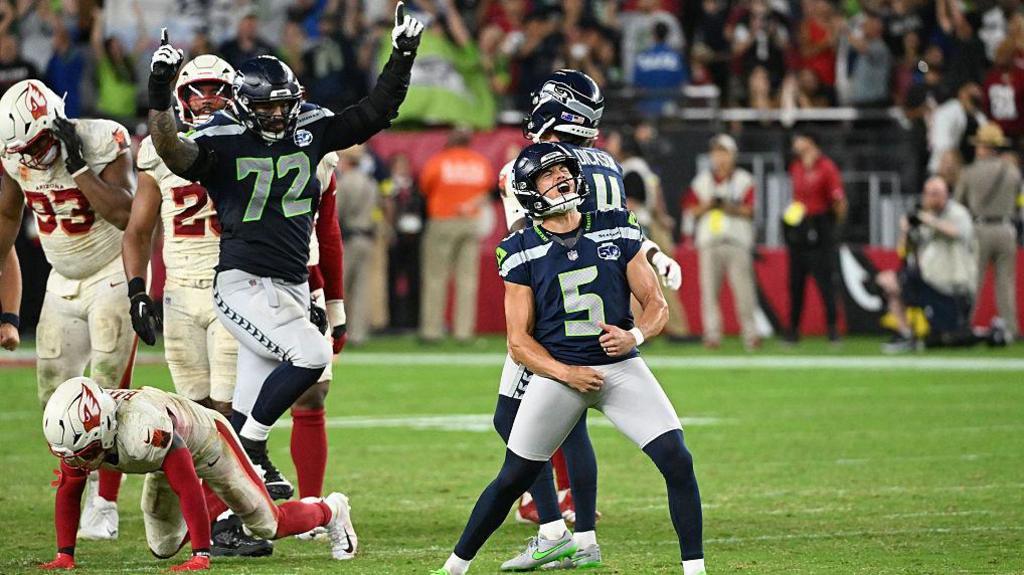
The Seattle Seahawks defeated the Arizona Cardinals in a dramatic 23-20 victory in the final play of the season with a 52-yard field goal by Jason Myers.
With 28 seconds left in the fourth quarter, the Cardinals rallied from 14 points down to tie the game, with quarterback Kyler Murray delivering two touchdowns.
Before Myers slotted the winning kick, Seahawks quarterback Sam Darnold then put his team in field goal territory.
After being defeated by the San Francisco 49ers on Sunday, Arizona lost the final kick of the game 16-15.
Myers, 34, missed one field goal from 53 yards just before the end of State Farm Stadium’s away game.
Coach Mike Macdonald called the Seahawks player “a stud” after seeing him play golf. He has “ice in his veins,” he claims. We anticipated that he would kick.
Myers continued, “I stayed true to my routine and didn’t try to change anything.”
Ashley Haruna had no intention of staying in Ghana, despite the fact that she had no intention of doing so. But everything changed for the 28-year-old health coach when she stood facing a dark cell inside the stone walls of Cape Coast Castle. Haruna claims she “felt something” as the tour guide explained that many of the exiled people had ended up in Haiti.
Having grown up in the United States to Haitian parents, she realised “my ancestors could’ve passed through here. This location This ground.
She reflects, “I wasn’t looking for that.” “But it found me. ”
The feeling it stirred within her only grew when she returned home to Ohio. She eventually returned to Ghana after a short while, with her family’s uneasy approval.
That was in December 2021, and Haruna was following in the footsteps of many other African Americans who had sought to reconnect with the country that may once have been home to their ancestors.
Kwame Nkrumah, Ghana’s first prime minister and president, pushed for the diaspora’s return as part of his efforts to create a nation-by-the-number in the 1950s. During the US civil rights movement, he invited Black American activists, including W E B Du Bois, Marcus Garvey, and Julian Bond, to relocate to Ghana. De Bois and Maya Angelou both moved there in the 1960s.
Ghanaian leaders continue to encourage the African diaspora to reconnect and relocate. More than 200 people from the US and the Caribbean received Ghanaian citizenship in 2019 as part of the “Year of Return” commemorating 400 years since the first Africans were enslaved in Virginia. In 2024, as part of the government’s “Beyond the Return” initiative – the same programme that encouraged Haruna to move to Ghana – 524 African diasporans were granted citizenship.
However, as Haruna discovered, creating a new life in Ghana presents challenges.
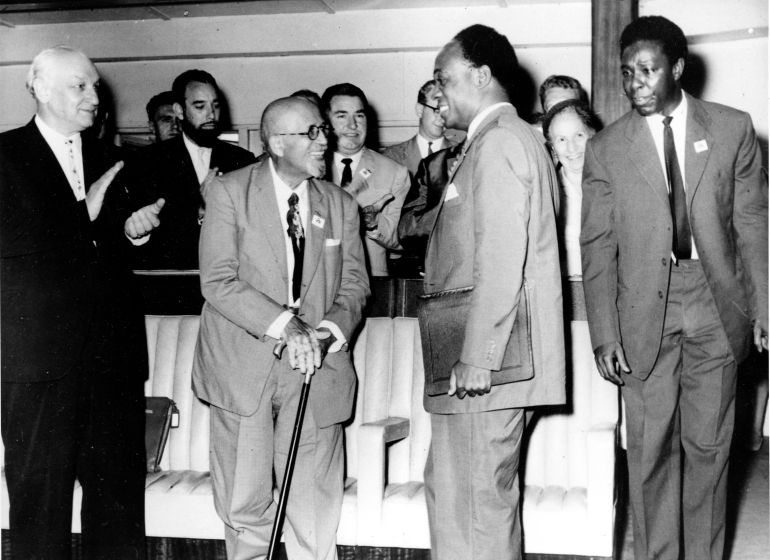
President of Ghana, Kwame Nkrumah, second from right, talks with 93-year-old American scholar W E B Du Bois shortly before opening the World Peace Conference in Accra, Ghana, on June 21, 1962 [AP Photo]
Diaspora Diaspora Villa
Her first apartment was located two hours north of Accra, in the mountainous Eastern Region, and while Haruna had imagined herself integrating into a local community, she instead found isolation. She found herself feeling alone and frustrated because there were no nearby grocery stores and no one to assist her with questions about how to use a gas stove or what to do if the water stops running.
She recalled a YouTube video she’d seen while still in the US about a place called Diaspora Diaspora Villa – a co-living space where the owner, herself a “returnee”, as African Americans relocating to Ghana refer to themselves, helps others navigate their new lives in the country. Haruna dug through her browser history until she found the video. A week later, she moved into the villa in an upscale suburb of Accra.
She learned to navigate the practical and cultural difficulties of finding her new home in the warm communal living room and kitchen she shared with two other African-American tenants. These included learning to say “please” before every word.
When Haruna was injured in a car accident, it was the villa’s owner, Michelle Konadu, 37, and the community of former tenants who helped her. Her lifeline was the villa. Like the other tenants – who tend to stay for between three and nine months – Haruna moved out of the villa after a while, but it is still Konadu she calls when she needs help.
Ashley Haruna sits in the kitchen at Diaspora Diaspora Villa, a co-living space in Kwabenya, a suburb of Accra [Alfred Quartey/Al Jazeera]
‘They want healing’
Konadu is aware of the conflict created by other worlds. Born and raised in New York City to Ghanaian parents, her family apartment was a landing place for visiting relatives, distant cousins and friends of friends. She claims that “we were always residing someone.”
It wasn’t until she visited Ghana for a funeral in 2015 that she first contemplated leaving the fast pace of New York for the slow flow of Ghana. She initially assumed it would feel like home, but she claims she frequently felt alien. “Too American to be in Ghanaian spaces. But America would not be able to tolerate it because of Ghana.
A cousin named Alfred softened her landing by teaching her how to navigate markets, hail a trotro (a local minibus taxi), and understand the unspoken etiquette of greeting elders and never using the left hand to make gestures towards anybody.
She claims that she might have left and never come back without his advice.
Recognising that not every returnee has their own Alfred, Konadu decided to help. In 2017, she opened Diaspora Diaspora Villa, a three-bedroom co-living compound alongside her larger family home in Kwabenya. She invites the tenants she hosts into the everyday life of her neighbourhood and introduces them to middle-income Accra. Beyond providing accommodation, she helps returnees find schools, consults on land purchases, and connects them with social groups and sports clubs.
Her goal is simple: to help people belong by providing “an already-made community”.
The majority of them arrive in this country on a soul mission, Konadu explains. “They want healing. or reconnecting. Or just a fresh start. Many people have a lifelong dream of visiting Africa. But the people they meet might not understand that. ”
Michelle Konadu stands outside Diaspora Diaspora Villa [Alfred Quartey/Al Jazeera]
When their intended destination was to leave, her family was unable to comprehend why she had relocated. But now other families are relieved to know that their loved ones will spend their first months in Ghana surrounded by people on a similar journey. Konadu believes that if people can live with her, they can also live in the community as a whole after ten years.
She points to the Brazilian “Tabom” community in Jamestown, Accra, which she sees as a perfect example of a well-integrated returned diaspora group. In the 19th century, they emigrated from Brazil as slaves, settled among the Ga people, had intermarried, had language training, and had a way of living that incorporated their Afro-Brazilian heritage into the social structure. Over the generations, their names – De Souza, Silva, Nelson – have become part of the Jamestown story. Konadu anticipates that the younger returnees will experience the same fate, and that the strong African-American culture will remain a part of larger Ghanaian society.
Haruna understands that integration takes time, and she acknowledges that returnees like her have privileges that others in Ghana don’t. Her preferential treatment includes faster service in restaurants, locals ready to help, and her ability to generally make things happen more quickly, like meetings with authorities, because lighter skin and an American accent frequently open doors in ways that never happened back in the US.
“It is uncomfortable as a self-aware person to notice that I have privilege, something that is the total opposite of what is happening in the United States. She says, “I’m still getting my head around it.”
“I’m Ghanaian. I’ve returned, too, says Konadu. “We’ve always been connected: Ghana and its diasporans. Although this isn’t new, the “Year of Return” made things more obvious. ”
Some friction has resulted from this increased visibility and the clustering of returnees in particular settlements, which add to the cost increase.
An aerial view of Kwabenya, where Diaspora Diaspora Villa is located [Alfred Quartey/Al Jazeera]
They won’t see the Ghana, they say.
Anthony Amponsah Faith runs a business renting out cars and driving clients around Ghana, including returnees navigating the country for the first time. He attributes their permission to lead him to places like the middle-belt waterfalls and the Nzulezu stilt village, which he had never visited before. “Before, I never got to go anywhere. The 32-year-old claims to have seen the entirety of Ghana now.
On these trips, Amponsah has witnessed his African-American clients’ emotional visits to coastal slave castles and memorials, but he has also seen friction up close. While wealthy neighborhoods, where returnees frequently settle, have access to supermarkets and cafes, and have access to paved roads and supermarkets, have water on cycles, while basic services need improvisation. Returnees complain about power cuts or heavy traffic, while locals shrug them off as part of daily life. He recalls a client who argued that Ghana should be affordable and that he was being overcharged.
Earlier this year, Amponsah awoke one night to find his mattress floating in a room flooded with water. He claims that Ghana won’t be seen there. “It doesn’t flood in the areas where returnees stay. ”
He is frustrated by the rising cost of housing, which he attributes to returnees’ willingness to pay more. He claims that it is not expensive to them. “They come from places where they earn more. However, I hold the government accountable. Why aren’t we getting those same opportunities? ”
In 2019, he paid 120 cedis ($10-12) a month for a small studio; he now pays 450 cedis ($42-44).
“The cost of living is rising by the second. Finding a place is scary because of it, Amponsah claims. He would prefer to be closer to his customers, many of whom live at least an hour away, but he can’t afford to move.
On the outskirts of Akwamufie [Alfred Quartey/Al Jazeera] the entrance to the diaspora settlement Fihankra.
‘A town from scratch’
Some Ghanaians carry an often unspoken burden due to their ancestors’ involvement in the transatlantic slave trade, which makes some chiefs offer land to returnees as atonement. Many newcomers feel guilty about their economic and social privileges.
Across Ghana, at least two diaspora settlements, Fihankra and Pan African Village emerged that way, while other returnee-focused residential projects, including gated communities, are under construction.
In the African-American community known as Pan African Village, businessman and investor Dawn Dickson is constructing a house for herself. She moved to Ghana in 2022, after envisaging a life outside the US in a place where she wasn’t “the minority”.
The 46-year-old claims she had no intention of looking for a diaspora-only community. Dickson, who traces her ancestry to the Akan people in Ghana and Ivory Coast, was struck by the sense of familiarity, warmth and energy among the Ghanaians she met. However, when she began to look for land, she discovered that other returnees were purchasing property close to Asebu, in the coastal Central Region, where a traditionalist had carved out 20,000 plots for diasporans.
“For me, it was the excitement that I got to be part of building a town from scratch,” Dickson explains.
She purchased land before starting a business to assist other African Americans in purchasing and building homes. Dickson is employing sustainable rammed earth technology to construct houses for 35 returnees as well as roads, a school, a church and boreholes, and is training locals to master this building technique.
However, there have been some unanswered questions in the community.
In 2023, a family challenged the decision to allocate land they claimed was their ancestral property as part of the village. Despite a high court’s ruling requiring the suspension of construction, progress has continued, and 150 farmers who depended on this land claim to have lost their lives.
Dickson says the land she has helped purchase is not contested, and if farmers are using it, she negotiates shared-crop agreements or payment.
In other instances, new diaspora initiatives are being worked on and are being investigated.
Sanbra City (“Return City”) is a 300-acre private real estate development outside Accra. Initial rumors that the government was behind an exclusive returnee enclave with homes starting at $ 80,000, which is beyond the reach of most Ghanaians, caused a backlash against the planned eco-friendly gated community. Sanbra City founders have said the project is a collaboration between African-American and Ghanaian developers, not a government initiative, and Ghanaians would be welcomed.
Dickson claims she has witnessed other instances of African Americans defrauding themselves by charging outrageous prices for services rendered by a scammer.
Black Star African Lions guesthouse in Akwamufie [Alfred Quartey/Al Jazeera]
A hub for the local community and a pan-African refuge
The very first planned diaspora community in the country was Fihankra, on the outskirts of Akwamufie town in Ghana’s southeastern Eastern Region.
The Akwamu Traditional Area chief gave land to diasporans who wanted to resettle in Ghana in 1994. Fihankra is a Twi phrase that loosely translates as, “When you left this place, no goodbyes were bid. It represents the agonizing separation of diasporas from their ancestral homes.
Once promoted as a Pan-African refuge, Fihankra is now largely deserted and marked by scandal.
In the late 1990s, when she and her husband were residing in London, retired nurse and Afro-Caribbean Afro-Caribbean, Harriet Kaufman, 69, first learned about Fihankra.
By the time they arrived in Ghana in 1998, rumours were swirling that Fihankra turned away Jamaicans and Nigerians, reserving land solely for African-American investors and charged inflated prices and rents. So the couple settled down on their own and slowly constructed a 15-minute residence in Fihankra.
Over time, some diasporans at Fihankra started calling themselves the royal family, prompting the minister in charge of chieftaincy to take legal action against them for impersonation. Then, in a 2015 attempted robbery, two female African-American residents were killed. Soon after, the small community was largely abandoned.
Only two people, according to Kaufman, reside in Fihankra today.
The Kaufmans’ home, meanwhile, named Black Star African Lion and situated on hills overlooking the Volta River, has grown into a local community hub with a small children’s library, cafe, bar, music studio, guesthouse and prenatal care business.
In front of her Akwamufie home [Alfred Quartey/Al Jazeera] steht Kaufman.
‘I am fortunate’
It took years for the community to grow, and Kaufman is moved by how quickly returnees appear today. When she first came to Ghana, she and her husband rented from a family in Accra and it took them several years to find land and build the first building. No electricity or smartphones were available in the area. There was no Instagram to glamourise the journey or real estate agents curating “Africa” from afar. Social media, in her opinion, has made return appear simple and even luxurious.
“I guess it was a different time than now. My husband and I were outside to watch the stars at night as we came, she says. “Today, all these influencers are posting about Ghana on Instagram, and people think it is just easy and nice villas by the river. ”
Kaufman believes this contributes to perceptions that returnees are privileged.
After all these years, when she occasionally sells bananas from her garden on the local market, she is given prices that are lower than what customers would typically accept. She says she is still seen as someone who already has more than enough and shouldn’t be seeking profit. Kaufman claims she understands it and feels privileged to live there.
As more recent arrivals build new lives in local communities or choose to be surrounded by other diasporans, many returnees face integration challenges.
In response to international calls for sporting sanctions against Israel for its genocide in Gaza, the US government says it will work to stop any attempt to stop Israel from playing in the 2026 World Cup.
A representative from the US State Department pledged in a statement to various media outlets on Thursday that “we will absolutely work to completely stop any attempt to ban Israel’s national football team from the World Cup.”
Recommended Stories
list of 4 itemsend of list
The US, Canada, and Mexico are scheduled to host the 2026 FIFA World Cup.
After a UN commission of inquiry concluded last week that Israel is committing genocide against the Palestinian people, pressure is mounting on the European football association UEFA to outlaw Israel from international competitions. This could potentially prevent Israel from trying to qualify for the next World Cup.
According to The Associated Press news agency, the majority of the 20-member executive committee of UEFA supports a ban on Israel’s football team, with many concerned about how inconsistent football has been with regard to Russia and Israel.
In 2022, Israel joined the world’s top footballing organization, FIFA, despite numerous accusations of war crimes and the UN’s declaration that it is the perpetrator of a genocide in Gaza. Both UEFA and FIFA, the world’s governing body for football, banned Russia.
No Russia or Israel should be competing in any international competition until the barbarity ends, according to Spain’s prime minister Pedro Sanchez, who added pressure last week.
According to Reuters news agency, UEFA officials are scheduled to hold an emergency vote the following week to decide the ban.
Although UEFA has the authority to forbid Israel from competing in any games that involve its European competitions, FIFA cannot forbid the Israeli national team from participating in World Cup qualifiers.
Gianni Infantino, the head of FIFA, is close to US President Donald Trump and has visited the world’s satellite offices in Trump Tower this week.
It’s unclear whether FIFA would support a ban on Israel given that the majority of the 2026 World Cup games are anticipated to take place in the US and that Trump is a staunch supporter of the event.
According to Reuters reports, President of the Palestinian Football Association, Jibril Rajoub, told Norway’s TV2 that Israel should be out of the World Cup.
“Israel has broken FIFA’s rules, values, and rules. Therefore, I think it’s appropriate to sanction Israel,” Rajoub said.
“UEFA and FIFA should be the ones to impose sanctions.”
Amy Canavan, BBC Sport Scotland and Richard Winton, BBC Sport Scotland
Unacceptable. Predictable . Ignored . whimpering out. No convictions. Out of ideas, raging.
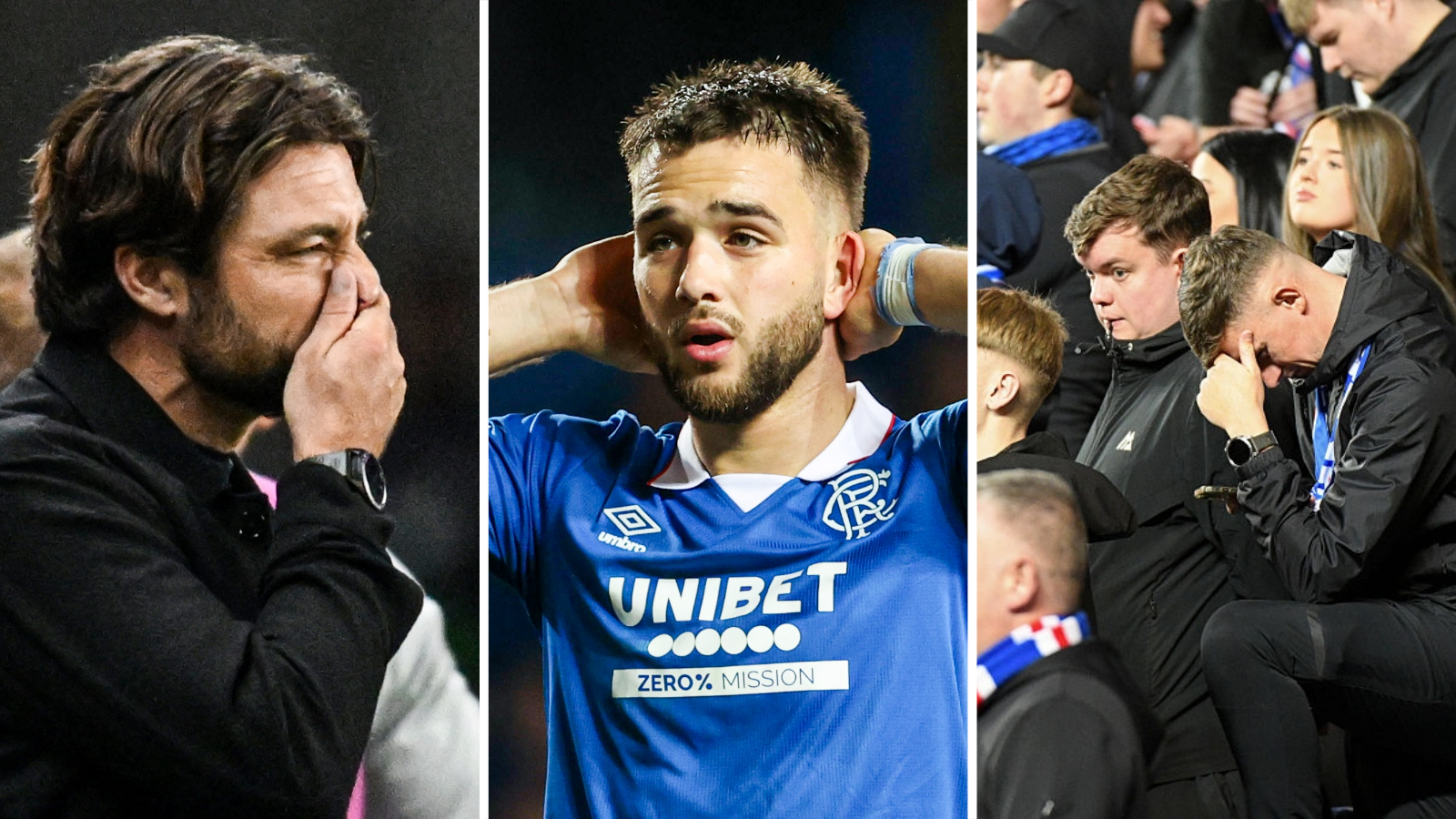
After the Europa League defeat by Genk, which was a fourth in their previous seven games under Russell Martin, several former Rangers players were left in their mouths on Thursday.
What they said didn’t make anyone feel good. Not a lot of anger either. only regret, frustration, and sadness.
Even Ally McCoist, who is frequently ebullient, maintained a calm disposition.
Following the 1-0 defeat, the legendary former club’s manager and striker declared on TNT Sports, “The manager is in big trouble.”
“Something must change, and that means it must change dramatically.” This won’t last long. There is no purpose if the crowd doesn’t cheer you up at the stadium.
Martin’s unconvincing message is becoming less and less effective.
For the first time in his interview after the defeat, Martin may have doubted his repeated insistent that things will get better.
His “we’re not far away,” mantra was present, but it wasn’t delivered with the customary bullish tone. Instead, the Rangers’ head coach was sly, snippy, and depressing.
There was a hint that he knew things were going to get worse despite his ability to pick out positive individual performances that perplexed pundits and punters.
Rangers had their own problems this evening. a careless red card explore your imagination. a lack of enthusiasm Poor defense
The scoreline might have been more similar to what they did last face a Belgian side had it not been for Jack Butland.
Rangers had urged Martin to “attack” this competition. However, his team only had two shots on target and only had 13 touches inside the visitors’ penalty area.
He asserted that they were “a lot in Genk’s box, had good control, and were aggressive,” which surprised former Rangers midfielder Andy Halliday.
The Motherwell midfielder said on Sportsound, “I’m surprised he said Rangers were aggressive.” I did not witness them creating chances or causing aggression.
Steven Thompson, who was at Ibrox with Halliday, acknowledged that Martin’s unconvincing message had a certain air of “acceptance.”
The former Ibrox striker claimed that his press conference lacked energy. He was able to sense that it was affecting him.
JavaScript must be enabled in your browser to play this video.
“It seems as though Rangers players don’t believe it.”
Some of Martin’s players either help him or not.
Mohamed Diomande’s “sheer stupidity” against Genk, as he was called by former Rangers midfielder Derek Ferguson, hampered his team’s attempts to regain any momentum following their weekend victory against Hibs.
An already struggling Rangers were sucked out by the midfielder’s needless first-half red card, which was a third in Martin’s first 14 games.
Before that moment of madness made life even more difficult, they were huffing and puffing in reality.
Given Genk’s quick start and the incisive runs of Zakaria El Ouahdi, in particular, Martin claimed his side had the upper hand early on, but many would argue otherwise given that many would disagree.
Rangers’ apparent lack of self-assurance was what caused former Ibrox players to be particularly troubling amid the punditocracy.
No quick start was required. When their team-mate left, no one could hear their sneer. There was no decisive decision. It was all… meh.
Ferguson remarked during the game on Sportsound, “It’s a struggle.” “I am aware that there are only 10 men, but you can always find a way with 10.”
It appears as though Rangers players don’t think there’s a way to get back into this game.
Hendrik Van Crombrugge, a goalkeeper for Genk, had a few close calls in the final five minutes, but nothing particularly troubling happened.
What do we do when players are looking at each other? ‘, “added Thompson”. They appear to have run out of ideas. Everything is so laborious and predictable.
Someone at Rangers must “take the bull by the horns,” the saying goes.
Listen on Sounds
What are the fans saying when they say, “Pack your bags”?
Any domestic issues Rangers have encountered during the last few seasons have been comforted and eased by Europa League nights.
However, Thursday never appeared to be one of those explosive evenings.
Apathy and angst were present instead of enthusiasm and energy. As the players exited the tunnel, large areas of empty seats greeted them instead of a bellowing sea of blue.
Martin acknowledges that only positive outcomes will cause change. The brains of those who had to make their decisions were not persuaded to reconsider.
Few people praised the head coach when BBC Scotland asked viewers for their opinions.
Sam, I’m watching Martin’s interview. He never apologized to the fans who paid well; instead, he yelled and wiggled his way out of the situation. We don’t want to hear any of his excuses anymore because they are getting old. Pack your bags and do the right thing.
Robert: Martin has had numerous chances, but the football is terrible, and if nothing is changed, the supporters will leave.
Seb: Nothing at all. Lack of conviction, no clear strategy, possession for possession, open to almost every counterattack, and front-line cutting edge. The best way to sum up the management and team is anaemic. lacking in any positive aspects.
Mark: I won’t watch or watch Rangers until the new owners realize they hired them because they made a mistake hiring Martin. Formerly regarded as a club, but not anymore. We are so shocking that I wouldn’t be surprised if we were relegated.
Sally: There are players. They aren’t being managed. When possession is played to forwards, it is only of value. Tavernier needs to realize that other players can kick corners and free kicks. He consistently exposed the defense.
Amy Canavan, BBC Sport Scotland and Richard Winton, BBC Sport Scotland
Unacceptable. Predictable . Ignored . whimpering out. No convictions. Out of ideas, raging.
After the Europa League defeat by Genk, which was a fourth in their previous seven games under Russell Martin, several former Rangers players were left in their mouths on Thursday.
What they said didn’t make anyone feel good. Not a lot of anger either. only regret, frustration, and sadness.
Even Ally McCoist, who is frequently ebullient, maintained a calm disposition.
Following the 1-0 defeat, the legendary former club’s manager and striker declared on TNT Sports, “The manager is in big trouble.”
“Something must change, and that means it must change dramatically.” This won’t last long. There is no purpose if the crowd doesn’t cheer you up at the stadium.
Martin’s unconvincing message is becoming less and less effective.
For the first time in his interview after the defeat, Martin may have doubted his repeated insistent that things will get better.
His “we’re not far away,” mantra was present, but it wasn’t delivered with the customary bullish tone. Instead, the Rangers’ head coach was sly, snippy, and depressing.
There was a hint that he knew things were going to get worse despite his ability to pick out positive individual performances that perplexed pundits and punters.
Rangers had their own problems this evening. a careless red card explore your imagination. a lack of enthusiasm Poor defense
The scoreline might have been more similar to what they did last face a Belgian side had it not been for Jack Butland.
Rangers had urged Martin to “attack” this competition. However, his team only had two shots on target and only had 13 touches inside the visitors’ penalty area.
He asserted that they were “a lot in Genk’s box, had good control, and were aggressive,” which surprised former Rangers midfielder Andy Halliday.
The Motherwell midfielder said on Sportsound, “I’m surprised he said Rangers were aggressive.” I did not witness them creating chances or causing aggression.
Steven Thompson, who was at Ibrox with Halliday, acknowledged that Martin’s unconvincing message had a certain air of “acceptance.”
The former Ibrox striker claimed that his press conference lacked energy. He was able to sense that it was affecting him.
JavaScript must be enabled in your browser to play this video.
“It seems as though Rangers players don’t believe it.”
Some of Martin’s players either help him or not.
Mohamed Diomande’s “sheer stupidity” against Genk, as he was called by former Rangers midfielder Derek Ferguson, hampered his team’s attempts to regain any momentum following their weekend victory against Hibs.
An already struggling Rangers were sucked out by the midfielder’s needless first-half red card, which was a third in Martin’s first 14 games.
Before that moment of madness made life even more difficult, they were huffing and puffing in reality.
Given Genk’s quick start and the incisive runs of Zakaria El Ouahdi, in particular, Martin claimed his side had the upper hand early on, but many would argue otherwise given that many would disagree.
Rangers’ apparent lack of self-assurance was what caused former Ibrox players to be particularly troubling amid the punditocracy.
No quick start was required. When their team-mate left, no one could hear their sneer. There was no decisive decision. It was all… meh.
Ferguson remarked during the game on Sportsound, “It’s a struggle.” “I am aware that there are only 10 men, but you can always find a way with 10.”
It appears as though Rangers players don’t think there’s a way to get back into this game.
Hendrik Van Crombrugge, a goalkeeper for Genk, had a few close calls in the final five minutes, but nothing particularly troubling happened.
What do we do when players are looking at each other? ‘, “added Thompson”. They appear to have run out of ideas. Everything is so laborious and predictable.
Someone at Rangers must “take the bull by the horns,” the saying goes.
Listen on Sounds
What are the fans saying when they say, “Pack your bags”?
Any domestic issues Rangers have encountered during the last few seasons have been comforted and eased by Europa League nights.
However, Thursday never appeared to be one of those explosive evenings.
Apathy and angst were present instead of enthusiasm and energy. As the players exited the tunnel, large areas of empty seats greeted them instead of a bellowing sea of blue.
Martin acknowledges that only positive outcomes will cause change. The brains of those who had to make their decisions were not persuaded to reconsider.
Few people praised the head coach when BBC Scotland asked viewers for their opinions.
Sam, I’m watching Martin’s interview. He never apologized to the fans who paid well; instead, he yelled and wiggled his way out of the situation. We don’t want to hear any of his excuses anymore because they are getting old. Pack your bags and do the right thing.
Robert: Martin has had numerous chances, but the football is terrible, and if nothing is changed, the supporters will leave.
Seb: Nothing at all. Lack of conviction, no clear strategy, possession for possession, open to almost every counterattack, and front-line cutting edge. The best way to sum up the management and team is anaemic. lacking in any positive aspects.
Mark: I won’t watch or watch Rangers until the new owners realize they hired them because they made a mistake hiring Martin. Formerly regarded as a club, but not anymore. We are so shocking that I wouldn’t be surprised if we were relegated.
Sally: There are players. They aren’t being managed. When possession is played to forwards, it is only of value. Tavernier needs to realize that other players can kick corners and free kicks. He consistently exposed the defense.