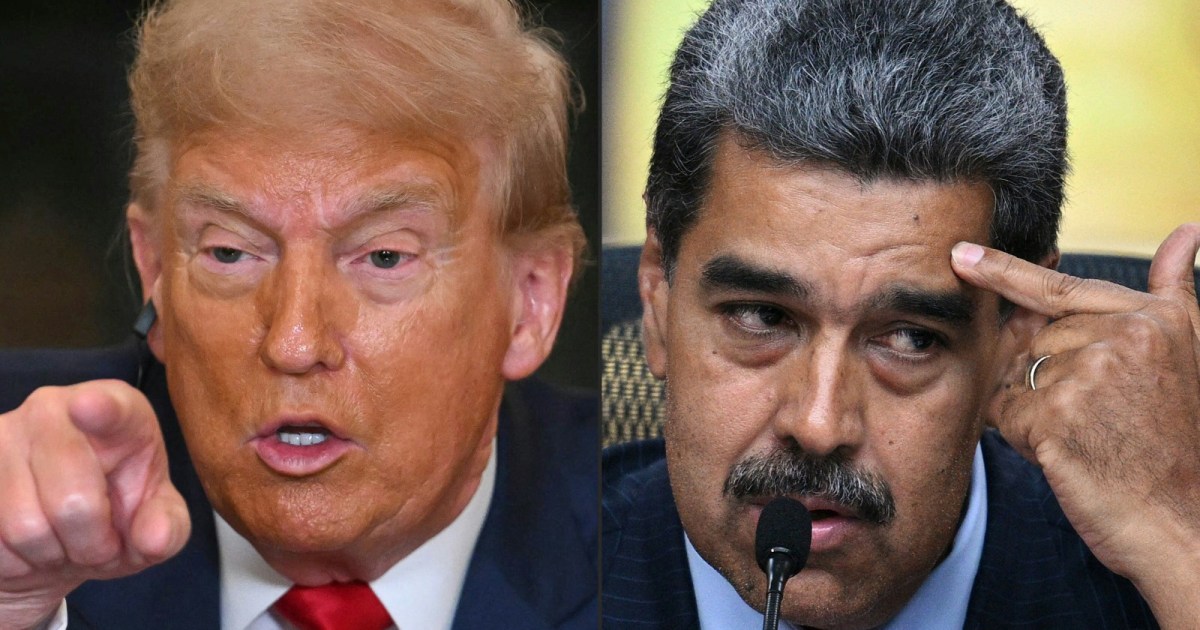
United States President Donald Trump confirmed on Wednesday that he has authorised the CIA to carry out secret operations in Venezuela.
The New York Times first disclosed the directive, quoting US officials who privately said the administration’s strategy is focused on removing President Nicolas Maduro from power.
Recommended Stories
list of 4 itemsend of list
Trump also said his administration was mulling a land attack on Venezuela, amid sharply escalating tensions after multiple US strikes on Venezuelan boats in the Caribbean Sea in recent weeks and a troop build-up in those waters ordered by the US president.
Maduro appeared on national television Wednesday night, urging restraint and caution against any further escalation.
“No to regime change that reminds us of the failed wars in Afghanistan, Iraq, Libya … No to coups d’état carried out by the CIA … Latin America does not want them, does not need them, and rejects them,” said the Venezuelan president in response to Trump’s announcement.
So what might Trump be planning? Are his moves legal? How has Venezuela responded, and what does history tell us about what covert CIA operations in Latin America might look like?
What did Trump announce?
“Why did you authorise the CIA to go into Venezuela?” a journalist asked the US president at a White House news conference.
“I authorised for two reasons, really,” Trump said.
“Number one, they [Venezuela] have emptied their prisons into the United States of America.
“And the other thing are drugs. We have a lot of drugs coming in from Venezuela, and a lot of the Venezuelan drugs come in through the sea, so you get to see that, but we’re going to stop them by land also,” he added.
When asked if the CIA “had the authority to take out Maduro”, Trump demurred – refusing to rule out regime change, though not committing to it, either.
“Oh, I don’t want to answer a question like that … That’s a ridiculous question for me to be given … not really a ridiculous question, but it would be a ridiculous question for me to answer. But I think Venezuela is feeling heat,” Trump added.
What operations has the US already carried out?
The US has carried out at least five strikes on boats in Venezuelan waters, alleging that the boats were carrying drugs, and killing a total of 27 people.
The latest attack took place on Tuesday, Trump said.
“Under my standing authorities as commander-in-chief, this morning, the Secretary of War, ordered a lethal kinetic strike on a vessel affiliated with a Designated Terrorist Organization (DTO) conducting narcotrafficking in the USSOUTHCOM area of responsibility – just off the Coast of Venezuela,” Trump wrote in a post on his Truth Social platform. He added that six “male narcoterrorists aboard the vessel” were killed.
The first US strike on a Venezuelan boat was on September 2, killing 11 people. Two more attacks were carried out on September 15 and 19, each killing three people. A fourth strike occurred on October 3, with US Defense Secretary Pete Hegseth reporting four people killed.
Trump and his administration have so far not provided any evidence that these bombed boats were carrying narcotics headed for the US.
Can the president launch secret or military actions without Congress?
Experts have previously told Al Jazeera that US strikes on Venezuelan boats possibly broke international law and went against the US Constitution.
Declared operations on Venezuelan land, whether by the CIA or the US military, would go even beyond maritime strikes in testing the legal authority of the president.
Salvador Santino Regilme, an associate professor at Leiden University in the Netherlands, explained to Al Jazeera last month that the use of deadly force during maritime operations must respect the right to life and adhere to the principles of law enforcement necessity and proportionality.
“UNCLOS [United Nations Convention on the Law of the Sea] and the 1988 UN Drug Trafficking Convention emphasise cooperation, boarding and consent mechanisms at sea, not summary destruction. Any strike that kills suspected traffickers should trigger a prompt, independent, and transparent investigation,” Regilme said.
Constitutional lawyer Bruce Fein was even more definitive in his criticism of the US maritime operations.
“Any use of the military [except] in self-defence to an actual attack requires express congressional statutory authorisation. The military attack on the alleged Venezuelan drug traffickers was unconstitutional,” Fein told Al Jazeera last month.
The War Powers Resolution of 1973 is a federal law that requires the US president to obtain Congressional approval before committing to war. It also mandates that the president notify Congress within 48 hours of initiating any military action.
Fein told Al Jazeera that there would need to be a public vote in Congress for the approval of such a strike, and such a vote has not taken place.
At the beginning of his term, Trump designated Venezuelan drug cartels as foreign terrorist organisations. In a statement to Al Jazeera in August, Fein said this designation is “illegal because [it is] contrary to the statutory standards to qualify as a Foreign Terrorist Organization “.
The standards, according to the US Constitution, are that a group must be based outside the US, involved in terrorist acts or activities, and its terrorism must pose a threat to the safety of US citizens or to US national security.
Trump has also repeatedly alleged that Maduro’s administration is behind the Venezuelan drug cartels that the US administration has branded “terrorist” organisations, even though US intelligence agencies have themselves said there is no evidence to back this assertion.
How has Venezuela reacted?
Venezuela accused the US of violating international law and the United Nations charter.
“The purpose of US actions is to create legitimacy for an operation to change the regime in Venezuela, with the ultimate goal of taking control of all the country’s resources,” the government said in a statement.
Maduro also rebuked the CIA’s involvement in different parts of the world, without explicitly referencing Trump’s authorisation of the CIA to carry out operations in Venezuela.
Carlos Pina, a Venezuelan political scientist, said Trump’s announcement could unify Maduro’s political base domestically.
“Today, the Venezuelan president once again denounced US interference in Venezuela’s internal affairs and, in particular, reinforced the anti-colonialist discourse that a large number of leftist governments and parties in the region have used in the past to oppose Washington’s influence in their own countries,” Pina said.
“That said, in practical, real-world terms, Trump’s announcement will likely lead the Venezuelan government to increase its mechanisms of internal surveillance and repression – which, if left unchecked, could result in possible human rights violations.”
What is the CIA’s history in Latin America?
It is dirty, and while, at the moment, it is unclear what the US’s external espionage organisation plans for Venezuela, history offers clues to the nature of its operations in Central and South America and the Caribbean.
From the late 1800s through the early decades of the 20th century, the US carried out a series of military interventions in Central America — the so-called Banana Wars — to protect the interests of US corporates with interests in the region.
In 1934, under President Franklin D Roosevelt, the US adopted what was known as the “Good Neighbor Policy”, which in effect meant a commitment to not invade or occupy Latin American nations and to not interfere in their domestic affairs.
But the US did not remain a “good neighbour” for long.
Through the Cold War, in particular, the US funded several operations to unseat elected left-wing leaders in Latin American countries.
Here are some instances:
1950s in Guatemala
In 1954, elected Guatemalan President Jacobo Arbenz was toppled by local fighter groups backed by the CIA under the presidency of Dwight Eisenhower.
Arbenz had sought to nationalise a company, stoking fears within the US of more socialist policies in the country.
Under the CIA’s Operation PBSuccess, the agency trained fighters led by military officer Carlos Castillo Armas, who took power after the coup. A civil war raged in Guatemala from 1960 to 1996 between the Guatemalan government and military on the one hand, and leftist rebel groups on the other.
1960s in Cuba
In 1959, Cuban communist leader Fidel Castro came to power after overthrowing dictator Fulgencio Batista.
Under Eisenhower, the CIA devised a plan to train Cuban exiles to invade the country and overthrow Castro. Democratic President John F Kennedy, who won the 1960 election, was briefed about the plan during his inauguration.
Castro found out about the training camps through Cuban intelligence. In 1961, Kennedy signed off on the Bay of Pigs Invasion, a plan for the Cuban exiles to overthrow Castro. However, the invasion failed when the Cuban military overwhelmed them.
1960s in Brazil
In 1961, Joao Goulart came into office as president, with a mandate to pursue social and economic reforms. He maintained good relations with socialist countries such as Cuba and nationalised a subsidiary of the US-owned International Telephone and Telegraph (ITT).
In response, the CIA funded pro-US politicians and supported anti-communist groups. This undermined Goulart’s leadership, culminating in a military coup in 1964, which established a US-friendly dictatorship.
1960s in Ecuador
Ecuador had long been a basket case of political instability, with 27 presidents between 1925 and 1947. That, however, changed in the 1950s when the country witnessed a rare period of stability.
It was not to last. By the early 1960s, the US was worried about the pro-Cuba policies of President Jose Velasco Ibarra and his Vice President Carlos Julio Arosemena, who in fact advocated even closer relations with Soviet bloc nations.
The CIA, using US labour organisations as its conduits, financed the spread of anti-communist sentiment in the country.
“In the end, they [the CIA] owned almost everybody who was anybody [in Ecuador],” a CIA agent told analyst Roger Morris later, in a 2004 CIA-approved appraisal of the agency’s activities in Latin America.
Arosemena first staged a coup against Ibarra, and initially turned further to the left, before trying to moderate his positions. Then, in 1963, the military staged a coup against him, banning the communist party and severing ties with Cuba, aligning with US interests.
1960s and 70s in Bolivia
Between 1963 and 1964, the US used covert funding, largely through the CIA, to influence Bolivia’s politics.
The funding backed leaders that were friendly to the US, and supported a military coup in November 1964 led by General Rene Barrientos Ortuno against elected President Victor Paz Estenssoro. The coup was successful and forced Paz Estenssoro into exile.
But the US was not done with interfering in Bolivia.
By the early 1970s, Washington had eyes set on another regime change. This time, the target was President Juan Jose Torres, who had come to power in 1970 and had nationalised multiple US companies in the country.
According to the US State Department’s official history, the US ambassador in La Paz, in June 1971, told Washington that it needed to support Torres’s opponents. The White House secretly sought, and received $410,000 in what critics within the administration described as “coup money” to finance military leaders and political leaders opposed to Torres.
Two months later, senior military officer Hugo Banzer led a successful coup against Torres. The US continued to fund Banzer’s government, which ruled until 1978. Nearly two decades later, Banzer would return to power once again, after actually winning an election in 1997.
1970s in Chile
The CIA provided funding to help end the presidency of Salvador Allende, an elected leftist leader. Allende had planned to nationalise Chilean copper companies, many of which were owned by US interests.
The CIA funding was used to back Allende’s opponent and spread anti-communist sentiment. This spiralled into the 1973 military coup led by General Augusto Pinochet. Allende shot himself dead using an AK-47 rifle before he was captured: Doubts about the cause of his death lingered for decades before it was confirmed by an independent autopsy years later.
The brutal US-backed dictatorship of Augusto Pinochet lasted 17 years.
1970s: Operation Condor
In 1975, the CIA supported right-wing military dictatorships in six Latin American countries in setting up a transnational network of terror called Operation Condor. This began during the presidency of Gerald Ford.
These countries included Argentina, Bolivia, Brazil, Chile, Uruguay and Paraguay. The operation was aimed at crushing political dissidents, leftists and communist sympathisers. The dictatorships used a shared database to monitor dissidents and their families across state borders.
They used tactics such as exchanging intelligence, information, prisoners and torture techniques. Under the operation, at least 97 people were assassinated, according to Plan Condor, a joint initiative by Latin American organisations and the University of Oxford.
1980s in El Salvador
In December 1981, the Salvadoran military’s elite Atlacatl Battalion conducted a deadly massacre in the village of El Mozote, killing about 1,000 civilians, including women and children. This was during El Salvador’s civil war of 1980-92.
The battalion was trained and equipped by the US under its larger Cold War policy of suppressing leftist rebellions in Latin America. The US government greatly increased military aid to El Salvador between 1980 and 1982.
1980s in Grenada
It was a familiar story by now. Maurice Bishop, the prime minister of the tiny Caribbean island, had adopted Marxist-Leninist policies after seizing power himself in 1979 when the previous premier, Eric Gairy, was out of the country.
By the early 1980s, the US was worried about Cuban influence in the country. As bloody infighting broke out within Bishop’s party over a leadership struggle in October 1983, the US swooped in, invading the country, capturing Cubans in Grenada and ensuring that the country’s future was aligned with US priorities.
1980s in Panama
The US invaded Panama in 1989 during the presidency of Republican George HW Bush. The invasion was called Operation Just Cause.
The US underplayed the death toll and justified the invasion, saying it was carried out to remove President Manuel Noriega for alleged drug trafficking.
What are the possible risks or consequences for Venezuela and the region?
Pina, the Venezuelan analyst, told Al Jazeera that most other Latin American countries have so far been cautious in their response to Trump’s order and threat.
Pina said there are a few exceptions to this, such as Gustavo Petro’s Colombia, and those in the regional ALBA (Bolivarian Alliance for the Peoples of Our America) bloc: Cuba, Nicaragua, Bolivia, Honduras and some Caribbean islands.
He said that while an escalation like this would normally cause serious friction between Latin American governments and the US, many Latin American countries have erred on the side of caution after Maduro returned to power through a controversial presidential election in July 2024.
“The current situation is due to the fact that Maduro ‘burned’ many diplomatic bridges after the presidential elections of July 28, 2024.”
The election in Venezuela resulted in widespread allegations of fraud from within and outside the country. The US, which has not had a diplomatic relationship with Venezuela since 2019, and its allies did not accept the election result. In July 2024, the Carter Center and a UN panel said they could not confirm the credibility of Venezuela’s election results, stating the vote lacked international standards for fairness and democracy. Nine Latin American countries also called for the results to be reviewed by independent observers.
Pina said that for the region, the most likely response is that some countries might try to act as mediators and encourage talks between Venezuela and the US to find a peaceful solution. However, at the moment, that seems unlikely, with both sides seeming “far” from reaching an agreement.
He added that, for now, he expects the US to continue to put pressure on Maduro to step down peacefully, while increasing its military and naval presence – but that Maduro is likely to resist these demands.
A full-fledged war will also have consequences for all of Latin America. Already, because of US sanctions on Venezuela and the economic crisis that has gripped the oil-rich nation for years, more than 8 million people have migrated from the country since 2014, mostly to other nations in the region.