News

Inside McLaren’s season – the rules, values, incidents & relationships


McLaren’s greatest achievement this year is arguably not what they have accomplished on track. It’s something they have managed off it.

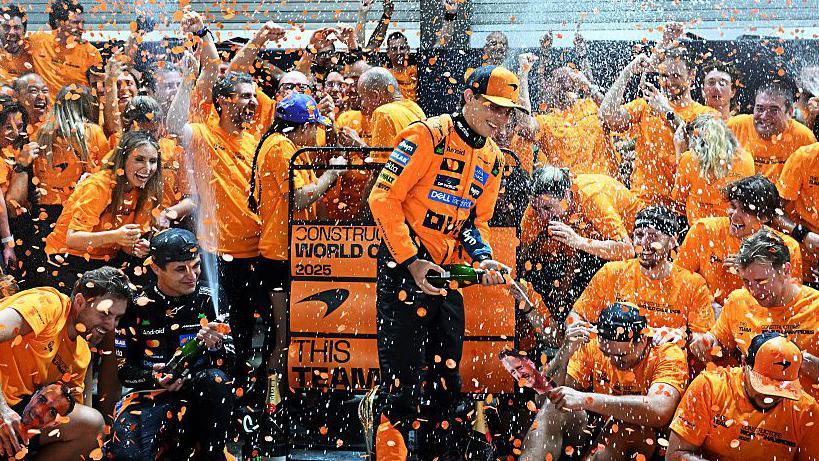
The team won the constructors’ championship with six races remaining, with Lando Norris eventually pipping Red Bull’s Max Verstappen and his McLaren team-mate Oscar Piastri to the drivers’ title in a three-way showdown at the season finale in Abu Dhabi.

Norris and Piastri got there while remaining friendly.

McLaren’s ability to keep two evenly matched drivers, of a similar age and career development, competing for their first title in the same team without falling out with each other is almost unprecedented in modern F1.

This sort of situation turns toxic far more often than not.

Not just, most infamously, Ayrton Senna and Alain Prost at McLaren in 1989. But also Nigel Mansell and Nelson Piquet at Williams in 1986-7, Lewis Hamilton and Fernando Alonso at McLaren in 2007, Sebastian Vettel and Mark Webber at Red Bull in 2010, and Hamilton and Nico Rosberg at Mercedes in 2014-16.

It’s hard enough to stop things getting noxious even when two title rivals are in different teams, such as in the tense relationship between Hamilton and Max Verstappen in 2021.

But add in the claustrophobia of the rivals being in the same engineering meetings and team briefings, balancing race strategies, and the intensity only increases.

Heading into this season, McLaren Racing chief executive officer Zak Brown and team principal Andrea Stella were well aware of the jeopardy, and consciously created a culture aimed at preventing the relationship between Norris and Piastri descending into disruptive conflict.

They have a carefully thought out internal philosophy, applied with intelligence and empathy to two drivers who have been convinced that keeping things harmonious is the best solution for all.

McLaren operate on a principle of fairness, trust and transparency, rooted in a basic principle that the drivers are allowed to race each other with equal treatment, with the proviso that they don’t crash into each other.

“We are McLaren Racing,” Stella says. “We are here to race.

“We want to give our two drivers the possibility to express their talent, achieve their aspirations, but this needs to be done within the principles and the approach that we have contributed to build together with our drivers. Fairness, sportsmanship, and respect for one another.”

The underlying philosophy

The starting point was that the only place the team cannot be fully united is in the quest for the drivers’ championship. So don’t ignore that. Put it first, and work from there.

“The way we operate now is the result of having learned so many lessons,” Stella says. “We talk to the driver – straight talking.

“And if we get something wrong now, it needs to be, ‘We didn’t think about it.’ But it can’t be because we haven’t talked openly and straight and honestly enough. Because that’s the recipe to have a problem.”

Why this approach? Because if issues are not discussed when they arise, they are likely to pop up the next time there is a moment of stress, when they are more likely to be expressed in a negative way, and so become harder to control.

Stella’s achievement has been to get Norris and Piastri to buy into the idea that trusting the team to operate fairly is in their best interests, as well as those of the team, and consequently that the drivers should behave accordingly.

He has probably been aided in this by the fact that both have spent their entire careers at McLaren, are growing up with the team and, thanks to their relationships with the management, trust what the team are trying to create and achieve.

The drivers have reflected the culture Stella has constructed in repeatedly making two key points this year.

First, that open, fair competition between two evenly matched team-mates drives McLaren forward by consistently raising the bar of performance, and gives them a collective advantage over rivals who don’t have that; and second, that they both wanted this to be their first title campaign with McLaren, not their only one.

Norris, who eventually prevailed thanks to his third-place finish in Abu Dhabi, says having “two drivers who respect the team and are not selfish” is fundamental in this.

“We work very well as team-mates,” he says. “We’ve helped the team in a very good way. There’s been plenty of examples [in the past] of things not going as smoothly as they have done. And the team’s then gone in a downward spiral. That’s what we want to avoid as a team – that’s our priority.”

He adds: “I’ve always got on well with my team-mates since karting. I’ve always wanted to because it just makes my life more fun, more enjoyable, and that’s also why I’m here – because I love what I do. So, the more I can do that, the better.

“But we still very much understand that we work for McLaren, we want the best for the team, we work very hard.

“As drivers always do, you try and maximise your own performance more than anything. But when we step out of the car, we can still have a joke, we still have laughs in our debriefs, and we still enjoy everything away from the track.”

Off track, there is no tension between Norris and Piastri. They are friendly but not best friends.

What does that mean? Well, for example, if they are at an event, they will chat and eat with each other, quite happy in each other’s company. But they probably won’t be messaging when they’ve left.

Both have been firm in their conviction that they would rather race this way and risk being beaten to the title by a rival – as so nearly happened with Verstappen this season – than have one prioritised by the team to the detriment of the other.

Piastri says: “On both sides of the garage, we want to win because we’ve been the best driver, the best team, including against the other car in the team.

“You always want to earn things on merit and you want to be able to beat everyone, including your team-mate.

How it works in practice

The McLarens of Oscar Piastri and Lando Norris collide at the start of the US Grand Prix sprint, putting both drivers out of the raceGetty Images

A small group of senior figures at McLaren discuss with the drivers how they are going to approach their racing. They review what happened after each grand prix, and apply the lessons for the following race.

This happens in formal meetings, more informal conversations and ad hoc.

And they keep building on that process, over and over again.

This is all well and good in theory, but it’s only sustainable in practice if everyone sticks to the principles when problems arise, as they inevitably do through an F1 season.

In 2025, there have been a number of races where equality and harmony have been tested – particularly Hungary, Italy, Singapore and Austin.

In Hungary, Norris was allowed to switch to a one-stop strategy after a bad start left him fifth, and ended up beating Piastri, whose two-stop from an early second place saw him spend the final laps trying and failing to pass Norris for the win.

In Italy, a decision to invert the natural pit-stop choreography after they had spent the race running in the order Norris-Piastri behind Verstappen was followed by a slow pit stop for Norris, and Piastri being asked to hand back the second place he had inherited.

In Singapore, Norris scrambled past Piastri into third place at the first series of corners, banging wheels in the process, leading to the Australian saying over the radio: “Are we cool with Lando just barging me out of the way?”

In Austin, an attempted cut-back move by Piastri on Norris at the first corner of the sprint race ended up in a collision that took both of them out.

Externally, these situations have either led to accusations that Norris was being favoured, or that McLaren were meddling too much, or both.

Internally, they were dealt with quietly, behind closed doors, and with the apparent result that everyone came away satisfied it had been resolved in the best possible way.

McLaren insiders have told BBC Sport that the driver meetings really are conducted in the way they are externally presented – issues are discussed openly, constructively and calmly, and a resolution is arrived at from which everyone can move on with equanimity, even if they had issues with what happened at the time.

If there has been any deviation from that in the drivers’ minds privately, they have certainly not given any hint of it in public.

Piastri has rejected any suggestions that the team was not being fair, saying he’s “very happy that there’s no favouritism or bias”.

And Norris says: “We still always have the right to question it. We’re never going to just go around – because I think it’s just a racing driver’s mind – and be happy to accept whatever the team wants to do or what they think is correct.

“I understand that a lot of people have different opinions and think maybe other things are correct. But I still stand by the fact that Andrea and Oscar and all of us together are confident that our approach is better than what other people’s are.”

Brown says that any idea the team were siding with Norris is “nonsense”.

He explains that when they let Norris switch to a one-stop in Hungary, “Andrea and I were like, ‘This ain’t gonna work.’ But it was a free punt, and Lando drove brilliantly.”

Monza, he says, was “just like what happened in Hungary the year before”, when Norris let Piastri by for the win after a similar pit-lane arrangement.

“If the lead car is prepared to sacrifice their rights to the first call to help his team-mate, who’s actually his number one competitor in the championship, that’s great teamwork,” Brown says.

“So I understand what it looks like from the outside, but it’s not what’s going on on the inside, and we’re trying so hard to give them equal opportunity and let them race hard. I wish everyone recognised more of that.

Can this be sustained into 2026? That’s impossible to know.

Norris and Piastri seem level-headed and humble. They are also both intensely ambitious.

Becoming world champion can change drivers. The more successful they become, the more demanding they get, especially in their requirements off-track.

McLaren have managed Norris and Piastri with sensitivity and effectiveness, but the challenges do not lessen just because that has been the case so far.

If anyone has an understanding of how hard it is to pull this off, it is Fernando Alonso.

The two-time champion has lived this dynamic in a title fight, and he’s worked with both Stella and Brown – Stella at Ferrari then McLaren from 2010-18, and Brown when the American came on board at McLaren in 2016.

“The credit has to go for Andrea and Zak that they created a winning structure and car, but they were also able to manage the drivers for the benefit of the team,” Alonso says.

“It is less exciting to watch and for media because there is no controversy in some of the wins, not yet.

Related topics

  • Formula 1
  • Insight: In-depth stories from the world of sport

More on this story

    • 8 December 2025
    A smiling Lando Norris is interviewed with the background of a night sky in Abu Dhabi the day after winning the Formula 1 drivers' championship
    • 7 December 2025
    Lando Norris celebrating with McLaren after winning his first world championship
    • 8 December 2025
    Lando Norris makes the thumbs-up gesture on the podium after the Abu Dhabi Grand Prix
    • 7 December 2025
    Norris celebrates by holding both index fingers in the air at Knockhill in 2014
    • 7 December 2025
    Lando Norris holds the British Grand Prix winner's trophy at Silverstone

England’s AI World Cup masterplan – from perfecting penalties to powering players


Artificial intelligence is making a big mark in elite football, and England are at the cutting edge when it comes to using it in the men’s international game.

From penalty taking and powering players’ wellbeing to targeting their rivals’ tactical weaknesses, AI is underpinning the Three Lions’ plans for next summer’s World Cup.

Could AI power England to World Cup glory?

Watch on iPlayer

Penalties revolutionised by AI

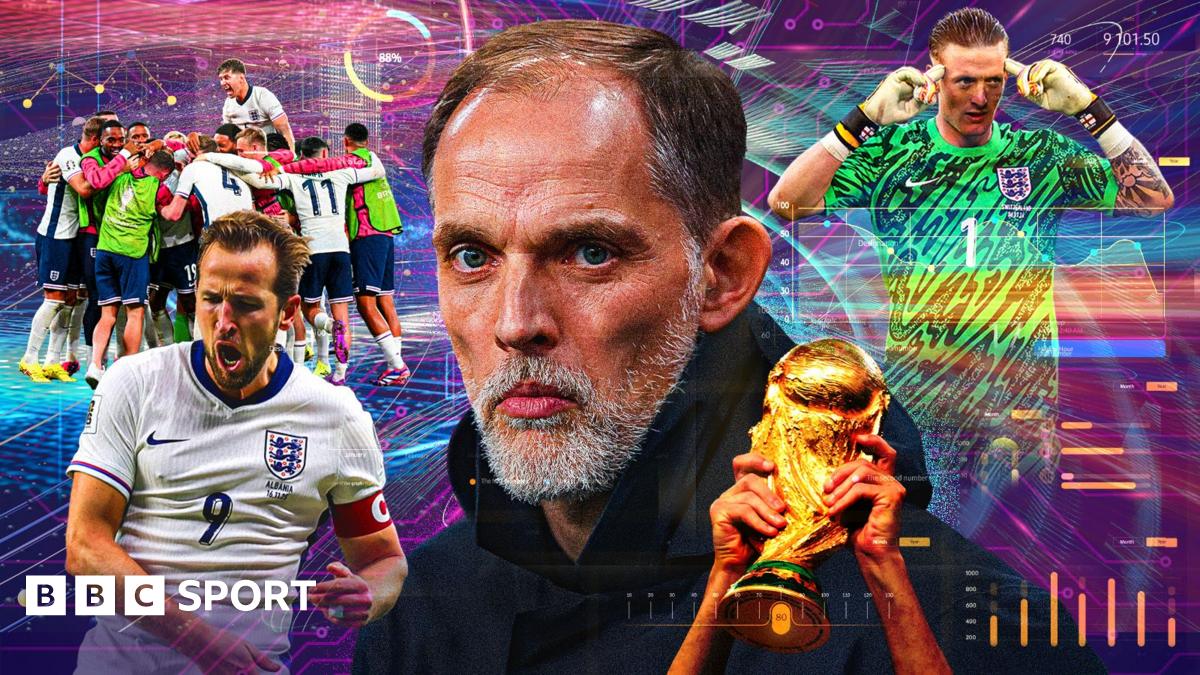
As well as the coaches and physios who sit alongside head coach Thomas Tuchel on the bench, England’s staff includes groups of analysts, data scientists and in-house software development teams.

They use different AI tools – some purchased from external tech firms, some built inside the FA – to analyse data, find interesting information, and create presentations which are used in meetings to make complex information understandable for coaches and players.

The idea is that England’s players are then able to make better decisions on the pitch, including their approach to penalties.

“AI can show certain tendencies for where opposition players put their penalties that we probably weren’t thinking of,” explains Rhys Long, who since 2016 has been the FA’s head of performance insights and analysis.

“When we get to a World Cup, we have 47 teams’ worth of information to profile – where has every player in every squad put every penalty since they were 16?

“It used to take us five days to collect one team’s worth of penalty-taking information. Using AI, that can now be brought down to about five hours. Then that becomes a five-minute conversation with our goalkeeper, for five seconds of them hopefully saving a penalty.”

In theory, then, the penalty information stuck on goalkeeper Jordan Pickford’s water bottle is more accurate and detailed then ever before.

And the results so far are strong.

“The penalty stuff really opened my eyes,” explains Conor Coady, a member of the England squads at Euro 2020 and the 2022 World Cup.

“We had a big meeting before the Euros – there was a diagram up on the board of where you’re more likely to score, then they would give you individualised information on where they think is best for you to go.”

The visuals are based on both opposition goalkeeper tendencies, like if they dive more often to one side, and analysis of how each England player prefers to strike the ball.

“Them telling you where to go took the pressure off, because it was them saying – ‘it’s on us’,” Coady says. “It was something we needed.”

Crucial to the success of analysis like that is players’ willingness to engage with data and understand the information given to them.

“Players are getting far more attuned to interpreting their own data,” Long says.

“The amount of information we’re trying to make sense of has exploded. You’ve got to filter all of that information down to have a good conversation with a coach and then a player.

To play this video you need to enable JavaScript in your browser.

England leading tech charge

In the past few years, AI football software has advanced to the extent that it can now track tens of thousands of on-field movements and events every second, is able to tag tactical patterns during live play so that analysts can immediately find them on video for in-game adjustments and half-time feedback, and can create graphics instantly.

While Spain, France and Argentina have been more successful in the most recent international tournaments – and will be among the favourites next year – it is England, Germany and the USA who are widely believed to be at the forefront of using AI to try to gain an advantage.

“England have a big resource and have heavily invested in this,” says Allistair McRobert, professor of performance analysis at Liverpool John Moores University. “They have data engineers, data analysts and performance specialists behind the scenes across all their teams from juniors up to senior.

“We did a piece of work with one of the analysts who works at England about building tactical knowledge.

To play this video you need to enable JavaScript in your browser.

Player wellbeing decisions influenced by AI

AI is not just harnessed by England for on-field matters – they also use it to monitor players’ wellbeing.

“What AI is doing is surfacing things up – it can look at what is having an effect physically, tactically or technically on a player,” Long says. “It might spot something in wellness data that we collect from the players that is then having some kind of impact on their training.

“It’s then for a doctor, physio, coach, or specialist analyst to have a conversation with the player and make sure we’re getting the best out of them.

“To try and do all of that really quickly used to take days. It’s now taking hours. It might take minutes in the future.”

Coady explains the process: “You wake up every morning and as you’re going down to breakfast there is a wellness area where you fill out a form on an iPad.

“‘How did you sleep? How did you feel this morning? Are you fatigued?’ And then you leave comments on it – maybe ‘my hamstrings are sore from training yesterday’. And then the staff cater for you during the day, in terms of what you need in training, your food, how they set up a session.

To play this video you need to enable JavaScript in your browser.

Will AI replace human coaches or harm smaller nations?

New AI tech firms are being created every day, and one piece of software can cost national federations hundreds of thousands of pounds.

“It’s not about going after every shiny new AI toy and using them for the sake of it,” Long says. “What you’ve got to do is ask if it is really going to help performance.”

Because of the costs involved, there is a risk some of the less wealthy nations are left behind.

“I think AI will widen the gap,” says Tom Goodall, who works in analysis for Iceland. “England, for example, have basically unlimited resources, money, and staff. We are the polar opposite of that.

“I’m the only full-time analyst here and money is tight. It’s very difficult for us to take a gamble on an expensive piece of technology.”

There are also widespread concerns about AI’s impact on jobs in the future.

“What we’ve got to remember is it’s not a silver bullet,” Long says. “AI will make everything far more efficient, but it’s about having people in sport who can really understand how to use this new technology very well.

“We’re not going to replace humans – it’s about augmenting their decision making. AI won’t be picking the team and it won’t be playing the game.

Related topics

  • Insight: In-depth stories from the world of sport
  • Football
  • England Men’s Football Team
  • FIFA World Cup

England’s AI World Cup masterplan – from perfecting penalties to powering players


Artificial intelligence is making a big mark in elite football, and England are at the cutting edge when it comes to using it in the men’s international game.

From penalty taking and powering players’ wellbeing to targeting their rivals’ tactical weaknesses, AI is underpinning the Three Lions’ plans for next summer’s World Cup.

Could AI power England to World Cup glory?

Watch on iPlayer

Penalties revolutionised by AI

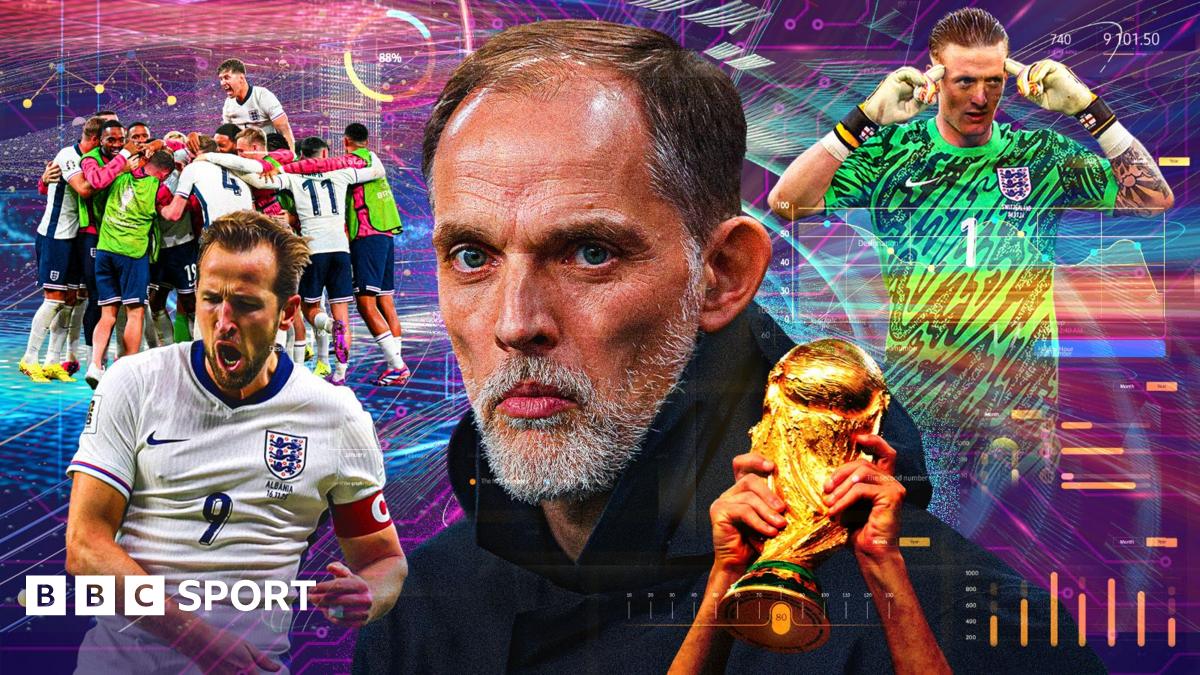
As well as the coaches and physios who sit alongside head coach Thomas Tuchel on the bench, England’s staff includes groups of analysts, data scientists and in-house software development teams.

They use different AI tools – some purchased from external tech firms, some built inside the FA – to analyse data, find interesting information, and create presentations which are used in meetings to make complex information understandable for coaches and players.

The idea is that England’s players are then able to make better decisions on the pitch, including their approach to penalties.

“AI can show certain tendencies for where opposition players put their penalties that we probably weren’t thinking of,” explains Rhys Long, who since 2016 has been the FA’s head of performance insights and analysis.

“When we get to a World Cup, we have 47 teams’ worth of information to profile – where has every player in every squad put every penalty since they were 16?

“It used to take us five days to collect one team’s worth of penalty-taking information. Using AI, that can now be brought down to about five hours. Then that becomes a five-minute conversation with our goalkeeper, for five seconds of them hopefully saving a penalty.”

In theory, then, the penalty information stuck on goalkeeper Jordan Pickford’s water bottle is more accurate and detailed then ever before.

And the results so far are strong.

“The penalty stuff really opened my eyes,” explains Conor Coady, a member of the England squads at Euro 2020 and the 2022 World Cup.

“We had a big meeting before the Euros – there was a diagram up on the board of where you’re more likely to score, then they would give you individualised information on where they think is best for you to go.”

The visuals are based on both opposition goalkeeper tendencies, like if they dive more often to one side, and analysis of how each England player prefers to strike the ball.

“Them telling you where to go took the pressure off, because it was them saying – ‘it’s on us’,” Coady says. “It was something we needed.”

Crucial to the success of analysis like that is players’ willingness to engage with data and understand the information given to them.

“Players are getting far more attuned to interpreting their own data,” Long says.

“The amount of information we’re trying to make sense of has exploded. You’ve got to filter all of that information down to have a good conversation with a coach and then a player.

To play this video you need to enable JavaScript in your browser.

England leading tech charge

In the past few years, AI football software has advanced to the extent that it can now track tens of thousands of on-field movements and events every second, is able to tag tactical patterns during live play so that analysts can immediately find them on video for in-game adjustments and half-time feedback, and can create graphics instantly.

While Spain, France and Argentina have been more successful in the most recent international tournaments – and will be among the favourites next year – it is England, Germany and the USA who are widely believed to be at the forefront of using AI to try to gain an advantage.

“England have a big resource and have heavily invested in this,” says Allistair McRobert, professor of performance analysis at Liverpool John Moores University. “They have data engineers, data analysts and performance specialists behind the scenes across all their teams from juniors up to senior.

“We did a piece of work with one of the analysts who works at England about building tactical knowledge.

To play this video you need to enable JavaScript in your browser.

Player wellbeing decisions influenced by AI

AI is not just harnessed by England for on-field matters – they also use it to monitor players’ wellbeing.

“What AI is doing is surfacing things up – it can look at what is having an effect physically, tactically or technically on a player,” Long says. “It might spot something in wellness data that we collect from the players that is then having some kind of impact on their training.

“It’s then for a doctor, physio, coach, or specialist analyst to have a conversation with the player and make sure we’re getting the best out of them.

“To try and do all of that really quickly used to take days. It’s now taking hours. It might take minutes in the future.”

Coady explains the process: “You wake up every morning and as you’re going down to breakfast there is a wellness area where you fill out a form on an iPad.

“‘How did you sleep? How did you feel this morning? Are you fatigued?’ And then you leave comments on it – maybe ‘my hamstrings are sore from training yesterday’. And then the staff cater for you during the day, in terms of what you need in training, your food, how they set up a session.

To play this video you need to enable JavaScript in your browser.

Will AI replace human coaches or harm smaller nations?

New AI tech firms are being created every day, and one piece of software can cost national federations hundreds of thousands of pounds.

“It’s not about going after every shiny new AI toy and using them for the sake of it,” Long says. “What you’ve got to do is ask if it is really going to help performance.”

Because of the costs involved, there is a risk some of the less wealthy nations are left behind.

“I think AI will widen the gap,” says Tom Goodall, who works in analysis for Iceland. “England, for example, have basically unlimited resources, money, and staff. We are the polar opposite of that.

“I’m the only full-time analyst here and money is tight. It’s very difficult for us to take a gamble on an expensive piece of technology.”

There are also widespread concerns about AI’s impact on jobs in the future.

“What we’ve got to remember is it’s not a silver bullet,” Long says. “AI will make everything far more efficient, but it’s about having people in sport who can really understand how to use this new technology very well.

“We’re not going to replace humans – it’s about augmenting their decision making. AI won’t be picking the team and it won’t be playing the game.

Related topics

  • Insight: In-depth stories from the world of sport
  • Football
  • England Men’s Football Team
  • FIFA World Cup

Strictly’s Amber Davies feels like ‘trash’ after failing to win over viewers

Amber Davies, the star of Strictly Come Dancing, opened up about her heart-wrenching “gut wrenching” dance with football player Jimmy Floyd Hasslebaink after admitting she felt like “trash.”

Amber Davies has admitted she has felt like “trash” following her shock Strictly Come Dancing dance off with Jimmy Floyd Hasslebaink. The Love Island star, 29, ended up in the bottom two with former footballer Jimmy, 53, after they failed to win over the public vote.

They were both among the highest scorers of the week yet viewers clearly thought differently to the judges. Amber and her professional partner Nikita Kuzmin scored 33 points for their Cha Cha Cha while Jimmy and Lauren Oakley bagged 30 points for their American Smooth.

Both pairs had to perform again, with Craig Revel Horwood, Motsi Mabuse, Shirley Ballas and Anton Du Beke all deciding to keep Amber in the competition. After Jimmy’s shock exit, Amber took to social media where she said she felt like “absolute garbage”.

READ MORE: Strictly fans demand La Voix should replace Claudia Winkleman and Tess DalyREAD MORE: Shirley Ballas already knows who should host Strictly Come Dancing

The reality TV star remained acquiescent in her pajamas while holding onto a photo of her and Nikita performing. She lip-synched a video that said, “I woke up this morning and I felt like absolute garbage,” which is French for trash.

“A gut-wrenching evening in the dance off, especially dancing against two of the most amazing people I’ve met on this experience, @official_jfhasselbaink &amp, @laurenmayoakley,” added Amber. There will be two very special people who will be missed, despite my best efforts to experience Halloween week on Strictly.

“I guess this week we aim for a comeback week if you voted for us, really, really thank you”? Thank you for putting your incredibly shaky hands to the side.

Following his surprise exit, Jimmy took to his own account where he said: “My time on the show has come to an end, and while I left earlier than I’d hoped, I walk away proud of what I achieved. In just a few weeks, I made my point- a footballer can dance, and it’s more than okay to put yourself out there.

I made my daughters proud, most of all. I explained to them that working hard and pushing your comfort zone is worthwhile. Thank you so much, Lauren, from the bottom of my heart.

Without prior authorization, content cannot be displayed.

Your dedication, perseverance, and faith in me made this journey special. I’ll always be grateful for the way you lifted me up and helped me grow, and dancing with you has been a privilege. You are the engine of this show, to the hidden heroes behind the scenes, such as hair, makeup, wardrobe, costume, runners, backstage, and camera crew.

“Thank you to everyone who voted in favor of us.” THANK YOU. It’s been a pleasure getting to know you, contestants I’ve met. I’ll be cheering everyone on from the sidelines. Keep shining and dancing.

Tess Daly, the host of the results show, questioned how Jimmy had spent time on Strictly, saying, “I have absolutely loved my experience. I have to say thank you very much for allowing me to experience this, as well as to my daughters for encouraging me to do this.

I never imagined my enjoyment would be this great. Thank you very much for the incredible people working in the behind the scenes, from the hairdressers to the wardrobe people.

“This experience will forever be with me.” This girl is simply incredible, most important to [Lauren]. She has treated me like a top priority. You are a diamond, Lauren.

Continue reading the article.

READ MORE: Scottish skincare brand offers £563 beauty products for £72 has shoppers ‘impressed’

Charlotte Tilbury’s Mystery Boxes are back and have 50% off for a limited time

If you were to believe Charlotte Tilbury’s Black Friday and Cyber Monday sales couldn’t possibly get any better, we have some good news for you: the company just introduced its renowned Mystery Boxes with a massive 50% discount, giving you the opportunity to purchase either four or seven of its exquisite items for the same price.

Beauty enthusiasts can choose between a box of unknown goodies, which typically costs just £110 for just £55, or a stocking containing seven products valued at £203 for £101. This is a popular deal year-round. While The Beauty Trinkets Mystery Boxes, £55, come filled with make-up looks that are centred around two shades, pink and peach, the stocking seems to have a mixture.

You’ll be in for a treat if you’re looking for a mystery treat, including the Beautyverse Palette and a miniature Magic Cream, though we’re not sure what four hand-picked “beautiful secrets” are contained in this night-crimson gift box are contained.

Read more: New Look’s ‘ super soft ‘ £33 pyjamas ‘ almost identical ‘ to £590 designer pair

Read more to learn how to save up to 40% on YSL perfume, which I wear every time.

As for the stocking, fans of Charlotte Tilbury will receive seven mystery products for the skin, eyes, lips and cheeks. A stunning red stocking with white and gold stars, worth £25, contains the five make-up products and two skincare items. This would make a wonderful addition to your Christmas decor.

A luxurious filled stocking and a Beauty Trinket box both have 50% off (Charlotte Tilbury) and have been released as part of Charlotte Tilbury’s Mystery bundles.

These items have received praise from those who have purchased them in the past for being both the “perfect Christmas gift” and being “full of must-haves.”

The offers don’t just include one box or one stocking either; instead, you can purchase a Mystery Box Duo for £156 (was £313) or the Pink or Peach Beauty Trinkets Mystery Box Duo for £110 instead of £220.

The only drawback to these Mystery Bundles is that you don’t know what will be inside, which could result in an unwelcome product. Although many Charlotte Tilbury products cost more than £50 on their own, it’s a significant saving if you’re just testing out a few items before purchasing them as gifts.

Meanwhile, Charlotte’s Black Friday reductions are still ongoing with up to 40% on selected sets, like this 3 Steps to Beautiful Lips set now £42 from £70, and individual items, so you can stock up on your favourite creams, bronzers, beauty wands and more whilst saving money.

You can get yours hands on some pretty epic bargains elsewhere, such as 25% off Charlotte Tilbury’s Magic Cream from Cult Beauty, now costing £39 instead of £52. This Cult Beauty Buyers’ Edit has also been reduced by 25%, resulting in savings of £29.25 versus £39. Over on LookFantastic, you can grab the Black Friday edit for £28 instead of £40, snagging some Sol de Janeiro perfume, a hydrating face mask and more.

‘Integral’ Rafferty closes in on 50 caps for NI

Press Eye

Tanya Oxtoby, the manager of Northern Ireland, describes Laura Rafferty as “integral” to their continued growth as she wraps up 50 caps.

Rafferty, a Rangers defender, will be eligible for the milestone if she plays on Friday night in Croatia’s opening Euro 2025 play-off game.

And Oxtoby heaped praise on the 28-year-old, who has also captained her country on numerous occasions recently.

“I always say about Raff, you know exactly what you’re going to get, she’s fully committed, gives 100% to the group and as a coach that is all you can ask for”, Oxtoby told BBC Sport NI.

We have a lot of tactical flexibility, they claim.

This video can not be played

JavaScript must be enabled in your browser to play this video.

The Northern Ireland squad has undergone a number of changes since Bosnia-Herzegovina’s final Euro 2025 qualifier in July.

Former captain Marissa Callaghan and Glentoran’s Demi Vance are two high-profile omissions, with the likes of Joely Andrews, Nadene Caldwell, Caragh Hamilton and Kerry Beattie ruled out through injury.

Oxtoby reiterated that “the door will remain open” for their return despite the numerous adjustments, but believes the squad has enough experience and quality to overcome Croatia.

“Those conversations]on the absences] will remain private between myself and the players as I think that is respectful, they have been given feedback like every player does”, Oxtoby explained.

“We feel we have a great squad composition, we have a lot of tactically flexibility, so I feel like we’re in a really good place”.

After impressing for her club, Nat Johnson, Nottingham Forest defender, was pleased to join Oxtoby’s first squad since making her debut at Euro 2022.

“She’s fitted in really with this group, brought a lot of positive energy and really wants to be a sponge”, the manager added.

Magill “exemplifies” the leadership qualities that NI desire.

Simone Magill in action for Northern Ireland

Press Eye

Oxtoby also believes that new captain Simone Magill “epitomises” qualities she wants in an on-field leader.

Marissa Callaghan, who left the position in May, took over as Northern Ireland’s captain on Monday.

Simone epitomizes the qualities and traits we sought in our leadership team, according to Simone.

No matter who wears the armband, we have a great group of leaders in this group and we’re continuing to develop them, according to the players, who were a part of a really diligent process.

Northern Ireland will face the winner of the tie between Norway and Albania in Switzerland’s European Championships if they advance past Croatia.

Due to the absence of the Women’s Premiership players, the play-off will take place in December, which opens a new ambiguous window for Oxtoby.

The manager is happy to have a season window open for players from Northern Ireland and England and Scotland and for those who have just finished their studies.

“We’re going to be back in that difficult position in the next window, but we’re in a good position in this one.”

Related topics

  • Northern Ireland Women’s Football Team
  • Football
  • Women’s Football