Video game juggernaut “Call of Duty,” co-creator of the acclaimed video game franchise, Vincent Zampella, passed away in a car crash, according to a report from Electronic Arts on Monday. He was 55.
According to local broadcaster NBC4, the developer and executive died on Sunday while driving his Ferrari on a picturesque road north of Los Angeles.
Without naming the two victims, the California Highway Patrol said in a statement that “for unknown reasons, the vehicle veered off the road, struck a concrete barrier, and completely engulfed.”
The CHP added that both the driver and a passenger who were pulled from the car both suffered injuries.
Call of Duty Tops the US 2024 Games Charts, READ ALSO.
Witnesses on the mountain road posted video of the mangled cherry-red Ferarri engulfed in flames. The crash’s cause is still being investigated.
Zampella was regarded as an innovator in first-person military shooter-style video games, and his studios were the ones that made the best-selling titles in the world.
Despite having a long gaming career, Zampella expressed gratitude this year when his “Battlefield 6” video game set a new record for the franchise’s sales.
Over 100 million people have been playing the mass-combat game in its various iterations over the past 20 years.
That is not a first, though. More than 100 million active players are reported each month in “Call of Duty.”
In a 2016 interview with IGN, Zampella said, “You have that dream of the game being popular, but I don’t think you’re ever ready for that level of success.”
Profound and significant
Zampella is best known for co-creating the “Star Wars Jedi” games and founding Respawn Entertainment, which is the studio that produced “Titanfall,” “Apex Legends,” and “Star Wars Jedi.”
He co-founded Infinity Ward in 2002 and contributed to the launch of “Call of Duty” in 2003 after beginning his career in the 1990s as a designer on shooter games. Later, his studio was acquired by Active.
He left Activision in contentious circumstances and founded Respawn, which Electronic Arts purchased in 2017.
He eventually took over the “Battlefield” franchise at EA, earning him a reputation as one of the most influential figures in contemporary first-person shooter games.
Our thoughts are with Vince’s family, his loved ones, and everyone who has been affected by his work, according to Electronic Arts in a statement.
Vince’s impact on the video game industry was “deep and profound,” the company claimed, adding that “his work helped shape contemporary interactive entertainment.”
Respawn praised Zampella for “showing up every day, trusting his teams, encouraging bold ideas, and believing in Battlefield and the people building it,” according to a statement posted on the “Battlefield” X account.
Because it mattered, Zampella championed what he thought was best for the studio owners and our players.
According to Washington Post video game reporter Gene Park, “It was a bold, transgressive method of storytelling, of a time when it was political, violent, and that had an impact.”
He “truly understood how to tell stories and create experiences that really struck at the heart of the human experience, whether it was through heroism or dread.” Through the designs of the video games he created, in my opinion, he was able to kind of encapsulate that, Park said.
Many Congolese were hopeful that a permanent ceasefire would soon be established after Qatar assisted in signing a peace agreement last month to put an end to the conflict between the M23 rebel group and the Democratic Republic of the Congo’s (DRC) government.
Since late 2021, the group, which the United States and the United Nations say is backed by Rwanda, has clashed with the Congolese army in heavy offensives that have killed at least 7, 000 people , this year alone. Regional resolution efforts have failed in various instances. Still, when M23 representatives and Congolese government officials met for negotiations in Doha and proceeded to sign a peace deal in November, exhausted Congolese dared to hope. Some believed that this deal could be different.
Recommended Stories
list of 3 itemsend of list
So when the rebels launched yet another offensive and temporarily seized the strategic city Uvira this month, hopes for lasting peace were painfully crushed, as some concluded that those at the helm of the talks were playing politics.
From the M23-held eastern city of Goma, Congolese lawyer and political analyst Hubert Masomera blaming both sides, “It’s obvious that they don’t have any will end this conflict.” “Despite the number of deaths and the extent of the destruction, there is still procrastination over the implementation of the peace agreements and compliance with the ceasefire. People in this place feel abandoned by their unhappy fate.
Fears that the conflict will not only continue, but that it could soon take on a regional dimension, are deepening, too – a sensitive prospect in a DRC where two civil wars in the past were prompted by its neighbours.
Following US pressure last week, the rebels’ withdrawal from the newly seized city of Uvira as a “trust-building measure” followed by a major transportation and economic hub in the enormous South Kivu province. It’s strategically located on the border with Rwanda and is just 30 kilometres from the Burundian capital, Bujumbura. The city was the last of the Congolese army’s eastern allies, which included local “Wazalendo” militias and about 3, 000 Burundian soldiers. Early this year, M23 also seized control of South Kivu’s capital city, Bukavu, as well as Goma, the capital of North Kivu province.
According to experts, M23’s advance on Uvira significantly widens the group’s area of control, places it directly in the mineral-rich Katanga region, and places Rwandan proxies directly on Burundi’s doorstep as both governments launch a rhetorical war of words and accuse one another of supporting rebels.
Rwanda, for its part, continues to distance itself from accusations that it backs M23.
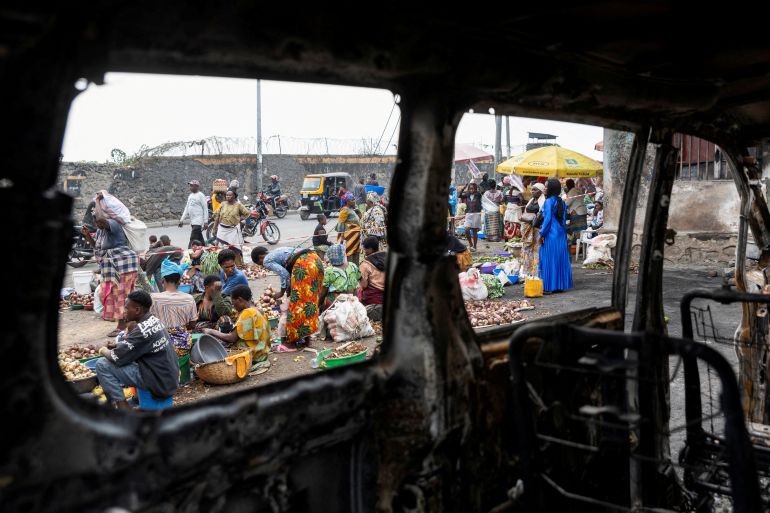
On February 5, 2025, a view shows the remains of a vehicle that was struck by heavy and light weapons during the battle that resulted in Goma being overthrown by M23 rebels.
DRC conflict’s complex history
According to conflict monitors, the recent events in eastern DRC appear to be a haunting playback of a tragic story.
Similar peace negotiations in late 2024, led by the African Union and Angola, seemed ready to deliver peace ahead of a new year. However, they fell apart after the presidents of Rwanda and the Democratic Republic of Congo called off a highly anticipated meeting. Both sides , accused each other of foiling the talks.
According to Nicodemus Minde, an analyst for East Africa at the Institute for Security Studies (ISS), “there’s a sense of deja vu.” “It’s symbolic because we were exactly here last year … the prospects for peace are dire”.
A complex combination of ethnic grievances, subpar governance, and interference from its much smaller neighbours has long sparked conflict in the DRC. It goes back to the 1994 genocide of Tutsis and moderate Hutus in Rwanda, which displaced millions into neighbouring eastern DRC, making them a minority there. However, Rwanda’s hot pursuit of the Hutu genocidaires led to the first and second Congo wars (1996-2003), and it has since since seen the DRC as a hiding place for them. The UN also accused the Rwandan and allied Ugandan forces of looting the DRC’s vast mineral wealth, including gold, coltan and tin, during the conflict.
In the wars, many of which are still active in the DRC, hundreds of militias emerged as governments armed and counter-armed civilians. The M23 itself is only the latest iteration of a Tutsi militia that fought in the Congo wars, and whose fighters integrated into the DRC army. These fighters revolted in 2012 and complained of Congolese forces’ poor treatment. Now, the M23 claims to be fighting the marginalisation of ethnic Tutsis, some of whom say they are systematically denied citizenship, among other complaints. Despite members of the group’s frequent threats to advance on the capital, the M23 and its allies, the Congo River Alliance (AFC), have not stated their intentions to invade Kinshasa. Officially, the rebels claim to be “liberating” eastern DRC communities.
M23 initially emerged with sufficient force to seize Goma, but Congolese forces and a special UN intervention force made up of troops from South Africa, Tanzania, and Malawi forced them to retreat within a year. When the M23 resurfaced in late 2021, though, it was with much more ferocity, boosted by about 4, 000 Rwandan troops in addition to its own 6, 000 fighters, according to the UN. Since its light-ning, bloody offensives, which have included the major cities of Goma, Bukavu, and now, Uvira, have been under its control.
On the map, M23 appears to be eking out a slice of Congolese territory wedged between the DRC and neighbouring Rwanda, Uganda and Burundi. If it had complete control of the two Kivus, it would rule over a resource-rich, five-fold-the-size Rwandan region with easy access to Kigali and Kampala.
“They are trying to create some sort of buffer zone which the neighbouring countries, particularly Rwanda but also Uganda, have an interest in controlling”, analyst Paul-Simon Handy, also of the ISS, told Al Jazeera.
Despite being accused of supporting a Hutu rebel group, the Democratic Forces for the Liberation of Rwanda (FDLR), Kigali officially denies backing M23 and uses its justification to support its actions. The FDLR did exist for many years in the DRC, but it simply no longer poses a significant threat to Kigali, analyst Minde said.
Similar historical ties exist between Rwanda and Burundi, where the Hutus who carried out the 1994 genocide also emigrated, and where Kigali claims the government continues to support rebels. In 2015, Burundi accused Rwanda of sponsoring an abortive coup in Bujumbura. Kigali refutes this.
US President Donald Trump hosts the signing ceremony of a peace deal with the president of Rwanda, Paul Kagame, left, and the president of the Democratic Republic of the Congo, Felix Tshisekedi, right, at the United States Institute of Peace in Washington, DC, on December 4, 2025]Andrew Caballero-Reynolds/AFP]
Is there a chance the US deal will go through?
Several African countries have attempted to help solve the crisis, militarily and diplomatically, but all have failed. As part of the Kenyan-led Peace Process that was supposed to bring several rebel groups to an agreement, the East African Community, which includes the DRC, deployed about 6, 500 peacekeepers as part of the regional bloc’s efforts to stabilize eastern DRC. The agreement collapsed only a year later, however, after Congolese President Felix Tshisekedi grew frustrated over the force’s refusal to launch offensives against M23.
Then, in May 2023, the Southern African Development Community (SADC), to which the large DRC is a part, sent troops from South Africa, Tanzania, and Malawi. There was hope that the trio, which proved crucial in driving back the first M23 insurrection, would again record success. However, they withdrew this June because they didn’t seem to be up to par with the new M23.
Meanwhile, the Angola-led Luanda Peace Process collapsed after President Joao Lourenco stepped back in March, citing frustration with both sides amid constant finger-pointing.
In June of this year, Qatar and the US intervened by using a unique two-pronged strategy to broker peace. The Doha peace talks, on the one hand, have focused on negotiations between the DRC and M23, while the Washington talks focus on the DRC and the Rwanda governments. According to some experts, Washington’s motivation was a condition of the agreement that guarantees US extraction of rare earth minerals from both nations, aside from President Donald Trump’s fixation on being a global peacemaker figure. The agreement was unlikely to hold on that basis, rights groups said.
The M23 finally accepted the Doha framework  on November 15 after a few stumbling blocks and stumblings. The agreement includes eight implementation protocols, including one on ceasefire monitoring and another on prisoner exchange. As all three agreed to the US-peace agreement, which forbids both Rwanda and the DRC from supporting armed groups, President Trump sat next to Paul Kagame and Tshisekedi as they signed it in Washington on December 4. There were pockets of fighting as the signatures were penned, but all was supposed to be largely peaceful from then on.
The opposite was the reality of what transpired in Uvira just one week later. The Congolese government said at least 400 people were killed and 200, 000 others displaced as M23 fighters pressed on the city. Burundi, where 200 000 Congolese refugees are currently residing, had displaced thousands of people there. Fleeing Uvira residents shared accounts of bombed villages, summary killings and widespread sexual violence by both sides, according to medical group Doctors Without Borders (MSF).
Exists a chance for peace?
Even though M23 began withdrawing from Uvira on Thursday, analysts are still scrambling to understand what the group was hoping to achieve by taking the city, shattering the peace agreements and angering Washington.
After Uvira was captured, US Secretary of State Marco Rubio directly criticized Rwanda, claiming Kigali had broken the deal. Last week, Deputy Secretary of State Christopher Landau met with DRC Foreign Minister Therese Kayikwamba Wagner in Washington and promised that the US “is prepared to take action to enforce adherence” from Rwanda.
What exactly will happen is a mystery, but Minde claimed that the agreement seemed to favor Kigali more than Kinshasa.
“If you look at the agreement, the consequences]of either party breaching] were not forthright, and this points to the weakness of the deal”, he said, adding that there is much more at stake for DRC if there is a breach, including escalating conflict and mass displacement within the country. The analyst explained that, however, was not taken into account.
Uvira’s fall, albeit on hold, is not only a blow to Trump’s peacemaker reputation but also sharpens tensions between Burundi and Rwanda, with analysts saying it could lead to direct clashes.
Rwanda and the rebels deny the accusations made by Bujumbura that Kigali supports the anti-government Red Tabara rebels, and tensions between the two governments have caused border closures since last year. Last week, M23 announced that it captured hundreds of Burundian soldiers during the Uvira offensive.
The UN Security Council decided to extend the MONUSCO peacekeeping mission’s mandate by a year in advance of its December 20 expiration due to concerns about a regional spillover. The 11, 000 troop force has been in place since 1999, but has a complicated relationship with the DRC government, which says it has not done enough to protect civilians. In response to the M23 offensive’s escalating expansion, UNO forces initially began pulling back in 2024 before putting a stop to it in July. Ituri, the force’s headquarters, is held by M23, meaning the troops are unable to do much.
According to analysts, the Congolese people are feeling the most depressed at the start of the year amid the chaos, finger-pointing, and political games. After more than three decades of war that has turned the green, undulating hills of eastern DRC into a perpetual battlefield, Masameko in Goma said it’s locals, more than anyone else, with the most at stake.
The Tax Reform Acts passed by the lawmakers have been requested by the National Assembly by Chukwuemeka Eze, a tax expert, Chukwuemeka Eze, and Godwin Oyedokun, a member of the Governing Council of the Chartered Institute of Taxation of Nigeria.  ,
The duo asserted this on Tuesday’s episode of Channels Television’s Sunrise Daily show, saying that the publication will address concerns over the alleged amendments to some bills.
According to Eze, “one of the lessons Nigerians must learn is that their website should contain and publish the harmonized version without delay,” putting the National Assembly to the test. When you visit several countries’ websites and see all of their information, this happens.
Nigerians are left to speculate when we don’t receive enough information from our institutions. We will still encounter this issue if the National Assembly doesn’t publish the harmonized legislative bills on its website even if the issue is resolved.
Oyedele Households Earning $250,000 Or Less Monthly Won’t Pay Taxes, READ ALSO:
Godwin Oyedokun, a second guest on the breakfast program, requested that lawmakers release information about the tax laws that they passed.
How do you explain that there are no websites that can provide you with all the information you need about Nigeria’s activities given our position in the Committee of Nations?
As a fraud examiner and forensic accountant, I want to let you know that complex transactions favor fraudulent activities. Oyedokun  said that when things are kept secret, fraud and similar things occur.
This kind of fraud is legislative fraud, or “legislative fraud,” but the problem is that when you are supposed to provide information but aren’t, it is an omission.
And when it is deliberate, you put the other party in danger if you want to benefit symmetrically from someone else’s knowledge of the truth.
Chris Rea, 74, a driving home for Christmas rocker, passed away on Monday after receiving the devastating news that he had pancreatic cancer at the age of 33.
3 images to be seen
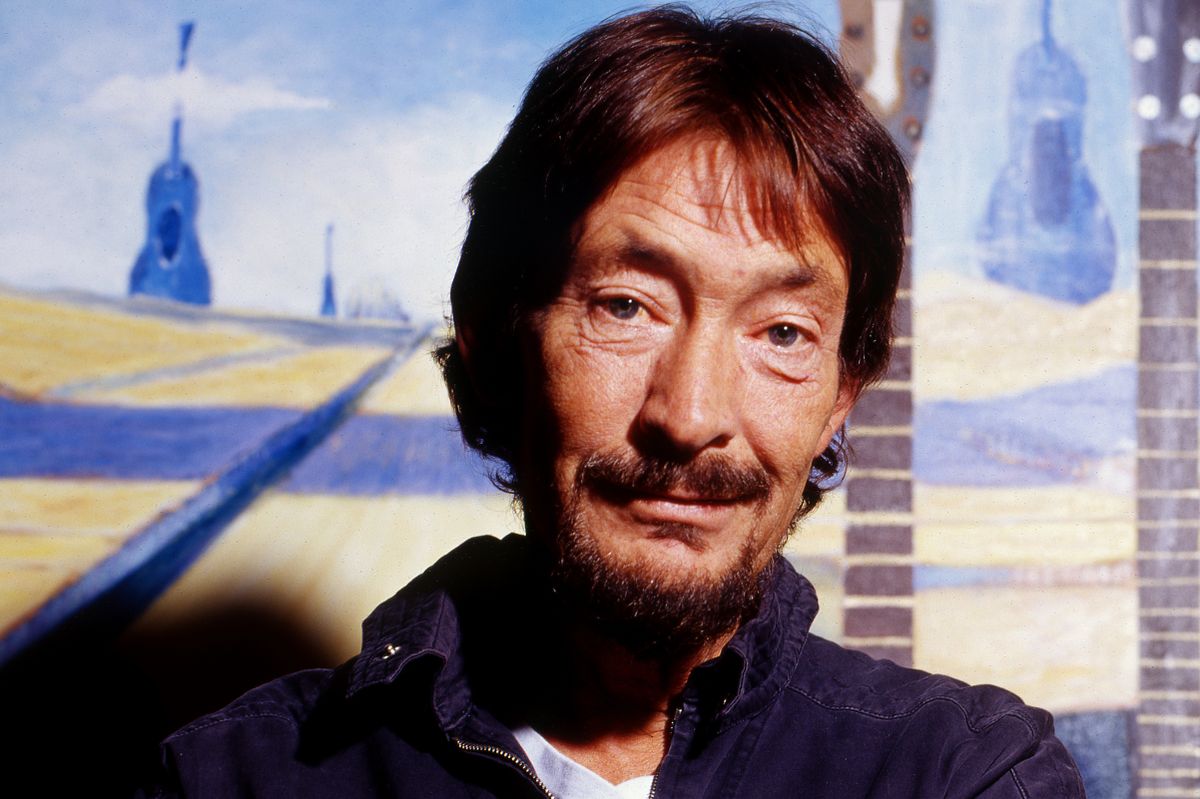
The star had a defiant response to his shock cancer diagnosis(Image: Redferns)
Chris Rea, the rock star who sadly died after many years of poor health on Monday, had a defiant response to the heartbreaking news aged 33 that he had pancreatic cancer.
The Driving Home for Christmas singer said he ‘wasn’t afraid of dying’ as he faced various serious health battles that plagued him for the best part of his successful singing career.
Rea, whose festive classic has consistently topped the UK singles chart every year since 2007, passed away on Monday at the age of 74 after a brief illness.
READ MORE: M&S’s £33 Cardigan hailed as ‘perfect’ for versatility and comfort
And the star shared a now haunting last social media post just hours before his death, featuring a car on a snow-filled motorway, with a road sign which read: ‘Driving home for Christmas with a thousand memories’.
Posted on Sunday, the Middlesborough native – whose sad death was announced by his wife Joan, who was his childhood sweetheart, added the caption, ‘Top to toe in tailbacks If it’s a white Christmas, let’s hope the journey’s a smooth one.’
following his 33-year diagnosis of pancreatic cancer. Although the singer suffered from diabetes and kidney issues, he eventually recovered fully, having removed a portion of his pancreas, his gall bladder, and a portion of his liver.
In 2016, he had a stroke – but would go onto release further music, albums Road Songs For Lovers in 2017 and One Fine Day in 2019. But his frailty was clear to see after he seemed to collapse onstage during a 2017 gig in Oxford and was rushed to hospital.
But the star previously confessed that rather than let his various health issues drag him down, he used them to dig deep into his first musical love – the blues.
He acknowledged in an interview that “the end definitely seemed to come, but what made me through was the idea of leaving a record on which my two teenage daughters could sing: “That’s what Papa did — not the pop stuff, but the blues music.” He was concerned about that. ‘
However, he once said, and the subsequent operations he’d had to go through since 1994, were a “living nightmare.”
In ten years, he said, “I’ve had nine significant operations.” The internal tissues of the body are frequently associated with retroperitoneal fibrosis, which is a form of internal fibrosis.
No one was aware of its existence until 20 years ago, which is completely unpredictable. I then have a stroke, which affects the colon, pancreas, gall bladder, liver, and other parts of the body.
A statement released on Monday from his heartbroken wife Julia and the couple’s daughters, Josie and Julia, read: ‘It is with immense sadness that we announce the death of our beloved Chris. He passed away peacefully in hospital earlier today following a short illness, surrounded by his family.’
In an interview on Good Morning Britain, Gene Simmons claimed that Ed Balls had “flirted” him, which viewers at home were quick to refer to as an “awkward” segment of the ITV show.
3 images to be seen
Gene Simmons had something of an ‘awkward’ interview on GMB with Ed Balls and Charlotte Hawkins (Image: ITV )
Gene Simmons thought Ed Balls was “flirting” with him on Tuesday’s episode of Good Morning Britain. The KISS legend, 76, appeared on the ITV morning show via video link from Los Angeles to discuss his legendary career, in which he has become known for his extravagant clothes and makeup.
The US rocker spoke about a time when he and his bandmates were valued only for their appearances before proving that they could still fill out stadiums without the whole aesthetic, even though they eventually went back to their roots.
When host Ed pointed out that Gene looked “better and more glamorous” without all his makeup, Gene joked: “I don’t know how to tell you this, I don’t wanna break your heart but I’m heterosexual,.” Ed joked: “That is the biggest disappointment of my Christmas, I am disappointed!”
READ MORE: BBC Breakfast shares emotional tribute to ‘irreplaceable’ rock star after deathREAD MORE: KISS star Ace Frehley’s death ‘being investigated’ with toxicology report ordered
After revealing his love for the UK and its culture, Gene asked Ed to be considerate of the viewers. You sounded flirtatious, he continued, “I don’t want your viewers to be spilling their coffee on you because this is morning television.” We have become Anglophiles ever since we first visited your stunning island, and I want to tell you something.
“The home of the Beatles, when we first stepped off the jet in 1974 or 1975, I can’t tell you the emotions we felt. We grew up with A Hard Day’s Night, all that stuff and it changed our lives.
“It literally changed our lives so I’ve always been a massive, massive fan of England. It’s this magical island that’s almost like Harry Potter, or Lord of the Rings. This magical island that gave the world the biggest bands. And don’t get rid of the monarch, keep the King, it’s cool!” As he wrapped up the interview, Ed vowed to continue to be a “groupie” who would “throw things on the stage” and made him promise to do a UK tour with his band next year.
Charlotte Hawkins, Ed’s co-host, was spotted giggling throughout the entire segment. Before Ed responded, “I didn’t say what I was going to throw,” she said, “I think you put him off by saying you were gonna throw things at him.” I never said “my underwear”!
The “awkward” elements of the interview were definitely picked up by viewers at home. On X, someone said, “Typically, you blur your face rather than your background.” Another person said, “This interviews awkward, and Gene has done it the other way around.”
A third wrote: “#gmb omg that silence was unbearable,” and a fourth wrote: “Great quote for the day from Gene Simmons…. ‘keep busy and try to stay out of trouble.'”
Earlier this year, Gene caused outraged when he offered one fan per show the opportunity to live the rockstar life with him, including helping him set up for his gig and hanging out with his crew backstage for the sum of almost £10,000. Despite the fun bits of the day being levelled out with heavy work, Gene, 75, has the experience up for grabs for $12,495 (around £9,650), with payment plans available.
Gene seemed to acknowledge the work involved, describing the “ultimate Gene Simmons experience” as being his “Personal Assistant &, Band Roadie For The Day” (Personal Assistant &, Band Roadie For The Day)! “!
Fans on X, which was formerly Twitter, were astonished by the cost of Gene and his band’s “ultimate” experience. One eagle-eyed critic noted that “tickets to the show are not included because they are sold through the individual venues,” along with a number of laughing emojis.
“Gene Simmons is currently just as bad as Donald Trump,” Simmons said. Another person said, “Wait… pay you… to work FOR you, Gene… and a hell of a lot more than £10k,” while a second agreed. Like, at no point are the maths math.
“Surely, the person doing the job is the one who deserves to be paid,” the question remains. What a plonker, cried a third person, “Disgusting, he doesn’t need that money,” one complained. Give it to a genuine fan for nothing and cheer them up.
“Shouldn’t be paying someone to serve as his roadie and day’s PA?” Not that he lacks “a bob or two,” is that true? The joker added that “I need you to send me $12k for you to be my roadie” is similar to Instagram scam DM material.
People were especially infuriated by Gene’s money-making scheme considering his jaw-dropping net worth, which is estimated to be around $400 million as of this year, according to Finance Monthly.
When the Darfur conflict started in 2003, I was about 13 years old. Before the emergence of social media, I was a teenager who read and listened to the news, but I now fully comprehended the historical or political context. a need to end a humanitarian crisis One of the events that ultimately led to my career as a doctor and working in conflict and natural disasters.
In al-Dabba, in Sudan’s Northern State, I volunteered with an NGO that provided medical care for internally displaced people (IDP) during the first two weeks of December. In some ways, I have turned my attention to the beginning, to the moment when I first started acting.
The camp’s population increased from 2, 000 to more than 10, 000 over the course of the two weeks we spent there. There were times when it seemed like there would never be enough resources to accommodate everyone. Not enough water and food. Not enough medication. Not enough latrines are available.
Instead, I repeatedly witnessed the Sudanese people’s courage, generosity, and selflessness, from the IDPs themselves to the local NGO staff I was volunteering with.
Some of the people I met while spending a day at the camp have these tales.
Fatima, 15, is popular among people. She had traveled to al-Dabba in 21 days. She fled as the Rapid Support Forces, a militia that is currently battling the Sudanese army, advanced upon her hometown.
She gave birth to her first child at 10 weeks. She required a hospital transfer for a fetal ultrasound. I politely inquired if the child’s father would accompany her to the hospital. She turned her head away. I was informed by her mother that she had been raped. I placed Fatima’s hand in hers, and we sat silently there, her tears slipping down my sleeves.
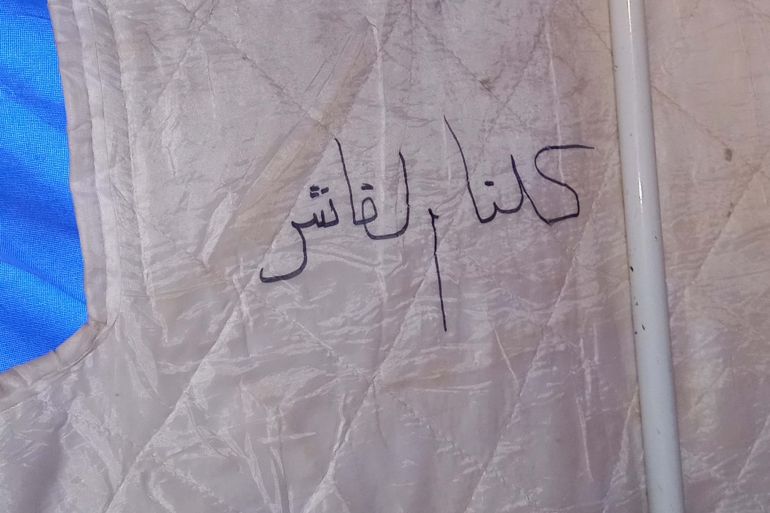
We are all el-Fasher, a sign that appears on a tent in Arabic at the Sudanese al-Dabba camp [Photo by Dr. Nabiha Islam]
Then, I ran into Aisha, a five-year mother. On the difficult but exhausting journey from El-Fasher to al-Dabba, she lost her husband. I informed her that she would need to be transferred to the hospital where she would receive a blood transfusion because her hemoglobin was so low. After losing their father, she couldn’t bear to leave her children, who were repeatedly having nightmares and not sleeping well at night.
We resolved to let the children stay with their grandma while Aisha was transferred to the hospital after trying to solve problems with her for the better part of an hour.
Khadija followed. She had to travel to al-Dabba for four weeks. She witnessed her husband being shot in the back while he was attempting to flee El-Fasher. She carried on with her three young children, fleeing on foot, as it was heartbreaking to leave without giving him a proper burial.
There was little food and potable water on the way. Her eldest child, who was malnourished and severely diarrhoea, was also fatal. She managed to snag the money to travel for a portion of the way with her two other children while trying to cobble together the money.
However, another tragedy struck. They were involved in a motor vehicle collision. Her injuries caused the death of her second child. Khadija brought her only son, who was the only one still living, to al-Dabba with her.
Khadija had her fourth child at 36 weeks pregnant when we first met in our medical tent. I prescribed her a course of antibiotics because she had an infection in her urinary system. She generously kissed both of my cheeks and thanked me profusely. I felt even more embarrassed when she expressed her gratitude for everything she had to offer a person who had endured great hardship. She was being kept in my prayers, I told her.
She suddenly asked me my name as she approached me. She kept repeating my name after I gave it to her, letting it gently fall off her tongue. Then she said, “This is what I will call my child,” and then pointed to her pregnant belly. When she had already taken so much from me, I was overwhelmed by what she was giving me.
I once needed to take a break for Auntie Najwa’s thatched straw home because I needed to pray at noon. She had spent more than a year interning at the IDP camp. One of her few possessions was her prayer mat. However, she gave it to anyone who needed it. Her home sounded like a secure haven. I was told to drink tea, but she refused. She graciously offered me cooked lentils and beans when I declined politely. I was left humbled by her generosity.
And Ahmed, my translator, had the same level of courage. He was a member of the neighborhood staff at the nonprofit where I was volunteering. Ahmed traveled to Egypt with his parents and siblings at the start of the war in 2023, made sure they were safe, and then went back to Sudan to serve his people. This is a story I’ve heard before and always.
Despite numerous threats to their own personal safety, the local team in Sudan had made countless sacrifices to remain there and serve its citizens. I can only imagine how worried and worried my own father is when he dropped me off at the airport before my scheduled trip to Sudan, knowing that Ahmed’s parents choose to keep their son in a warzone and live in relative safety.
The world’s biggest humanitarian crisis is occurring in Sudan. It has only received 35% of its global funding needs, or less. One-third of the population has been relocated, according to wikipedia. One in two people is hungry. Millions of people are famine-prone in many areas of the nation.
I’m not sure what the solutions are. However, I am aware that the international community has repeatedly failed Sudan and its people.
Better is possible. Better work is required.
Better is due to Fatima, Khadija, Aisha, Auntie Najwa, and Ahmed.
The people of Sudan deserve much better.
*Names have been changed to protect their identities in all cases.