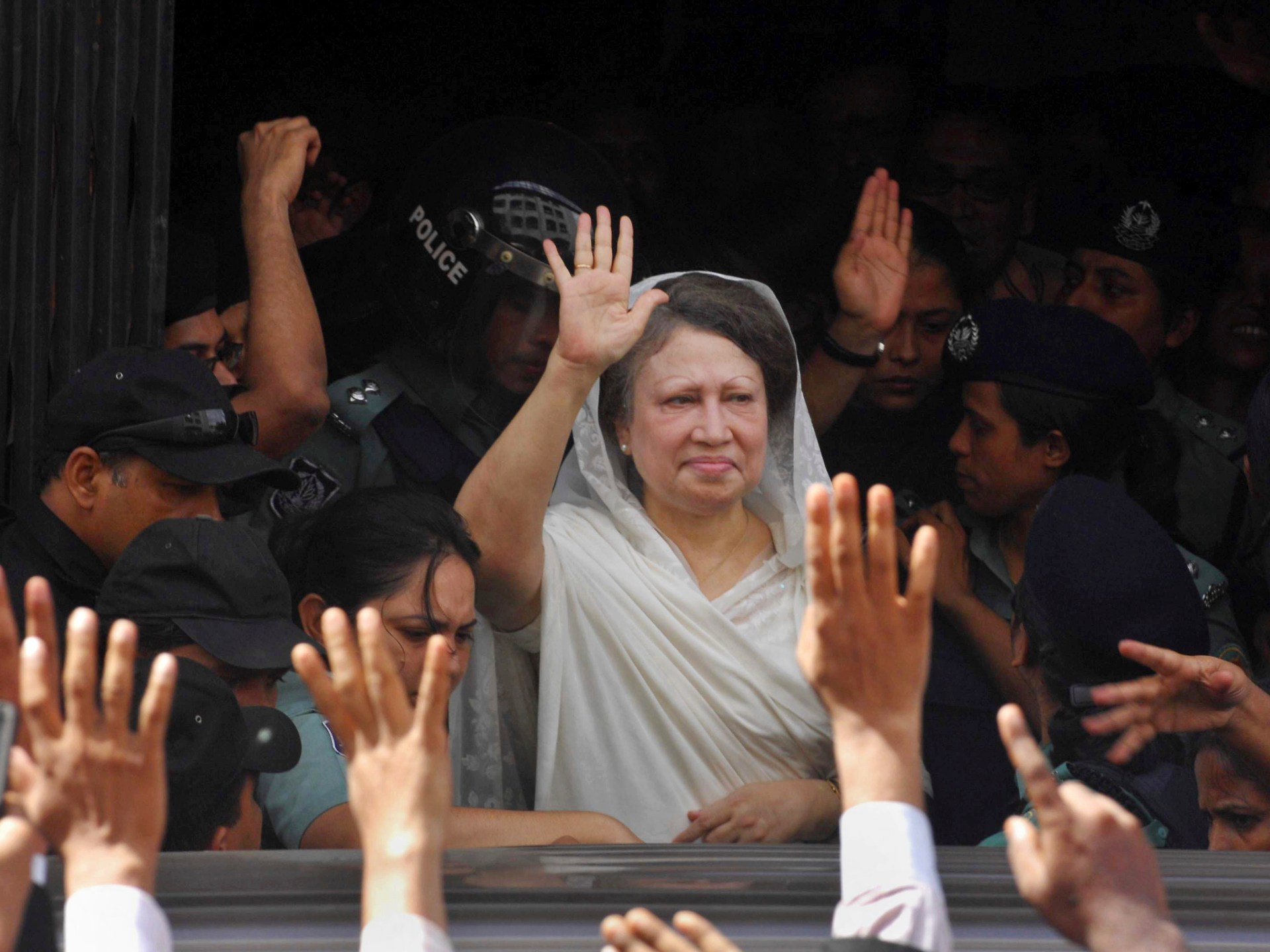
Tipu Sultan, 48, a grassroots activist for the Bangladesh Nationalist Party (BNP), sat in front of Dhaka’s Evercare Hospital in early December and proclaimed, “I want to donate my kidney to Begum Khaleda Zia.”
A video of Sultan and the placard went viral in Bangladesh, a country of 170 million people that has been on edge since Khaleda, the BNP chairperson and former prime minister, was admitted to hospital on November 23. Tipu has since promised to stay put until he learns about her recovery, spending the rest of his days opposite the hospital gate.
“She is like my mother. She sacrificed everything for democracy”, he told Al Jazeera. He continued, “My only prayer is that God allows her to see the upcoming election,” referring to the February 12 national elections that are scheduled for that day.
But it was not to be. According to her party, Khaleda, 80, passed away in a hospital on December 30 early in the morning.
“Our beloved national leader is no longer with us. She left us at 6am today”, the BNP said in the statement posted on Facebook.
Khaleda’s death marks the conclusion of more than three decades of conflict between the two leaders, who were known as the “battling begums,” an honor that was customarily reserved for Muslim women of authority, and her archrival and fellow former prime minister Sheikh Hasina, who is currently imprisoned in India.
But as with Hasina, Khaleda’s legacy is grey: Both women fought for democracy, against authoritarianism. Contrary to Hasina, Khaleda was never charged with carrying out widespread atrocities against her critics. Her uncompromising style while in opposition – leading election boycotts and prolonged street movements – combined with recurring allegations of corruption while she was in power, inspired intense loyalty among supporters and equal distrust among her critics.
The rise
Begum Khaleda Zia was born on August 15, 1946, in Dinajpur, then East Bengal of British India, in northern Bangladesh.
Her father, Iskandar Majumder, originally from Feni in the country’s southeast, had previously run a tea business in Jalpaiguri (in present-day India) before relocating with his family to East Bengal, which would soon become East Pakistan after the 1947 partition of India.
Khaleda attended Dinajpur’s Government Girls’ High School for her early years before enrolling in Surendranath College.
Her entry into politics was shaped not by early ambition but by upheaval.
The assassination of her husband, President Ziaur Rahman, in an abortive military mutiny in Chattogram on May 30, 1981, plunged Bangladesh into deep uncertainty. Rahman, who had stabilized the nation after years of coups and countercoups, left behind a fragile political system and the BNP, a defunct ruling party.
Although Khaleda had not been politically active during her husband’s presidency, senior BNP leaders saw her as the only figure who could unify the party’s competing factions and preserve Ziaur Rahman’s legacy. Vice President Abdus Sattar resigned as president after his passing, and he later won an election. But within months, Army Chief Hussain Muhammad Ershad seized power in a bloodless coup in March 1982, imposing martial law. It was in this volatile context – with the military back in control and political parties fighting for survival – that Khaleda began her ascent, eventually emerging as a central civilian figure challenging authoritarian rule.
Khaleda was elected party chairperson in August 1984 after joining the BNP as a general member in January 1982, as well as becoming its vice chair in 1983. In the decades that followed, she would win three elections to become prime minister in a political landscape that she dominated alongside her longtime rival, Sheikh Hasina, and her Awami League party.
Her public life and personal struggles included: her older son, Tarique Rahman, was detained in 2008 while her younger son, Arafat Rahman Koko, passed away while living abroad as a result of a cardiac arrest. Khaleda herself later spent long periods in prison after her 2018 convictions in corruption cases brought under the Awami League government, followed by years of political isolation and deteriorating health.
Tarique eventually returned to Dhaka on December 25, after the cases against him were dropped by the interim government of Nobel Laureate Muhammad Yunus that yook office after Hasina’s ouster.
According to Dilara Choudhury, a political scientist who closely observed both Khaleda and her husband, “Her]Khaleda’s entire life was filled with hardship, yet she chose her country over personal comfort.” “That is why she is remembered across political lines as one of the most emblematic leaders of her time”.
Priority should be placed on private life.
People who knew Khaleda before she entered public life describe her as a woman who was reserved, soft-spoken and consistently courteous. She married army officer Ziaur Rahman in 1960 when she was about 15, long before he emerged as a national figure. Rahman gained notoriety after Bangladesh’s independence in 1971, when he became president in 1977 and founded the Bangladesh Nationalist Party (BNP) in 1978. Zia would later inherit her husband’s politics – centred on nationalism, multi-party democracy and a market-oriented economy.
She and her family lived in a modest military home in Dhaka Cantonment between 1978 and 1981, where her husband, President Rahman, served as aide-de-camp at 6 Moinul Road, which was later designated as the deputy chief of the army.
“She coordinated the house herself, welcomed guests and managed family matters”, Colonel Khan told Al Jazeera. “I never saw her raise her voice. She had a sense of self-awareness.
He recalled her calm approach to parenting: When her younger son, Arafat, then aged 7, struggled to gain admission to a school, she asked only for other alternative school options, when the boy later injured himself imitating a television stunt, she expressed no anger towards the staff who were supposed to be minding him.
Khan remarked, “That was the person she was.” “Graceful, composed and considerate”.
But everything changed on May 30, 1981.
Khan discovered that President Rahman had been killed in Chattogram, a port city, in an apparent coup attempt by a group of army officers that would eventually lead to Ershad’s army chief, even though Ershad would gain control several months later.
“For a moment]after learning of the assassination], I felt the ground slip beneath my feet, but I did not share the information with Madam]Begum Zia] for moments”, he said.
He immediately commanded a company of about 120 soldiers to be prepared to defend the family because he was worried the family’s residence might become the next target.
In the early morning, the two boys came out of their bedrooms, preparing to leave for school, but he stopped them. Minutes later, Khaleda stepped out of her bedroom. She inquired, “What has happened? ” I told her there was unrest outside”, he said.
She retreated to her bedroom as a housekeeper turned the radio on, and the news of her husband’s passing flooded the room.
“She stepped back, looked at my eyes – and she understood”, the former aide-de-camp said. “She sank into the floor”.
Khan stayed with the family for two more months. “She was mentally shattered”, he said.
Khaleda lived there until Hasina’s administration evicted her in 2010 because Ziaur Rahman had no other personal residence to share with his family. The government then gave her the house at 6 Moinul Road.
From first lady to first female prime minister
Following Ziaur Rahman’s assassination in 1981, senior leaders of the Bangladesh Nationalist Party (BNP) urged Khaleda – who was not even a party member at the time – to take on a public role.
The army chief imposed martial law after taking over as president and suspended the constitution. Her rise coincided with growing public distaste for Ershad’s military rule.
Throughout the 1980s, the BNP and the Awami League – the two largest political parties – led parallel but often coordinated street movements calling for the restoration of parliamentary democracy.
A crucial turning point occurred in 1986, according to Choudhury, the political scientist, when Ershad announced a national election that the opposition had criticized as unconstitutional because political freedoms were still restricted and martial law was still in effect. While the Awami League eventually chose to contest the polls, the BNP under Khaleda’s stewardship boycotted the election entirely.
“Her decision to boycott the 1986 election – which she denounced as illegal even as the Awami League participated – reinforced her public image as someone unwilling to trade principle for expediency”, she said.
This perception about her was bolstered by repeated house arrests under the Ershad regime. “Khaleda Zia was unwavering in her objective to remove Ershad and restore democracy”, Choudhury said. She was praised for her willingness to endure arrest, even if she was in good health.
The 1991 election – the first after the end of military rule in December 1990 – produced a hung parliament.
The BNP won 140 seats, short of the 151 needed to form a government. The Jatiya Party and Jamaat-e-Islami won 88 seats, while the Awami League and Jamaat-e-Islami won 18 respectively.
Jamaat chief Ghulam Azam opened negotiations with Sheikh Hasina. In addition, Lieutenant General Nuruddin, Khaleda, Motiur Rahman Nizami, and Golam Wahed Choudhury, the husband of Dilara Choudhury, the former minister of communications of undivided Pakistan, convened a covert meeting at his Dhaka residence.
Khaleda arrived alone, without informing other BNP leaders. The negotiations ultimately paved the way to allow Bangladeshi citizenship for two very contrasting political figures. Azam, the Jamaat chief who had backed Pakistan during the war of independence, had previously been denied citizenship. Kader Siddique, a prominent 1971 war hero aligned with the Awami League’s political legacy, had been in exile in India after leading his private militia against the government and military following the 1975 assassination of Hasina’s husband, Sheikh Mujibur Rahman – the leader of the country’s independence struggle and its first prime minister and president.
Khaleda received the numbers needed to form a government by agreeing to back the BNP in parliament.
“This negotiation showed her political prudence and firmness”, Choudhury said. “It could easily have failed”.
In addition to Indira Gandhi, Sirimavo Bandaranaike, and Benazir Bhutto, a line of South Asian women had already held the region’s highest office.
Governance, reforms and cries of cronyism
Khaleda led Bangladesh three times, once in 1991 and 1996, once in 1996 during a short-lived second term, and once more between 2001 and 2006.
Recalling the negotiation mediated by her husband in early 1991, Choudhury, the political scientist, said that as Khaleda was leaving the meeting, she paused to speak with the women of the household and asked what they expected from her.
“My elder sister, Professor Husneara Khan, replied, ‘ We want you to give the country a comparatively honest and corruption-free administration'”.
It’s a complex question, Choudhury said, whether she ultimately delivered that. “She genuinely had that intention – inspired by her husband’s nationalist philosophy. In many ways, she was successful.
Supporters credit her government with policies aimed at stabilising a state emerging from years of authoritarian rule. Her administration pursued economic liberalisation, export-led growth, revival of industry, expansion of the garment sector, and wider access to education – particularly for girls. Her tenure also coincided with the establishment of a relatively free press.
When her last elected term ended in 2006, Bangladesh’s gross domestic product (GDP) growth rate stood at about 7 percent – one of the highest in the country’s post-independence history and well above the average of roughly 4.8 percent in the 1990s and about 3.8 percent in the 1980s. Bangladesh was referred to as “Asia’s next tiger economy” by the World Bank at the time.
Her administrations, however, did draw criticism too.
In 1995, an acute fertiliser shortage and a resulting sharp increase in prices – driven by hoarding and distribution failures at a crucial time for the winter paddy crop – led to protests by thousands of farmers. In clashes that sparked widespread rural unrest, police opened fire on several districts: At least a dozen farmers and one officer died.
During her 2001–2006 term, critics accused her elder son, Tarique Rahman, of building an alleged parallel centre of influence around his political office, widely known as Hawa Bhaban.
Under her leadership, persistent questions about governance were fueled by allegations of corruption and claims that important decisions were being influenced by this parallel structure.
Political missteps
Chaudhury pointed to two episodes in which Khaleda’s governments were also accused of trying to influence electoral outcomes. Numerous people criticized the 1994 by-election as being manipulated to benefit the BNP. Later, towards the end of her 2001–06 term, Zia was accused of trying to install a partisan caretaker government tasked with carrying out the next election.
Khaleda, a self-published historical account of the former prime minister’s legacy, was written by political historian Mohiuddin Ahmed, who also pointed out other instances that he claimed had harmed her credibility.
A grenade attack on a rally of Hasina’s then-opposition Awami League on August 21, 2004, in Dhaka, killed at least 24 people and injured hundreds. The investigation under the BNP-led government was widely criticised for failing to promptly pursue credible leads into the role of Islamist armed groups that were ultimately blamed by investigators. The Harkat-ul-Jihad al-Islami organization is one of them.
A Dhaka court in 2018 convicted several individuals in connection with the attack. Many Bangladeshis still have questions about responsibility for the 2004 attack, despite subsequent appeals and High Court decisions that have overturned some convictions and acquired others.
In another incident in April 2004, police and coastguard intercepted a large consignment of illegal weapons believed to be destined for the United Liberation Front of Asom (ULFA), an armed separatist group in India’s Assam region.
“These incidents deepened political hostility at home and created significant discomfort in Bangladesh’s relations with neighbouring India”, Ahmed , told Al Jazeera.
The political unrest that resulted in a military-backed takeover of power on January 11, 2007 was a result of Zia’s mistakes during her rule from 2001 to 2006.
The army’s senior leadership pressed then-President Iajuddin Ahmed to declare a state of emergency, resign as chief adviser of the sitting caretaker government and cancel elections scheduled for later that month. Former Bangladesh Bank governor Fakhruddin Ahmed was given the backing of a new interim caretaker government, which would be in charge of stabilizing the nation and putting together future elections. The move effectively sidelined both Khaleda and Hasina from front-line politics for nearly two years.
“Her]Khaleda’s] party created the circumstances]for the events of January 11, 2007], and the party – as well as her family – eventually became the victims of it”, Ahmed, the political historian, said.
“Democracy commitment”
Amir Khasru Mahmud Chowdhury, a former commerce minister in Khaleda’s 2001–04 cabinet and a current BNP leader, said that his former boss never wavered from her political positions even when she was under immense pressure to compromise.
He claimed that party workers were profoundly affected by her loyalty to democracy and patriotism. “Attempts to break the BNP – during 1/11 and later under Sheikh Hasina – never succeeded because her ideals held the organisation together”, he added, referring to the events of January 11, 2007.
Ahmed, the political historian, also said that while “many have benefited from politics in recent decades”, Khaleda had “paid a very high price, especially after 2006″. He made reference to her and her family’s years of imprisonment, political persecution, and constant pressure.
” Right or wrong, she rarely walked back from her stated positions, which we did not see among other contemporary politicians, “Ahmed said, citing her firmness during the anti-Ershad movement and her insistence on elections only under caretaker governments.
A portion of her legacy will always be that she was the first woman to hold the highest office in a socially conservative society that was historically skeptical of female leadership.
Her refusal to flee the country during crises – whether after January 2007, when her elder son was forced into exile as they faced numerous cases, or when she faced retribution under Hasina – also helped hold the BNP together, say analysts.
” She could have left, but she chose to stay and face the consequences. She was different, according to Ahmad.
The political historian also pointed to Khaleda’s restraint in political language”. She refused to respond in a manner that was offensive and abusive even when she was the target of harsh propaganda.
Her message following the fall of Hasina in August 2024 was an example.
Freed from house arrest on August 6, after student-led protests forced Hasina to flee to India, Khaleda urged her supporters not to pursue retaliation.
It was “an almost unimaginable moment for many,” Mohiuddin said. She avoided inflammatory language even when the political tide turned in her favour. “
This quality is essential to how many regular Bangladeshis will remember her. Both Hasina and Khaleda ruled the country well, but in my opinion, Khaleda did better, “said 77-year-old Nazim Uddin, speaking to Al Jazeera in early December while chatting with friends outside a commercial complex not far from Evercare Hospital.
But a key question now looms: What awaits the BNP in a post-Khaleda era?
Tarique Rahman, Khaleda’s sole surviving son, is at the center of any response to that query.
” Like the Awami League, the BNP has become a one-person-centric party, “political historian Mohiuddin Ahmed said”. The BNP is likely to experience a serious leadership crisis because Tarique Rahman’s leadership is still untested.
Choudhury, the political scientist who knew Khaleda well, offered a sharper assessment:” Leaders in the post-Khaleda BNP will likely split into two or three factions, as she served as a symbol of unity for party members. That fragmentation, I fear, will create a serious political vacuum in the country. “
Others are in opposition, though.
Amir Khasru Mahmud Chowdhury, the former minister under Khaleda, said that he believes Tarique, who has led the party as acting chair since 2018 from exile in the United Kingdom, has already” taken up the torch that his mother carried from his father, Ziaur Rahman”.
When Tarique returned from exile to Dhaka on Christmas Day, just weeks before the national election, where the BNP and its former ally, the Jamaat-e-Islami, were in a close fight for the top spot in the polls, with a significant show of support from the party’s supporters.
In his first comments since returning, Tarique spoke of wanting to build an inclusive Bangladesh. Some experts believe the 60-year-old might also be able to repair ties with India, which have suffered since Hasina’s removal and her decision to flee to New Delhi. Although India and the BNP have traditionally had chilly ties, New Delhi favors Hasina’s Awami League as Dhaka’s partner, both have recently exchanged open letters.
Source: Aljazeera

Leave a Reply