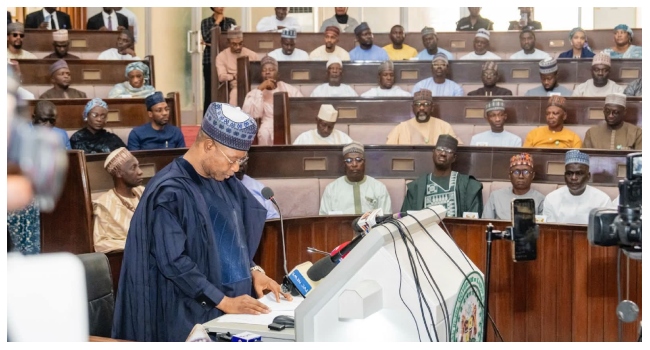
A 985.9 billion 2026 Appropriation Bill, which is the state’s governor Uba Sani, has been presented to the State House of Assembly. It is described as a people-centred financial plan designed to consolidate ongoing reforms in security, infrastructure, education, and rural development.
The governor described the budget as “a solemn civic engagement” rooted in equality, transparency, and the welfare of the people when he presented it to lawmakers.
He claimed that traditional rulers, CSOs, women’s groups, youth organizations, academic leaders, business leaders, and vulnerable groups from all local governments were the subjects of one of the state’s largest consultation processes.
The document’s backbone, in his opinion, was made up of inputs from farmers, traders, teachers, artisans, disabled people, and widows, strengthening participatory governance and accountability.
Governor Sani compared the year’s performance to that of 2025, noting that despite economic pressures, fluctuating federal funding, and persistent security concerns, it would stand out as a year for “remarkable achievements and resilient advancement.”
Governor Sani stated that the proposed 985. 9 billion budget includes 734.2 billion recurrent revenues and 251.6 billion in capital receipts, with 71% going to capital expenditure, which is in line with the government’s development priorities.

Read more: Nigeria’s centralized policing system is ineffective in meeting demands from northern leaders.
According to him, the state’s long-term transformation agenda for education and infrastructure received 25%, health 15%, agriculture 11%, security 6%, social development 5%, governance 5%, and environment and climate action 4%, respectively.
Sani reaffirmed that each of the state’s 255 wards would continue to receive 100 million dollars for community-identified projects through the Ward Development Committees, describing it as one of the largest grassroots budgeting schemes in Nigeria.
Concerning security, the governor noted that Kaduna was increasingly threatened by things like banditry, kidnappings, and communal conflicts, but that stronger cooperation with federal security forces improved operations and increased confidence in many troubled communities.
He claimed that communities that had been torn apart by conflicts were gradually resolving, farmland was open, and school activities that had previously been suspended due to insecurity had resumed full activity thanks to the Kaduna Peace Model.

Sani announced that his administration was carrying out 140 road projects totaling 1,335 kilometers, of which 64 were completed. He claimed that the new roads have forged links between previously abandoned communities and opened economic corridors.
The governor also praised the pace of the state’s transportation reforms, particularly the first KBRT system in Northern Nigeria, which features CNG-powered buses, digital ticketing, and a 24-kilometer dedicated corridor.
He claimed that the subsidized transportation system, which offers free and discounted rides, would sanitize intercity travel while the Interstate Bus Terminal in Kakuri, which is 75% finished, has saved residents over $500 million.
Sani continued, noting that the Kaduna Light Rail Project was moving forward with Phase I’s Phase I, Phase II, Phase II, Phase I, Phase II, Phase II, Phase II, Phase II, and Phase II, along with the state’s ongoing construction of significant bus parks.
More than 500, 000 hectares of abandoned farmland have been recovered and reopened, according to the governor, and feeder roads, markets, and extension services have been restored to increase food production.
He claimed that the state’s development push continues with a focus on education. The government reduced tertiary school fees by 40%, and the government reopened 535 schools in 2025 alone, and returned over 300,000 of the country’s out-of-school students to classrooms.
He further listed the establishment of bilingual schools and vocational hubs, as well as the construction of 736 classrooms, the renovation of 1,220 others, and the provision of boreholes, toilets, furniture, and training for more than 33, 000 teachers.
In terms of health, he announced the commissioning of the 300-bed Bola Ahmed Tinubu Specialist Hospital, the completion of 15 general hospitals, and the upgrading of all 255 primary healthcare centers to Level 2 status.
Sani claimed that his administration improved the state medical warehouse, strengthened emergency services, and allocated $1 billion to insure flimsy households.
Additionally, the governor praised accomplishments in vocational training, including the expansion of partnerships with Microsoft and Google, and the expansion of Panteka Market to support over 38, 000 artisans.
Sani recalled Sani’s account of Sani’s recall of how the state’s investment increased from 1.4 billion in 2023 to 74.2 billion in 2025, resulting in the distribution of more than 900 trucks of free fertilizer in addition to funding for irrigation, mechanization, livestock vaccines, and seed improvement.
He claimed that the African Quality Assurance Center, which is supported by the $ 510 million Special Agro-Industrial Processing Zone, is transforming Kaduna into an agricultural hub and that farmers would be able to access export markets with the aid of the African Development Bank.
He urged lawmakers to take the proposal seriously, claiming that the 2026 budget represents “renewal, resilience, and a far-reaching vision” to ensure progress in every home, ward, and local government area of Kaduna State.
Hon. Hon., the Kaduna State House of Assembly Speaker, addressed the audience after the presentation. The budget was “ambitious, comprehensive, and in line with the state’s development priorities,” according to Yusuf Liman.
He claimed that the proposal for 2026 shows a clear commitment to strengthening human capital, ensuring equitable development in both urban and rural areas.
Liman praised the Governor for respecting the separation of powers and for allowing legislators to participate directly in constituency projects for the first time in the state’s history.
According to him, the Assembly has had the advantage of delivering democracy dividends and accelerating development initiatives because of the synergy between the Executive and the Legislature.
Source: Channels TV

Leave a Reply