London, United Kingdom – Juliet Stevenson, one of Britain’s most recognisable actors who is widely regarded as a national treasure, has taken on a new role over the past two years.
She has become a leading voice for Palestinians, marching at rallies, making speeches, signing protest letters, writing columns and producing films – using every opportunity to spell out the brutality of Israel’s atrocities on Gaza and the occupied West Bank.
Recommended Stories
list of 4 itemsend of list
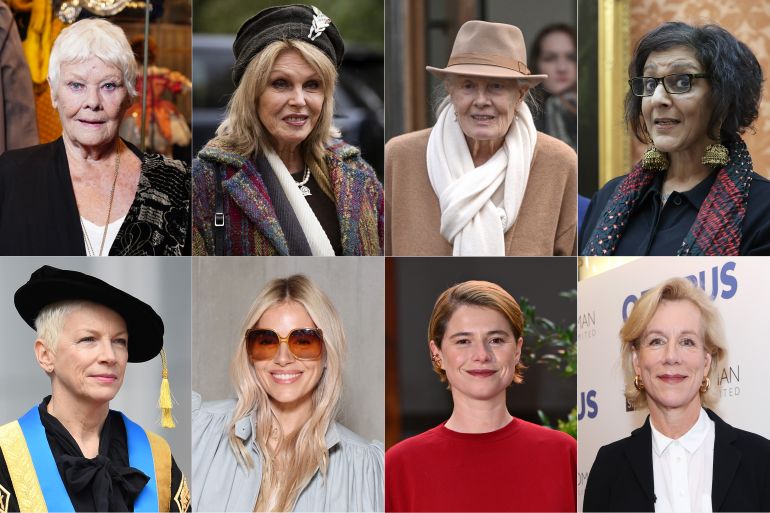
Last week, alongside dozens of other cultural icons such as Judi Dench, Meera Syal and Sienna Miller, Stevenson wrote to the founder of Mumsnet, a popular online forum where mothers discuss a range of issues from childcare and parental leave to transgenderism, politics and global wars.
Left to right, bottom row: Annie Lennox, Sienna Miller, Jessie Buckley, Juliet Stevenson – All women are among more than 100 cultural figures urging Mumsnet to show moral support for parents in Palestine [Getty Images]
The famous mothers want Justine Roberts, the founder, to pressure the United Kingdom’s government to demand that Israel allow maternity clinics stuck in Egypt into Gaza and give access to NGOs trying to deliver aid – especially items essential to women and girls, such as menstrual and hygiene supplies.
Mumsnet has said Roberts will meet with the group.
Al Jazeera spoke with Stevenson about why she believes British mothers should offer moral support to Palestinian parents, the roots of her activism, and her determination to keep speaking up despite the risks it carries to careers.
Al Jazeera: Why are you appealing to Mumsnet?
Juliet Stevenson: Mumsnet has about nine million users monthly in this country. So I am told that it has the ear of the government, because that’s a good chunk of the electorate. And the community of mothers on Mumsnet crosses divisions of class, faith, ethnicity.
This campaign is about mothers for mothers. The situation being endured by mothers in Gaza is unimaginably brutal and horrific.
We want to galvanise the mums of Great Britain to speak up for the mums of Gaza through their communities, one of which – and probably the most powerful – is Mumsnet. Many people express the desire and need to do something in relation to the suffering they see in Gaza and across the occupied territories, but they don’t know what or how. This campaign is something they can join with if they want to.
Al Jazeera: As a mother yourself, how has it felt watching the genocide unfold?
Stevenson: Honestly, unspeakable. Sometimes I feel beside myself.
Everybody in the world loves their children in the same way. Palestinian parents love their children just as much as we do. How can our politicians sit back and watch what these parents are enduring? And watch the unimaginable suffering being inflicted on children?
There are more child amputees now in Gaza than in any other time or place in history. There are many children who have lost all their family, young children without parents or family left. There are parents who have no children left. There are pregnant mothers who are starving, giving birth to premature and very underweight babies who struggle to survive. Most of Gaza’s healthcare system has been destroyed, and where hospitals are still functioning, they do so with a chronic lack of equipment and medicines. There are minimal resources for maternal and neonatal care. The infant mortality rate has leapt up by 75 percent, and miscarriages by 300 percent.
Any mother in the world seeing this situation would be haunted and horrified, I think. I would hope so.
Al Jazeera: For many years, you’ve protested for the rights of Palestinians. What’s behind your activism, something that, as we have seen, comes with risk to careers?
Stevenson: I learned about the situation of the Palestinian people many years ago. It struck me from the very first as a narrative of extreme injustice. My husband is Jewish and his mum, my beloved mother-in-law, was a refugee from Hitler’s Vienna [Austria was annexed by the Nazis in 1938 and liberated in 1945].

I fully understand what the Holocaust left in its wake, and the need for the Jewish people to feel secure and safe – and never again to be vulnerable to the appalling ravages of anti-Semitism. But as many, many Jews are now saying, what the Israeli government is doing now, what has been perpetrated on the Palestinian people since 1948, was never a just or wise solution. The UK is deeply implicated in those historical events.
I read Edward Said and other Palestinian writers, and I read Israeli writers … I’m concerned with the safety and security of Israeli citizens, too. The brutality lashed out against Gaza and the occupied territories serves nobody in the region.
As for careers, my career – I honestly feel that if people don’t want to work with me because they don’t like what I’m saying about this, then I don’t think I want to work with them. And if they’re going to punish me for my belief system, then I probably don’t belong there. And most importantly, I don’t think my career is more important than the lives of Palestinian children. I really, really don’t.
And when I come to the end of my life, whenever that is, I want to be able to look back at my life and say I hope I did the right thing at the right time.
Of course, I want to go on working as an actor; I love the work. And I need my platform and my profile to be able to be effective – that’s important, too. But I haven’t yet felt that I’ve been penalised for activism – I’ve never worked as hard or as much as I did last year. So I’m optimistic that there are enough people in the industry who don’t want to punish me for this, and who feel the same.
Al Jazeera: How do you characterise the muted response to the genocide in Gaza from usually outspoken characters in the arts or feminists who speak up about oppression in other regions of the world?
Stevenson: I’m painfully disappointed by the silence in my industry, by the silence everywhere. I’m dismayed by how people are allowing the bullying into silence to be effective – by their yielding to that power. At this point in the genocide, silence is not a passive act. It’s active – it’s a decision to collude.
We look back at Germany at the time of the Holocaust, and we harshly judge those who didn’t speak out against that barbarism, and we admire those who did. But what about the current genocide? Why do we so often look back at history and assess it in that way, but we don’t bring those judgements to bear on the world we’re living in now?
I do wish more leading figures in the arts, and more arts and cultural institutions, would engage with what is happening in Palestine and use their voices and influence. It’s our job, isn’t it, to reflect the human condition, human experience? If we’re not doing that in relation to the genocide, then I don’t know what we are doing, really.
Al Jazeera: Several British actors over the years, yourself included and Vanessa Redgrave, have criticised Israeli policy that disregards Palestinian rights. Has the space for speaking up become more restrictive in recent years?
Stevenson: I’d like to acknowledge Vanessa’s astonishing legacy of always speaking out and always fighting for human rights. She’s been a really inspiring person in our industry doing that. And I would also like to acknowledge the voice and the actions of many young people in my industry now – not famous or with high profile, but who are really engaged and tirelessly support the Stop the War movement, and who call for humanity and action. It takes bravery – as it does in Hollywood, where a few have stood up and spoken out. I’m so grateful that they found the courage. … But most people have not.
There was a great wave of public support that grew during last summer. My great fear now is that it’s subsiding again – the illusion of the so-called “ceasefire” has taken hold – when in fact there has been no ceasefire [and] much of the mainstream media colludes. There is, in addition, so much distraction in the news because of world events elsewhere … and then of course there is the power of Israel’s propaganda machine, which is immense and far-reaching.
Al Jazeera: What propels you to keep going?
Stevenson: It’s vitally important to keep Palestine conscious in people’s minds – to sustain its presence in the media. To keep the movement for peace and justice alive and energised.
My values have shifted, my community of friendships has partly shifted, my work and general interests have shifted. Much has changed for me in relation to this. A lot of the people I spend time with now are people who are in this community, and who will not give up hope. My mantra in life is one that I adopted when I was very young – “Despair is a luxury we cannot afford.”
Al Jazeera: Does your family join your activism?
Stevenson: My husband Hugh [Brody], though not religious, feels his Jewish identity very deeply. Our children identify as Jewish. And we have many Jewish friends, but all of them are appalled by what’s happening. Most of them would adhere strongly to those who are saying “Not in my name”.

This insistence by the government of Israel that to criticise Israel is anti-Semitic, this eliding of criticism of Israel with anti-Semitism, is not only ludicrous – what government in the world is beyond criticism? – but it’s very, very dangerous for Jewish people. Because if you say that criticism of Israel is anti-Semitic, then it means that all Jews are somehow implicated in what Israel’s doing. Which is palpably very far from the truth – and feeds the real and abhorrent currents of genuine anti-Semitism in the world.
Hugh is a writer and an anthropologist, less inclined to be collective. But for a while now, he has gone on the Saturday marches and walked with the Holocaust group. He has committed to that community.
I am relieved and very strengthened by that and by the support of our children. It would be very painful and difficult if we were not of like mind in this.
Source: Aljazeera

Leave a Reply