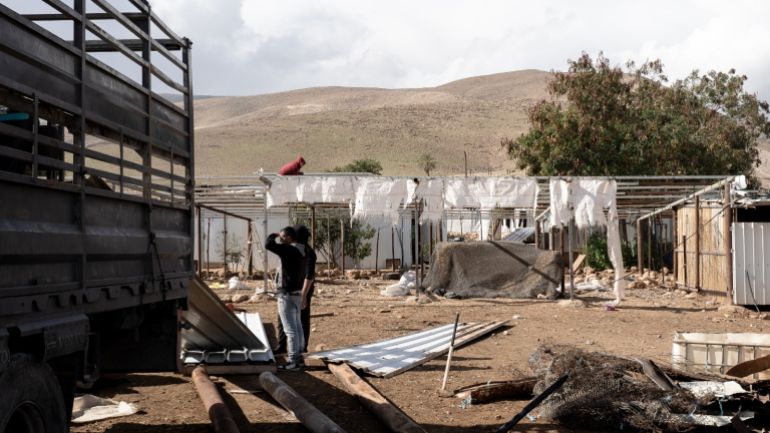
Naif Ghawanmeh, 45, sits in front of the fire when the music stops, which is played during Ras Ein al-Auja, an occupied West Bank town. The night is chilly, and for the first time in weeks, everything is still for a moment – the Israeli settlers’ celebrations have finished for the day.
Ras Ein al-Auja, which is located in the Jericho governorate of the eastern West Bank, is now almost completely uninhabited.
The village was one of the last Palestinian herding communities in this part of the Jordan Valley, but now, the herders’ sheep have gone – most of them stolen or poisoned by settlers or sold off by villagers under pressure. The Ras Ein spring, which the nearby settlers have been ostensibly blocking for the past year, has been closed off to the water.
And for the past two weeks, most of the community’s homes have been dismantled. Before they leave, many of the families who were forced to flee have burned their furniture to use by the invaders.
“By God, it’s a difficult feeling,” Ghawanmeh says. He fidgets by the fire, rubbing his face in agony and exhaustion, and is sometimes at a loss for words. ”Everyone left. There is not a single one. They all left. ”
Since the start of this year, about 450 of the 650 Palestinian inhabitants of Ras Ein al-Auja have fled their homes – for many the only place they have ever lived – because of violence by Israeli settlers.
The rest of the Ghawanmeh families are packing up and departing in the coming days, aside from the 14 who claim to have nowhere to go, including a sizable number of children.
This rapid displacement of hundreds of people marks the largest expulsion from a single Bedouin community as a result of Israeli settler violence in modern times – a feat that has elicited taunting celebrations by the encroaching settlers and left lives in ruins for Bedouin families now deprived of shelter, livelihoods and community.
No land, no sheep, no water, no safety
Despite a wave of physical assaults, thefts, threats, movement restraints, and property destruction by settlers, the people of Ras Ein al-Auja had continued to live on their lands until the new year. This is now all too common for rural Palestinian communities in the West Bank.
Settlers have been enabled by rapid growth in the number of settlement outposts springing up across the West Bank. International law prohibits settlements and these outposts. They are also built without the legal permission of Israeli authorities but in practice are largely tolerated and offered protection by Israeli forces, especially in recent years under the far-right government of Prime Minister Benjamin Netanyahu.
According to international law, occupying powers like Israel are prohibited from settling occupied territories like the West Bank, where about 700,000 settlers currently live.
In December, another 19 settler outposts built without government approval were retroactively approved by Israel’s government as official settlements. Since 2022, there have been 141 to 210 settlements and outposts in the West Bank and occupied East Jerusalem, totaling nearly 50%.
This recent explosion of settler outposts has given way to a more recent yet even more dangerous phenomenon: shepherding outposts.
These outposts mimic the Bedouin culture with their own grazing flocks, but with a different landscape. They are typically run by a single armed Israeli settler supported by several armed teenagers often funnelled in by government-funded programmes intended to support “at-risk” troubled youth.
According to the Israeli NGO Kerem Navot, these settlers had already taken control of roughly 14% of the West Bank by April 2024 by using animal grazing as a means to overthrow Palestinian shepherds and seize their lands. That figure has increased since then by at least tens of thousands of dunums (1 dunum equals 0. Dror Etkes, the founder of Kerem Navot, claims that there is 1 hectare and a quarter of an acre.
The outposts serve as a launching pad for attacks, controls on Palestinian movement and army-coordinated arrests, which have unfolded in places like Ras Ein al-Auja.
Palestinian shepherds, who largely live in these remote areas, depend on settlers to steal and poison their livestock for a living. On top of this, settlers are preventing Palestinian shepherds who still have flocks from accessing the grazing lands they’ve always used. Palestinians are being forced to purchase expensive animal fodder to supplement their flocks by the builders who also use intimidation and violence to enforce them.
Settlers also target the basic resources that Bedouin Palestinians rely on for themselves. The Israeli government forbids electricity to residents of Ras Ein al-Auja, like most other Palestinian communities in Area C, which Israel vetoes. The Israeli Civil Administration, which controls zoning and planning in Area C, rarely grants permits for Palestinians to build infrastructure, including connecting to the grid or installing solar energy systems. The settlers have frequently destroyed the solar panels the villagers have constructed.
In addition, these Palestinian shepherding communities, often located in dry regions, are now denied sufficient access to water, including from the lush springs found in Ras Ein al-Auja which once made this village one of the most prosperous of the shepherding communities.
According to Ghawanmeh, “they prevented us from getting water.” “They prevented us from bringing the sheep to the water and getting water from the spring. ”

Near-total impunity
Israeli settlers have also been emboldened by a wide-scale armament programme spearheaded at the start of Israel’s genocidal war in the Gaza Strip by National Security Minister Itamar Ben-Gvir and the near-total impunity they enjoy when they carry out attacks. Although there have been a few court decisions in favor of Palestinians and against settlers, they are uncommon.
According to the United Nations Office for the Coordination of Humanitarian Affairs, more than 1,800 settler attacks – about five per day – were documented in 2025, resulting in casualties or property damage in about 280 communities across the West Bank, and besting the previous year’s record of settler attacks by more than 350. In the West Bank in 2025, settlers or Israeli forces killed 240 Palestinians, of which 55 were children.
These unprecedented levels of settler and soldier violence alongside the wholesale deprivation of basic resources that rural Palestinians need to survive have led to the erasure of dozens of rural Palestinian communities.
According to the Israeli human rights organization B’Tselem, the Israeli military forced about 40,000 people from Tulkarem and Jenin’s refugee camps in January and February 2025. Since the Gaza war began in October 2023, settler violence has forced out 44 Palestinian communities in the West Bank consisting of 2,701 people, nearly half of whom are minors. There have been partially transferred to another three additional communities, which total 452 people. These people end up wherever they can find a place to stay, resulting in fractured communities and families.
In the West Bank, these displacement figures have not been seen in decades.

Two years of psychological strain
For 27 months, Ras Ein al-Auja has been subjected to all of these types of attacks and restrictions. In the last year, several Israeli shepherding outposts have appeared at various locations throughout the village, which total 20,000 dunums (20 km or 7). 7sq miles), and have come increasingly closer to Palestinian homes.
An exhausted Ghawanmeh describes the haphazard shifts the men of his village have been working overtime to keep watch. “If you sleep, the settlers will burn your house. ”
Under the pressure of settler attacks, poisonings and thefts, the number of sheep belonging to the community has dwindled from 24,000 to fewer than 3,000. Nine solidarity activists, some progressives from Israel and others from other nations, were required to maintain a 24-hour security presence because settler attacks and invasions have become so frequent.
Without anywhere else to go – and knowing from both settler threats and accounts from displaced relatives elsewhere that settlers would likely follow them anyway – the people of Ras Ein al-Auja had hung on by a thread.
That is until the most recent settler base.
Following a pattern seen in other now-displaced Bedouin communities like nearby Mu’arrajat, some of whose inhabitants fled to Ras Ein al-Auja, settlers began erecting outposts directly next to people’s homes at the beginning of the year – right in the middle of the community.
According to Ghawanmeh, “life has completely stopped ever since.” Families have barricaded themselves inside their houses, terrified of the settlers who now routinely graze their flocks just outside Palestinian homes.
Then, as a result of the recent attacks, more families were forced to flee and bring the last of their sheep with them. Almost three-quarters of the community has now gone. Although the majority of these families reside in the cramped towns and cities of Area A, which accounts for 18% of the West Bank and is run by the Palestinian Authority, are now dispersed throughout the West Bank.
As a result, these communities’ centuries-old traditions as Bedouins are coming to an end.
According to Ghawanmeh, there is a saying among Bedouins that says, “Upbringing outweighs origins.” “It means you were raised here, you eat from the land, you drink from the land, you sleep on the land. It is from you, and you are. ”
He continues, “It is very, very difficult to leave your house and your village.” But we are forced to. ”
The children who remain have been left rudderless and afraid at night as they look at empty, scarred patches of land where once their friends and family lived. According to Ghawanmeh, “children are scared, scared that the settlers, the [settler security guards] will come.”
Al Jazeera requested comment from the Israeli military about the accusations made in this article and to ask for details about what action is being taken to prevent settler attacks on Palestinian communities, including Ras Ein al-Auja. No response was provided.

I won’t be happy if you don’t sing along until tomorrow, I promise.
As the swell of violence and land thefts gives way to a steady exodus of the last remaining villagers, a couple of musicians come to provide some relief from another day of traumatic separation and displacement.
Kai Jack, a professional contrabass player and solidarity activist, says, “I hope they will feel seen, and I hope they will feel happy for at least a few moments, and that they can feel like children.”
About a dozen children huddle in plastic chairs in a tin shack that once served as the meeting place for the community’s many families to hear this rare performance. The children begin to clap and sing to songs from the classics Wein a Ramallah (Where? ), then relax and start chanting a few Palestinian folk songs. To Ramallah).
The kids even manage to make a few smiles for the first time in a few weeks.
And then, Jack and the accompanying violinist, Amalia Kelter Zeitlin, settle into playing the Palestinian lullaby Yamma Mawil al-Hawa (Mother, What’s with the Wind? . . . The children’s mothers, looking on from the sidelines, begin to softly sing along:
My life will continue as a result of my sacrifice for freedom. ”
The mothers give rounds of applause to the children as the song comes to an end. “Beautiful? Jack inquires.
“Very,” replies one of the mothers who explains how she helps her child fall to sleep with this very song. And it has been a long time since they were sleeping well. ”
A few of the remaining Ghawanmeh brothers leave as the performance draws to a close and the audience members gather around Jack’s enormous bass. They soon find themselves thinking about their unavoidable expulsion.
“These songs are for the children,” Naif Ghawanmeh says. We are exhausted inside, she said. Very tired. ”
One of his small nephews, Ahmed, just 2 years old, begins to sing the chorus of Wein a Ramallah. The atmosphere is almost festive for a brief moment. But while he is happy the children are relaxing, Ghawanmeh shrugs it off himself.
By the way, he says, “By God, look at me,” as the settlers are burning whatever supplies they didn’t want to bring with them. “Even if you sing for me until tomorrow, I won’t be happy. You see, I’m inside exhausted. For two years, I’ve been suffering from oppression, hardship and problems day and night from the settlers.
Source: Aljazeera

Leave a Reply