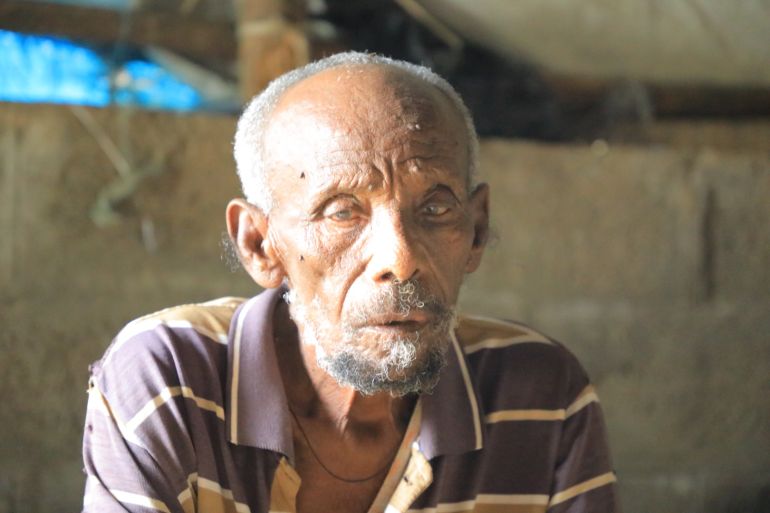
Nireayo Wubet, 88, recently spends a lot of his days burying friends and family members in Tigray, Ethiopia. As he grieves, he worries about whether there will be anyone left to offer him a decent burial when the time comes, as severe hunger ravages a large swath of his village in Ethiopia’s northern Tigray region.
The octogenarian laments that his frailty appearance in his village of Hitsats, close to the Eritrean border, is similar to that of many others. “We have little humanitarian support,” he laments. He asserts that famine is the cause of conflict rather than conflict.
Recommended Stories
list of 3 itemsend of list
After fleeing conflicts and ethnic strife that had caused him and others in the area to flee, Wubet fled to Hitsats four years ago, where he was once a proud farmer from Humera, which is currently a disputed area in the Amhara region.
He was first displaced in the middle of the Tigray war, which started in 2020, killing thousands of people and displacing millions more. Even after the conflict ended in 2022, he was unable to come home and reclaim his life.
A desolate village known as Hitsats is now supported primarily by humanitarian organizations, including USAID, which was once Ethiopia’s main source of humanitarian aid.
But that changed abruptly a year ago when US President Donald Trump took office and promptly demolished the agency’s work and cut funding across the globe.
Up to 80% of Tigray province’s population needs emergency assistance, according to humanitarian organizations like the World Food Programme (WFP). However, the USAID cuts mean that overall, there is less humanitarian funding available, and what remains are frequently directed to disasters and conflict areas that are viewed as worse emergencies.
Medical aid organisation Doctors Without Borders, known by its French initials MSF, which assists vulnerable populations in Ethiopia and across the Horn of Africa region, notes that the US cuts “upended global health and humanitarian programs around the world” in 2025.
In a statement released this week, MSF stated that “the human costs [around the world] have been catastrophic.
According to the report, aid failures in Somalia caused shipments of therapeutic milk to halt for months, leading to a rise in child malnutrition cases at the MSF clinic there. In Renk in South Sudan, funding cuts caused a hospital staff to stop supporting maternity care, and in the Democratic Republic of the Congo, the destruction of USAID caused the cancellation of an order for 100, 000 post-rape kits, which included medication for preventing HIV.
In Ethiopia, which used to be the largest recipient of USAID funds in sub-Saharan Africa prior to Trump’s cuts, the funding shortfalls have created critical gaps and put more pressure on other organisations.
According to Joshua Eckley, MSF’s head of mission for Ethiopia, “donor funding cuts have put additional strain on an already fragile public health system.”
The most vulnerable are having less access to medical care, water, and sanitation services as aid organizations reduce or suspend operations in the area as a result of budget constraints, while overall humanitarian needs are continuing to outnumber the collective capacity.
Like pouring a glass of water into a lake.
Wubet and others in his community are still dealing with the effects of the humanitarian aid cuts, which have caused even more destruction to already struggling communities.
Terfuneh Welderufael was displaced from the town of Mai Kadra during the Tigray war.
Since 2022, the 71-year-old has resided in Hitsats. He claims that the village suffers from severe hunger and that it’s unusual to find anyone who hasn’t intermented a loved one in the past year.
Abraha Mebrathu, the coordinator of a government-run camp housing about 1, 700 internally displaced persons (IDPs) in Hitsats, says he has witnessed minimal humanitarian aid entering the village. He acknowledges that many civilians are dying and that there appears to be little support for those who continue to suffer.
He claims that because the death toll rate is too high, they no longer collect data on the victims, and that their main concern is now to advocate for those who are still alive.
“We have had little support, and the need is overwhelming”, he told Al Jazeera. The majority of the land is not arable, and people who have been displaced are unable to cultivate food there. He claims that the majority of people are “waiting for their turn to pass away.”
To make matters worse, many local humanitarian workers have not been paid for the last year, and Mebrathu says most are starving like many of their neighbours.
Due to budget cuts as a result of USAID’s reduced role in Ethiopia, the situation in Hitsats has been worsened by the WFP office’s abrupt closure, which is home to one of the largest IDP populations in the country.
Many claim little has been done to areas like Tigray, whose economies, as well as population, remain devastated by years of conflict, despite the US government’s suspension of USAID in Ethiopia.
“While little support is starting to come to Hitsats, with close to 2, 000 people in dire and urgent need, it’s like pouring a glass of water in a lake”, Mebrathu says.

Watching people “die from a distance”
In the absence of USAID support, some Ethiopians decided they wanted to help.
Online influencers from Tigray’s provincial capital Mekelle and Addis Ababa launched a wave of support for internally displaced and vulnerable civilians last month.
The Ethiopian government, however, warned citizens against raising money and making direct donations to those affected there, including Hitsats, and that they were already sending plenty of resources there. The government has yet to officially acknowledge that there is a severe hunger crisis occurring. According to observers, the main goal of the project is to portray Ethiopia as a positive, aspirational nation while avoiding narratives that might portray it as dependent or helpless.
Adonay, a popular influencer, had joined others to raise money for the Hitsats residents, but their effort was cut short because they feared reprisal from the authorities.
Another influencer involved in the fundraiser, speaking on condition of anonymity, told Al Jazeera, “We went to the area most affected by the famine, we had the will and ability to save lives and collect scarce resources, and it hurts that we cannot do that and we are forced to watch them die from a distance”.
The Ethiopian government maintains that the Horn of Africa country has adapted to feed its impoverished populations, but critics object to this claim.
While WFP claimed that more than 10 million Ethiopians were in famine, Prime Minister Abiy Ahmed told parliamentarians in 2024 that “there are no people dying due to hunger in Ethiopia.”
Last year, Abiy announced the creation of EthioAid, similar to USAID, to help neighbouring nations facing famine, including war-torn Sudan, which received $15m from the Ethiopian government.
The Ethiopian Disaster Risk Management Commission, a federal agency tasked with coordinating disaster relief, has refuted reports of widespread starvation in towns like Hitsats and other parts of the country. More than 15 million Ethiopians are in need of emergency food aid in spite of the shrinking international humanitarian aid, according to the most recent forecasts from the Famine Early Warning Systems Network.
The government agency said it recently distributed food aid worth the equivalent of $1.8m to the Tigray provincial government, blaming them for misappropriation and distribution problems. However, the provincial government disputes this assertion.
Gebrehiwot Gebre-Egziahber, the head of the Tigray Disaster Risk Management Commission, claimed that the provincial government had been forced to slash funding for humanitarian aid in the region’s most extreme locations, primarily in rural areas where a large population is severely infected.
Despite Addis Ababa’s insistence that the situation is stable, with dwindling international humanitarian aid and an overwhelming hunger crisis causing people to flee in desperation, this month the government belatedly announced that it will soon launch a new tax system on fuel and telecommunications to help fund local initiatives to curb the impending famine that many say is in Ethiopia’s future.

Not enough burial space available
Almaz Gebrezedel, 71, has lived in Hitsats for four years. She searches the neighborhood for any assistance from strangers and the few organizations that have assisted her. She competes for what is readily available, which is primarily leftovers from nearby restaurants because there are so few resources in the village.
She says many people are just falling like leaves, with little humanitarian support in the village aside from small donations from local organisations with little financial means.
In a makeshift shelter underneath a torn tent, her next-door neighbor, Marta Tadesse, is bedridden, ill, and hungry.
The 67-year-old widow claims she has HIV, that her children abandoned her when they sought better opportunities elsewhere, and that she has been forced to live on her own.
Her HIV medication was provided to her courtesy of PEPFAR, the US President’s Emergency Plan for AIDS Relief, which was initiated in 2003 by former President George W Bush. Millions of people worldwide are now receiving the aid thanks to it, but Tadesse and millions more do not.
Tadesse claims that her top priority is now food because hunger has become a constant issue, but she also mentions that she has medical needs as well.
Tadesse predicts she will die a silent death amid her neighbours, who are facing a desperate and deteriorating situation.
The burial sites are being quickly filled up, according to a deacon in a church with a view over the village, Yonas Hagos.
It’s obvious that we will soon be running out of space, he says, “with the many residents who are dying constantly, mostly as a result of hunger.”
Source: Aljazeera

Leave a Reply