To play this video you need to enable JavaScript in your browser.
- 97 Comments
Liam Rosenior is the fifth full-time head coach to take charge at Chelsea in five years, but what will the new boss bring to Stamford Bridge?
The former Strasbourg manager has said he wants fans “to be off their seat in the first 10 minutes” of every match, but doing so with a Blues side who have gone five games without a win provides a challenge.
How Rosenior sets up out of possession
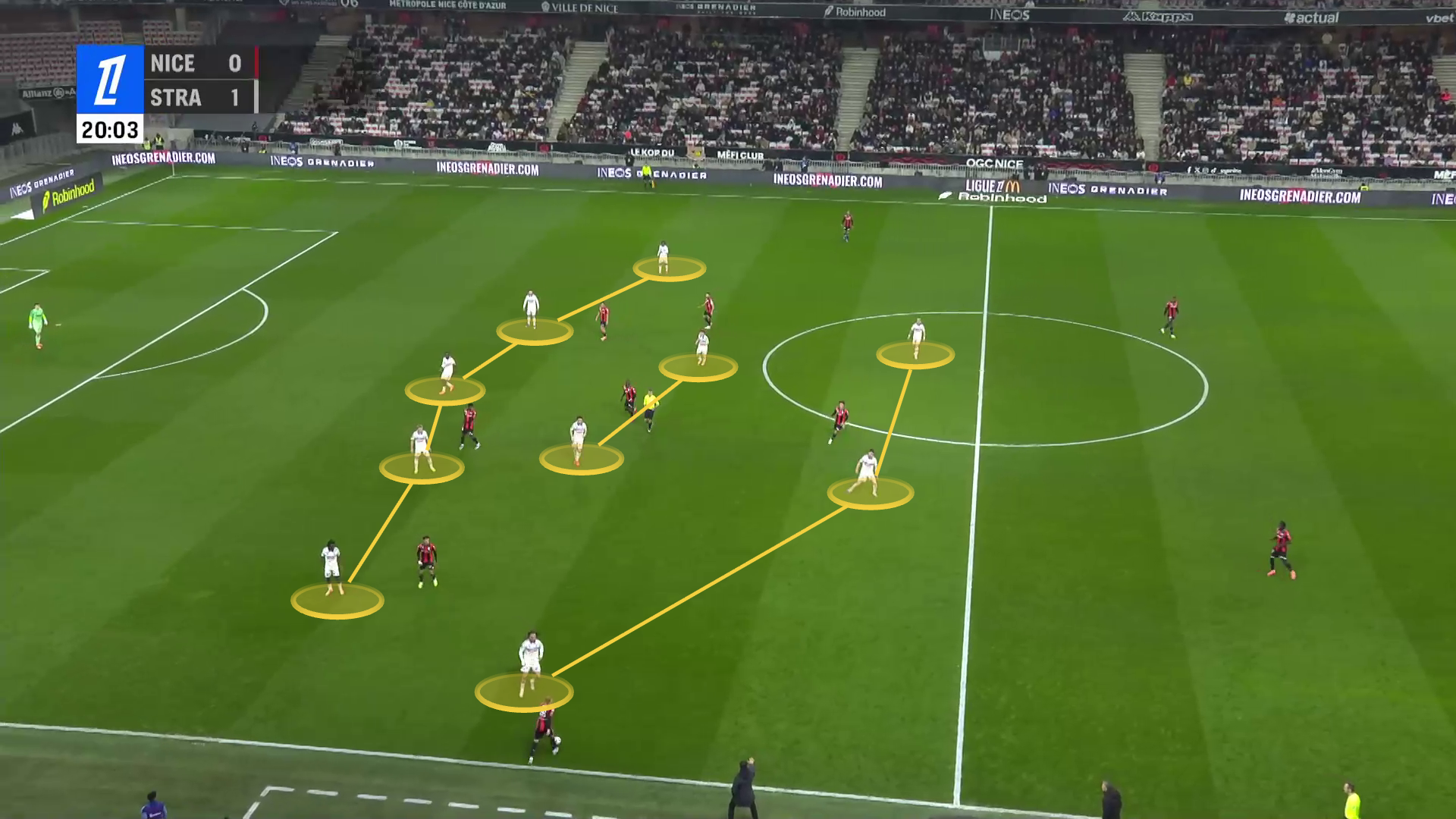
From his time in charge of Hull City and Strasbourg, we have a strong idea of how Rosenior likes to set up his teams, with an emphasis on stopping opponents having a numerical advantage on the last line.
When rivals put five players in attack, with two wide players, two attacking midfielders and a striker, Rosenior’s sides adopt a back-five shape while defending near their goal.
This can mean a five made up of three central defenders and two wing-backs, but sometimes Rosenior will create a back five by asking one of his wingers to drop in alongside the back four.
At Chelsea, a winger like Pedro Neto may be asked to do this role given his work-rate.
Higher up the pitch, Rosenior’s Strasbourg tended to maintain this 5-2-3 shape, applying more intense pressure when looking to win back possession.
On occasion, from a higher defensive position, the team may press from a 4-4-2 starting shape. This is usually done if the opposition build with a back four rather than a back three.

How Rosenior sets up in possession
Rosenior’s in-possession tactics are perhaps the most interesting part of his strategy. His side move into a 3-2-2-3 shape when they have the ball, irrespective of how many natural defenders they have on the pitch.
A good reference point is the shape that his predecessor, Enzo Maresca, deployed at Chelsea. Maresca also elected for a 3-2-2-3 shape that became a more attacking 3-1-6 at times.

The midfield two in front of the back three is where Rosenior’s version of the 3-2-2-3 differs from Maresca’s.
The former Blues boss often opted to invert a full-back, alongside Moises Caicedo, to form a midfield two.
Rosenior prefers both players here to be starting central midfielders.
By avoiding players having to swap roles, this appears to be a safer approach as it reduces the likelihood that the middle of the pitch may be exposed at any time.
The new head coach will need to consider who best fits the role directly alongside Caicedo.
Chelsea’s right-back and captain Reece James may even be considered for a central midfield role under Rosenior.
Having coached Andrey Santos at Strasbourg last season, Rosenior will also know how to get the best out of the Brazilian in midfield, so he could be a contender.
How Rosenior uses multiple attacking variations
The two attacking midfield positions and the two wide positions allow Rosenior to experiment.
These four roles are often occupied by any combination of the wingers, full-backs or wing-backs.
If the wide defenders are impressive in the centre of the pitch, Rosenior will give them licence to move into positions behind the striker – like Maresca used Marc Cucurella and Malo Gusto at times. This would work if paired with wingers who are strong dribblers and hold the width.
Alternatively, if the forwards selected are better moving inside – such as Cole Palmer or Estevao Willian, then playing with wide defenders suited to hugging the touchline makes sense.
Rosenior has also used one full-back and one attacker in the central attacking positions, with the other full-back and attacker in the wide attacking positions. For Chelsea, this may look like Cucurella and Palmer playing behind the striker with Garnacho and Gusto out wide.

How Rosenior uses his goalkeeper
From goal-kicks and in build-up, Rosenior’s Strasbourg keeper Mike Penders was heavily involved in play, something that Robert Sanchez will need to get to grips with.
Strasbourg often set up in a 5-2-4 shape from goal-kicks if you include the goalkeeper as being part of the first line of defence, opting to play risky short passes.
The idea is to entice the opposition to press with many players, which in theory opens space for Rosenior’s sides to attack higher up the pitch.


This approach looks great when it works.
However, errors at the back leading to goals are relatively common. Strasbourg have the joint-most errors leading to goals in Ligue 1 this season.
With better players at Chelsea, the hope is that these errors will be reduced, but pressing in the Premier League is arguably more effective than anything Rosenior will have faced so far.
Some teams have decided against pressing Rosenior’s side intensely. When teams defend in a mid or low block, Strasbourg play many sideways passes between the back line.

Against compact defences, Strasbourg kept the ball well but struggled to break teams down. The 3-2-2-3 shape meant they were well placed to defend if they lost possession by putting five players behind the ball, but this would leave only five players to attack.
High potential but even higher pressure
It is clear that Rosenior is an impressive young coach with clear principles, but there will naturally be questions around how his system may scale to the Premier League.
Goalkeeper Sanchez’s passing will be tested, and seeing whether the English coach persists with his shape and tactics will be interesting, if errors occur.
The Premier League possesses teams and coaches that are quick to figure out and adapt to opposition plans.
It would not be a surprise to see teams sit off Rosenior’s Chelsea, challenging them to break them down.
With any new manager, time and patience is needed.
Related topics
- Chelsea
- Premier League
- Football
- 1 day ago

- 19 hours ago

- 6 days ago




Source: BBC

Leave a Reply