Guineans will vote on Sunday in a likely-surprising manner four years after military leader General Mamady Doumbouya led a coup that overthrew the country’s fragile democracy and toppled its civilian government of the day.
The young military leader, known for his signature wraparound sunglasses, is widely expected to win the vote on December 28 and solidify his hold on power in the resource-rich West African nation, as key opposition figures have been barred from participating.
Recommended Stories
list of 4 itemsend of list
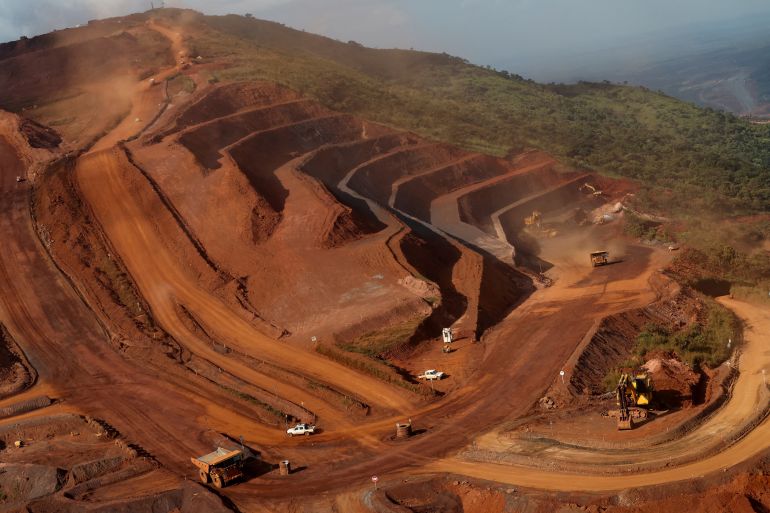
Guinea, the largest exporter of bauxite, a crucial component of aluminum, and has a population of 15 million people. Doumbouya’s government is banking on its vast mines, especially the mega Simandou mine – one of the largest iron ore projects in the world, to create more jobs and revenue in the coming years. The nation has a lot of uranium, gold, and diamond deposits.
Doumbouya has gained some support due to new policies that have boosted mining exports. The general’s opponents, however, dispute his legitimacy, citing both his previous election-run pledge and his various media and protest bans.
The 2021 coup destabilised Guinea’s democratic trajectory. Guineans only voted in the first truly free and fair elections since independence from France in 1958 after decades of coups and dictatorships. The coup also caused suspensions from the African Union and sanctions from the regional Economic Community of West African States (ECOWAS) bloc.
Conakry, a coastal city in Guinea, serves as its capital. Most Guineans practise Islam (85 percent), while others are Christians and animists (15 percent). Although there are more than two dozen ethnic groups, the Fulani, Peul, Malinke, and Soso are the largest. The country is known for being the source of the Niger River, which flows through several countries and empties into the Atlantic Ocean through Nigeria.
How does voting work?
About 6.7 million eligible voters over the age of 18 have registered for the election. There are 23, 662 polling stations.
For a seven-year term, the president will be elected by an absolute majority vote through a two-round process.
A high turnout is expected based on the 87 percent of voters who turned up for a referendum held in September. More than 90% of those who voted “yes” to a new constitution, which increases the presidential mandate from five to seven, and creates a senate, where a third of the members would be presidential appointees, were largely seen as a test of Doumbouya’s popularity.
Nine presidential candidates have been cleared to run, although the major opposition challengers who stood a real chance were barred on technicalities. None of the eight opposition candidates has strong political standing. Candidates took part in an evening series on state television where they debated each other’s proposals weeks ahead of the vote.
Campaigns began on November 28 and ended midnight on December 25. Doumbouya largely stayed off the campaign trail, although his ministers travelled across the country, urging civilians and the military to vote at large rallies that featured musicians and attracted young people. This week, a private businessman also held a carnival in Conakry in aid of Doumbouya.
About 10, 000 election observers from the Economic Community of West African States (ECOWAS), the European Union, the United Nations, the International Organisation of the Francophonie and several other organisations will be present.
Who has been excluded?

Cellou Dalein Diallo, 73
Diallo, a long-standing opposition leader, was going to be Doumbouya’s most formidable challenger. The former prime minister (2004-2006) heads the Union of Democratic Forces of Guinea (UFDG). He contested the elections of 2010 and 2015, but his archrival, Alpha Conde, won both of them. When the coup leaders seized power in 2021, Diallo welcomed the move and pledged his willingness to work with them in restoring democracy.
However, when Diallo was the transport minister, the Doumbouya government began a corruption investigation against him in relation to the sale of Air Guinee, the country’s national carrier, in 2002. Diallo, who accused the military ruler of a witch-hunt to block him from elections, has since been forced into exile in neighbouring Senegal and in France. His party was one of three suspended in August due to “substantial deficiencies” in the documents they submitted, according to the Ministry of Territorial Administration, the body’s representative, as opposed to an independent elections commission. Diallo was also disqualified based on his residency, as the new constitution adopted in September requires that presidential candidates have their primary residence in the country.

Alpha Conde, 87
After serving two five-year terms, Conde’s decision to run for a third term in 2021 caused chaos in Guinea and led to the coup in September.
A longtime opponent of military regimes in the country, Conde promised to strengthen democracy upon his election in 2010, after polls that, despite being turbulent, were also a chance for the country to depart from decades of dictatorship. In a free election, he became the first Guinean president to be elected. His government oversaw improvements in the mining sector and managed the 2014 Ebola epidemic, but is also accused of gross corruption and mismanagement.
He won a referendum in March 2020, pushing him to seek two more terms, claiming it raised his cap. The move led to widespread protests across the country that turned violent as the police and army attempted to shut them down, leading to dozens of deaths. At least 30 people were killed during the election in October 2020 as a result of the unrest. In September 2021, Conde was deposed and arrested by a group of soldiers led by Doumbouya, whom he had appointed in 2018 as head of the elite Special Forces Group. In Turkiye, it is thought that he is reportedly in exile. Conde’s Rally of the Guinean People (RPG) was one of the parties suspended in August because it had “not fulfilled the obligations required”, according to the authorities.
Sidya Toure, 80
The former prime minister (1996-1999) is another well-known opposition figure who has been sidelined. With 13% of the vote, he finished third in the historic elections of 2010. Toure is the leader of the Union of Republican Forces (UFR). He has spent a number of years living in exile in the Ivory Coast, and because of his foreign residency, he was exempt from the elections.
Who is running?

General Mamadou Doumbouya, 41
The incumbent is the clear favorite to win the elections, and activists and opposition parties accuse him of using the vote to legitimize and secure his rule.
Doumbouya took power in the September 2021 coup, deposing then-president Alpha Conde after months of tension and protests. He vowed to bring democracy into the country and end the hostility.
The regional ECOWAS bloc has pressured Doumbouya to present a fast transition timeline. Initial promises of an 18-month transition were made by the military ruler, who then largely ignored two deadlines and continued to do so. However, ECOWAS, while keeping up pressure, has not been overly critical. Contrary to his fellow countrymen in Mali, Niger, and Burkinabe, who were under pressure to hold elections after their coups, rebuffed ECOWAS by disbanding the alliance and creating a new one in January. ECOWAS is wary of antagonising Doumbouya and possibly causing Guinea to join the rival alliance.
Local news reports and civil society organizations claim that the Doumbouya government has since 2022 restricted local news organizations, banned protests, and targeted activists who were arrested. A week before the elections, authorities also blocked Facebook.
More than 2, 250 kilometres of new roads, schools, and hospitals have been constructed, according to the military ruler’s supporters. They also point to the launch of the mega Simandou iron ore mine project, which saw its first iron ore exports this year, 30 years after it was licensed to operate.
International interest has been piqued by the project. Analysts say that’s partly why Western governments, with whom Doumbouya has maintained a friendly stance even as Conakry ramps up trade with China, are careful not to criticise his hold on power.
The president has promised to increase the infrastructure improvements made over the past four years as campaign posters of the smiling Doumbouya are plastered across Conakry’s streets and in Kankan, his political stronghold. He has also pledged to build better democratic institutions, fight corruption, boost health and education access, and support women and youth. He is a candidate for the GMD movement, or Generation for Modernity and Development.
Others are:
- Former minister of education under Alpha Conde and former World Bank economist Aboulaye Yero Balde Balde is running under the Front for Democracy in Guinea (FRONDEG).
- The Front for National Alliance (FAN) party’s only female candidate, Makale Camara, is its president. She has promised better access to water and electricity, and wants to diversify the economy beyond mining. She served from 2016 to 2017 as a former foreign minister.
- Faya Millimono – the head of the Liberal Bloc party. He initially supported the military coup, but he now antagonizes Doumbouya because he was critical of Conde.
- Ibrahima Abe Sylla – the former energy minister under the military government, is running under the New Generation for the Republic party. He previously ran in 2020 and 2010.
- Abdoulaye Kourouma – the 2020 presidential candidate and former parliamentarian, is running under the Rally for Renaissance and Development party.
- Mohamed Nabe, a member of regional electoral missions, is an expert on electoral issues. He will run under the Alliance for Renewal and Progress party.
- Former parliamentarian Elhadj Bouna Keita is the RPG’s leader, R.P.G.
- Mohamed Cherif Tounkara – is running as an independent candidate.
What are the main problems?

The economy and mining
Guinea remains a poor country despite its immense mineral wealth. The International Labour Organization claims that the literacy rate is low and that about half of the workforce is unemployed.
Much hope for change hinges on restructuring in the mining sector to unlock lucrative deals for the country. Due to Doumbouya’s government’s reliance on the Simandou mine, which Chinese and Australian companies own stakes in, to provide sufficient funds to fund additional infrastructure and amenities. The first shipment from the mines left for China early in December, after a newly constructed railway allowed for ore to be transported out of the remote Simandou highlands to the port of Conakry. Many Guineans are optimistic about the proceeds, but there are also concerns that the government’s continued corruption could stifle the industry. Many are also concerned about the fate of the thousands of construction workers employed at the mine once building projects are complete.
Justice for the stadium massacre on September 28
In 2009, former military leader Moussa Dadis Camara, who seized power in 2008, oversaw the massacre of protesters who gathered in their tens of thousands at a stadium in Conakry to call for democratic rule. In an effort to halt their protests, Camara’s forces opened fire on the demonstrators. Many were shot, while others were crushed in the ensuing stampede. During the massacre, 109 women and girls were raped, and at least 156 were killed. It was one of the country’s most tragic events.
Camara, who eluded a coup and attempted assassination attempt months later, has long been a target of the yearned for justice and a trial in Guinea. Doumbouya’s government launched a 22-month-long trial against him, and a court convicted Camara and seven of his military commanders in July 2024. The verdict was hailed as a landmark case for justice by rights organizations. Camara was handed a 20-year sentence, and he and the others were ordered to pay compensation to the victims of the massacre. To the detriment of the victims and rights activists, Doumbouya pardoned Camara on alleged health grounds in March, just one year later.
Source: Aljazeera

Leave a Reply