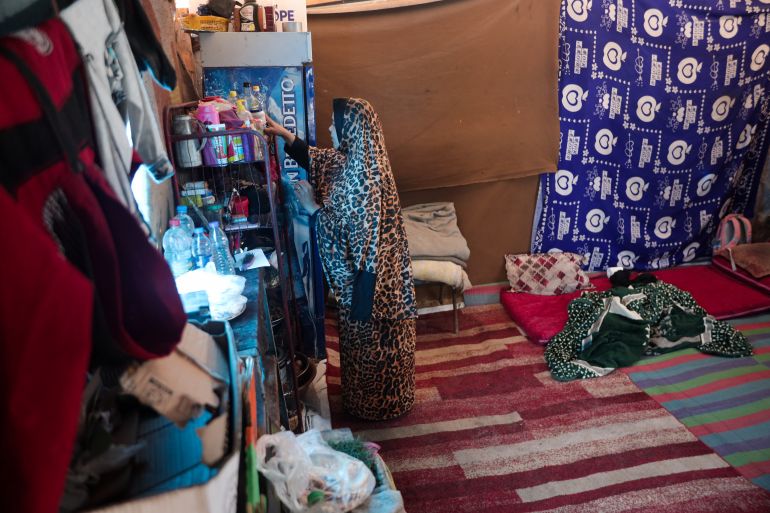
Sanaa Issa tries to steal a moment with her daughters in her tent made of fabric sheets and a roof covered in white plastic tarp.
Sanaa spoke to Al Jazeera as the new year approached, and with a ceasefire officially in place in Gaza. Sanaa is not particularly optimistic about the rain that is pouring down on her as she lies on a wet blanket in a tent.
Recommended Stories
list of 3 itemsend of list
“We didn’t know whether to blame the war, the cold, or the hunger. We’re going through a difficult year in the Gaza Strip, Sanaa told Al Jazeera, describing the hardship she and other displaced Palestinians have endured.
Amid worsening humanitarian conditions, the once-ambitious hopes of Palestinians in Gaza, dreams of a better future, prosperity, and reconstruction, are gone. Basic human needs are securing flour, food, and water, bringing them tents to a shelter from the cold, getting medical care, and just surviving bombardments.
For Palestinians like Sanaa, hope for the new year has been reduced to a daily struggle for survival.
After her husband was killed in an Israeli strike in November 2024, at the conclusion of Israel’s first year-long genocidal war on Gaza, Sanaa, a 41-year-old mother of seven, was solely in charge of raising her children.
“Responsibility for the children, displacement, securing food and drink, making tough decisions here and there. Sanaa, who escaped from al-Bureij to Deir el-Balah with her family in central Gaza, said, “Everything was required of me at once.”
Sanaa’s biggest challenge in 2025 was securing “a loaf of bread” and getting her hands on even a kilogram of flour every day for her family.
“I slept through the famine and had one wish when I woke up, enough bread for the day.” I felt I was dying while my children were starving before me, and I could do nothing”, she said bitterly.
Sanaa made the decision to travel to the Gaza distribution points for GHF aid that were later established with US support at the end of May.
“At first, I was scared and hesitant, but the hunger we live through can force you to do things you never imagined”, Sanaa said, describing her weekly visits to the aid points.
It was inherently risky to visit the sites that the US and Israel supported as alternatives to long-established aid organizations. More than 2, 000 Palestinians were killed in and around GHF sites, according to the United Nations, before the GHF officially ended its mission in late November.
However, visiting the sites left behind behind in Sanaa’s life was more than just a risk to her. It was also a path that “took away her dignity,” leaving behind lasting scars.
On one occasion, Sanaa was hit by shrapnel in her arm while waiting for aid at the Netzarim distribution point in central Gaza, and her 17-year-old daughter was injured in the chest at the Morag point east of Rafah.
However, she continued to try even though she started going alone and leaving her children behind in relative safety because of her injuries.
Desperation
The conflict in Gaza caused severe food and humanitarian aid stops, the last of which started in late March of this year, leading to the outbreak of a famine. It continued until October 2025, gradually easing after the ceasefire announcement.
The UN’s official declaration of famine for this time, which confirmed that parts of Gaza were in severe need of food, water, and medicine, as well as high rates of malnutrition in pregnant women and children.
Thousands of residents had to search for food using dangerous methods, including by waiting for long hours at the GHF sites.
“Hunger didn’t last for a day or two, so I had to come up with a solution,” Sanaa said. “Each time, people crowded in their hundreds of thousands. Hundreds of thousands of displaced people, including men, women, children, old and young, would spend the night there.
“The scenes were utterly humiliating. Bombing, heavy gunfire, pushing, and fighting among the public over aid, all combined.
The crowds meant that Sanaa often returned to her tent empty-handed, but the rare times she brought back a few kilos of flour felt like “a festival”, she recalled.
I once received five kilograms [11 pounds] of flour. I cried with joy returning to my children, who hadn’t tasted bread for days”, she added.
![Sana’a sits with her children inside their tent, holding on to hope that living conditions will improve in the coming year [Abdelhakim Abu Riash/ Al Jazeera]](https://i0.wp.com/www.aljazeera.com/wp-content/uploads/2025/12/873A1784-1767206217.jpg?w=696&ssl=1)
Sanaa divided the five kilos over two weeks, sometimes mixing it with ground lentils or pasta dough. She said with a sense of humour, “We wanted to recite a spell over the flour so that it would multiply.”
A heavy silence followed as Sanaa adjusted the plastic tarp over her tent against the strong wind, then said:
“We had unimaginable humiliation to our credit.” All this for what? For a loaf of bread, please! she added with tearful eyes. They might have felt more compassion for us if we were animals, they might have said.
Despite the hardships she has endured and continues to face, Sanaa has not lost hope or her prayers for Gaza’s future.
“Two years are sufficient. Each year has been harder than the previous one, and we are still in this spiral”, she added. We want life and reconstruction, gas cylinders to cook food in instead of wood, and shelter in the winter.
“Our basic rights have become distant wishes at year’s end”.
![Batoul Abu Shawish, 20, lost her entire family in an Israeli strike that targeted their home in Nuseirat during the ceasefire in November 2025 [Abdelhakim Abu Riash/ Al Jazeera]](https://i0.wp.com/www.aljazeera.com/wp-content/uploads/2025/12/873A1950-1767206334.jpg?w=696&ssl=1)
The only survivor
One of the over 71, 250 Palestinians killed by Israel during the war was Sanaa’s husband.
Twenty-year-old Batoul Abu Shawish can count her father, mother, two brothers and two sisters – her whole immediate family – among that number.
Batoul wishes for only one thing in the new year: family.
Her heartbreaking loss came just a month before the end of the year, on November 22.
An Israeli bomb went off at the home where her family had fled in the Nuseirat refugee camp in central Gaza despite the ceasefire.
“I was sitting with my two sisters. She recalled describing the day as her brothers were in their room, my father had just come back from the outside, and my mother was cooking food in the kitchen.
“In an instant, everything turned to darkness and thick dust. Due to the shock, Batoul continued as she stood next to the ruins of her destroyed home, not even knowing what was happening nearby.
She was trapped under the debris of the destroyed home for about an hour, unable to move, calling for help from anyone nearby.
“I was in shock at what was happening. I wished I were dead, unaware, trying to escape the thought of what had happened to my family”, Batoul said.
“I called for them one by one, but no sound came.” My mother, father, siblings, no one”.
She was immediately transported to a hospital after being saved, where she had sustained hand injuries.
“I was placed on a stretcher above extracted bodies, covered in sheets. I became enraged and asked my uncle, “Who are these people? ” who was there with me. He said they were from the house next to ours”, she recalled.
Before Batoul could learn what had happened to her family, she was immediately taken into emergency surgery on her hand.
“I kept asking everyone, ‘ Where is my mom? My dad’s whereabouts? They told me they were fine, just injured in other departments”.
Batoul continued, “I didn’t believe them, but I was also afraid to call them liars.”
The following day, her uncles broke the news to Batoul that she had lost her mother and siblings. They informed her that her father was still in the intensive care unit, which was a critical condition.
“They gathered around me, and they were all crying. She said, “I fully comprehended.”
“I broke down, crying in disbelief, then said goodbye to them one by one before the funeral”.
Three days after the incident, Batoul’s father succumbed to his injuries, leaving her to face her grief.
“I used to go to the ICU every day and whisper in my father’s ear, asking him to wake up again, for me and for himself, but he was completely unconscious”, Batoul said as she scrolled through photos of her father on her mobile phone.
It appeared to me as though the world had completely disappeared before his death.
![Batoul holds a photo on her phone showing her with her family, including her father, mother, and siblings Muhammad, Youssef, Tayma, and Habiba [Abdelhakim Abu Riash/Al Jazeera]](https://i0.wp.com/www.aljazeera.com/wp-content/uploads/2025/12/873A2057-1767206534.jpg?w=696&ssl=1)
Where has the ceasefire been?
Israel said that it conducted the strikes in Nuseirat in response to an alleged gunman crossing into Israel-held territory in Gaza, although it is unclear why civilian homes in Nuseirat were therefore targeted.
Around 2, 613 Palestinian families were completely destroyed during the conflict in the Gaza Strip, up until the ceasefire was declared in October 2025, according to Gaza’s government media office and the ministry of health.
Those families had all of their members killed, and their names erased from the civil registry.
According to the same figures, approximately 5, 943 families were left with just one surviving member after the rest were killed, a painful illustration of the magnitude of social and human suffering the war caused.
These figures may change as documentation continues and bodies are recovered from beneath the rubble.
Batoul and her family were known for their strong bond and deep love for one another, making them nothing short of ordinary.
“My father was deeply attached to my mother and never hid his love for her in front of anyone, and that reflected on all of us”.
My siblings loved each other beyond words, and my mother was my closest friend. Our home was full of pleasant surprises and warmth”, she added.
We used to sit together, hold family gatherings, and support one another through so much of what we were through even before the war.
The understandable grief that has overtaken Batoul leaves no room for wishes for a new year or talk of a near future, at least for now.
However, she has a lot of questions to answer: why was her peaceful family targeted, especially during a ceasefire?
“Where is the ceasefire they talk about? She claimed that this is just a lie.
“My family and I survived bombardment, two years of war. We both fled together to this apartment block in eastern Nuseirat after it hit our home. We lived through hunger, food shortages, and fear together. Then, we believed the war had ended and that we had survived.
“But sadly, they’re gone, and they left me alone”.
Batoul aspires to join her family as soon as possible, a wish she has since birth.
At the same time, she carries an inner resignation that perhaps it is her fate to live this way, like so many others in Gaza who have lost their families.
A second-year university student studying multimedia, who is currently residing with her uncle and his family, said, “If life is written for me, I will try to fulfill my mother’s dream that I be outstanding in my field and generous to others.”
“Life without family”, she said, “is living with an amputated heart, in darkness for the rest of your life, and there are so many like that now in Gaza”.
![Batoul stands in front of the rubble of her destroyed home, where she was trapped for about an hour before being rescued when it was hit [Abdelhakim Abu Riash/ Al Jazeera]](https://i0.wp.com/www.aljazeera.com/wp-content/uploads/2025/12/873A1970-1767206634.jpg?w=696&ssl=1)
Source: Aljazeera

Leave a Reply