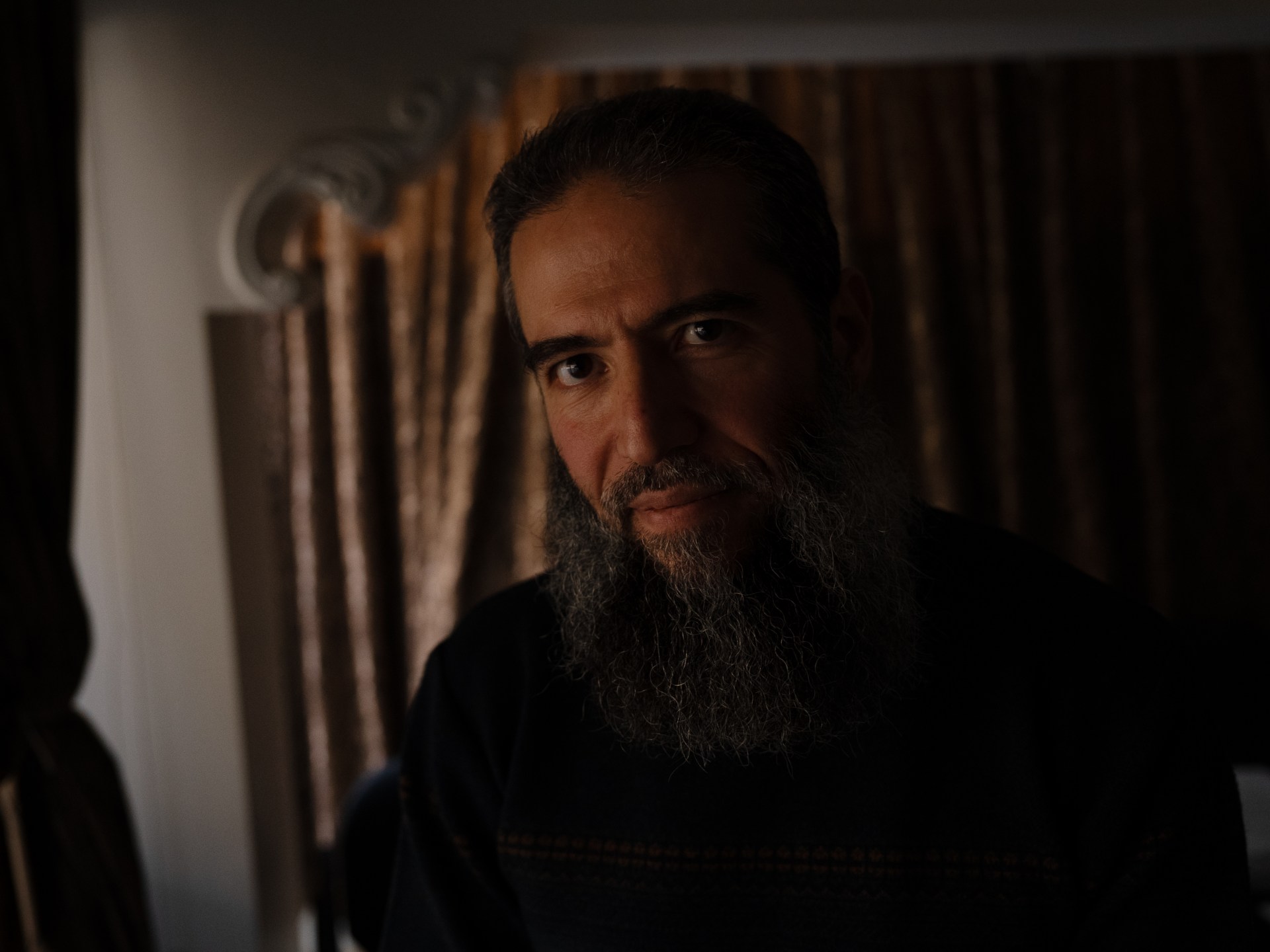
Damascus, Syria – Fouad Naal spent 21 years in prison under the regime of Bashar al-Assad.
He remained in the notorious Sednaya and Adra prisons until December 8, 2024, which was not only his liberation but also the liberation of Syria from al-Assad’s rule, he told Al Jazeera a day before the anniversary.
Recommended Stories
list of 3 itemsend of list
Tall and slim with a long salt and pepper beard, Naal, 52, speaks with enthusiasm and moves fluidly despite his years in confinement.
He was a practising imam before his arrest and holds his faith closely, he explains in the salon of his modest apartment in Damascus’s Muhajreen neighbourhood, a 10-minute walk from al-Assad’s former residence.
‘Tomorrow, I will get out’
On December 8, Syria celebrated the first anniversary of al-Assad fleeing Damascus for Moscow. His flight meant the end of five decades of al-Assad family rule, known for its brutality and ruthlessness.
Hundreds of thousands of people have disappeared in the al-Assad prison network. Even more experienced the brutal conditions and were left with physical or mental ailments, traumas or severe health conditions.
Naal said he was summoned by the regime “hundreds of times” before his arrest and imprisonment in 2004 for issuing a fatwa, a religious opinion, saying Syrians shouldn’t go fight the United States invasion in Iraq.
He and many others believed the Syrian state was encouraging Syrians to go to Iraq to fight against the US military, which had invaded the country in 2003.
Many Muslims Naal knew decided to go, but never made it to Iraq. The buses that had been provided to take them across the border into Iraq were bombed before leaving Syrian territory, he said.
Naal suspected the Syrian state was behind the attack on the convoy and put out his fatwa.
He was arrested with his wife and then-four-year-old daughter and given a life sentence. He said the regime accused him of planning to assassinate al-Assad and several other senior regime figures.
The charges were fake, he said, but he admitted to them under coercion to free his daughter and wife. He was sent to Sednaya, where he was held in what in later years would become known as the “Red Prison”.
He passed the time working out, reading and studying law. In 2005, after a full year in jail, he was allowed monthly visits.
Conditions in Sednaya were difficult. He recalled a time when his eyelid was inflamed but medicine was withheld. The prisoners were also not allowed to pray in groups or read the Quran together, he said.
Still, he never gave up hope of leaving prison. “I had a bag packed, ready to go, every single day,” he said.
“I always thought: ‘Tomorrow, I will get out.’”
The revolution begins
After Naal had been in Sednaya for seven years, the Syrian uprising began.
He and his fellow prisoners had been following the revolutions in Tunisia, Egypt and Libya but didn’t believe a similar event would happen in Syria.
“It was really surprising that in Syria this is happening,” he said.
“They were really great moments of joy. I was happy with the beginning of the revolution.”
In 2012, Naal said he was transferred from Sednaya to Adra Central Prison on the northeastern outskirts of Damascus, where he and other Muslims were put into a special political wing.
It seemed as though Sednaya was being emptied to receive Syrians who were being rounded up for opposing the regime.
In Adra, the conditions were easier. Naal was placed with other alleged Islamists. They could pray. They were granted weekly visits during which they got news of the outside world.
“Within a month of the first visits, everyone in the prison had one or two phones,” he said.
Furthermore, the prison administration in Adra was afraid of Naal and the other prisoners due to rumours that had spread about them. One day, a police officer approached him to ask about them. He was named Khadr, and Naal said he later defected and joined the opposition
“He said: ‘Can I ask you a question, sheikh?’ I told him: ‘Please.’
“He actually asked me if it were true that we used to cut off the heads of officers in Sednaya and play football with them.”
‘Hey, you animals! Open the doors!’
On December 7, 2024, Naal said he and his fellow inmates knew anti-Assad forces were heading their way. The excitement was palpable, and some prisoners suggested trying to break out.
“People couldn’t bear it any more,” he said.
By now, the prisoners knew that Aleppo had been liberated and were eagerly anticipating the rebels’ arrival in Homs, Syria’s third-largest city.
Naal was awoken by the smell of coffee being made by his fellow prisoners sometime in the wee hours of December 8, 2024. The prisoners were anxious but excited.
At one point, Naal rang a bell that alerted the guards that a prisoner was in need, but no one responded. He rang again and, again, nothing.
Although swearing was forbidden in the prison, Naal began swearing at the guards to try to elicit a response.
“Hey, you animals! Open the doors!”
At one point, a prisoner who could see out a window spread the news that the prison guards had lined up and were leaving the prison.
Shouts of “God is greatest” spread around the prison. The excitement began to grow to the point that Naal said inmates began breaking the prison doors themselves.
But the trauma that some of the prisoners suffered was so high that they were begging others to keep the doors locked, fearing repercussions. Some, he said, hid under their covers.
Others felt there was no turning back and continued breaking down their cell doors.
When they broke out of their cells, the prisoners found guard uniforms scattered on the ground as they ran to the prison’s weapons depot.
“People shot in the air out of joy,” Naal said.
The prisoners moved away from the prison and found an abandoned checkpoint. “There was a pot of mate still boiling on the burning wood,” he said. “Guns were on the ground next to abandoned military uniforms.”
As they continued walking, Naal said he and his fellow prisoners encountered soldiers. Some had removed the tops of their uniforms but kept their pants. Instead of firing at them, the soldiers were telling the prisoners: “We are with you. We are with you,” Naal recalled.
Naal said the power of this moment appeared to be a gift from the divine.
“You feel that even a person who has no faith in God Almighty would feel that there is a greater power than himself.”
A similar prison for al-Assad in exile
Naal emerged from prison in much better physical condition than others who were in al-Assad’s prison system for shorter sentences.
“I exercised every day in prison,” he told Al Jazeera.
“I’m 51 years old,” he said, then corrected himself.
“I’m 52, but I still associate myself with the age I was when I left prison.”
But he has not emerged unscathed. He pointed to the closed door of the small room where he was giving the interview.
“I don’t like closed places. I don’t like it in general, but I don’t get affected by it psychologically,” he said.
“I don’t want to sleep with a closed door. I’m not upset, but I prefer to have it open,” he said.
He also said he and many of his fellow prisoners struggled to sleep after they escaped prison because they’d grown accustomed to the quiet there.
Just a couple of days before this interview, he revisited Sednaya Prison with a group of Syrians and Ukrainians. The visit was emotionally fraught for him, but he recognised its importance for finding justice for people in Syria and beyond.
“What does Bashar al-Assad feel today? He is listening to these words and sitting like a mouse hiding in a burrow in Russia. Even if this burrow is built of gold.
“We used to say that if the prison were a palace of gold, we still wouldn’t want it. We’d rather go home and live for an hour and die hungry for our freedom. Today, he is living the same way,” Naal said.
Before his imprisonment, Naal said he enjoyed doing everything at home. He used to not enjoy going to restaurants. “My mother raised me not to eat in front of people in case they couldn’t afford what I am eating,” he said.
“I’d prefer to get food and come back home to eat.”
Now, however, he enjoys leaving the house to walk around his neighbourhood. And he endures going to restaurants because he sees the value in sharing a communal experience in public, something that can’t be done in prison.
He also says it is important to remember that in Syria, “the children made a revolution.”
“The one who won the revolution was Hamza al-Khatib,” he said, speaking of the 13-year-old from Deraa who was likely brutally tortured to death by Syrian security forces for taking part in an anti-regime protest in 2011.
He also spoke of the teenagers in Deraa who graffitied a wall with the phrase “Your turn has come, oh doctor.” It referred to al-Assad, who studied ophthalmology in London.
“They were the trigger of this popular explosion, … the volcano,” Naal said
Source: Aljazeera

Leave a Reply