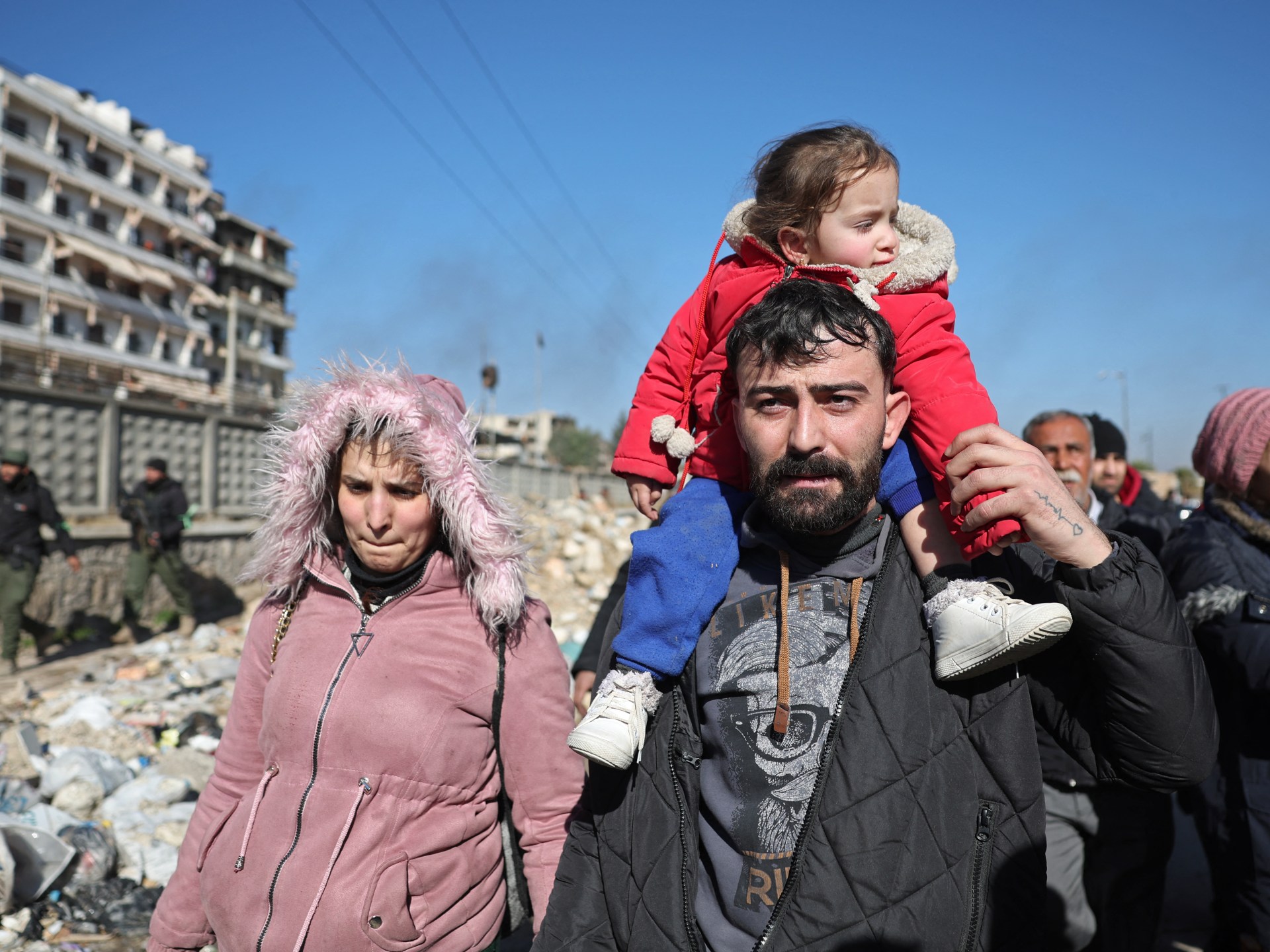
A drone has struck a governorate building in Aleppo, marking a sharp escalation in fighting between the Syrian army and the Kurdish-led Syrian Democratic Forces (SDF).
The drone, believed to be launched by Kurdish-led SDF on Saturday, hit the building as several high-ranking officials, including Aleppo’s governor and two Syrian government ministers, were holding a news conference inside.
Recommended Stories
list of 4 itemsend of list
The United States-backed SDF and the Syrian army have been battling for control of Aleppo’s Kurdish neighbourhoods this week. It was the first time the SDF had reportedly fired long-range drones into other areas of Syria’s second-largest city.
Reporting from Aleppo, Al Jazeera’s Resul Serdar Atas said the upper floors of the governorate building were blackened by the blast caused by the drone.
“While this was happening, Governor Azzam al-Gharib was delivering a press briefing, giving the latest developments and trying to inform the public about what is happening now, not only in Sheikh Maqsoud and Ashrafieh – where heavy fighting has been ongoing for four days – but also across the rest of the city,” he said, adding that it was not clear if there were any casualties.
The drone strike came shortly after the Syrian army announced it had suspended all military operations in Aleppo’s Sheikh Maqsoud neighbourhood.
Under the proposed agreement, the SDF fighters were to withdraw from the predominantly Kurdish area, surrender their weapons and be transferred to the town of Tabqa in northeastern Syria.
Syrian authorities said the deal was aimed at restoring security and preventing further bloodshed.
However, Kurdish authorities denied claims that the district had fallen fully under government control, with the SDF calling it “a blatant attempt to mislead public opinion”, saying their fighters were still repelling a “fierce attack”.
According to Syrian officials, government forces entered Sheikh Maqsoud on Saturday and carried out sweeps of the neighbourhood, confiscating weapons and detaining or disarming SDF fighters.
State media reported that several SDF members surrendered at Yassin Hospital and that the remaining fighters would be transferred to Tabqa. The army said it had completed operations to secure the area.
Kurdish-led authorities disputed those claims, saying fighting continued in parts of the district and that government forces had not established full control.
Thousands displaced
The renewed fighting has had a severe effect on Syrian civilians.
Nearly 180,000 people have been displaced from Sheikh Maqsoud and Ashrafieh neighbourhoods, where the fighting has been focused.
Health officials said at least 22 people had been killed since the latest escalation, including civilians, with dozens more wounded.
Authorities warned residents not to return to the affected neighbourhoods due to ongoing military operations and the risk posed by unexploded ordnance.
Both sides traded accusations of attacks on civilians and civilian infrastructure.
Kurdish forces accused pro-government factions of shelling areas near Deir Hafer, saying the attack killed a 10-year-old girl.
Syrian officials, meanwhile, accused SDF fighters of operating from civilian buildings, including hospitals, and using residents as human shields.
Since the fall of former President Bashar al-Assad’s regime in December 2024, efforts to integrate the SDF into state institutions and the Syrian army have repeatedly stalled.
The SDF rose to prominence as Syria began to fragment under the strain of civil unrest in 2011.
It was officially established in 2015, with the People’s Protection Units (YPG), a Kurdish militia linked to the Kurdistan Workers’ Party (PKK), forming the bulk of its fighting force.
In an agreement signed last March, the SDF and the then-interim Syrian government emphasised the unity of Syria, and stipulated that “all civil and military institutions in northeastern Syria” be merged “into the administration of the Syrian state, including border crossings, the airport, and oil and gas fields”.
The agreement aimed to bring the semi-autonomous region in northeastern Syria under the full control of the Syrian central government.
Since then, Kurdish leaders have expressed concerns over security guarantees and political representation, while Damascus has pushed to reassert control over all remaining autonomous areas.
Global concern
International actors have expressed concern over the renewed violence.
The US welcomed the reported ceasefire and called for calm, urging all parties to protect civilians and prevent further escalation.
Reporting from Damascus, Al Jazeera’s Ayman Oghanna said Washington can “do the most” to boost talks between the Syrian government and the SDF.
“The US has enjoyed a strong relationship with the SDF for over a decade. The US helped build up and train the SDF, it fought alongside the SDF, and 1,000 US troops remain in SDF territory where they work closely together in the effort to eradicate ISIL (ISIS) from Syria,” Oghanna said.
“But the US has also recently strengthened its ties with Damascus,” he added.
The United Nations also voiced alarm at the resumption of fighting, warning of the humanitarian consequences and calling on all sides to respect international law and ensure civilian protection.
Tom Barrack, the US special envoy for Syria, said in a statement on X posted on Saturday that he had met with Jordan’s Foreign Minister Ayman al-Safadi in Amman to consolidate a ceasefire and ensure the Kurdish forces’ “peaceful withdrawal” from Aleppo.
Source: Aljazeera

Leave a Reply