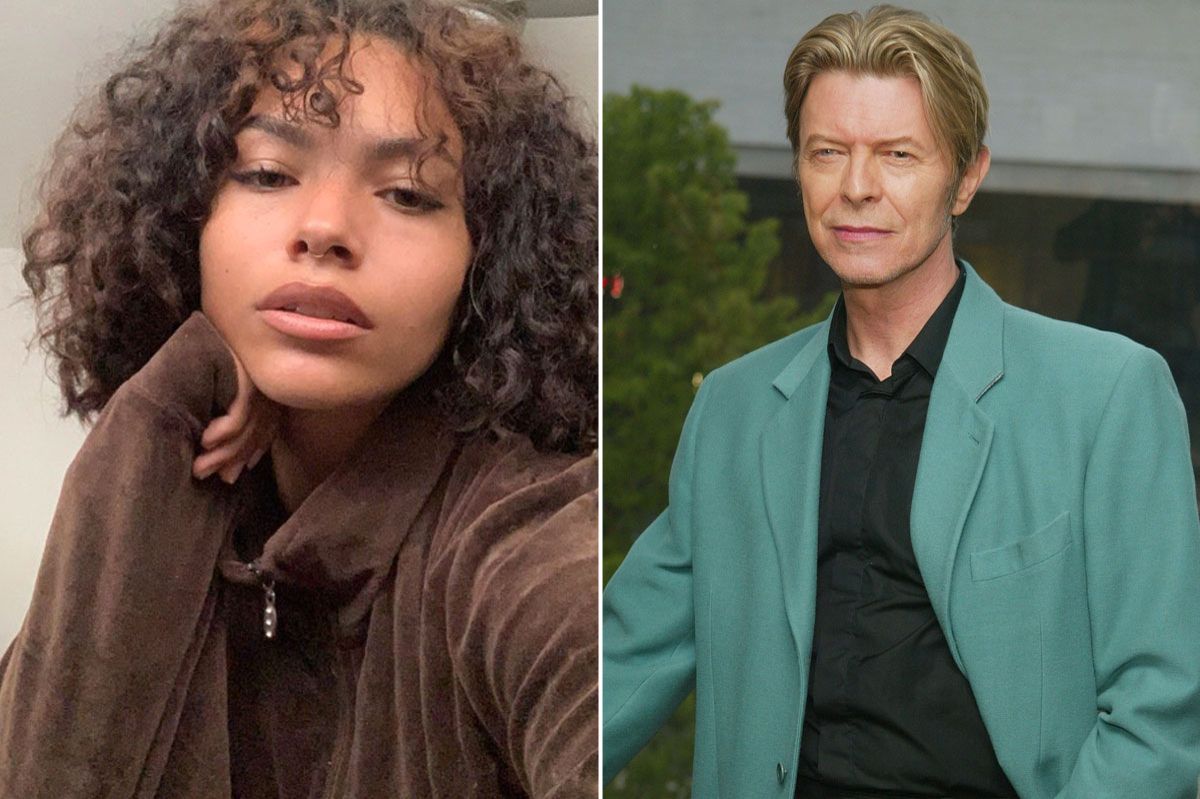
David Bowie’s daughter Lexi Jones, 24, has publicly attacked her friends for failing to text her condolences on what would have been her late father’s 79th birthday
David Bowie’s daughter has publicly criticised her friends for not reaching out to her on what would have been the late music icon’s 79th birthday. Bowie passed away at his New York City home, which he shared with wife Iman and their daughter Lexi Jones, on 10 January 2016. His death came just two days after his 79th birthday and followed a secret battle with liver cancer.
Both Iman and Lexi have since paid individual tributes to the legendary star on his birthday, their posts on social media garnering a flood of empathetic responses from followers. However, 24 year old Lexi has since taken aim at those in her personal circle for neglecting the significance of the date and its closeness to the tenth anniversary of her father’s passing.
In a selfie shared with her Instagram followers, she vented: “Thank you to all the people I don’t know who wished me condolences, and f**k you to all of my friends who never texted me at all.” She further expressed her disappointment, adding: “I got 1 text! F**k all y’all.”
Lexi, whose full name is Alexandria Zahra Jones, had earlier posted a touching throwback photo with her dad, captioning it: “Da big 79 today. Happy birthday pops, miss ya!”
This comes only months after Lexi disclosed her autism diagnosis, following a ‘long and exhausting journey’ and years of struggling to fit in. In August, she took to Instagram to discuss the ‘validating’ diagnosis and her lifelong efforts to appear ‘normal’.
She also revealed that she’d spent thousands of dollars seeking professional help. The artist sought professional help and was formally diagnosed with autism and ADHD by a specialist. She first shared her diagnosis in June, confessing that understanding she was autistic brought her ‘clarity and relief’, after unknowingly concealing it for years, which left her feeling exhausted and isolated.
She took to Instagram to share: “Autism does not have one look, one voice, or one way of showing up. It comes in many forms, and a lot of us learn to hide it without even realising we are doing it.”
“I was recently diagnosed as autistic, and it finally made sense of so much I have carried quietly my whole life. It is very common for women and people socialised as female to be diagnosed later in life. We are often conditioned to mask, mirror, and internalise. That does not make it any less real.”
“This diagnosis does not change who I am, but it gives me language, clarity, and relief. I am sharing this because I know I am not the only one, and because stories like this deserve to be seen.”
Alongside her post, she shared a deeply personal essay titled, The Quiet Effort: ‘Neurodivergence through my lens’, where she candidly discussed how she’d ‘spent my whole life feeling like I was different’. Lexi remembered feeling ‘isolated’ growing up and spent years mirroring those around her and ‘masking’ – a term used to describe the conscious or unconscious effort by individuals to suppress their natural autistic traits and behaviours to appear more neurotypical.
She penned: “I never really felt like I belonged anywhere, and it ultimately left me exhausted from masking”.
Lexi admitted to feeling ‘exhausted from masking’ and confessed that she had become adept at ‘blending in’, but it was a skill that didn’t come naturally to her and required ‘conscious construction’.
She penned: “It feels more like a performance I have built over time, not a reflection of how I truly think, feel, or function.”
She detailed how she would often get overwhelmed and either ‘shut down or lash out’, while describing her lack of self-identity as a ‘sense of pain’ that ‘chips away at my confidence and sense of worth.’.
Source: Mirror

Leave a Reply