Washington, DC: It has become a well-known pattern. United States presidents conduct unilateral military actions abroad. The Congress gives a shrug.
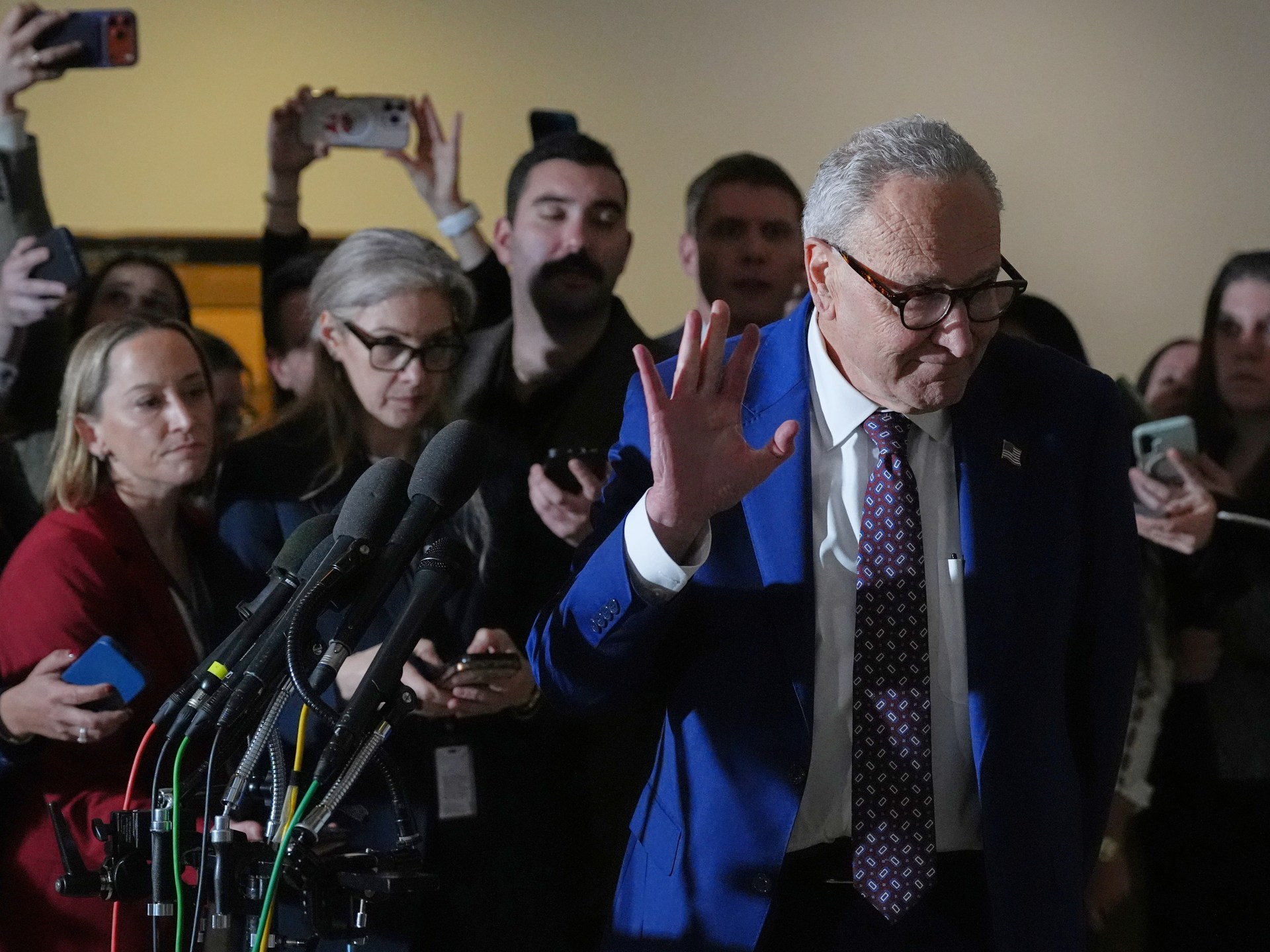
Democrats in the Senate pledged to pass yet another resolution to stop US President Donald Trump’s military actions on Saturday in the wake of Nicolas Maduro’s abduction by the US military.
Recommended Stories
list of 4 itemsend of list
The party’s top Democrat, Chuck Schumer, has promised to push for a vote in the coming week. By all accounts, the odds of its success remain long.
Congress has weighed numerous bills that would require him to seek legislative approval before initiating a military strike since Trump ran for a second term in 2025.
According to David Janovsky, the acting director of the Constitution Project at the Project on Government Oversight, the most recent attack on Venezuela is an egregious example of presidential overreach.
Experts say it is also one of the clearest tests in recent history of whether Congress will continue to cede its authority to check US military engagement abroad.
According to Janovsky, “there are many different ways you can approach this to explain why it’s a clear-cut case.”
He noted that Congress is the only body authorized to authorize military action under the US Constitution. He also noted that the Venezuela attack “is in direct contravention of the UN Charter, which is, as a treaty, law in the United States”.
Any fig leaf used by presidents in the past to justify unilateral military action simply doesn’t apply in this situation, Janovsky added. This is “particularly brazen,” he said.
An uphill battle
The Trump administration has begun a “maximum pressure” campaign against Venezuela since August.
Trump reportedly signed a secret memo to urge the US military to take steps to combat criminal networks abroad that month. Then, on September 2, the Trump administration began conducting dozens of strikes on alleged drug-smuggling boats off the Venezuelan and Colombian coasts.
That deadly bombing campaign was also criticized as a violation of international law and an insult to Congress’s constitutional authority. It occurred as a result of the US military’s expansion in the Venezuelan region.
Trump also dropped hints that the US military campaign could quickly expand to alleged drug-trafficking targets on Venezuelan soil. Trump said on September 16 that “we’re going to stop them the same way we stopped the boats.”
In December, the House of Representatives approved two measures in the country’s legislature: one that would require Trump to request approval for strikes on alleged drug-smuggling boats and the other that would require congressional approval for land strikes on the South American nation.
Both resolutions, however, failed roughly along party lines. In November, a similar resolution in the Senate, which would have required congressional consent prior to any additional attacks, also failed.
Senator Tim Kaine said he hoped lawmakers would be shocked by Trump’s latest actions in Venezuela after speaking to reporters shortly after the US operation on Saturday.
Republicans, he said, can no longer tell themselves that Trump’s months-long military build-up in the Caribbean and his repeated threats are a “bluff” or a “negotiating tactic”.
According to Kaine, “It’s time for Congress to get its a** off the couch and carry out its duties.”
US Senator Chris Murphy also acknowledged that it was “true” that Congress had become incapable of handling legal issues, a blunder that has spanned both the Democratic and Republican administrations.
Bash pointed to former President Barack Obama’s 2011 military deployment to Libya, which went unchecked by Congress.
Murphy responded, “Congress needs to own its own role in allowing a presidency to become this lawless.”
Republicans are snobby about resolutions.
Under the US Constitution, only Congress can declare war, something it has not done since World War II.
Instead, lawmakers have historically approved authorizations for use of military force (AUMFs), which authorize sending troops to recent wars, such as the US invasions of Iraq and Afghanistan and the strikes against alleged al-Qaeda affiliates in the Middle East, Africa, and Asia.
There are no AUMFs that would be related to Venezuelan military action.
When lawmakers believe a president is acting beyond his constitutional power, they can pass a war powers resolution requiring Congressional approval for further actions.
These resolutions provide a legal foundation to challenge further executive orders in the judiciary beyond their symbolic significance.
However, they have a high bar for success, with both of Congress’s chambers required to have a two-thirds majority to override a presidential veto.
Given the current makeup of Congress, passage of a war powers resolution would likely require bipartisan support.
Because Republicans have such slim majority in the House and Senate, a war powers resolution would need to be supported by members of Trump’s own party.
Only two Republicans split from their party in November’s Senate vote, including Alaska’s Lisa Murkowski and Kentucky’s Rand Paul. It failed by a margin of 51 to 49.
The House only received 211 votes for and 213 against when a parallel resolution was introduced in December. In that situation, one Democrat opposed the resolution while three Republicans opposed it in their own party.
But Trump’s abduction of Maduro has so far only received condemnation from a tiny fragment of his party.
Overall, elected Republicans have responded with little. Instead of focusing on praising the ouster of the long-standing Venezuelan leader, who has been accused of numerous human rights violations, regular critics of presidential adventurism focused instead on praising his ouster.
Senator Todd Young, a Republican considered on the fence ahead of November’s war powers vote, has praised Maduro’s arrest, even as he contended the Trump administration owed Congress more details.
Young remarked that “we still need more answers,” particularly regarding the upcoming transitional stages in Venezuela.
In the wake of the operation, some Democrats have also provided thoughtful messaging.
That included Debbie Wasserman Schultz, a Democrat who represents a large Venezuelan diaspora community in Florida.
Wasserman Schultz avoided making any mention of the military operation that led to Maduro’s removal in a statement released on Saturday. She argued instead that Trump owed Congress a timeline explanation.
“He has failed to explain to Congress or the American people how he plans to prevent the regime from reconstituting itself under Maduro’s cronies or stop Venezuela from falling into chaos”, she wrote.
However, Wasserman Schultz joined a group of Florida Democrats in urging Congress to impose its oversight authority as Trump mounted military pressure on Venezuela in December.
What follows?
For its part, the Trump administration has not eased up on its military threats against Venezuela, even as it has sought to send the message that Maduro’s abduction was a matter of law enforcement, not the start of a war.
Trump has once more denied that any further military action required congressional approval. He continued to express hope in a Monday interview with NBC News about having the support of Congress.
“We have good support congressionally”, he told NBC. “Congress had good support from Congress all along, but we knew what we were doing.” Why wouldn’t they back us, they ask?
Since Saturday’s attack and abduction, Trump has warned that a “second wave” of military action could be on the horizon for Venezuela.
Delcy Rodriguez, Maduro’s deputy, was formally sworn in as the nation’s interim president on Monday, which could lead to the threat of being forced to step down.
According to Trump, “She will pay a very high price, probably more than Maduro,” if she doesn’t do what’s right.
The administration has also said that strikes on alleged drug-smuggling boats near Venezuela will continue and that US military assets will remain deployed in the region.
However, Janovsky, a constitutional expert, thinks Congress needs to act now.
Trump’s demise would only serve to further bolster a decades-old practice of lawmakers reneging on their oversight bodies, he explained. That, in turn, offers tacit support for the presidency’s growing power over the military.
According to Janovsky, “to say that this was a targeted law enforcement operation and ignore the ongoing situation” would be a risky abdication of Congress’ authority as a key factor in how the US military is used.
Presidents are only able to act however they want, he continued.
Source: Aljazeera

Leave a Reply