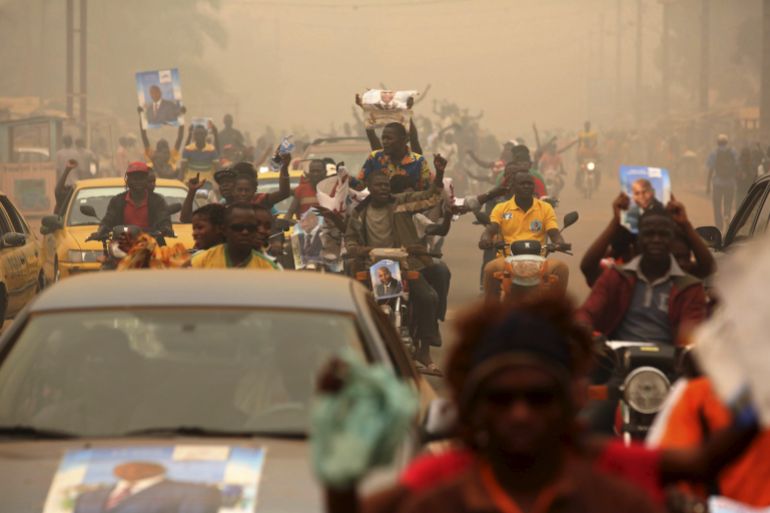
The highly contentious presidential and legislative elections in the Central African Republic (CAR) will be held on Sunday in a first-ever election that will extend President Faustin-Archange Touadera’s term beyond two terms.
Touadera, who helped put his country on the map when he adopted Bitcoin as one of its legal tenders in 2022, had earlier pushed through a referendum abolishing presidential term limits. Some opposition groups have boycotted the vote, calling it a “sham,” as well as significant delays that almost upturned the confirmation of two significant challengers.
Recommended Stories
list of 4 itemsend of list
CAR will also hold local elections for the first time in 40 years, after a long period of destabilising political conflict, including an ongoing civil war between the predominantly Muslim Seleka rebel movement and the largely Christian Anti-balaka armed groups, which has led to the displacement of one million people. There are concerns that a vote of this magnitude won’t be conducted by the electoral body of the nation.
The landlocked nation is sandwiched between several larger neighbours, including Chad to the north and the Democratic Republic of the Congo (DRC) to the south. About 5.5 million people live there, with the national languages of Sango and French, making up the majority of the country’s roughly 5.5 million people.
Although rich in resources like crude oil, gold and uranium, persistent political instability since independence from France in 1960, and the ongoing civil war (2013-present) have kept CAR one of Africa’s poorest nations. To protect major cities from rebels, CAR is increasingly reliant on Russian assistance for security.
Citizens of CAR are referred to as Central Africans. Bangui, the country’s largest city and capital, is named after the Ubangi River, which serves as the DRC’s natural border. The country exports mainly diamonds, timber and gold, but much of the population depends on subsistence agriculture, and economic activity is limited.
Here’s what we know about Sunday’s election:
How does voting work and who can vote?
About 2.3 million Central Africans over the age of 18 are registered to vote for the country’s next president. Since the previous election in 2020, there have been new registrations of 749, 000 of these.
They’ll also be voting for national lawmakers, regional and, for the first time in about 40 years, municipal administrators. According to the International Foundation for Electoral Systems (IFES), the average turnout in previous years was about 62 percent. There are about 6, 700 polling units across the country.
The National Elections Authority initially planned to hold municipal elections in August, but the organization moved them to December, citing insufficient funds as well as technical and organizational difficulties. The decision has added to concerns among election observers and opposition politicians about how prepared the electoral body is.
The president’s rallies were first staged on December 13, but opposition groups claim that the president’s rallies have been hampered by delays in including Touadera’s biggest rivals.
The presidential candidate with an absolute majority is declared the winner, but if there is no outright winner in the first round, a second run-off vote will determine the victor.
A contentious 2023 referendum removed term limits and made each term renewable to seven years, replacing the previous two- and five-year terms that presidents were previously limited to.
Who is running for president?
Touadera, an ex-Prime Minister Henri-Marie Dondra, and five others were given the go-ahead by the nation’s constitutional court, who were also included in the prominent opposition leader Anicet-Georges Dologuele.
However, delays in approving the two major opponents and concerns around the readiness of the electoral body have led an opposition coalition, the Republican Bloc for the Defence of the Constitution (BRDC), to boycott the election. Therefore, no candidate has been submitted by the group.
Here is what we know about the candidates who are standing:
Faustin-Archange Touadera
Touadera, 68, is a mathematician and former vice chancellor of the University of Bangui. He is a candidate for the United Hearts Movement (MCU), which is in power.
He served as the country’s prime minister from 2013 to 2015 under President Francois Bozize. Although opposition groups fought the election, he was elected president twice in 2016 and again in 2020.
Touadera, who is the favourite to win in these polls, has campaigned on promises of peace, security and new infrastructural development in the country.
The president’s legacy is ambiguous after ten years in office. His administration has been dogged by accusations of suppressing the opposition and rigging elections.
Without Touadera, who prevented the passage of the 2023 referendum, Touadera would no longer be able to run. He sacked a chief judge of the constitutional court in October 2022, after she ruled that his referendum project was illegal.
The Touadera camp received more “yes” votes from opposition members who boycotted the referendum. Although a civil society group launched a legal challenge against his candidacy before the polls, the constitutional court threw out the suit.

Touadera is credited with spearheading some economic development, compared with his predecessors. Although the World Bank still rates CAR’s economy as “stagnant,” new roads and highways have been constructed where there were previously no.
Touadera has also been praised for achieving relative stability in the conflict-affected country where armed groups hold swaths of territory, especially in the areas bordering Sudan.
Recent years, Russian Wagner mercenaries, Rwandan troops, and United Nations peacekeeping forces have all contributed to lessening violence.
CAR was the first country to invite the Russian mercenary group to the continent in 2018 in a security-for-minerals deal, before other countries, including Mali, Burkina Faso, and Niger, also secured security contracts.
CAR’s military alliances and aid budgets were initially closer to those of the former colonial power France, but Paris suspended them in 2021 as a result of Russian cooperation.
At a meeting with Russian President Vladimir Putin in 2023, Touadera praised Russia for saving CAR’s democracy. In January 2025, the two parties reconnected.
In advance of the elections, Touadera has also signed a series of peace accords with some armed groups active in the country, although there are fears that the agreements will only hold until after the polls.
In 2022, the president made CAR the second nation to legalize Bitcoin, following El Salvador. The idea drew scepticism, as less than 10 percent of Central Africans can access the internet, and was ultimately abandoned after a year.
The $CAR meme coin, which the government claimed is an experiment, was introduced by CAR in February 2025.
This week, Touadera’s government signed a new contract with Elon Musk’s Starlink to expand internet services to rural and remote regions.
Henri-Marie Dondra
The 59-year-old is a career banker and former finance minister. He is attempting to run for Republican Unity (UNIR), a party that does not belong to the opposition. He served as prime minister under Touadera between 2021 and 2022 but was fired, likely because of his strong pro-France tendencies at a time when the administration was turning towards Russia, according to reporting by French radio, RFI.
After Touadera accused him of having Congolese citizenship, which he denied, Dondra’s candidacy was not approved until November 14. The accusations raised fears that he would be barred from the vote. Before the vote, Dondra informed Human Rights Watch that two of his brothers had reportedly been detained and arrested without being charged.

Anicet-Georges Dologuele
The main opposition leader of the Union for Central African Renewal (URCA) party broke from the boycotting opposition coalition in order to run in these elections. Some analysts believe that Dologuele’s candidacy has sparked xenophobic comments from Touadera’s supporters.
The 68-year-old dual citizen French-CAR politician first ran for the top job back in 2015 and was the runner-up in the 2020 presidential race. His third application for citizenship was challenged. The 2023 referendum limited candidates to CAR citizenship only, and derisive comments from some in the governing camp have suggested some opposition candidates are not “real Central Africans”.
Dologuele claimed in September that he had given up his French citizenship, but a Central African court in October revoked his CAR citizenship, citing a provision in the previous constitution that forbids dual citizenship. Dologuele reported the issue as a violation of his human rights to the UN human rights agency. Although it’s not clear what course of action the organization took, Dologuele’s name appears to be associated with his reinstatement of citizenship on the final candidates list.
Dologuele served as prime minister in the 1990s, under President Ange-Felix Patasse, before joining the Bank of Central African States and later heading the Development Bank of Central African States.
Some associate him with previous government failures, but others view him as having experience. Dologuele is promising stronger democratic institutions and better international alliances.
other well-known candidates
- Aristide Briand Reboas – leader of the Christian Democratic Party, the 46-year-old was a former intelligence official and the sports minister until 2024. He is relying on promises of better amenities, including water and electricity. He previously ran in 2020.
- Serge Djorie, a former government official until 2024, is running for the new Central African Republic party under the name Collective for Political Change. The medical doctor and published researcher has campaigned on public health reforms, poverty reduction and more pan-Africanism. In the 2020 elections, Jorie ran.
- Eddy Symphorien Kparekouti – The civil engineer helped draft the new constitution that was controversially adopted in 2023. The independent candidate has put a focus on reducing poverty in his campaigns to combat political insecurities and other development issues.
What are the key issues for this election?
Armed organizations
Protracted political conflict in CAR has continued for more than a decade, with many Central Africans saying they want a leadership that can bring peace.
Following a coup led by the predominantly Muslim Seleka rebel alliance, which overthrew President Francois Bozize in March 2013, trouble started to develop. In retaliation, Bozize assembled Christian and animist rebel armed groups, known as the Anti-balaka. Rights groups have accused both sides of killing civilians and of committing war crimes. Bozize, who continues to lead a rebel coalition, is now in exile in Guinea-Bissau. Touadera’s Russian mercenaries defrained his 2020 attempts at attacking him.
However, killings, kidnappings and displacement continue in many rural communities in the country’s northwest, northeast and southeast regions, despite recent peace deals signed with some groups. Russian mercenaries have played a key role in securing significant areas, but they are also accused of carrying out mass killings and other human rights violations, and opposition politicians have criticized the reliance on foreign fighters.
A 17, 000-strong UN peacekeeping force, MINUSCA, has been extended until November 2026, although the move faced resistance from the US, which wants CAR to handle its own security going forward. This year alone, the force has lost at least three lives in deadly attacks. There are also fears about the security of voters in rural areas, about 800 voting units were forced to close in the last elections due to rebel violence.
Poverty
More than 60% of the world’s population lives in poverty, according to the World Bank, making CAR one of the poorest nations in the world.
Most people live in rural areas and survive on subsistence farming in the absence of any state-propelled industry.
The rate of economic growth is slow, growing on average yearly by 1.5 percent. Only 16 percent of citizens have access to electricity, and only 7.5 percent have access to the internet.
Economic activity is hampered by persistent fuel shortages.
The country ranked 191st of 193 countries in the 2022 Human Development Index.
Divisive politics
The country’s turbulent political history and the present landscape of deeply divided political groups have failed to deliver a unified opposition coalition that can challenge Touadera and enshrine a functioning democracy.
Source: Aljazeera

Leave a Reply