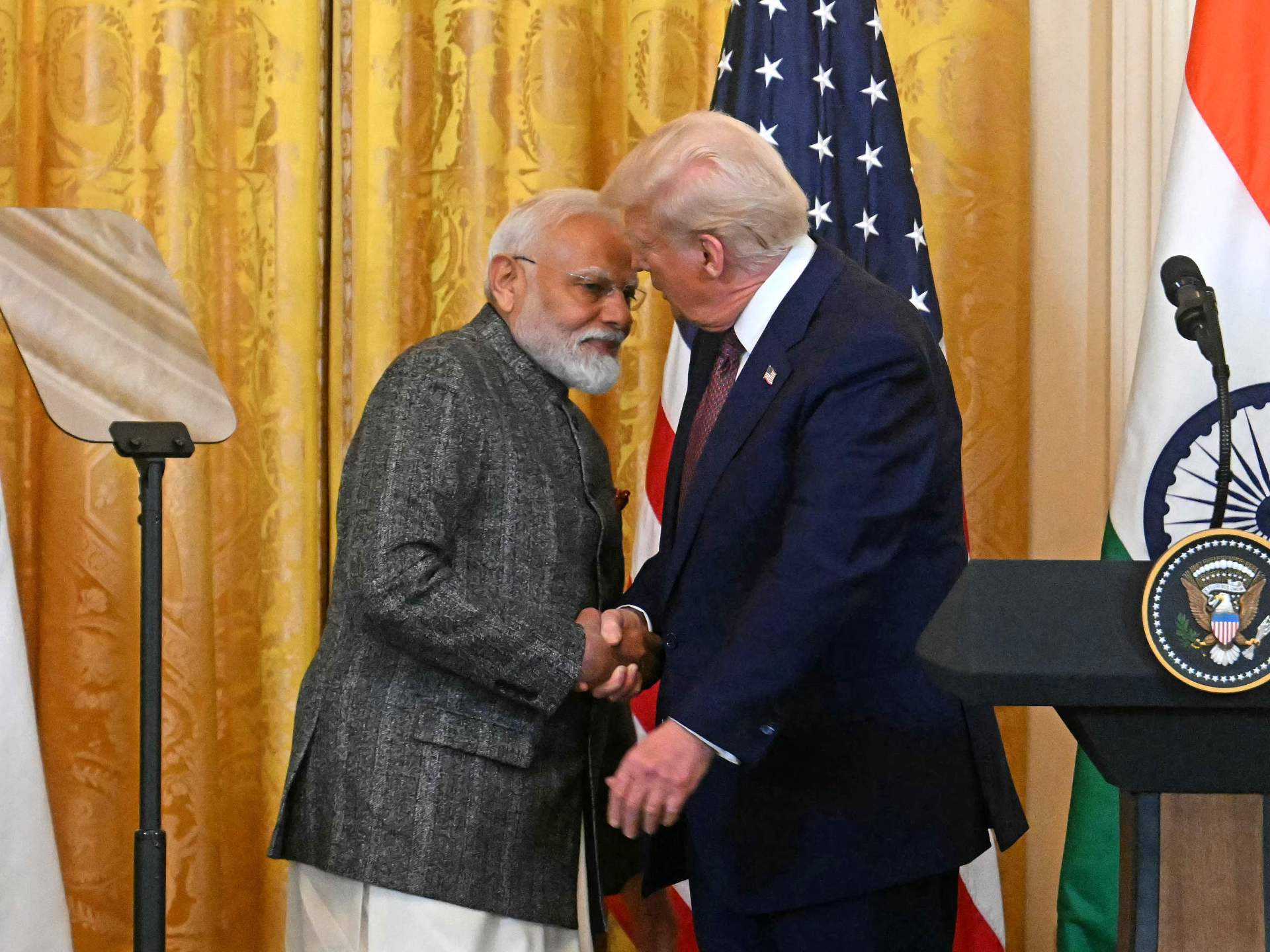
United States President Donald Trump has claimed that India has agreed to stop buying Russian oil, as Washington seeks to pressure Russia to end its war in Ukraine by cutting off the Kremlin’s vital energy revenues. Trump had said he would try to persuade China to do the same.
The US president told reporters on Wednesday that he had received assurances from Prime Minister Narendra Modi that India would halt its oil purchases “within a short period of time”. India and China are the two biggest buyers of Russian seaborne crude exports.
Recommended Stories
list of 4 itemsend of list
Trump has sought to leverage his ongoing trade negotiations with New Delhi to pressure India over Russian oil. And, in August, he used India’s continuing imports of Russian oil as a pretext to impose additional trade tariffs on New Delhi. But Modi has so far refused to back down. For months, Indian officials have defended purchases of Russian energy as vital for India’s national security.
A move by India now to stop its imports would signal a major shift by one of Moscow’s top energy customers, and could undermine Russia’s war efforts in Ukraine.
Why has Russian oil been a bone of contention between India and the US?
Citing India’s continued imports of Russian oil, Trump slapped an additional 25 percent trade tariff on New Delhi in August – bringing tariffs to a total 50 percent. He did not instigate similar punitive actions against China, which remains the largest importer of Russian oil, however.
China imported a record 109 million tonnes of Russian crude last year, representing nearly 20 percent of its total energy imports, according to Chinese customs data. India, by contrast, imported 88 million tonnes of Russian oil in 2024.
New Delhi has, therefore, accused Washington of selectively targeting India in its latest round of tariffs. Some observers argue that Trump’s stance in part reflects frustration with India’s unwillingness to acquiesce to his specific demands in ongoing trade talks.
“India’s longstanding protectionist measures – such as high tariffs for agricultural goods and subsidies on pharmaceuticals – have been a point of friction in US-India trade talks,” Alicia Garcia Herrero, chief Asia Pacific economist at Natixis in Hong Kong, told Al Jazeera.
By contrast, Trump has adopted a noticeably softer approach with China, avoiding similar punitive, energy-linked tariffs. Some observers believe he may be biding his time to secure a broader trade deal with Beijing that would include access to China’s rare-earth metals.
Rare earths are a group of 17 elements essential to various manufacturing industries, including in the US, from car parts and military technology. China has long dominated the mining and processing of rare earth minerals and currently restricts exports of 12 of them.
The upshot is that “China has much more leverage [than India], as shown by its recent export controls”, explained Garcia Herrero.
The most recent of China’s export restrictions, which require foreign companies to obtain special approvals from Beijing if they wish to purchase certain rare-earth products, were introduced this week, ahead of an expected meeting between Trump and his Chinese counterpart – President Xi Jinping – later this month.
In response to Beijing’s move, Trump has threatened to impose a new 100 percent tariff on Chinese exports from November 1. Still, he said his planned meeting with Xi is expected to go ahead: “I’m going to be there regardless, so I assume we might have it,” he told reporters last Friday.
How reliant is India on Russian energy?
Russia is New Delhi’s largest source of oil. According to Kpler, the shipping analytics company, India imported 4.5 million bpd (barrels per day) of crude in September. Of that, Russian supplies accounted for roughly 1.6 million bpd – or 34 percent of the total.
That represents an eye-watering 2,250 percent increase from January 2022, one month before Russia launched its full-scale invasion in Ukraine. At the time, India was importing just 68,000 bpd of oil from Russia.
Meanwhile, India is the second-largest buyer of Russian energy after China, according to data from the Centre for Research on Energy and Clean Air (CREA). China purchased 47 percent of Russia’s crude exports in September, followed by India at 38 percent.
Why is India buying so much Russian oil now?
In December 2022, several Western nations imposed a $60 price cap on Russian crude oil in a bid to reduce Russia’s ability to finance its war in Ukraine. This forced Moscow to compete more aggressively on prices if buyers wanted access to Western shipping and insurance services.
But cheaper Russian oil helped narrow New Delhi’s current account deficit, which fell by 65 percent in 2023-2024 compared to the previous year. Elsewhere, Reliance Industries (RIL) – now India’s top importer of Russian seaborne crude – became the biggest corporate winner.
In 2021, Russian crude accounted for just 3 percent of imports at Reliance’s Jamnagar refinery, India’s largest private facility. By 2025, that share had surged to around 50 percent, according to CREA.
CREA has also calculated that the Jamnagar refinery exported $85.9bn of refined products globally from February 2022 to July 2025. Incidentally, an estimated 42 percent ($36bn) of that has gone to countries sanctioning Russia.
How has India responded to Trump’s latest claim?
India has not officially confirmed Trump’s claim that it has promised to stop buying Russian oil.
Despite Trump’s punitive tariffs, New Delhi has consistently defended its purchase of Russian oil amid the war in Ukraine. A spokesperson for India’s External Affairs Ministry, Shri Randhir Jaiswal, reiterated that stance on Thursday. But he also hinted that India could look to diversify its import base.
In an official statement, he said: “Ensuring stable energy prices and secured supplies have been the twin goals of our energy policy. This includes broad-basing our energy sourcing and diversifying as appropriate.”
He added: “Where the US is concerned, we have for many years sought to expand our energy procurement … The current Administration has shown interest in deepening energy cooperation with India. Discussions are ongoing.”