How to ‘fake’ food in Gaza

Gaza, Nuseirat – As Gaza’s entire population suffered as a result of Israel’s siege and food shortages, my family had to find creative ways to expand their food supplies while making up for lost ingredients.

We experimented with new recipes, created combinations we never imagined trying, and managed to come up with some solutions that would help us a bit to endure the harsh realities of famine and survive as best we could.

converting pasta and lentils into bread

We used pasta to make our bread when the wheat flour ran out, as almost everyone in Gaza did.

Bread is a core part of our eating habits, and the current famine means there is nothing else in the market – no fruits, vegetables, eggs, cheese, chicken, or meat.

Instead of cooking and eating pasta as is, people in this country prefer to make bread with it. Unlike pasta, which is typically meant for lunch, bread can be consumed at every meal.

We also genuinely believe bread is more filling and keeps us satisfied longer.

At the beginning of June, we first attempted to make pasta bread. Doha, my brother Fady’s wife, got in touch with her family, who had been surviving on pasta bread for some time.

Doha started working on the recipe with the help of my mum, Saham.

The pasta was soaked until it was soft, then it was kneaded until it came together as a dough. It requires a lot more time and perseverance, and the bread texture is a little different from flour-only bread.

After shaping the dough as usual, my brother, Fady, 35, went out to bake the bread in a communal oven, where he had to wait in line for about 30-45 minutes for his turn.

We were all interested in the taste when Fady returned with the bread. Our impression of reassurance was helped by the bread’s appearance, which was not significantly different from our regular bread.

When we shared a loaf to taste it, the flavour was acceptable, and we were happy – it would serve the purpose.

However, pasta became scarce and cost skyrocketed over the next few weeks as more and more people in Gaza relied on it to make bread.

Many people, including my family, were unable to pay for it, so we had to look for a substitute in July.

So we thought: Maybe lentils would work for making “fake” bread in Gaza.

[Photo by Deema Fayad] The lentil bread had an odd flavor, which only got worse the next day.

Following a friend’s recipe, Fady milled lentils into flour before handing them to us to knead them with some wheat flour, as we had done with the pasta.

But lentil dough was far harder to work with than pasta dough, taking my mum and me forever to turn into dough. And it didn’t taste good either, instead tasting more like lentils.

We tried to avoid the odd lentil taste while eating, but it was a major disappointment. Yet we had to eat whatever was available, we simply don’t have the luxury of choice.

The lentil bread got drier, harder, and more and more difficult the next day, making each bite feel like a rock in your throat.

We tried to eat it with Dukkah, our standard breakfast and dinner, after heating it up to make it softer and edible.

Dukkah is a mix of toasted wheat and spices, like dried coriander and dill seeds, ground up and combined with sesame seeds – but in these lean times, we make it with lentils instead, like everyone else in Gaza.

My brother Fady began making terribly funny jokes about how we were consuming dukkah, which was also made of lentils.

We never made lentil bread again despite the fact that many people chose it as their only option because we preferred the taste of cooked lentils cooked on their own rather than in bread form.

A burger treat, but faked

I left my sister Fidaa at home on May 11 while I was volunteering at a shelter in Deir el-Balah, knowing that I was only a short drive away from her place.

My 37-year-old sister, who lost her lovely home in Khan Younis, works as a WASH officer and shares a shared shelter with her coworkers.

Fidaa was in her small cooking space in the shared kitchen, getting ready to prepare something.

She responded, “Fake burgers from canned meat and lentils,” with a sarcastic smile. The recipe is from a neighborhood Facebook group I found.

She wanted to make it as a special treat for her four little children – Basma, Ward, Assem, and Omar Abu Daqqa.

Because the canned meat we used wasn’t made for these purposes, I began to help her shape the patties.

We added some meat spices hoping it would give it a dash of familiar taste because it was ready-to-eat and very different from fresh meat in both texture and definitely taste.

a metal tray of crumbly-looking fried patties
The author’s sister tried making ‘ fake ‘ burgers using canned meat and lentils]Deema Fayyad/Al Jazeera]

My sister’s husband, Anas, went to the balcony to chop the wood and start the fire so we could fry the patties, while Anas and I played in the room while the kids were waiting for lunch.

My sister brought the burgers back the same day with the same sarcastic smile on her face as she had done them. Their smell wasn’t bad, but their texture was disastrous. Fidaa was unable to remove a few of the round patties from the pan because they were so soft and crumbly.

Because we didn’t have any buns to use as sandwiches, we instead made them out of regular flatbread and some cucumbers.

When we first tasted it, we agreed that it didn’t taste too bad, but with the next few bites, we weren’t so sure.

Although I’m not sure if our fake burgers were good, they were all eaten.

Snacks

We tried making fake snacks in an effort to lessen the suffering caused by this cruel famine for both ourselves and our children.

In June, Doha made chocolate spread from the halva that we used to get in the aid kits before the complete blockade.

Tahini and sweeteners are used to make the region’s famous halva. It has the same flavor as the aid kits, but it can either taste good or be cheap.

Doha added water to the halva and mixed it until it was a liquid sauce, then added a lot of cocoa and heated the mixture over the open fire.

The cocoa served as the spread’s only flavor because it was still halve-free, and we were happy to use it to make our breakfast sandwiches.

Mohammed and Adam, my two youngest nephews, were thrilled and asked their mother to keep making it, but she only succeeded in making it once or twice before the cocoa ran out.

As a salty treat, we made fake chips by frying pasta and adding spices to it – a famous famine snack.

A friend and neighbor, Afnan Baraka, roasted chickpeas to replace nuts on Friday, and then sprinkled them with spices.

Nuts are a very well-liked snack in Gaza. We used to enjoy nuts anytime, anywhere, salted and flavoured with various spices.

We all learned something new when Afnan made the chickpea nuts. It was a really good substitute for what we really liked, though. Yet, it’s not easy to prepare often, as it all is made over an open fire, consuming time, effort and many smoky tears.

A pan of chickpeas going into an open-flame oven to be roasted
[Deema Fayad/Al Jazeera] Chickpeas can be roasted and flavored to replace nuts.

We eat essentially the same foods, including lentils, pasta, and chickpeas, but my family frequently jokes that we do the same.

They were common in the aid kits distributed by UNRWA before the blockade in March. Even these foods have since become indisputable and expensive.

My sister Mariam made a bitter joke about how important it is to give pasta and legumes for sticking with us and providing them with alternatives for as long as they did.

But for me, and I think for many others, we feel a deep need for compensation.

I want to eat anything and everything after this terrible blockade is over, aside from the foods I consumed during these illiberal days.

I’d like to be compensated. Compensation for every time I craved fruit, vegetables, eggs, chicken, or anything fresh and found none. I was unable to eat or feel dizzy at all.
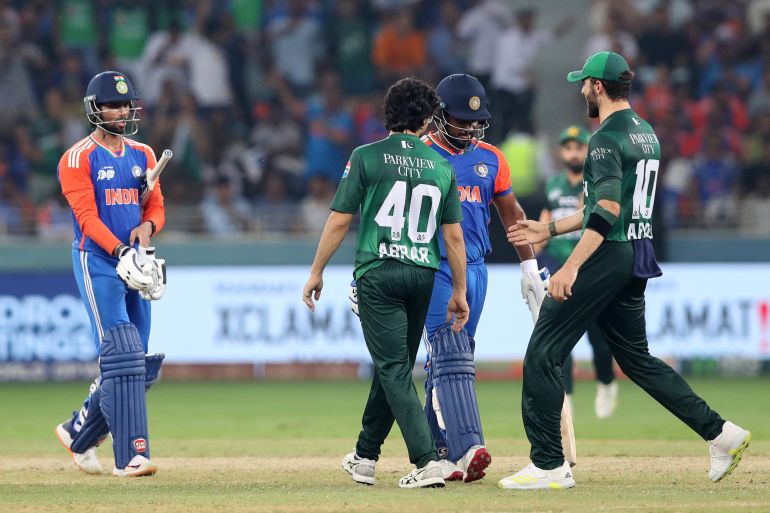
PM Modi invokes conflict with Pakistan after India’s Asia Cup cricket win

To celebrate India’s victory in the Asia Cup final against their regional arch foes, India’s prime minister Narendra Modi has contentiously invoked the conflict with Pakistan in May, which sparked a fifth all-out war.

On the games field, “#OperationSindoor.” India wins, and the outcome is the same! Congratulations to our cricketers,” Modi posted on X on Monday.

Recommended Stories

list of 3 itemsend of list

In May, Modi made reference to the four-day conflict between the two countries, with an emphasis on India-administered Kashmir, following an attack that India blamed Pakistan for killing 22 tourists, an accusation Islamabad vehemently refutes.

In response to the attack, Modi declared “Operation Sindoor,” which heightened tensions and caused Pakistan to retaliate. More than 70 people were killed in the brief conflict by missile and drone attacks, with both parties claiming victory.

An Indian naval officer in June acknowledged that the country lost a number of fighter jets to Pakistani fire during their May-torn conflict and that the government had “constraints” placed on Indian forces in New Delhi.

As tensions between India and Pakistan continue to be high, Indian cricket players and Pakistani counterparts have exchanged other insults after refusing to shake hands in the Asia Cup final.

After India defeated Pakistan by five wickets on Sunday at the Dubai International Cricket Stadium, Mohsin Naqvi, the country’s interior minister, and the Asia Cricket Council (ACC) chief Mohsin Naqvi, the country’s interior minister, refused to accept the trophy.

Former New Zealand cricketer and broadcaster Simon Doull announced, citing the ACC, that the Indian team would not be able to collect their awards because of the tensions.

Abrar Ahmed of Pakistan congratulates Sanju Samson of India [Satish Kumar/Reuters]

In any of the three matches the two teams played, the Indian team refused to shake hands with the Pakistan team.

Naqvi reportedly refused to leave the award-giving ceremony altogether.

Indian players Tilak Varma, who won the player-of-the-match award, Abhishek Sharma, who won the player-of-the-tournament award, and Kuldeep Yadav, who won the most valuable player award, showed up to accept their individual awards, but did not acknowledge Naqvi.

The only other audience member on stage who did not applaud the Indian trio was the Pakistani official.

Yadav claimed he had “never seen” a winning team deny their trophy during a post-game press conference.

Salman Agha, the captain of Pakistan, claimed that India’s conduct at the tournament was “bad for cricket.”

A good team doesn’t do that, as they did today. Good teams follow our instructions. We waited for and took our medals, Agha said.

Devajit Saikia, the secretary of the Indian cricket board (BCCI), announced that the board would protest Naqvi at its upcoming November meeting of the governing International Cricket Council (ICC).

Michigan church shooting: What we know about suspect Thomas Jacob Sanford

In a mass shooting at the Church of Jesus Christ of Latter-day Saints’ chapel in Grand Blanc, Michigan, at least four people were killed and eight others were hurt.

The suspect, 40, was Thomas Jacob Sanford, who police claimed intentionally set the church on fire and spewed smoke out of the structure. In addition, Stanford was fatally shot while he was firing at law enforcement personnel.

What information is necessary here:

When and what happened?

Police received a call on Sunday morning at 10:25 am (14:25 GMT) about an armed man’s vehicle entering a church building.

At a press conference, Grand Blanc Township police chief William Renye stated that the attacker then opened fire with an assault rifle and “fired several rounds at people inside the church.” He added that the suspect is also alleged to have started a massive fire that quickly grew.

Just eight minutes after the shooting started, officers immediately responded and shot the suspect, who was ultimately killed, in the church parking lot at 10:33 am (14:33 GMT).

When the building caught fire, congregations were inside and attending services. According to officials, the chapel partially collapsed as a result of the fire.

According to Renye, “We are still trying to figure out exactly when, where, and how the fire started.” However, “we do think the suspect intentionally set it.”

Police believe the burned-out building may still have victims. The FBI is now taking charge of an investigation that it calls “an act of targeted violence.”

During the police investigation, three improvised explosive devices (IEDs) were discovered inside the suspect’s car, according to local media reports.

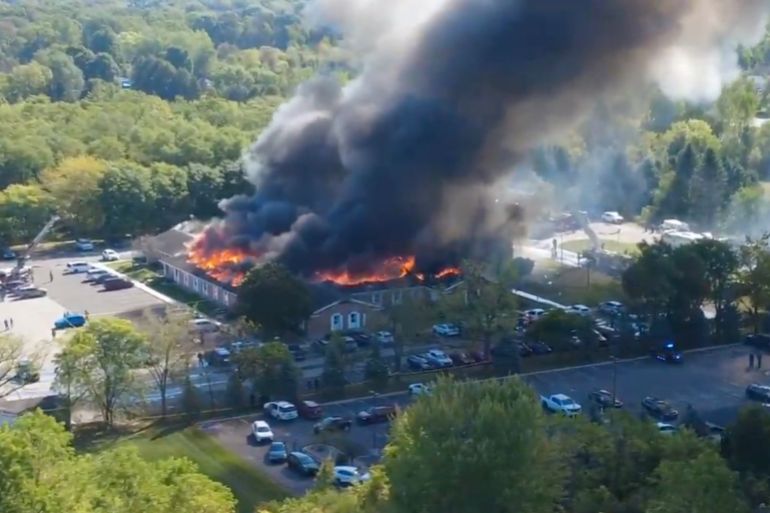
Flames and smoke appear from The Church of Jesus Christ of Latter-day Saints in Grand Blanc [Julie J/X via AP] in this screengrab from a Julie J video.

Where in Michigan was the shooting reported?

The Church of Jesus Christ of Latter-day Saints’ meetinghouse was in Grand Blanc, a township located 60 miles (100 kilometers) northwest of Detroit, where the attack occurred. There are about 7,700 people in Grand Blanc.

The Church of Jesus Christ of Latter-day Saints, or “the Mormon church,” teaches Joseph Smith, a religious leader from the United States, along with the gospel of Jesus Christ. Members put a lot of emphasis on family and traditional values, study the Bible and the Book of Mormon, and revere the church president as a living prophet.

Its teachings oppose same-sex unions, alcohol use, and abortion.

The attack occurred in Russell M. Nelson’s home just one day after his death, according to the president of the church.

Thomas Jacob Sanford, who was he?

Former US Marine from Burton, Michigan, who served in the military from 2004 to 2008, including a deployment to al-Fallujah, Iraq, during US occupation of the Middle Eastern nation, was the suspect.

Before the deployment in 2007, Jacob’s father, Thomas Sanford, stated in a local media outlet, “He’s a homegrown kid who misses his family when he’s gone.” When his service is over, Jake intends to return to this community. The report, which read “We are very proud of him,” continued with “We are very proud of him.”

He was promoted to sergeant in the Marines three months after returning to the US in March 2008.

Sanford, a graduate of Goodrich High School, moved into the trucking industry in 2016 and moved to Burton to live there.

His son Brantlee was a result of a rare medical condition known as hyperinsulinism, in which the pancreas produces too much insulin. He was also a father.

In a 2016 interview, Sanford recalled how they discovered that Brantlee was having issues shortly after his birth. For us, it was a nightmare.

Sanford was also known for his passion for hunting and fishing, with photos that show him posing alongside deer and displaying his catches from ice-fishing trips.

What are the victims’ details known to us?

Police have confirmed that the attack left eight people injured and at least four fatalities so far. Some of them were in critical condition.

Authorities say the partially collapsed chapel’s debris may still be the site of more victims.

According to a statement from the Church of Jesus Christ of Latter-day Saints, “Places of worship are intended to be sanctuaries of peacemaking, prayer, and connection.” We ask that all parties involved find peace and healing.

What are the current information on US shootings?

According to the Gun Violence Archive, the Michigan attack was the 324th mass shooting in the US to date in 2025.

At least two people were killed and several were hurt in Eagle Pass, Texas, which was also the third mass shooting to occur in one day, coming after one in Southport, North Carolina, and two in Southport, North Carolina.

In a strange coincidence, the suspect in the North Carolina shooting was a 40-year-old Marine veteran who had served in Iraq, similar to the shooting in Michigan. Three people were killed and five others were hurt in that attack, which took place less than 14 hours prior to the rampage in Michigan.

Police in Southport claim Nigel Max Edge fired shots from a boat into a waterfront bar on Saturday night. He is currently facing charges, including five counts of attempted murder and three counts of first-degree murder.

Trump to meet Netanyahu as ending Israel’s Gaza war reaches pressure point

As a plan for the future administration of a Gaza-devayed by Israel’s nearly two-year genocidal war is being discussed at a White House meeting on Monday, US President Donald Trump and Israeli Prime Minister Benjamin Netanyahu may be asked to discuss the ironclad relationship between the two nations.

Trump has repeatedly stated that the war needs to end, and he has promised “greatness in the Middle East” and “something special” in a separate all-caps post on his Truth Social platform on Sunday.

Recommended Stories

list of 3 itemsend of list

Netanyahu, on the other hand, claimed that Israel is working with Washington to “make the plan work.”

Arab and Muslim leaders were first given the 21-point “day after” war plan earlier this week at the United Nations General Assembly meetings in New York.

It demands that Hamas release all 48 Palestinian captives who are still alive, about 20 of whom are reportedly alive, within two days, according to numerous Israeli and Western reports.

If Hamas fighters reject resistance, they allegedly will be given the option of receiving amnesty or permission to leave Gaza. Israeli forces will gradually withdraw from the famine-stricken enclave, some Palestinian prisoners will be released from Israeli military concentration camps, and significant humanitarian aid will be provided.

The Palestinian organization confirmed in a statement on Sunday that it has not received any new proposals from Egypt and Qatar, which have reportedly both received Trump’s proposals.

Hamas’ armed wing warned that contact has been lost with Israeli forces capturing two Israeli captives in Gaza City as a result of an expanding Israeli ground invasion and aerial bombardment, which is causing dozens of Palestinian civilians’ daily casualties and the destruction of the area. Hamas said it will take a new offer to end the war into account.

Netanyahu’s delicate balance

Even though the plan, if implemented as it is, goes against some of Israel’s far-right government’s core beliefs, the Israeli prime minister appears to be supporting it.

The vision claims, among other things, that a future Palestinian state is open, something that top Israeli leaders have vowed never to permit.

The plan emphasizes that the Palestinians have a right of return if they choose to leave after two years of genocidal war have destroyed the majority of the enclave. It also emphasizes that they do not want to forcefully expel Palestinians from Gaza.

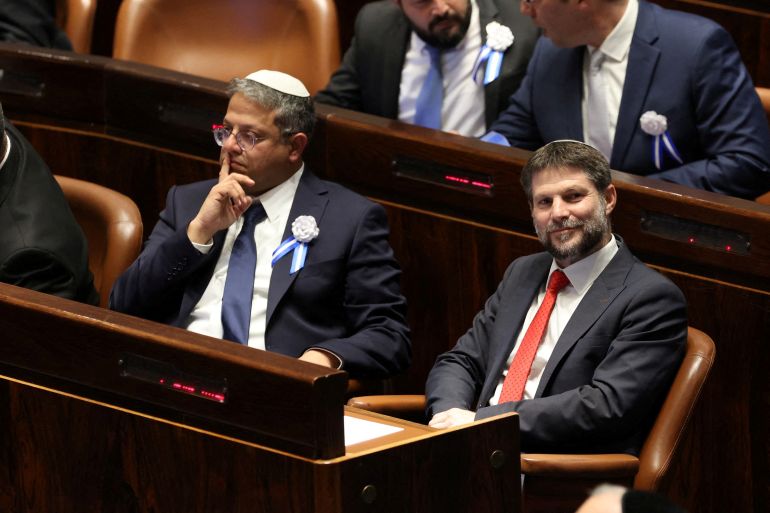
While Netanyahu’s top ministers and coalition partners, including Finance Ministers Bezalel Smotrich and Itamar Ben-Gvir, have vehemently advocated for “encouraging voluntary migration” without return and for the destruction of what is left of Gaza.

They want to halt all access to food, water, and medicine, as Israel did for months before torpedoing a previous ceasefire with Hamas, which caused widespread starvation and famine. After seizing and operating militarily in the area while annexing the occupied West Bank, they want to rebuild the illegal Israeli settlements there.

The two far-right extremists have already criticised Trump’s plan, who they have repeatedly praised as Israel’s biggest-ever ally in the White House, along with other ministers and leaders of violent settler organizations, and have been sanctioned by several western governments.

They contend that Netanyahu is not qualified to accept a deal that would prevent Hamas from being a key player in the conflict starting in 2023.

Trump may squeeze Netanyahu, who will want to appease him despite the White House’s unwavering support and diplomatic cover.

The 25th Knesset’s swearing-in ceremony for the new Israeli parliament, the 25th Knesset, took place in Jerusalem on November 15, 2022.

Netanyahu’s coalition, which has 32 seats in the Israeli Knesset, is already facing difficulties because it is forming a minority government with 60 out of 120 seats.

When one of the two major ultra-Orthodox parties left the government and the other left the coalition in mid-july because it was unable to guarantee religious students’ future military conscription during the war, Netanyahu was in a bind.

If Smotrich and Ben-Gvir’s parties all resign from the coalition, they could potentially overthrow Netanyahu’s highly critical government and force new elections.

In January, Ben-Gvir abruptly resigned from his cabinet position in protest of the Hamas ceasefire, which resulted in the release of several prisoners, but he soon returned after Israel resumed bombing Gaza.

The far-right groups, however, are unlikely to overthrow the coalition anytime soon because Israel continues to impede Gaza’s largest urban center by using tanks and sea to launch explosives from the air and sea.

In the West Bank, in spite of Trump’s claim that he will not allow annexation of the territory, Israeli raids and settler attacks are carried out daily against Palestinians.

Trump’s new proposal currently appears at best provisional, and even if it is approved by all, it will take a while to implement.

The future of Gaza’s administration structure

The plan proposed by Trump was developed in collaboration with Israel and the institute run by Tony Blair, who was the country’s prime minister in the Middle East when the US launched an invasion of Iraq in 2003 on the ground of false weapons of mass destruction.

After Hamas is ousted for a while, the Gaza International Transitional Authority (GITA), which has just been established, will be able to administer Gaza.

The entire power structure of the authority, according to Israel’s Haaretz newspaper, is at the top, with Palestinians running things on the ground at the bottom, according to a statement released on Monday.

In an effort to gain credibility, the international board of GITA will initially be based in Egypt or elsewhere near Gaza but because of the tumultuous situation created by Israel there. It may also include prominent Egyptian businessmen and Muslims.

According to reports, it will have an executive secretariat with five commissioners who will run it to deal with issues involving humanitarian aid, reconstruction, legislation, security, and coordination with the Palestinian Authority (PA), which is being urged to undergo reforms in exchange for a promise that it will take over governance at an undisclosed future date.

A Palestinian technocratic authority will be appointed by the board to oversee some implementation on the ground as a multinational stabilization force takes control of border crossings, Gaza’s coastline, and “perimeter zones” close to Israel and Egypt’s current borders.

This is in contrast to Netanyahu’s and others’ claims that Israel will operate “security control” over the enclave.

Cowboys, Packers battle to NFL’s first tie since 2022