Who: Benfica vs Real Madrid What: UEFA Champions League Where: Estadio da Luz, Lisbon, Portugal When: Wednesday, January 27 at 8pm (20:00 GMT) How to follow: We’ll have all the buildup on Al Jazeera Sport from 17:00 GMT in advance of our text commentary stream.
The league phase of this season’s UEFA Champions League (UCL) reaches its finale on Wednesday with some of Europe’s biggest names facing crunch ties – no bigger perhaps than Jose Mourinho leading Benfica against his former club Real Madrid.
Recommended Stories
list of 4 itemsend of list
Both sides are in need of a win if they are achieve their contrasting aims at this stage, with Benfica facing elimination from competing on the continent this season.
Al Jazeera Sport takes a look at a tie that has so much riding on it, including some small personal pride for one of Real’s most successful coaches.
What are Real Madrid’s Champions League chances?
Real have endured a turbulent season, with their coach Xabi Alonso sacked after only seven months in charge, but a serious challenge can still be mounted for a Spanish and European double.
Los Blancos find themselves hot on the heels of Barcelona in La Liga, having briefly claimed top spot when they beat Villarreal on Saturday, only for their rivals to reclaim the summit on Sunday.
In the Champions League, a draw may be enough to secure their automatic passage to the last 16, but only a win will guarantee it.
What are Benfica’s Champions League chances?
A win is an absolute must for Benfica, but it may not be enough to secure a place in the playoffs given the Portuguese giant’s rough run this season.
The Lisbon-based club currently sit in 29th position, out of the 36 competing teams, two points from claiming one of the 16 playoff spots.
A minus four goal difference will also hamper Benfica as they seek to climb above five teams to avoid elimination from the competition.
The domestic league season has seen them go unbeaten to date, but they have drawn six more games than leaders Porto, who are 10 points clear and similarly unbeaten.
How does Champions League qualification work from the league phase?
The top eight teams automatically qualify for the round of 16; the following 16 teams enter two-legged playoffs.
The bottom 12 teams, of which Benfica are currently one, drop out of all continental competition this season.
Real are currently third with 15 points, but the 10 teams immediately below them all have the chance to reach 16 points – which could see Los Blancos slide dramatically if they lose, while a draw will leave them sweating on other results.
When was Jose Mourinho manager of Real Madrid?
The former Chelsea, Inter Milan and Manchester United manager was in charge at Real for three seasons following his appointment in May 2010.
It followed huge success at Porto, Chelsea and Inter Milan, where he won the Champions League with the former and the latter, while also securing a first top-flight title in 40 years for Chelsea.
Mourinho only took over at Benfica in September, replacing Bruno Lage as manager after a slow start to the season.
What was Jose Mourinho’s record at Real Madrid and what did he win?
Mourinho finished second to Barcelona in his first season in charge, despite Cristiano Ronaldo leading the La Liga scoring charts with 40 goals that season.
Lionel Messi smashed in 50 goals the following season, but it was Real’s Portuguese pair that emerged smiling with Real’s first league title in three years – Barca claimed the crown in each of those seasons.
Mourinho’s stint at Bernabeu came to an end the following season when Barcelona won the title by 15 points – it remains the biggest winning margin in the competition’s history.
How many times have Real Madrid and Benfica won the Champions League?
Real are the record winners of Europe’s premier club competition with 15 titles to their name. The last coming in 2024.
Benfica have lifted the trophy on two occasions, and both of those came in consecutive years.
In what was regarded as Benfica’s golden era, Portuguese legend Eusebio helped the team to wins against Barcelona in 1961, and Real Madrid in 1962.
A hat-trick from Hungary’s finest export, Ferenc Puskas, could not save Real, with Benfica running out 5-3 winners – which included a double from Eusebio.
When did Real Madrid last face Benfica in the Champions League?
The two European giants have not met since March 17, 1965, when Real won 2-1 in Madrid.
It was not enough to overturn their knockout tie after Benfica claimed the first leg 5-1 in Lisbon three weeks earlier.
Head-to-head
This is staggeringly only the fourth meeting between two of the biggest clubs from Spain and Portugal.
Benfica edge the matches 2-1, with the first meeting between the clubs coming in the final in May 1962.
Benfica team news
Alexander Bah, Samuel Soares, Dodi Lukebakio and Henrique Araujo all remain absent through injury. Richard Rios is close to a return, but this match may come too soon.
Sidny Lopes Cabral and Rafa Silva, who both arrived in the January transfer window, are ineligible to feature.
Real Madrid welcome back Aurelien Tchouameni, who sat out Saturday’s win against Villarreal due to suspension.
Trent Alexander-Arnold’s thigh, Antonio Rudiger’s knee, and Eder Militao and Ferland Mendy’s hamstrings mean the Spaniards are light across the backline.
Coco Gauff looked for a place without cameras to channel her frustration after a straight-sets loss to Elina Svitolina in the Australian Open quarterfinals, but was unhappy to find out that a video of her smashing her tennis racket on the floor was broadcast to viewers worldwide.
Twice Grand Slam winner Gauff was visibly upset with her performance on Tuesday, as she committed 26 unforced errors and lost the match 6-1 6-2 in 59 minutes.
Recommended Stories
list of 4 itemsend of list
The American third seed went behind a wall near the match call area inside the venue, where a camera caught her hitting the racket repeatedly against the floor.
“I tried to go somewhere where there were no cameras,” the 21-year-old told reporters.
“I kind of have a thing with the broadcast. I feel like certain moments – the same thing happened to Aryna [Sabalenka] after I played her in the final of the US Open – I feel like they don’t need to broadcast.”
World number one Sabalenka, who will take on Svitolina in the semifinals, had smashed her racket in a training area after losing to Gauff in the 2023 US Open final, and video of the incident was also made public.
“I tried to go somewhere where they wouldn’t broadcast it, but obviously they did. Maybe some conversations can be had, because I feel like at this tournament the only private place we have is the locker room,” Gauff added.
“I think for me, I know myself, and I don’t want to lash out on my team. They’re good people. They don’t deserve that, and I know I’m emotional,” Gauff said.
“I just took the minute to go and do that. I don’t think it’s a bad thing. Like I said, I don’t try to do it on court in front of kids and things like that, but I do know I need to let out that emotion.
Hamza Al-Rubaie is one of at least 17,000 children to have lost both parents in Israel’s genocidal war on Gaza, but his tragedy doesn’t end there. His three siblings were also killed, leaving an aunt to raise the young boy. Al Jazeera’s Moath al-Kahlout has their story.
New Delhi, India – India and the European Union have signed a free trade agreement that both sides have hailed as “the mother of all deals”.
The agreement, announced on Tuesday, came together over nearly two decades of intermittent negotiations and during a geoeconomic crisis triggered by United States President Donald Trump’s trade war.
The deal between India and the 27-nation EU covers about 2 billion people and represents a combined market of nearly $27 trillion and about 25 percent of the global gross domestic product (GDP).
European Commission President Ursula von der Leyen and European Council President Antonio Costa joined Indian Prime Minister Narendra Modi in New Delhi on Monday as honorary guests for Republic Day and its annual military parade.
“This agreement will bring major opportunities for the people of India and Europe,” Modi said while addressing an energy conference virtually on Tuesday before an India-EU summit.
“Europe and India are making history today,” von der Leyen wrote in a post on X. “We have created a free-trade zone of two billion people, with both sides set to benefit. We will grow our strategic relationship to be even stronger.”
The deal is expected to significantly reduce tariffs for India and the EU.
So what’s in the deal? And how will Trump – who slapped India with 50 percent tariffs last year in part as punishment for continuing to buy Russian oil – take it?
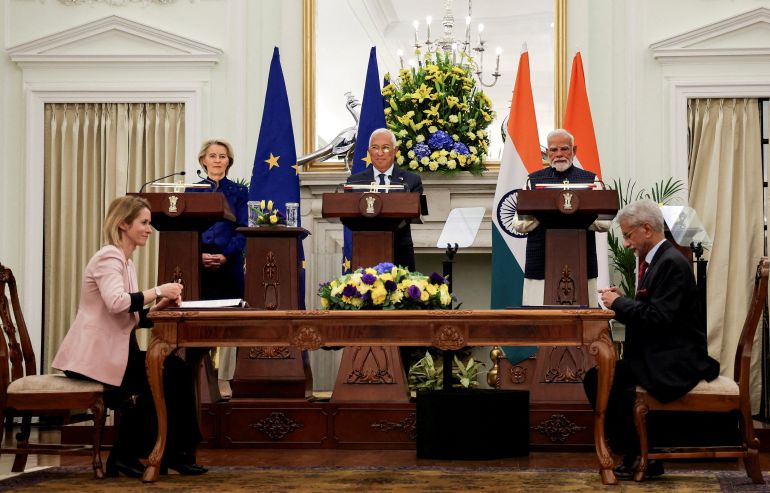
EU foreign policy chief Kaja Kallas and Indian External Affairs Minister Subrahmanyam Jaishankar sign an EU-India security and defence partnership on January 27, 2026 [Altaf Hussain/Reuters]
What does the deal cover, and how significant is it?
The deal is India’s largest and most comprehensive trade agreement and covers goods, services and investments across the EU’s customs union.
In 2023, the EU withdrew its generalised scheme of preferences (GSP) benefits for India, exposing its exporters to higher tariffs. The new deal, analysts noted, could give India an edge in several sectors, including textiles, pharmaceuticals, machinery, steel, petroleum products and electrical equipment.
Overall, the EU is giving India access to 144 services subsectors while India is opening 102 subsectors to the EU, including in the financial, maritime and telecommunications industries.
On Tuesday, Modi told Indian workers and industry leaders in sectors such as textiles, gems and jewellery that “the agreement will prove very helpful for you,” adding that it will not only boost manufacturing in India but will also expand India’s services sector.
“This free trade agreement will strengthen confidence in India for every business and every investor in the world. India is working extensively on global partnerships in all sectors,” Modi said.
The final draft of the trade agreement must still pass legal scrutiny in Brussels and New Delhi and may only become operational next year, said Biswajit Dhar, a trade economist who has been involved with multiple Indian trade negotiations.
Anil Trigunayat, a former Indian diplomat who has dealt with regional trading blocs, described the trade deal as “excellent, providing professional market access while taking care of the bureaucratic labyrinth of the EU”.
“Unlike 20 years ago, today India has the capacity to work together with the Europeans and provides a good market for them,” Trigunayat said. “There will be much more to look into other than cheaper wines or BMWs, including trade investments.”
“It’s a very significant deal for both India and the EU,” Dhar told Al Jazeera, “and a major step towards consolidating India’s trade and economic relations with its largest trade partner.”
Crucially, Dhar said, this deal represents an opportunity for both sides to “diversify and look beyond the US and grow beyond their dependence on the American market”.
Cars made by Germany-based BMW, on sale in Mumbai, are now subject to high Indian tariffs, but those duties will fall dramatically under the trade pact [File: Francis Mascarenhas/Reuters]
Is India opening its much-protected automobile industry?
India has been criticised in the past for its protectionist approach to the automobile sector, including by Tesla owner Elon Musk. It has been levying tariffs as high as 110 percent on foreign vehicles.
Negotiations to reach a trade deal between India and the EU broke down in 2013 over New Delhi’s reluctance to open its automobile sector.
Under the deal announced on Tuesday, however, New Delhi will open its domestic automobile market to EU imports, slashing tariffs on most cars from the EU to 30 to 35 percent, which are to be then phased down to 10 percent over several years.
It is understood that EU cars priced below 15,000 euros ($17,800) are excluded from the deal and will remain subject to higher tariffs. Cars costing more than this will be divided into three categories, each with quotas and separate tariffs.
Electric vehicles, however, will be excluded from import duty reductions for the first five years to protect investments by domestic Indian electric car manufacturers.
After that, imports from the EU will be restricted to 160,000 internal combustion engines and 90,000 electric vehicles per year.
Despite these safeguards, shares in Indian carmakers dipped by about 1.6 percent after the announcement of the trade deal.
Modi, von der Leyen and Indian Defence Minister Rajnath Singh attend the Republic Day parade in New Delhi on January 26, 2026 [Adnan Abidi/Reuters]
How will the deal benefit the EU?
Indian tariffs on 30 percent of goods imported from the EU will fall to zero immediately.
Overall, tariffs on 96.6 percent of EU goods exports to India will be eliminated or reduced, EU officials said. The deal will save up to 4 billion euros ($4.74bn) a year in duties on European products.
Besides the relaxation of tariffs on car imports from the EU, existing Indian tariffs of up to 44 percent on machinery, 22 percent on chemicals and 11 percent on pharmaceuticals will, for the most part, be eliminated.
Tariffs on EU aircraft and spacecraft will also be eliminated for almost all products while those on optical, medical and surgical equipment will be eliminated for 90 percent of products.
Meanwhile, spirits and wines imported to India from the EU, currently tariffed at 150 percent, will be cut to 20 to 30 percent for wines, 40 percent for spirits and 50 percent for beer.
India will also provide improved access for EU firms in financial and maritime services, and both sides will simplify customs rules and provide stronger intellectual property protections.
How will the deal benefit India?
The EU will scrap all tariffs on 90 percent of Indian goods, and within seven years, that will be extended to 93 percent of Indian goods.
Among those benefitting from zero tariffs immediately are marine/seafood products, such as shrimp and frozen fish (currently levied at up to 26 percent); chemicals (12.8 percent); plastics and rubber (6.5 percent); leather and footwear (17 percent); textiles (12 percent); apparel (4 percent); base metals (10 percent); and gems and jewellery (4 percent).
There will be partial tariff cuts and quotas for about 6 percent of Indian goods, bringing the EU’s average tariff rate down from 3.8 percent to 0.1 percent.
Overall, 99.5 percent of bilateral trade will benefit from some form of tariff concession.
India is still seeking improvements in tariff-free steel export quotas, and the outcome of these talks is due by June 30 before EU rules take effect on July 1. Under the deal as it stands, India would be allowed to export 1.6 million tonnes of steel to the EU duty-free, but this is only about half what it exports annually at present.
The EU has not granted India an exemption from its carbon border adjustment mechanism (CBAM), which taxes “carbon-intensive” goods – those that require large amounts of energy to produce, such as steel, cement, fertiliser and electricity.
Only countries that are associated with the EU, such as Norway, Iceland, Liechtenstein and Switzerland are exempt from these due to their participation in the EU emissions trading system or related agreements. Countries whose emissions-trading systems are linked directly to the EU’s, such as Switzerland, are also exempt.
However, India will be able to negotiate this if the EU grants flexibility to another country.
How significant is India-EU trade now?
The US remains the biggest overall trading partner for both India and the EU.
However, over the past decade, goods trade between India and the EU has grown substantially, rising from about $74bn in 2020 to $136bn in 2024-2025, making the EU India’s largest goods trading partner.
India has a favourable trade surplus with the EU of more than $15bn as its exports of $75.85bn outpace imports of $60.68bn.
EU exports are heavy on machinery, transport equipment and chemicals while India mostly exports chemicals, base metals, mineral products and textiles.
The two sides hope to increase that to about $200bn by 2030.
From 2019 to 2024, India-EU trade in services also grew with Indian exports rising from $22.5bn to $44bn while EU exports increased from about $17bn to $34bn. The two mainly trade in business consulting and IT services.
India is the EU’s ninth largest trading partner, accounting for 2.4 percent of its total trade, compared with 17.3 percent for the US and 14.6 percent for China.
As of 2024, 931,607 Indians resided in the EU, according to the Indian government. Comparative figures for EU citizens living in India are not available.
The EU says about 6,000 European companies operate in India while about 1,500 Indian companies have a presence in the EU.
US President Donald Trump and Modi are pictured in a mirror at a joint news conference at the White House in Washington, DC, on February 13, 2025 [Nathan Howard/Reuters]
Do both economies have tensions with the US?
Yes, on several fronts.
Despite Modi having relatively good relations with the US president, India is one of the countries most heavily tariffed by the US – at 50 percent on goods – as a result of Trump’s trade war. Half of that is punishment for India’s continued purchase of Russian crude oil, which White House officials said is financing the Kremlin’s war on Ukraine.
EU tensions with the Trump administration have been building as well, particularly over Trump’s insistence that the US be allowed to buy Greenland, which is a territory of EU member Denmark.
This month, Trump threatened additional tariffs of 10 percent – rising to 25 percent in June – against eight European countries that had objected to Trump’s demand to buy Greenland. Both Greenland and Denmark have repeatedly stated that the island, which is politically part of Europe but is geographically located in North America, is not for sale.
However, during the World Economic Forum in Davos, Switzerland, last week, Trump walked back this threat and said he would not impose tariffs. Instead, he said, constructive talks had laid the basis for a framework of an agreement over Greenland.
The EU is still subject to up to 15 percent tariffs by the US under an EU-US trade deal signed last year.
Experts said the finalisation of the India-EU trade agreement has been expedited, in part, in response to this pressure from the Trump administration.
“The global trade disruptions have become a norm, and there is an urgent necessity for both [India and the EU] to provide a certain degree of certainty to their businesses,” Dhar said. “The US is mired in uncertainty, and one just doesn’t know what’s going to happen tomorrow.”
How will the US react to the India-EU trade deal?
The White House has already criticised the agreement.
US Treasury Secretary Scott Bessent lashed out at the EU over the pact with New Delhi. “We have put 25 percent tariffs on India for buying Russian oil. Guess what happened last week? The Europeans signed a trade deal with India,” Bessent told ABC News on Sunday.
“They [the Europeans] are financing the war against themselves,” he added.
While the EU signed a trade deal with the US fairly quickly after Trump announced his trade war last year, New Delhi is still trying to negotiate one with Washington. It is also seeking to diversify trade to other parts of the world.
“India has taken a policy of strategic patience [in dealing with Trump’s trade war],” Trigunayat said. “The deal with the EU is part of the same process to cushion the impact and find new partners.”
Harsh Pant, vice president of the New Delhi-based Observer Research Foundation think tank, told Al Jazeera: “You have two big economic players coming together, which is a signal to the US that they are willing to move forward with their own agenda.”
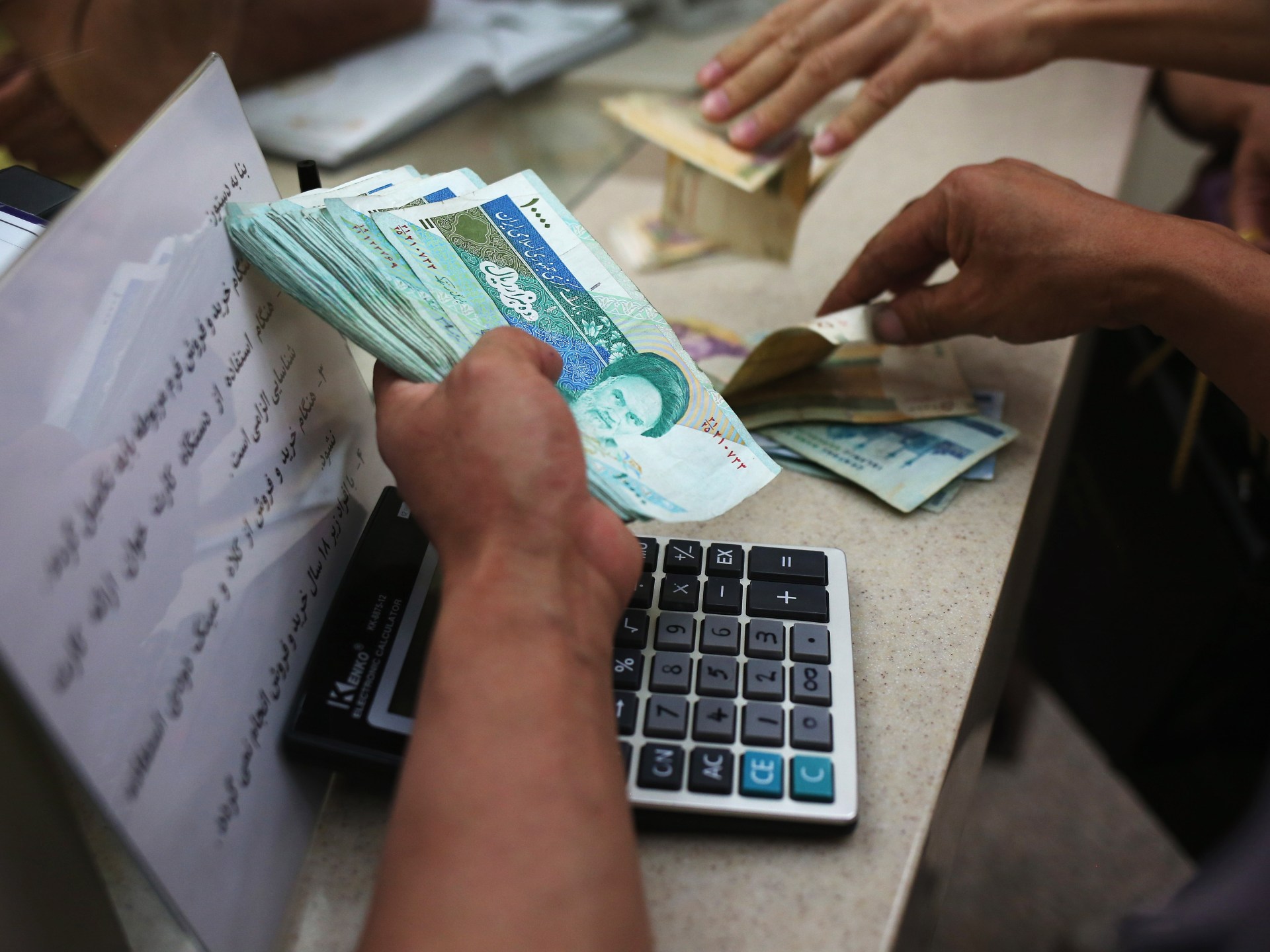
Iran’s currency has dropped to a record 1,500,000 rials to the US dollar, according to several Iranian currency tracking websites, weeks after protests sparked by the rial’s dwindling value rocked the country.
Exchange shops on Tuesday offered the record-low rial-to-dollar rate in Tehran, deepening the economic hardship for large swaths of the Iranian populace suffering from decades of extensive economic mismanagement and international sanctions.
Recommended Stories
list of 3 itemsend of list
Iran’s newly appointed Central Bank Governor Abdolnaser Hemmati said that “the foreign exchange market is following its natural course.”
This latest dip comes nearly a month after shopkeepers in Tehran’s Grand Bazaar shut their stores in protest against the falling value of the rial, hyperinflation and a government decision to end certain food and fuel subsidies.
The demonstrations that began in the capital on December 28 quickly spread across the country, with protesters demanding political change. They were met by a violent crackdown by Iranian security forces, the scale of which is only starting to become clear as the country faced more than two weeks of internet blackout – the most comprehensive in its history.
Iran’s government said at least 3,117 people were killed in the unrest, saying 2,427 were civilians and security forces, and labelled the rest “terrorists.”
The US-based Human Rights Activists News Agency, which verifies each death with a network of activists in Iran, put the death toll at 5,777 protesters, 214 government-affiliated forces, 86 children and 49 civilians who were not participating in the demonstrations.
Iranian state media accused forces abroad of escalating the protests as Tehran remains unable to address the country’s ailing economy, squeezed by international sanctions over its nuclear programme.
Economic instability has also been fuelled by spiralling tensions with the US and Israel. US President Donald Trump on Tuesday said the situation with Iran was “in flux” after he ordered what he described as a “big armada” to the region.
On Monday, the USS Abraham Lincoln, and the guided missile destroyers accompanying it, entered the US Central Command’s “area of responsibility”, marking a significant escalation in the US military posture near Iran.
Two Iranian-aligned armed groups in the Middle East have signalled their willingness to launch new attacks, likely trying to back Iran after Trump threatened military action over the killing of protesters. Gulf Arab states said they want to stay out of any attack, despite hosting US military personnel.
At the same time, Trump stressed diplomacy remains an option. “They want to make a deal. I know so. They called on numerous occasions. They want to talk.”
The election for Iraq’s next president has been postponed in order for more consultation between the two Kurdish parties to come to a decision.
The Kurdistan Democratic Party (KDP) and the Patriotic Union of Kurdistan (PUK) requested a delay in the parliamentary vote scheduled for Tuesday, according to the Iraqi News Agency (INA).
Recommended Stories
list of 4 itemsend of list
According to a sectarian quota system, the prime minister’s position is held by a Shia, the parliament’s speaker is a Sunni, and the presidency is largely ceremonial for Kurds.
A PUK member typically assumes the presidency in accordance with a deal reached between the two main Kurdish parties. The KDP selects the region’s president and regional leader, in contrast, from the region’s semi-autonomous Kurdish region.
However, the KDP chose Foreign Minister Fuad Hussein as the primary candidate in this instance.
Whoever is nominated by the two Kurdish parties still needs the support of the Shia and Sunni blocs in the parliament, according to Al Jazeera’s Mahmoud Abdelwahed, who is based in Baghdad.
The new president will have 15 days to choose a prime minister, presumably Nouri al-Maliki’s former leader, after the election.
Al-Maliki, 75, has previously served as Iraq’s prime minister for two terms, including two terms in 2006 and 2014. He abruptly resigned under American pressure. He is perceived as having ties to Iran.
Maliki was approved by the Coordination Framework, a coalition of Shia parties with a majority in parliament on Saturday. US Secretary of State Marco Rubio warned against an Iraqi pro-Iranian government the following day.
Washington “has conveyed to it a negative view of previous governments led by former prime minister Maliki,” according to an Iraqi source close to the coordination framework.
The United States will make its own sovereign decisions regarding the next government, according to US representatives in a letter.
Another Iraqi source confirmed the letter, noting that Maliki was confident that Washington’s concerns would be addressed by the Shia alliance, which had continued to advance with its decision.