‘Even the dead were not spared’: Israeli’s Gaza desecration compounds grief

Gaza City – Fatima Abdullah cannot erase the painful images from al-Batsh cemetery, which was excavated and desecrated this week by the Israeli military in the Tuffah neighbourhood east of Gaza City, as the army recovered the last captive’s body.

The cemetery contains the grave of her husband, who was killed during Israel’s genocidal war on Gaza, alongside thousands of other graves belonging to families across the devastated territory.

Recommended Stories

list of 4 itemsend of list

Fatima, a mother of three, has told Al Jazeera of the unbearable tension she felt knowing that the Israeli military’s search operations were focused on that cemetery.

“We were all on edge… we knew the operation was at al-Batsh cemetery, and everyone was scared it would be their loved one’s grave next. I imagined the machinery approaching my husband’s grave, and I said, ‘No, God.’”

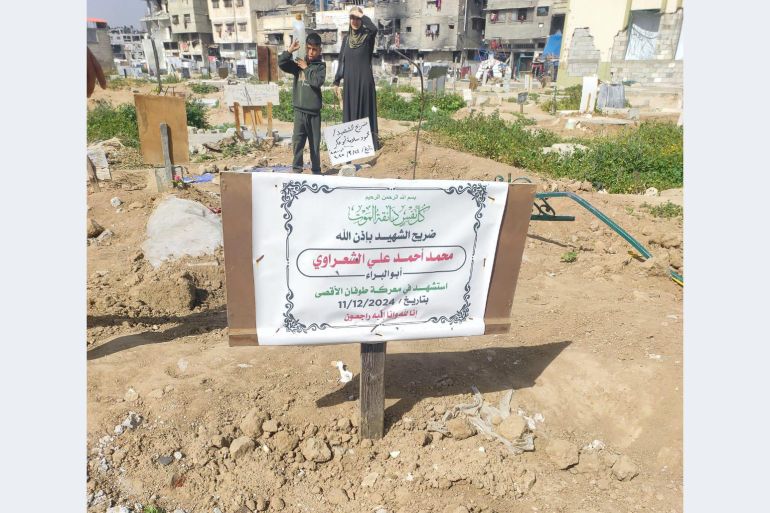
Fatima’s husband, Mohammad al-Shaarawi, was killed in an Israeli drone strike on December 11, 2024. The attack targeted him with a group of friends in Tuffah. At the time, Fatima and her children were displaced in southern Gaza.

“Even the dead were not spared,” Fatima says, describing a violation of the last remnants of their right to mourn and preserve dignity.

“Corpses scattered, bones, bags thrown … they were bulldozing graves, dumping the remains as if they were nothing.”

During the search and recovery of captive Israeli policeman Ran Gvili, about 250 graves were examined in a short period using heavy military machinery and bulldozers.

The operation led to the exhumation of both old and recent graves, the destruction of many tombstones, and a significant alteration of the cemetery’s landscape, according to aerial images of the site.

“I used to always visit him. On holidays, on his birthday, with the kids. The strange thing is that my children didn’t feel they were going to a sad place; they felt they were really going to visit their father,” Fatima says.

After the forced mass evacuation of tens of thousands from Shujayea in Gaza City amid intensive Israeli attacks in June 2024, Fatima could no longer reach the cemetery, surrounded by rubble, debris and military machinery.

The risk persisted after the ceasefire was declared in October 2025 because the cemetery lies near the so-called “yellow line” under Israeli military control.

“No one knows what they took, what remains were returned … if anything at all,” Fatima says, hoping that phase two of the ceasefire will allow her to visit the cemetery to check on her husband’s grave.

“We, the people of Gaza, didn’t even have the luxury of mourning properly, and now they’ve taken away the graves of our loved ones after death,” she adds.

Gaza Cemetery
The grave of Mohammed Al-Shaarawi, Fatima Abdullah’a husband, at al-Batch cemetery in the Tuffah neighbourhood, east of Gaza City [Courtesy of Fatma Abdullah]

Israel’s history of desecrating cemeteries

The Israeli military has wantonly bombed, bulldozed and desecrated Palestinian graves in Gaza multiple times over the years, drawing condemnation from human rights organisations as a flagrant violation of international humanitarian law.

The Euro-Med Human Rights Monitor documented that the Israeli army has destroyed or severely damaged approximately 21 out of 60 cemeteries in Gaza, exhuming remains, mixing them or causing them to be lost, leaving thousands of Palestinian families with crushing uncertainty about the fate of their relatives’ bodies.

Among instances of Israeli destruction are:

  • Beit Hanoon cemetery in northern Gaza
  • Al-Faluja cemetery in Jabalia, northern Gaza
  • Ali Ibn Marwan cemetery, Gaza City
  • Sheikh Radwan cemetery, Gaza City
  • Al Shuhadaa Eastern cemetery, Gaza City
  • Tunisian cemetery, Gaza City
  • Cemetery of Church of St Porphyrius, Gaza City
  • Khan Younis cemetery in the Austrian neighbourhood

The Gaza War Cemetery, in Tuffah, housing fallen soldiers during World Wars I and II from the United Kingdom and several Commonwealth nations, has suffered significant damage from Israeli bombardment but is not yet completely destroyed, according to local assessments. Damage has also been reported to the Deir el-Balah War Cemetery.

Additionally, earlier this month, Euro-Med called for urgent international intervention “to halt the crimes of widespread destruction and land levelling being carried out by the Israeli army in Rafah, in the southern Gaza Strip, until specialised teams and the necessary equipment are allowed to recover the bodies of victims, identify them, and ensure their dignified burial”.

Hamas also condemned the exhumation of hundreds of graves and described the act as “unethical and illegal, reflecting the international system’s failure to hold the occupation accountable for its unprecedented crimes in modern times”.

Gaza Cemetery
Madeline Shuqayleh stands at her sister’s grave in al-Batch cemetery for the first time, months after her burial [Courtesy of Madeline Shuqayleh]

Buried without farewell

For Madeline Shuqayleh, the exhumation of al-Batsh cemetery ripped open the wound of where her sister and niece were buried.

On October 28, 2023, her sister, Maram, and her four-month-old daughter, Yumna, were killed in an Israeli strike in central Gaza. The family did not immediately know of their deaths, as they were displaced in Deir el-Balah, while her sister stayed in the north with her husband’s family.

“Imagine knowing your sister was killed and buried without knowing how, where, or what happened to her. It was a crushing shock in every way.”

Maram and her daughter were buried in al-Batsh cemetery. “After a lot of effort, we found the place. When we visited, the grave was there, the tombstone intact … the pain was immense,” she added. “But now, to this moment, they’ve deprived us … as if they killed her again.”

The family still does not know what happened to the bodies of Maram and her daughter, or whether the exhumed graves were restored.

The UN and international human rights organisations have documented multiple cases of missing bodies and the deterioration of burial sites after cemeteries were bulldozed or destroyed during Israeli military operations.

In April 2024, UN High Commissioner for Human Rights Volker Turk noted the discovery of mass graves at al-Shifa and Nasser hospitals, containing hundreds of corpses, including women, the elderly, and wounded. Some were found bound and naked, raising “serious concerns” over possible grave violations of international humanitarian law.

‘My father has no grave today’

Rola Abu Seedo experienced compounded grief with her family after the bulldozing of her father’s grave by the Israeli army in a temporary cemetery at al-Shifa.

Rola had been displaced to the south with her mother and four siblings, while her father refused to leave and remained in their northern home until his death.

Her father remained in Gaza City under a severe blockade and a collapsed health system, suffering from diabetes, high blood pressure and a previous stroke, relying on medications that were no longer available.

“At that time, there was famine and no medicines,” Rola told Al Jazeera. “The medical report noted respiratory problems, and his condition worsened.”

On April 28, 2024, her father died, and the family did not learn of his death immediately. “Communications were nearly cut off; my father couldn’t charge his phone to reach us.”

A relative performed a burial and preserved the grave location, placing a simple marker sent to the family, who planned to move it later to an official cemetery once conditions stabilised.

But after another major Israeli incursion around al-Shifa in March 2024, bulldozers levelled the cemetery, leaving no grave markers.

“Our relatives went back to find the grave after the operation, but they said they couldn’t locate it and the area where he was buried had been bulldozed,” Rola said.

About a year ago, with news of potential grave transfers from al-Shifa to Beit Lahiya in northern Gaza, a committee of forensic authorities and the Red Crescent participated in digging operations based on residents’ testimonies.

Rola’s family searched for her father’s remains again, but to no avail.

“They dug in the spot we were sure was his grave … but they didn’t find a body.” To this day, the family does not know the whereabouts of her father’s remains.

“We still don’t know if they took the bodies, mixed them, or moved them,” she says. “My father has no grave today.”

“It’s as if they not only deprived us of our loved ones while they were alive, but also denied us the farewell after death.”

Gaza Cemetery
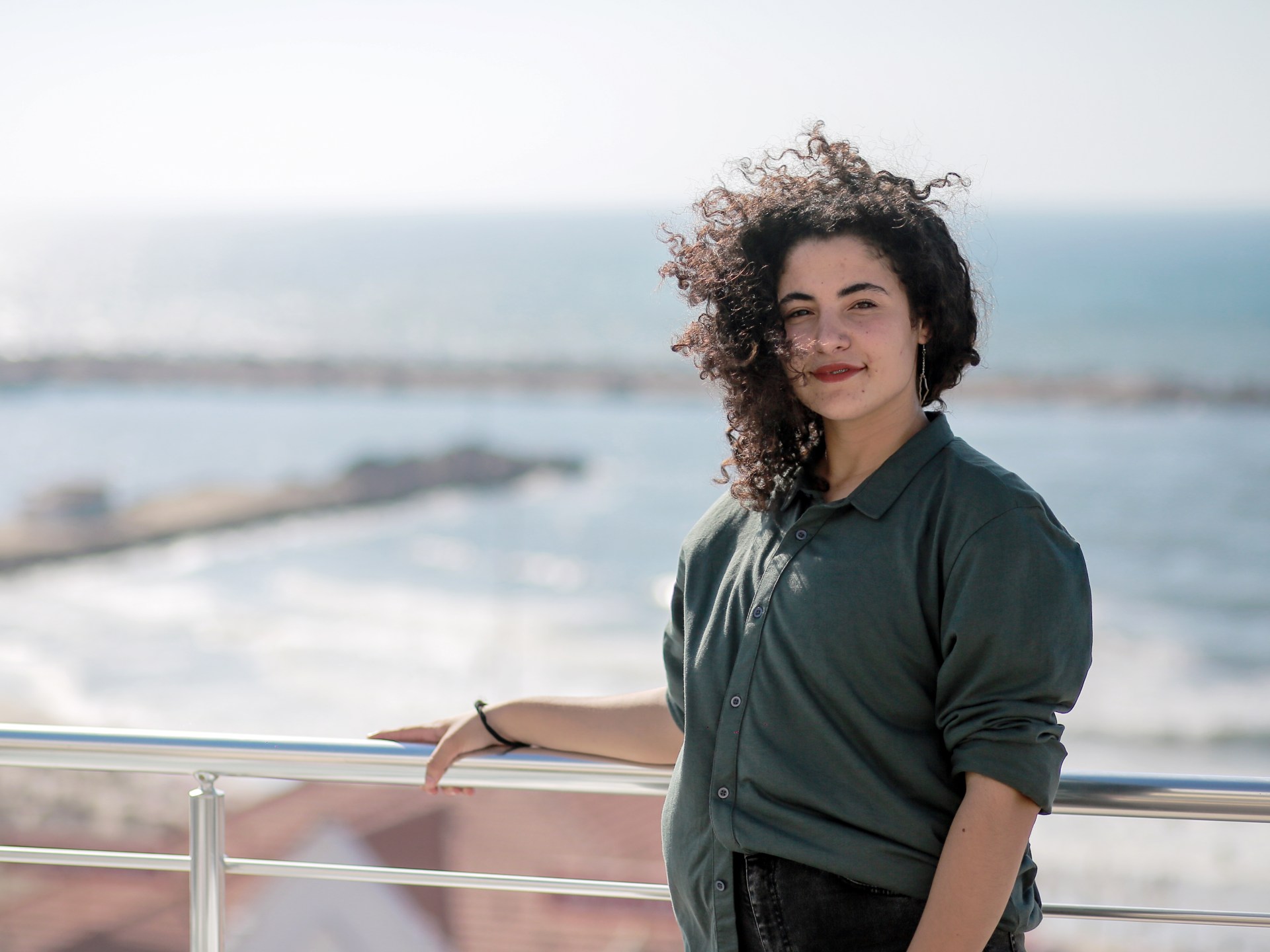
Fahmi Abu Seedo, 65, Rola’s father, who died in northern Gaza during the war after suffering from health complications [Courtesy of Rola Abu Seedo]

Palestinian journalist Bisan Owda with 1.4m followers reports TikTok ban

Award-winning Palestinian journalist Bisan Owda has said she has been permanently banned from TikTok, days after the social media platform was acquired by new investors in the United States.

Owda, an Emmy Award-winning journalist and contributor to Al Jazeera’s AJ+ from Gaza, shared a video on her Instagram and X accounts on Wednesday, telling her followers that her TikTok account had been banned.

Recommended Stories

list of 4 itemsend of list

“TikTok deleted my account. I had 1.4 million followers there, and I have been building that platform for four years,” Owda said in the video filmed from Gaza.

“I expected that it will be restricted, like every time, not banned forever,” she added.

Al Jazeera sent a query to TikTok inquiring about Owda’s account and is waiting for a reply.

Hours after Owda shared her video, an account that appeared to have the same username was still visible on TikTok with a message that said: “Posts that some may find uncomfortable are unavailable.”

The last post visible on that account was from September 20, 2025, nearly three weeks before a ceasefire was reached in Israel’s genocidal war on the Gaza Strip.

In her video on Wednesday, Owda pointed to recent remarks from Israeli Prime Minister Benjamin Netanyahu as well as Adam Presser, the new CEO of TikTok’s US arm, as a possible explanation for the ban.

Netanyahu met with pro-Israel influencers in New York in September last year, telling them that he hoped the “purchase” of TikTok “goes through”.

“We have to fight with the weapons that apply to the battlefield in which we engage, and the most important ones are social media,” Netanyahu, who is a war crimes suspect, said at the time.

“The most important purchase that is going on right now is … TikTok,” Netanyahu added. “TikTok, number one, number one, and I hope it goes through, because it can be consequential,” he said.

TikTok announced last week that a deal to establish a separate version of the platform in the US had been completed, with the new entity controlled by investment firms, many of which are American companies, including several linked to US President Donald Trump.

Owda also shared an undated video of Adam Presser, the new CEO of TikTok’s US arm.

In the video, Presser speaks about changes made at TikTok, where he previously worked as head of operations in the US, saying that “the use of the term Zionist as a proxy for a protected attribute” had been designated “as hate speech”.

“There’s no finish line to moderating hate speech, identifying hateful trends, trying to keep the platform safe,” Presser said.

Zionism is a nationalist ideology that emerged in the late 1800s in Europe, calling for the creation of a Jewish state.

Owda’s social media presence grew from posting daily videos in which she greeted her audience, saying, “It’s Bisan From Gaza – and I’m still alive.”

She made a documentary of the same name with Al Jazeera’s AJ+, which was awarded an Emmy in the Outstanding Hard News Feature Story category in 2024.

Her video on Wednesday came as Israel’s top court again postponed making a decision on whether foreign journalists should be allowed to enter and report on Gaza independently of the Israeli military.

Despite the ongoing ceasefire, an Israeli attack last week killed three Palestinian journalists in Gaza.

US agents involved in Alex Pretti’s killing in Minneapolis placed on leave

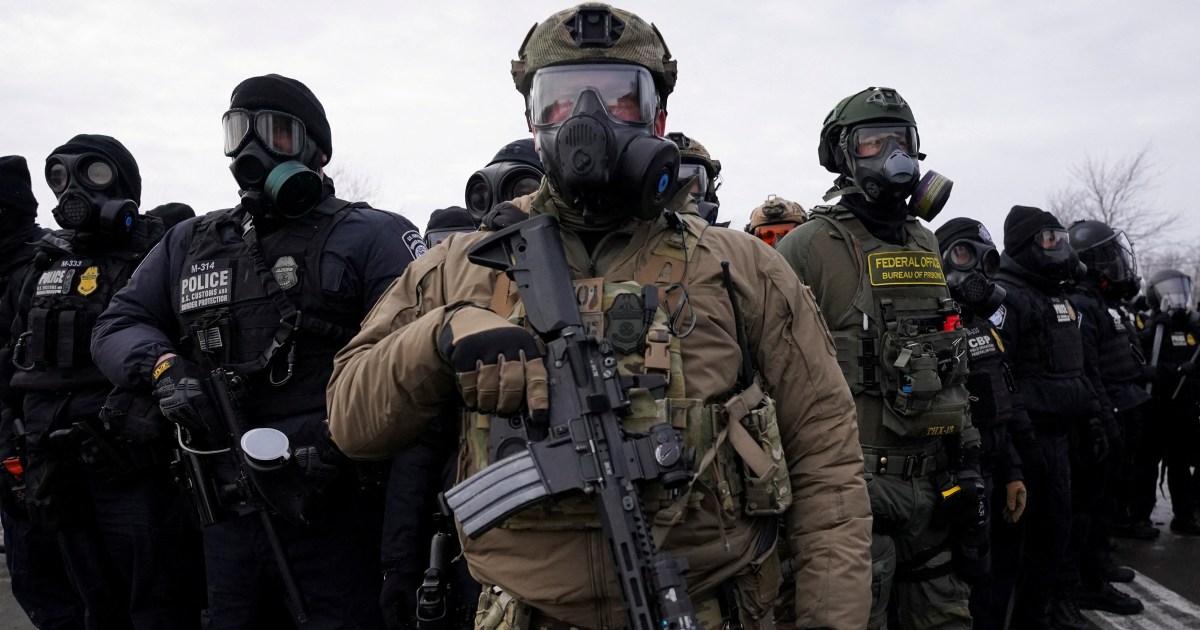
Two United States federal agents involved in the fatal shooting of intensive care nurse Alex Pretti during an immigration raid in Minneapolis have been placed on administrative leave, as fallout from the most recent killing of a US citizen continues to cause outrage.

The two officers have been on leave since Saturday, in what US officials said on Wednesday was “standard protocol”, when Pretti was shot multiple times after being forced to the ground by masked immigration officers in an altercation that quickly turned deadly and was captured on video.

Recommended Stories

list of 4 itemsend of list

“The two officers involved are on administrative leave and have been since Saturday,” Al Jazeera’s Manuel Rapalo said, reading from a statement from a Customs and Border Patrol (CBP) spokesperson on Wednesday.

Rapalo, reporting from Minneapolis, said that it was “unclear whether or not the Department of Homeland Security has taken any sort of additional actions against the other officers who were involved in that fatal shooting”, referring to agents “seen in multiple videos helping to restrain Alex Pretti in the moments before that fatal shooting took place”.

US media, citing a preliminary investigation sent to members of the US Congress, report that a US Border Patrol agent initially opened fire on Pretti while he was on the ground, followed by a CBP officer, who also fired.

The killing of Pretti has been widely condemned across the political aisle despite initial efforts by officials from the administration of President Donald Trump to justify the killing and paint the victim as being to blame.

Pretti’s shooting followed the January 7 killing of Minneapolis resident Renee Good, a mother of three who was shot by an Immigration and Customs Enforcement (ICE) officer.

In a bid to stem the political and public backlash over the violence by federal officers in Minnesota, President Trump has shuffled the leadership of immigration agents deployed in Minneapolis.

He replaced Greg Bovino, the Border Patrol official whose aggressive tactics in Minnesota have drawn widespread criticism, with his policy-focused border immigration chief Tom Homan.

But Trump’s signals have been mixed regarding the ongoing immigration raids in Minneapolis.

After stating on Tuesday that he wanted to “de-escalate” the spiralling crisis in the state, Trump on Wednesday warned Minneapolis Mayor Jacob Frey that he was “playing with fire” after Frey reiterated that his city would not help federal agents enforce immigration law.

Trump wrote on his social media platform Truth Social: “Could somebody in his inner sanctum please explain that this statement is a very serious violation of the Law, and that ‌he is PLAYING WITH FIRE!”

Responding to the president, Frey wrote on social media, “The job of our police is to keep people safe, not enforce [federal] immigration laws.”

Amid the mixed messaging from Trump, tensions remain high on the streets of Minneapolis, where observers said immigration raids had not slowed but appeared to be more targeted.

Attorney General Pam Bondi, a high-ranking member of Trump’s administration, was in Minneapolis on Wednesday, where she announced the arrests of 16 Minnesota “rioters” for allegedly assaulting federal law enforcement.

Trump has sent thousands of federal officers to the city of Minneapolis and the surrounding state of Minnesota as part of the president’s aggressive deportation policy.

“Community members are afraid to go out as a result of the occupation in our city by ICE,” US Congresswoman for Minnesota Ilhan Omar said.

“Not only is the federal occupation hurting businesses, the president’s reprehensible rhetoric has led right-wing grifters to show up here to terrorise our community. It is indefensible,” she said, warning that “constitutional rights are being crumpled” as “fear is being weaponised”.

The parents of Pretti have retained a former federal prosecutor who helped Minnesota’s attorney general convict a police officer of murder for kneeling on the neck of African American man George Floyd, and whose killing by white officer Derek Chauvin in 2020 ignited the global Black Lives Matter protests.

Steve Schleicher is representing Michael and Susan Pretti pro bono, according to a family spokesman.

Mourinho’s Benfica drag Real Madrid with them to Champions League playoffs

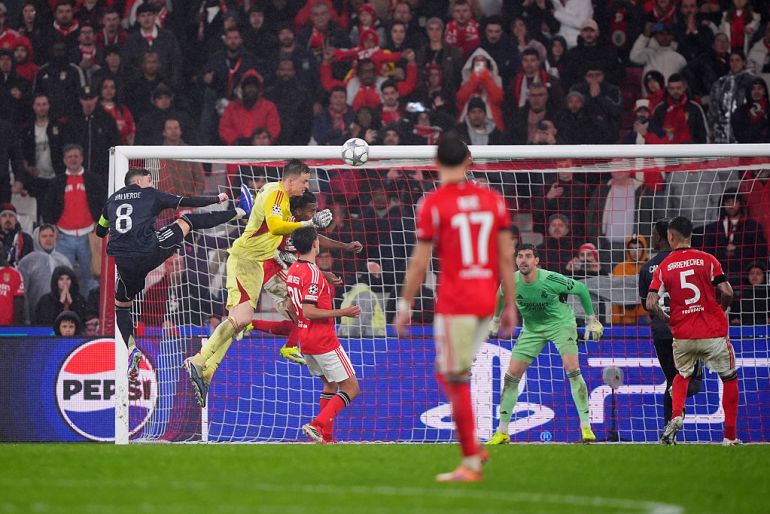
Goalkeeper Anatoliy Trubin scored an astonishing 98th-minute header as Benfica beat Real Madrid 4-2 to keep themselves in the Champions League and deny their illustrious opponents an automatic spot in the last 16.

In an extraordinary finale on Wednesday, the Portuguese side were ⁠heading out despite leading 3-2 with seconds of stoppage time remaining before Trubin came forward for a free ​kick to score the goal needed to sneak into the playoff round on goal ‍difference.

Recommended Stories

list of 4 itemsend of list

That sparked wild celebrations from Benfica players, fans and their charismatic coach Jose Mourinho – a former manager of Real Madrid – at the Stadium of Light in Lisbon.

The Spaniards had hoped to finish in the top eight and go straight into the ‍last 16, but ⁠their 15 points from eight games were not enough, and they finished the match with nine men as Raul Asencio and Rodrygo were sent off.

Andreas Schjelderup scored two goals for Benfica and Vangelis Pavlidis netted from the penalty spot, while Kylian Mbappe netted twice for Real in a hugely entertaining, end-to-end contest.

Benfica advance at the expense of Marseille, who lost 3-0 at Club Brugge. The giant screen in the stadium in Belgium congratulated both teams for advancing to the ​next stage, but that proved premature as Trubin turned the tables.

Both Benfica ‌and Real needed a goal for different reasons going into the final minutes, and it is a vindication of the competition’s format that a single goal could have such a dramatic effect on the table.

Anatoliy Trubin of Benfica scores his team's fourth goal
Goalkeeper Anatoliy Trubin of Benfica scores his team’s fourth goal with a header [Jose Manuel Alvarez Rey/Getty Images]

Benfica were denied two strong early penalty shots, ‌and Real took the lead on 30 minutes against the run of play when Asencio’s cross to the back post was headed in by Mbappe.

The home ‌side drew level six minutes later when Asencio’s slip in the ⁠wet conditions allowed Pavlidis to provide a perfect cross for Schjelderup to head into the net.

Benfica were awarded a penalty in first-half added time when Aurelien Tchouameni was adjudged to have hauled Nicolas Otamendi to the floor, and Pavlidis buried his spot-kick.

Schjelderup ‌scored his second of the game from Pavlidis’s perfect pass to make it 3-1, before Mbappe swept home his second, too – his 36th goal of the season in all competitions.

Barcelona claim Champions League last-16 spot, but its the playoffs for PSG

Barcelona stormed ‌back in the second half to claim a 4-1 victory over Copenhagen at the Camp ‍Nou, sealing ‍a top-eight finish and direct qualification for the last 16 of the Champions League.

Goals from Robert Lewandowski, Lamine Yamal, Raphinha and Marcus Rashford on Wednesday ensured the Catalans finished fifth in the standings on 16 points, level with Manchester City, Chelsea and Sporting but ahead on goal difference.

Recommended Stories

list of 4 itemsend of list

Copenhagen shocked ⁠the hosts early when 17-year-old Viktor Dadason slotted the opener past Joan Garcia in the fourth minute, but ​the second half began with a Barcelona fightback.

Yamal set up Lewandowski to equalise in ‍the 48th minute, before scoring himself in the 60th with a deflected effort that left Copenhagen keeper Dominik Kotarski helpless. Raphinha made it 3-1 from the penalty spot after Lewandowski was fouled, and Rashford added a fourth with a free kick ‍in the 85th minute.

“We ⁠all came here tonight thinking about getting into the top eight. We’re very happy with the win,” 18-year-old Yamal told Movistar Plus.

“When you concede a goal in the Champions League, it’s very difficult to come back, but the team was very resilient and managed to turn it around. With the number of matches we play in a season, having two fewer matches leaves you feeling much better.”

Despite the comfortable final result, Barcelona endured a frustrating first half, during which Copenhagen took ​a shock lead.

Dadason stunned the home crowd after Mohamed Elyounoussi delivered a ‌defence-splitting pass, allowing Dadason to outrun Barca’s high defensive line before rifling a low shot past keeper Garcia.

Clearly unsettled, Barcelona were wasteful in attack during the opening 45 minutes. Raphinha and Lewandowski spurned opportunities to equalise, while Eric Garcia came closest to levelling ‌when his driven effort struck the crossbar in the 33rd minute.

The second half, however, saw a completely transformed Barcelona.

Barely three minutes after the restart, Yamal burst forward ‌on a counterattack, darting past Copenhagen defenders before unselfishly squaring the ⁠ball for Lewandowski to slot into an empty net.

The hosts seized control and upped the tempo, pinning Copenhagen deep inside their own half, and Barca took the lead on the hour mark through Yamal, whose deflected shot from inside the box looped over a ‌stranded Kotarski and nestled into the far corner.

Raphinha made it 3-1 from the penalty spot in the 69th minute after Lewandowski was brought down inside the area while attempting to shoot, and substitute Rashford wrapped up ‍the scoring.

Although Barcelona delivered a clinical attacking display, questions remain about their defensive organisation. They completed the league phase without a clean sheet and finished with the worst defence among the top 13 teams.

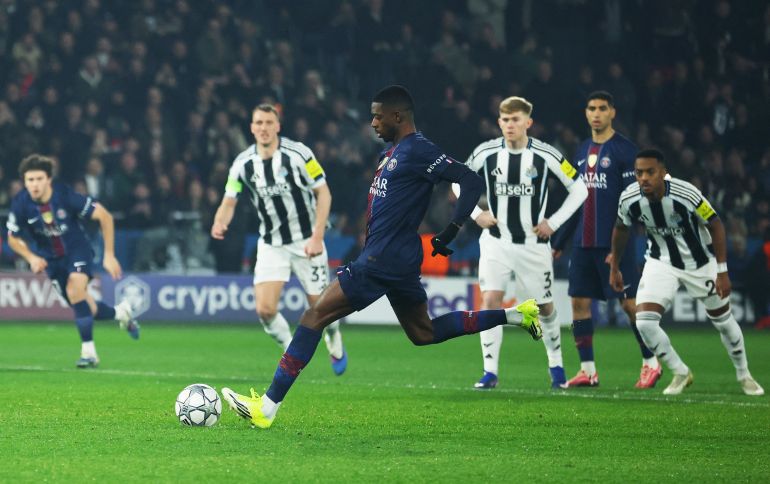
PSG's Ousmane Dembele
Paris Saint-Germain’s Ousmane Dembele has his penalty saved by Newcastle United’s Nick Pope [Sarah Meyssonnier/Reuters]

Dembele’s penalty miss costs PSG in 1-1 draw with Newcastle

Ballon d’Or winner Ousmane Dembele had a night to forget, missing an early penalty and a golden chance from close range as defending champion Paris Saint-Germain drew 1-1 with Newcastle in the Champions League.

The draw meant both sides finished out of the top eight places in the league table and failed to qualify automatically for the last 16. They will enter the playoffs instead.

PSG was awarded an early penalty when Bradley Barcola got behind the defence down the left wing with less than one minute played. The ball hit Barcola’s arm following a tackle from a defender coming across, and then flew onto the arm of Lewis Miley right behind him.

Miley seemed unsighted, and the handball appeared accidental, but referee Slavko Vincic awarded the spot kick following a short video review.

Dembele aimed for the bottom right corner, but goalkeeper Nick Pope made a brilliant save. Pope was beaten in the eighth minute when Vitinha curled a shot into the same corner after being set up by Khvicha Kvaratskhelia on the edge of the penalty area.

Dembele, who scored 35 goals overall last season, scooped the ball well over the crossbar from 10 metres out in the 40th minute when meeting a cross from the left.

Joe Willock equalised for the visitors in first-half stoppage time, and substitute Harvey Barnes missed a chance to win it for the visitors with moments left.

Liverpool's Mohamed Salah
Liverpool’s Mohamed Salah celebrates scoring their third goal against Qarabag [Phil Noble/Reuters]

Liverpool, Arsenal, Bayern, Sporting, Man City and Chelsea also finish UCL stage in style

Liverpool thrashed Qarabag 6-0 to end their group campaign in style and finish in third place – Alexis Mac Allister scoring twice and Mohamed Salah also among the goals.

Chelsea trailed 2-1 at Napoli but two goals by Joao Pedro earned them a 3-2 win to clinch sixth spot while defeat left Napoli down and out in 30th place.

That meant five of the six English clubs are in the last 16 and could yet be joined by Newcastle.

Portugal’s Sporting grabbed a last-gasp 3-2 win at Athletic Bilbao thanks to a goal by Alisson Santos to snatch a top-eight spot and effectively relegate Real Madrid to the playoffs.

Manchester City beat Galatasaray 2-0 at home to jump from 11th to eighth and spare themselves a repeat of last ​season when they failed to reach the last-16 after losing to Real Madrid in the playoffs.

Arsenal, who like Bayern Munich were already ‌assured of a top-eight finish, became the first club in the new 36-team group format to finish with a 100% record, beating bottom club Kairat Almaty 3-2. Runners-up Bayern ended with a 2-1 victory at PSV Eindhoven that left the Dutch club eliminated.

Just like last season, UEFA’s expanded Champions League group stage has proved a masterstroke with the suspense lasting to the final seconds of the eighth round of fixtures.

Before ‌the 18 matches kicked off only four of the 36 clubs were definitely eliminated and only Arsenal and Bayern Munich were guaranteed to be in the last 16.

Several who started outside the top eight needed wins and other results to go in their favour ‌with Barcelona, Manchester City and Sporting seizing their chance.

Erling Haaland and Rayan Cherki were on target for City.

Inter ⁠Milan got the win they required, beating Borussia Dortmund 2-0 away but, like fellow Italians Juventus, will have to take their chances in the playoffs.

Juventus could only draw 0-0 at Monaco. Dortmund missed out on being seeded for the playoffs, ending 17th.

Nowhere was the drama more compelling than at Atletico Madrid’s Metropolitano Stadium where Diego Simeone’s side hosted Norway’s Bodo/Glimt. Atletico led through Alexander Sorloth’s goal and at one point were into the ‌top eight but Bodo, who stunned Manchester City last week, hit back with goals by Fredrik Sjovold and Kasper Hogh for a remarkable 2-1 win to put the Arctic Circle debutants in 23rd and into the playoffs.

Atletico ended 14th and will have to be content with being one of the seeded teams in the two-legged playoffs.

Napoli and PSV Eindhoven were ‍not the only illustrious clubs to finish below the elimination trapdoor.

Marseille had eyes on a top-16 place and a seeded playoff berth, but a 3-0 hammering at Club Brugge meant they finished 25th with Brugge grabbing a playoff spot at their expense.

Quebec mosque attack anniversary renews call to end anti-Muslim hate

Montreal, Quebec, Canada – Canadian Muslim leaders are calling for an end to Islamophobic rhetoric and fearmongering, as the country prepares to mark the nine-year anniversary of a deadly attack on a mosque in the province of Quebec.

Stephen Brown, CEO of the National Council of Canadian Muslims (NCCM), said Thursday’s anniversary is a reminder that Islamophobia in Canada “is not benign”.

Recommended Stories

list of 3 itemsend of list

“It’s something that unfortunately kills people,” Brown told Al Jazeera. “[The anniversary] forces us to remember that there’s real consequences to hatred.”

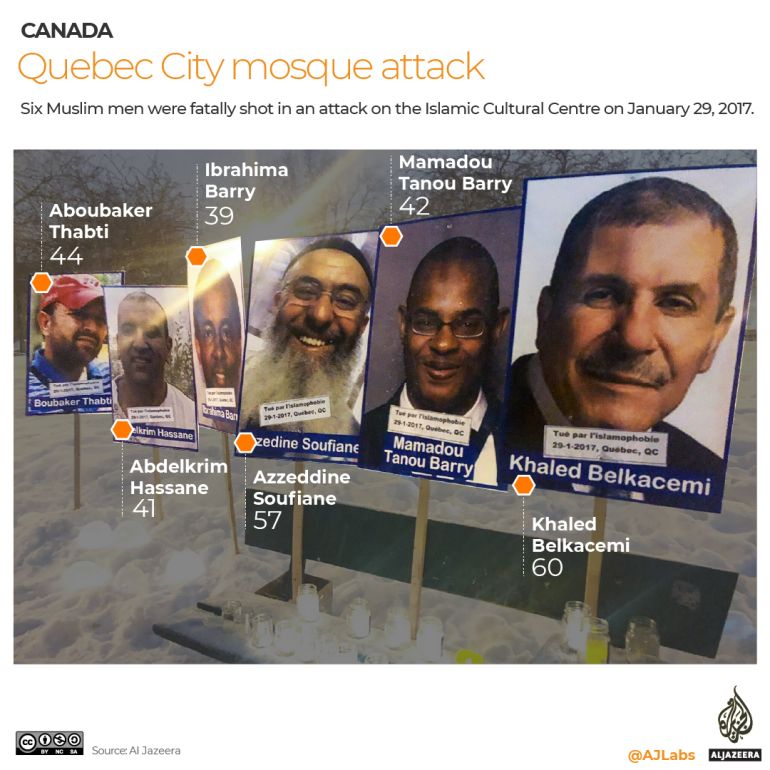
Six Muslim men were killed when a gunman opened fire at the Quebec Islamic Cultural Centre in Quebec City on January 29, 2017, marking the deadliest attack on a house of worship in Canadian history.

The assault left Quebec City’s tight-knit Muslim community deeply shaken, spurred vigils and condemnation across Canada, and shone a spotlight on a global rise in anti-Muslim hate and radicalisation.

The Canadian government denounced the shooting as a “terrorist attack” against Muslims and pledged to tackle the underlying issues.

In 2021, it announced it was designating January 29 as the National Day of Remembrance of the Quebec City Mosque Attack and Action against Islamophobia.

But Brown said he was not sure whether the lessons learned after what happened in Quebec City were being fully remembered today, nearly a decade later.

“Right after the Quebec City mosque massacre, there really was a desire in society to try to mend some of the wounds and build some bridges,” he said.

“Unfortunately, what a lot of people are seeing [now] – and especially for Muslims that live in Quebec – … is a massive return to using Islamophobia and spreading fear of Muslims for political gain.”

Photos of the six men killed during the Quebec City mosque attack
[Al Jazeera]

Laws and rhetoric

Brown pointed to a series of measures put forward by Quebec’s right-wing Coalition Avenir Quebec (CAQ) government that human rights groups say target Muslim Quebecers.

In power since 2018, the CAQ passed a law in 2019 to bar some public servants from wearing religious symbols on the job, including headscarves worn by Muslim women, Sikh turbans and Jewish yarmulkes.

The government justified the law, known as Bill 21, as being part of its push to protect secularism in the province, which in the 1960s underwent a so-called “Quiet Revolution” to break the Catholic Church’s influence over state institutions.

But rights advocates said Bill 21 discriminated against religious minorities and would have a disproportionately harmful effect on Muslim women, in particular.

As the CAQ’s popularity has plummeted in recent months, it has passed and put forward more legislation to strengthen its so-called “state secularism” model in advance of a looming provincial election later this year.

Most recently, in late November, the CAQ introduced a bill that would extend the religious symbols prohibition to daycares and private schools, among other places.

Bill 9 also bars schools from offering meals based exclusively on religious dietary requirements – such as kosher or halal lunches – and outlaws “collective religious practices, notably prayer” in public.

The main prayer room at the Quebec Islamic Cultural Centre is pictured
The attack on Quebec City’s largest mosque lasted less than two minutes [File: Jillian Kestler-D’Amours/Al Jazeera]

“Quebec has adopted its own model of state secularism,” said the provincial minister responsible for secularism, Jean-Francois Roberge.

Roberge has rejected the idea that the bill was targeting Muslim or Jewish Quebecers, telling reporters during a news conference on November 27 that the “same rules apply to everybody”.

But the Canadian Civil Liberties Association (CCLA) – which is involved in a lawsuit against Bill 21 that will be heard by the Supreme Court of Canada later this year – said Bill 9 “masks discrimination as secularism”.

“These harmful bans disproportionately target and marginalize religious and racialized minorities, especially Muslim women,” Harini Sivalingam, director of the CCLA’s equality programme, said in a statement.

According to Brown at NCCM, the Quebec government’s moves have sent “the message to society that there’s something inherently dangerous or wrong with being a visible, practising Muslim”.

He warned that, when people in positions of authority use anti-Muslim rhetoric to try to score political points, “it gives licence to those who already hold a lot of these Islamophobic views or hateful views to actually take it out on people”.

‘Hate continues to threaten’

At the federal level, Amira Elghawaby, Canada’s special representative on combating Islamophobia, said the Canadian government has shown a continued commitment to tackling the problem.

That includes through an Action Plan on Combatting Hate, launched in 2024, which has devoted millions of dollars to community groups, antifascism programmes and other initiatives.

But Elghawaby told Al Jazeera that Islamophobia has nevertheless been rising in Canada, “whether it’s through police-reported hate crimes [or] whether it’s Canadians sharing that they’re experiencing discrimination at work [and] at school”.

A memorial outside the Quebec City mosque is engraved with the names of six men killed
Three black stone plinths stand in a memorial to the victims of the attack, outside the Quebec City mosque, in 2022 [File: Jillian Kestler-D’Amours/Al Jazeera]

According to Statistics Canada, 211 anti-Muslim hate crimes were reported to police in 2023 – a 102-percent jump compared with the previous year. There was a slight increase in 2024 – the most recent year for which the data is available – with 229 incidents reported.

Elghawaby, whose office was established after another anti-Muslim attack killed four members of a single family in London, Ontario, in 2021, said the figures underscore “that hate continues to threaten Canadians”.

“Canada, despite a global reputation of being a country that welcomes people from around the world, does struggle with division, with polarisation, with the rise of extremist narratives,” she said, adding that remembering the Quebec City mosque attack remains critical.

“[The families of the men killed] don’t want the loss of their loved ones to be in vain. They want Canadians to continue to stand with them, to continue to stand against Islamophobia, and to do their part in their own circles to help promote understanding,” Elghawaby said.