Bogota, Colombia – Colombia’s Ministry of Transportation has confirmed that a flight carrying 15 passengers has crashed near the country’s eastern border with Venezuela, killing all 15 passengers on board.
“The country is in mourning,” the ministry wrote on Wednesday in a statement online.
Recommended Stories
list of 3 itemsend of list
In a news conference, Transportation Minister Maria Fernanda Rojas offered her condolences to the families of those killed and assured the public that an investigation into the crash was ongoing.
“We know that this situation is complex for any family involved, and I want to give the message that, on the part of the state, we are doing all the necessary tasks, protocols and procedures to address the situation and deliver responsible information,” she said.
Much is still unknown about the circumstances surrounding the crash and its causes. But the death toll reportedly includes two crew members, a Colombian congressional representative, and a candidate running in the country’s upcoming elections.
The flight, operated by the government-run commercial airline Satena, was en route from Cucuta to Ocana, two cities in the North Santander department bordering Venezuela, when it left radar coverage.
Local air traffic control sources say the plane’s flight history shows a sudden altitude drop 11 minutes before it was expected to land in Ocana.
Earlier in the day, Rojas wrote in a social media post on X that the accident investigation directorate of the Civil Aeronautics Authority was “gathering information regarding the loss of communication from aircraft HK4709”.
“The corresponding protocols have been activated, and we have already initiated PMU,” added Rojas, referring to the “Unified Command Post” set up to respond to emergencies.
The plane disappeared in a remote region characterised by dense jungle, complicating search-and-rescue efforts.
Among the passengers was Diogenes Quintero, a lower house lawmaker who holds a seat specially reserved for conflict victims. He was accompanied by Carlos Salcedo Salazar, a candidate running for the same seat.
A local government official, who requested anonymity since they were not authorised to speak to the press, told Al Jazeera that authorities suspected that the plane had been affected by adverse weather conditions.
Drug trade
The Catatumbo region is also an active conflict zone and is home to the world’s largest cultivations of coca, the plant which produces the raw ingredient used to make cocaine.
Both the drug trade and the region’s strategic location on the Venezuelan border have made it a historic hotbed for armed conflict between rebel groups.
In January last year, violent clashes between the National Liberation Army (ELN) and Frente 33, a dissident group of the demobilised FARC fighters, displaced more than 50,000 people in the region.
They were among the most costly wildfires in United States history, ravaging the densely populated metropolis of Los Angeles in southern California.
But almost a year after they were contained, the Eaton and Palisades fires are back in the headlines, as the administration of President Donald Trump seeks to wrest control of the rebuilding effort.
Recommended Stories
list of 3 itemsend of list
On Wednesday, at a speech in Washington, DC, Trump indicated he would appoint Lee Zeldin, the head of the Environmental Protection Agency (EPA), to take over the permitting process for home construction.
“I haven’t told this to Lee Zeldin yet, but I’m going to put you in charge of getting permits. I think we’re going to override the local authorities,” Trump told the EPA chief from the stage.
But that push has reignited tensions with state and local Democrats in California, who accuse Trump of seeking to shift attention away from the lack of federal aid for recovery efforts.
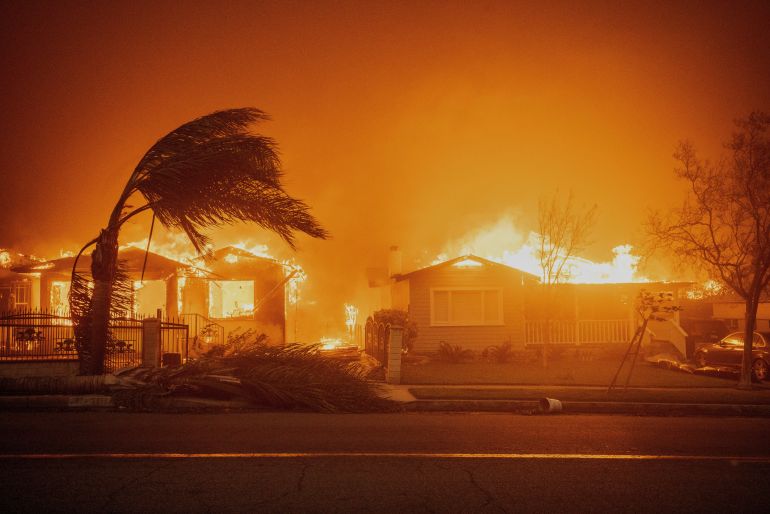
The southern California fires were the first major natural disaster to confront Trump’s second term. Erupting in early January 2025, they tore through more than 38,000 acres (15,378 hectares), whipped by the dry, gusting Santa Ana winds.
At least 16,000 buildings were destroyed. The official death toll placed the number of people killed at around 31, but academics at the University of Helsinki put the number of indirect deaths closer to 440, with people succumbing to conditions related to poor air quality, delayed medical care and mental health causes.
The cost of the damage has been estimated at $65bn, with some figures putting the economic losses even higher.
Critics have argued that the rebuilding process has been frustrating and slow. But politicians disagree over the cause.
The Eaton Fire burns structures on January 8, 2025, in Altadena, California [File: Ethan Swope/AP Photo]
On Tuesday, Trump issued an executive order taking aim at the Democratic leaders who run California, including Governor Gavin Newsom, a likely contender for the presidency in 2028.
Accusing them of an “abject failure to rebuild” southern California, Trump announced he would be preempting state or local permitting processes. He also added that the Federal Emergency Management Agency (FEMA) would be investigating whether federal funds “were awarded arbitrarily, capriciously, or contrary to law”.
Trump used his public appearance on Wednesday — organised to boost his child savings account programme — to double down on his attacks.
“I went there a couple of days after the fire, met so many people on the streets. In many cases, they were fairly wealthy people, some very rich people. Some of the best houses in California burned down,” Trump told his audience.
The Republican president, whose fortune derives from his family’s real estate empire, proceeded to bemoan the slow pace of construction permitting, as well as California’s tendency to lean Democratic.
“It’s a national emergency,” Trump said. “What they’ve done to these people is horrible. It’s just horrible. And they’ll still vote Democrat. Can you believe it? After all, it’s just they get used to it.”
But Democratic leaders have fired back, questioning Trump’s motives and authority.
Previously, the two sides have clashed over Trump’s decision to send National Guard troops to southern California without Governor Newsom’s permission, with Democrats arguing that Trump’s efforts also represented an unconstitutional overreach of presidential authority.
In a statement to local media this week, Los Angeles Mayor Karen Bass emphasised her view that Trump had once again overstepped his bounds.
“The President has no authority over the local permitting process, but where he could actually be helpful is by providing the critical FEMA funding we have been asking for, by speeding up FEMA reimbursements, and by regulating the industries that he alone can impact,” the statement said.
Bass added that Trump could also be helpful by pushing insurance companies to compensate homeowners for their losses, as well as by encouraging banks to offer mortgage forgiveness and no-interest loans to survivors.
California Governor Gavin Newsom attends the World Economic Forum in Davos, Switzerland, on January 20 [Markus Schreiber/AP Photo]
Under Bass’s leadership, in January 2025, the city of Los Angeles suspended requirements under the California Coastal Act and California Environmental Quality Act to help speed up reconstruction efforts.
The city also ordered an expedited permit review process that required qualifying reviews to be completed within 30 days of a submitted application.
Still, as of Wednesday, a state website monitoring reconstruction efforts showed that just 2,981 permits had been approved between Los Angeles County, the city of Los Angeles and the nearby municipalities of Malibu and Pasadena. A total of 6,811 applications had been received, according to the site.
But residents have also complained about delays in federal assistance, particularly as Trump takes efforts to dismantle FEMA and limit its payouts to disaster survivors.
Some California wildfire survivors have reported that their FEMA payments only covered a small fraction of the damage the agency estimated for their properties.
Governor Newsom, a frequent target of Trump’s, seized upon those accusations this week to issue a missive on social media that both mocked the president and criticised his lack of support.
“The Feds need to release funding not take over local permit approval speed — the main obstacle is COMMUNITIES NOT HAVING THE MONEY TO REBUILD,” Newsom’s press office wrote.
“Mr. President, please actually help us. We are begging you. Release the federal disaster aid you’re withholding that will help communities rebuild their homes, schools, parks, and infrastructure.”
Protesters in Baghdad burned photos of Donald Trump and waved the Iraqi flag, rejecting the US president’s demand that former Prime Minister Nouri al-Maliki not return to the premiership.
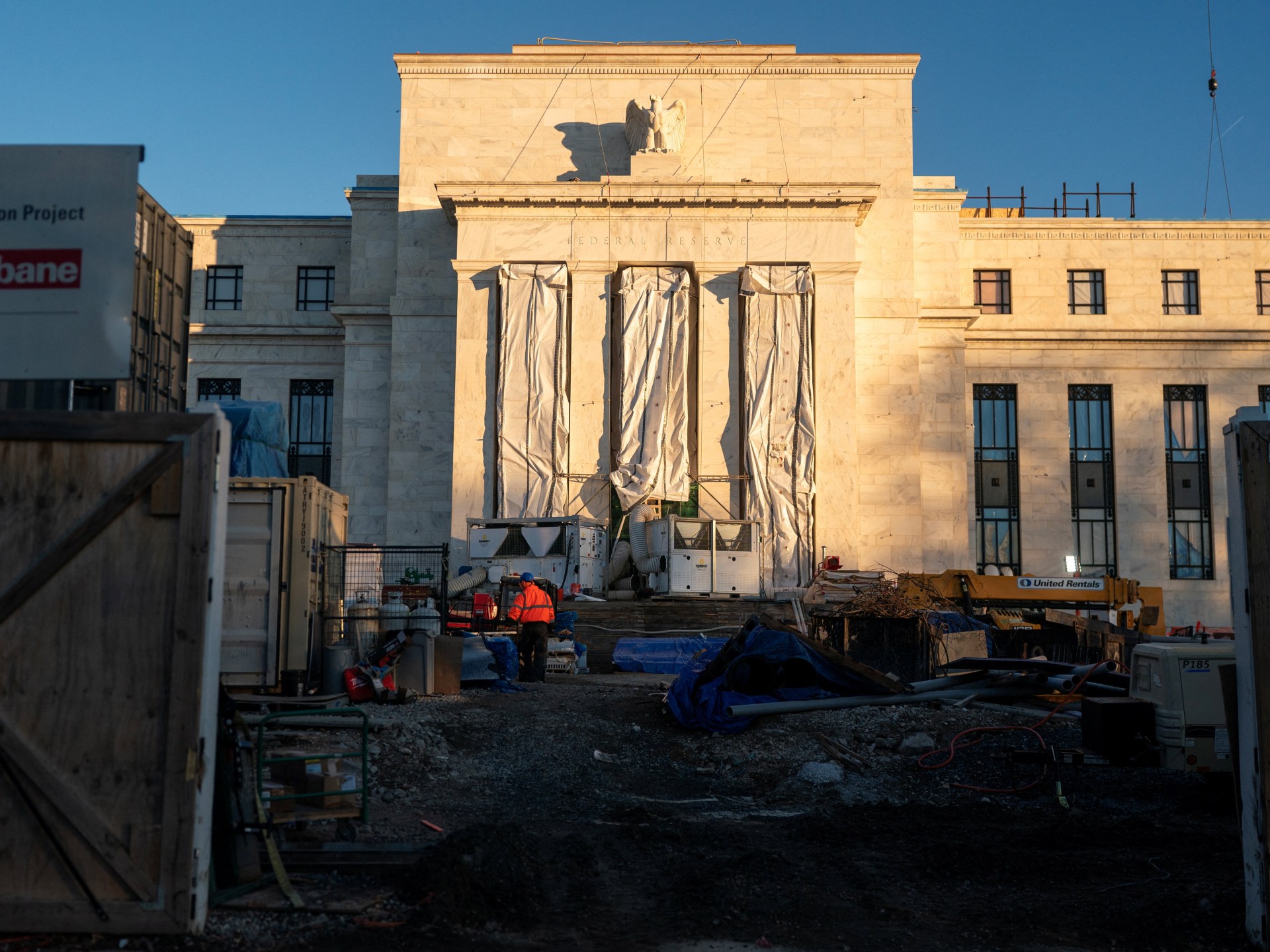
The United States Federal Reserve is holding interest rates steady in its first rate decision of 2026.
Rates will remain at 3.5 to 3.75 percent, the Fed said on Wednesday, defying US President Donald Trump’s calls for more aggressive interest rate cuts.
Recommended Stories
list of 4 itemsend of list
“The Committee seeks to achieve maximum employment and inflation at the rate of 2 percent over the longer run. Uncertainty about the economic outlook remains elevated,” the central bank said in its release announcing the decision.
Wednesday’s decision was widely expected. CME FedWatch, a tool that tracks expectations for monetary policy, forecast a more than 97 percent chance that the central bank would hold rates steady.
The tracker also expects two rate cuts in 2026, with the highest probability for the first cut occurring in June at the earliest.
“Available indicators suggest that economic activity has been expanding at a solid pace. Job gains have remained low, and the unemployment rate has shown some signs of stabilization,” the central bank said.
The decision comes amid signs of stabilisation in the US labour market. The US economy added 584,000 jobs in 2025, marking the lowest annual job growth since 2003. Payrolls rose by 64,000 jobs in October and 50,000 in December. While job growth remains weak, December’s figure represents a modest rebound from October, when the economy lost 105,000 jobs, according to the Bureau of Labor Statistics.
There are indications that the labour market may cool further in the months ahead. This week, both Amazon and UPS announced tens of thousands of job cuts, some of which were driven by a push towards increasing the use of artificial intelligence in the workplace.
Another threat to the US economy and the job market comes in the form of a looming government shutdown. That can happen as early as Saturday, and depending on its duration, it could slow spending as federal workers are temporarily left without paycheques.
Political tensions
The decision to hold interest rates steady comes despite Trump’s increased pressure on the central bank to cut rates. Fed Chairman Jerome Powell has long stressed the Federal Reserve’s independence, and Wednesday’s decision is the first since Powell’s rebuke of a criminal Department of Justice investigation into him. The central bank chair, whose term expires in May, called the inquiry a “pretext” to pressure him.
“The threat of criminal charges is a consequence of the Federal Reserve setting interest rates based on our best assessment of what will serve the public, rather than following the preferences of the president,” Powell said in remarks in early January in response to a subpoena.
On Wednesday, in the news conference that followed the rate decision, Powell, in response to a question on what advice he would give to his successor, said, “Stay out of elected politics.”
Last week, the Supreme Court heard arguments in a case examining whether Trump has the legal authority to remove Fed Governor Lisa Cook amid allegations of mortgage fraud, a hearing that Powell attended in a more public show of support for Cook than he previously had. US Treasury Secretary Scott Bessent had criticised Powell’s plans ahead of the hearing, calling it “political”.
In response to another question during the news conference on why he attended the court hearing, Powell said he thought it through and came to the conclusion that “that case is perhaps the most important legal case in Fed’s 113-year history, and I thought about it and went”. He added that Paul Volcker had gone to a Supreme Court hearing when Volcker was the Fed chair in the mid-1980s, “so it’s precedented, and I did it”.
Meanwhile, Fed Governor Stephan Miran’s term is set to expire this week. Trump picked Miran to temporarily fill the seat vacated by Adriana Kugler in August while seeking a more permanent replacement.
Miran was one of two central bank governors who voted to lower interest rates alongside Christopher Waller.
The developments come as Trump searches for a new Fed chair. He has explicitly called for further interest rate cuts and for a chairman who shares his views.
“Anybody that disagrees with me will never be the Fed Chairman!” Trump said in a post on Truth Social in December.
The political pressure has caught the attention of global central banks as well.
“The Federal Reserve is the biggest, most important central bank in the world, and we all need it to work well. A loss of independence of the Fed would affect us all,” Bank of Canada Governor Tiff Macklem said on Wednesday. Canada’s central bank held rates steady ahead of the US central bank’s decision.
Macklem was one of the central bank heads who earlier this month issued a joint statement backing Powell. Last September, Macklem said Trump’s attempts to pressure the Fed were starting to hit markets.
The US Federal Bureau of Investigation (FBI) is executing a search warrant at a Fulton County election office in Georgia related to the 2020 United States election, an agency spokesperson said.
An FBI spokesperson said agents were “executing a court-authorised law enforcement action” at the county’s main election office in Union City, just south of Atlanta. The spokesperson declined to provide any further information, citing an ongoing matter.
Recommended Stories
list of 3 itemsend of list
FBI agents were spotted entering the Fulton County Election Hub and Operation Center, said Fox News, which first reported the search of a new facility that state officials opened in 2023.
The probe concerns the 2020 election, in which Republican Donald Trump, the current US president, lost to the former US president, Democrat Joe Biden, the official said.
The search comes as the FBI, under the leadership of Director Kash Patel, has moved quickly to pursue the political grievances of Trump, including by working with the Justice Department to investigate multiple perceived adversaries of the commander-in-chief.
The Justice Department had no immediate comment.
Find the votes
Trump has long insisted that the 2020 election was stolen even though judges across the country and his own attorney general said they found no evidence of widespread fraud that tipped the contest in Biden’s favour.
Representatives for Fulton County’s election office referred queries to the county’s external affairs office, which did not immediately return a call seeking comment.
The Democratic-leaning county, home to Atlanta, backed Biden by a wide margin in the 2020 election, helping him win the state and the presidency.
Trump unsuccessfully sought to overturn the result, pressuring the state’s top election official to “find” him enough votes to claim victory.
Earlier this month, Trump asked a state court for $6.2m in legal fees, saying he spent it fighting criminal charges of election interference filed by Fulton County District Attorney Fani Willis.
In August 2023, Willis obtained an indictment against Trump and 18 others, accusing them of participating in a wide-ranging scheme to illegally try to overturn the results of the 2020 presidential election.
Russian President Vladimir Putin lauded Syrian President Ahmed al-Sharaa’s ongoing efforts to stabilise his country as the two met in the Kremlin. Their talks were expected to include a discussion on the future of Russian military bases in Syria.