An Italian court has opened the trial of four police officers and two members of the Italian coastguard over their response to a 2023 shipwreck that killed at least 94 refugees and migrants.
The trial opened in the southern port city of Crotone on Friday, where the defendants face charges of involuntary manslaughter and “culpable shipwreck”.
Recommended Stories
list of 3 itemsend of list
Rights activists assert that, as well as the individual officers, the right-wing Italian government’s immigration policies are also on trial.
Prosecutors accuse the police of failing to communicate key information with the coastguard, who they say did not collect details that would have informed them about the urgency of the situation as the ship struggled in dangerous waters on February 26, 2023.
The Summer Love boat then crashed off Cutro on Italy’s southern coast. There were 35 children among those killed.
Authorities say more people may have been killed, but their bodies were never found.
The boat was coming from Turkiye and carrying people from Afghanistan, Iran, Pakistan and Syria when it crashed into the rocks, the AFP news agency reports.
An aircraft belonging to the European Union’s Frontex agency had seen the ship in difficulty and alerted the Italian authorities. Although the Guardia di Finanza (GDF) sent a boat, it turned back due to bad weather.
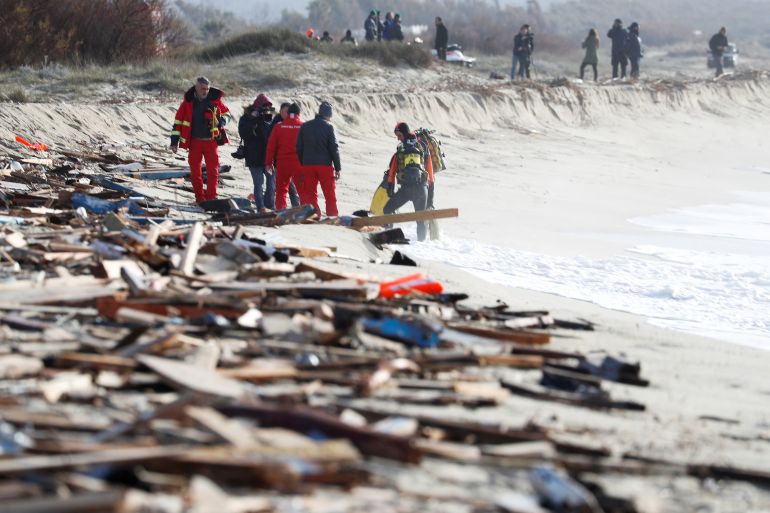
Rescuers get ready to search for survivors in the aftermath of a deadly migrant shipwreck in Crotone, Italy, February 28, 2023 [Remo Casilli/Reuters]
Charity groups that conduct rescue operations in the Mediterranean, including SOS Humanity and Mediterranea Saving Humans, are civil parties to the case.
Serena Chiodo, Amnesty Italy’s campaign specialist on migration, said the trial is “an opportunity to shine a light on systemic failures and reckless decisions by the Italian authorities that may have contributed to the enormous loss of life”.
“Those who drowned at Cutro could still be alive had authorities acted in line with their search and rescue obligations,” she added.
“Fewer people would be forced to make life-threatening journeys if European governments significantly increased access to safe and regular pathways for people fleeing desperate situations.”
The International Organization for Migration voiced concerns about multiple shipwrecks in the Mediterranean in recent days, noting it is “a stark reminder that this route remains the deadliest migration corridor in the world”.
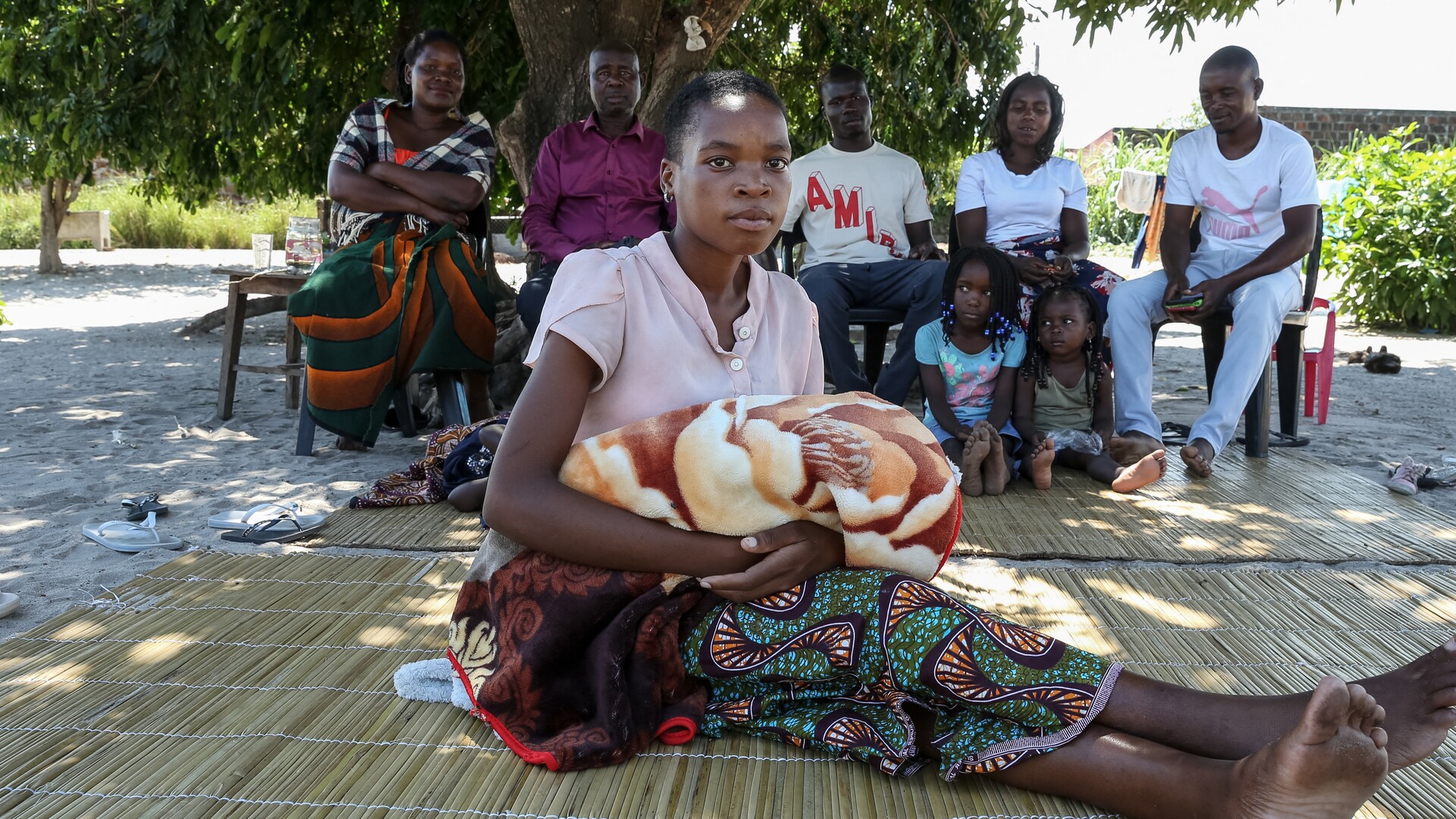
A pregnant woman says she was forced to give birth during deadly flooding in Mozambique, as hundreds of thousands have been displaced and aid workers try to reach people in isolated areas.
Turkiye’s main Kurdish football team has been fined for “ideological propaganda” in favour of Kurdish forces in northern Syria, the Turkish Football Federation (TFF) has said.
Amedspor FC, which is based in Diyarbakir, the main city in the Kurdish-majority southeast, was fined 802,500 Turkish lira (nearly $18,500) and its president slapped with a 15-day suspension from all football activity, the TFF said in a statement late on Thursday.
Recommended Stories
list of 4 itemsend of list
At issue was a 20-second clip on its social media accounts showing a woman having her hair braided set to a soundtrack featuring the widely used Kurdish slogan “Jin, jiyan, azadi” – which means “Woman, life, freedom”.
Over the past week, hair braiding has become a symbolic show of solidarity with Syrian Kurds as Damascus has pressed a military offensive in northeastern areas formerly part of the Kurds’ de facto autonomous administration.
In recent weeks, social media has been awash with clips of women braiding their hair in response to a video showing a Syrian soldier holding up a plait he claimed to have cut from a female Kurdish fighter in Raqqa that was recently taken by the Syrian military.
Although the claim could not be independently verified, it caused an online backlash.
The TFF said the club was guilty of “damaging the reputation of football” by “making ideological propaganda”.
Contacted by AFP, Amedspor President Nahit Eren said he had appealed against the decision, but made no further comment.
Eren – former head of the Diyarbakir Bar Association – had on Tuesday posted on X about “efforts to embroil our club in various controversies”.
Carlos Alcaraz overcame cramps and injury to fend off Alexander Zverev in an epic, momentum-swinging five-setter to become the youngest man in the Open era to reach the finals of all four Grand Slam events.
At 22, he’s aiming to be the youngest man to complete a career Grand Slam.
Recommended Stories
list of 4 itemsend of list
He reached his first Australian Open final the hard way, winning 6-4, 7-6 (5), 6-7 (3), 6-7 (4), 7-5 in 5 hours, 27 minutes on Friday.
That’s despite being two points away in the third set from a semifinal victory in a tournament where he hadn’t dropped a set through five rounds.
He was behind in the fifth set after dropping the first game and didn’t break back until Zverev was serving for the match in the 10th.
Alcaraz will next face either two-time defending champion Jannik Sinner or 10-time Australian Open titlist Novak Djokovic, who is bidding for an unprecedented 25th Grand Slam singles title. The long afternoon match delayed the start of the night’s semifinal.
The top-ranked Alcaraz was leading by two sets and appeared to be in the kind of form that won him the US Open last year and has helped him evenly split the last eight majors with Sinner.
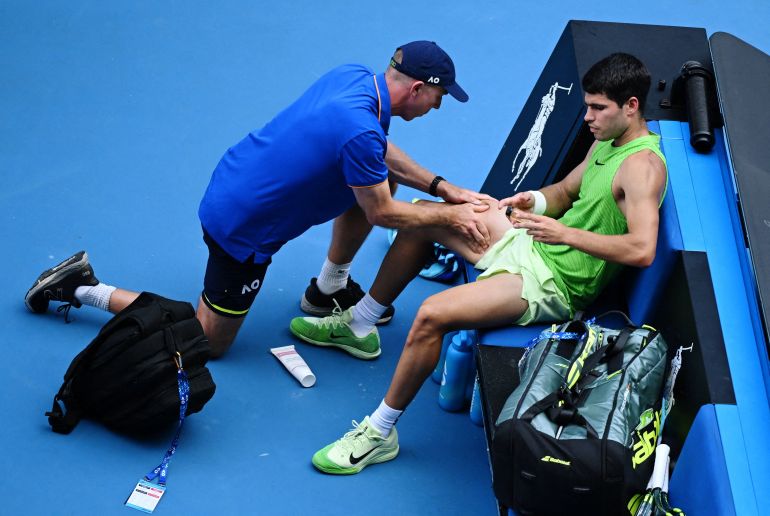
But in the ninth game of the third, he started limping and appeared to be struggling with an upper right leg problem. After holding for 5-4, he took a medical timeout in the changeover. It may have been cramp, but he rubbed the inside of his right thigh and called for the trainer, who also massaged the same area.
Zverev was demonstrably upset, talking with a tournament official, when his rival was given the three-minute break for treatment.
Spain’s Carlos Alcaraz receives medical attention during his semifinal match against Germany’s Alexander Zverev [Jaimi Joy/Reuters]
Even with his limited footwork, Alcaraz was able to hit winners and get to 6-5 before the trainer returned in the changeover to massage the area again.
When he went back out, the crowd gave him rousing support. Zverev served a double-fault to open the next game, and Alcaraz lobbed and then slapped a forehand winner down the line to get to 0-30. But Zverev won four straight points to force the tiebreaker and then win it.
No 3 Zverev, the 2025 runner-up, retained his composure despite Alcaraz’s obvious discomfort on the other side of the net, and the crowd on Rod Laver Arena firmly behind the Spaniard.
He was in front for the entire fourth set, but Alcaraz stayed with him, until Zverev again took charge in the tiebreaker. More than four hours had elapsed when the match went to a fifth set, the first five-setter on the centre court in the 2026 tournament.
Alcaraz dropped serve in the opening game of the fifth set but hung with Zverev, getting five breakpoint chances without being able to convert.
The drama lifted in the sixth game, when Alcaraz sprinted across court to track down a drop shot and slid at full pace for an angled forehand winner. The crowd went crazy.
Alcaraz finally converted the break when Zverev was serving for the match at 5-4 in the fifth set.
Kon Knueppel made two free throws with 4.1 seconds left for a career-high 34 points and the Charlotte Hornets beat the Dallas Mavericks 123-121, spoiling Duke roommate Cooper Flagg’s 49-point game.
Flagg, who turned 19 in December, broke the NBA record for points in a game by a teen. Cliff Robinson set the previous record of 45 at age 19 for New Jersey in a game against Detroit on March 9, 1980.
Recommended Stories
list of 4 itemsend of list
Flagg set career highs with 20 field goals on 29 shots, and also had 10 rebounds.
Knueppel grabbed an errant pass by Flagg near midcourt with seven seconds left and the score tied. He drove to the basket and was fouled by Flagg as the ball lodged between the rim and the backboard. Flagg’s shot at the buzzer to send it to overtime hit the back of the rim.
Knueppel made eight 3-pointers to set a rookie record for the Hornets, who have won five consecutive games for their longest winning streak since a five-game run in February 2023.
Brandon Miller scored 23 points, his ninth straight game with at least 20 points, for Charlotte. LaMelo added 22, hitting six 3-pointers.
Klay Thompson scored 16 points off the bench for Dallas, shooting 4 of 11 on 3s. The Mavericks have lost three straight — all at home — following a season-best, four-game winning streak.
The Hornets swept a road back-to-back while the Mavericks were swept in a home back-to-back.
The game was the first NBA meeting between Flagg and Knueppel, the 2024-25 Duke freshmen.
Mark Aguirre, Dallas’s only previous first-overall draftee after the franchise’s initial season in 1980-81, became the team’s fifth player to have his jersey retired during a halftime ceremony.
Canada’s Prime Minister Mark Carney has said that he expects the United States to respect the country’s sovereignty after reports that Alberta separatists have met several times with officials of the Donald Trump administration.
The Financial Times reported that US State Department officials held meetings with the Alberta Prosperity Project (APP), a group calling for a referendum on whether the energy-rich western province should leave Canada.
Recommended Stories
list of 1 itemend of list
Speaking in Ottawa on Thursday, Carney said he has been clear with US President Donald Trump on the issue.
“I expect the US administration to respect Canadian sovereignty,” he said, adding that after raising the issue, he wanted the two sides to focus on areas where they can work together.
Carney is himself an Albertan, raised in Edmonton, the provincial capital. The province has had an independence movement for decades.
Trump has repeatedly threatened to make Canada the “51st state” of the American Union.
Here is what we know:
Leaders of the APP have reportedly met with US State Department officials in Washington at least three times since last April. Trump entered office for a second time in January.
These meetings have prompted concern in Ottawa regarding potential US interference in Canadian domestic politics.
This follows comments by US Treasury Secretary Scott Bessent last week, who described Alberta as “a natural partner for the US” and praised the province’s resource wealth and “independent” character during an interview with the right-wing broadcaster Real America’s Voice.
“Alberta has a wealth of natural resources, but they [the Canadian government] won’t let them build a pipeline to the Pacific,” he said. “I think we should let them come down into the US,” Bessent said during an interview with the right-wing broadcaster.
“There’s a rumour they may have a referendum on whether they want to stay in Canada or not.”
Asked if he knew something about the separation effort, Bessent said, “People are talking. People want sovereignty. They want what the US has got.”
After Bessent’s comments, Jeffrey Rath, a leader of the APP, said that the group was seeking another meeting with US officials next month, where they are expected to ask about a possible $500bn credit line to support Alberta if a future independence referendum – which has not yet been called – were to be held.
The developments come at a sensitive moment in US-Canada relations, with trade tensions still simmering and after a recent speech at the World Economic Forum in Davos where Carney warned that Washington was contributing to a “rupture” in the global order.
Trump has repeatedly threatened to make Canada part of the American Union. His expansionist ambitions have been further underscored by his recent push to acquire Greenland from Denmark, which, like Canada, is a NATO ally. At the start of the year, the US military also abducted Venezuelan President Nicolas Maduro, and has since attempted to take control of the South American nation’s massive oil industry.
How have Canadian leaders reacted to the reports?
Speaking on Thursday, British Columbia Premier David Eby described the reported behind-the-scenes meetings as “treason”.
“To go to a foreign country and to ask for assistance in breaking up Canada, there’s an old-fashioned word for that – and that word is treason,” Eby told reporters.
“It is completely inappropriate to seek to weaken Canada, to go and ask for assistance, to break up this country from a foreign power and – with respect – a president who has not been particularly respectful of Canada’s sovereignty.”
Ontario Premier Doug Ford appealed for Canadian unity on Thursday morning.
“You know, we have a referendum going on out in Alberta. The separatists in Quebec say they’re gonna call a referendum if they get elected. Like, folks, we need to stick together. It’s Team Canada. It’s nothing else,” he said.
Alberta Premier Danielle Smith, however, said she won’t demonise the Albertans who are open to separation because of “legitimate grievances” with Ottawa and said she did not want to “demonise or marginalise a million of my fellow citizens”.
Smith has long been pro-Trump and visited the US president’s Mar-a-Lago estate in January 2025, at a time when most other Canadian leaders were joining hands to criticise his demand that the country become a part of the United States.
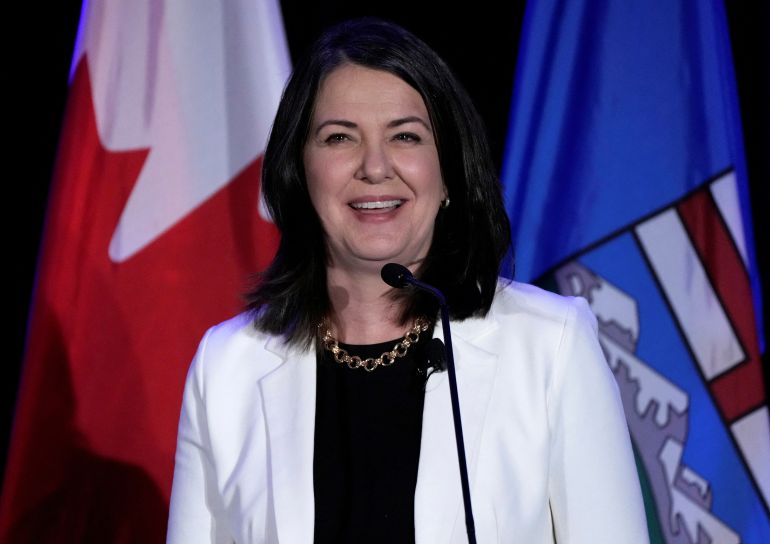
Alberta Premier Danielle Smith [FILE: Todd Korol/Reuters]
What do we know about a potential referendum in Alberta?
Anger towards Ottawa has been building in Alberta for decades, rooted largely in disputes over how the federal government manages the province’s vast oil and gas resources.
Many Albertans feel federal policies – particularly environmental regulations, carbon pricing and pipeline approvals – limit Alberta’s ability to develop and export its energy.
As a landlocked province, Alberta depends on pipelines and cooperation with other provinces to access global markets, making those federal decisions especially contentious.
Many Albertans believe the province generates significant wealth while having limited influence over national decision-making. In 2024-25, for instance, it contributed 15 percent of Canada’s gross domestic product (GDP), despite being home to only 12 percent of the population.
Alberta consistently produces more than 80 percent of Canada’s oil and 60 percent of the country’s natural gas.
Yet, many Albertans say that the federal government does not give the province its fair share from taxes collected. Canada has a system of equalisation payments, under which the federal government pays poorer provinces extra funds to ensure that they can maintain social services. While Quebec and Manitoba receive the highest payments, Alberta – as well as British Columbia and Saskatchewan – at the moment receive no equalisation payments.
A woman crosses an empty downtown street in Calgary, Alberta [FILE: Andy Clark/Reuters]
Carney recently signed an agreement with Alberta, opening the door for an oil pipeline to the Pacific, though it is opposed by Eby and faces significant hurdles.
Recent Ipsos polling suggests that about three in 10 Albertans would support starting the process of leaving Canada.
But the survey also found that roughly one in five of those supporters viewed a vote to leave as largely symbolic – a way to signal political dissatisfaction rather than a firm desire for independence.
A referendum on Alberta independence could happen later this year if a group of residents can collect the nearly 178,000 signatures required to force a vote on the issue. But even if the referendum passes, Alberta would not be immediately independent.
Under the Clarity Act, the federal government would first have to determine whether the referendum question was clear and whether the result represented a clear majority. Only then would negotiations begin, covering issues such as the division of assets and debt, borders and Indigenous rights.
What is the Alberta Prosperity Project and what does it want?
The APP is a pro-independence group that is campaigning for a referendum on Alberta leaving Canada.
It argues that the province would be better off controlling its own resources, taxes and policies, and has been working to gather signatures under Alberta’s citizen-initiative rules to trigger a vote.
While it describes itself as an educational, non-partisan project, the group has drawn controversy over its claims about the economic viability of an independent Alberta.
On its website, the APP says, “Alberta sovereignty, in the context of its relationship with Canada, refers to the aspiration for Alberta to gain greater autonomy and control over provincial areas of responsibility.”
“However, a combination of economic, political, cultural and human rights factors … has resulted in many Albertans defining ‘Alberta sovereignty’ to mean Alberta becoming an independent country and taking control of all matters that fall within the jurisdiction of an independent nation,” it adds.
What else has Washington said?
White House and State Department officials told the FT that administration officials regularly meet with civil society groups and that no support or commitments were conveyed.
A report published by Canada’s public broadcaster CBC earlier this year quoted US national security analyst Brandon Weichert as saying that Trump’s talk of Canada becoming the “51st state” was, in reality, aimed at Alberta.
Appearing on a show hosted by former Trump chief strategist Steve Bannon, Weichert suggested that a vote for independence in Alberta would prompt the US to recognise the province and guide it towards becoming a US state.
Has the Trump administration tried this elsewhere?
Yes, in Greenland.
As with Canada, Trump has repeatedly called for Greenland to be incorporated into the US. His threats to annex Greenland have prompted strong opposition from the government of the Arctic island, Denmark — which governs Greenland — and Europe.