Venezuela and Mexico: How Trump is trying to choke Cuba’s oil supplies

Mexico has temporarily halted oil shipments to Cuba amid heightened rhetoric from United States President Donald Trump, who has been seeking to isolate the communist-ruled island nation.

President Claudia Sheinbaum, however, said the pause was a “sovereign decision” not made under pressure from the US.

Recommended Stories

list of 4 itemsend of list

Mexico, along with Venezuela, has been providing the bulk of Cuba’s oil supplies, but Venezuelan crude was cut off from Havana after its president, Nicolas Maduro, was abducted in a military operation and taken to the US on January 3.

Mexico supplied 44 percent of Cuban oil imports and Venezuela exported 33 percent until last month, while some 10 percent of Cuban oil is sourced from Russia. Some oil is also sourced from Algeria, according to The Financial Times figures.

The erstwhile Soviet Union was the biggest backer of Cuba for decades, but since its fall in 1991, support has dwindled drastically.

So, what’s behind the Mexican government’s decision and will it exacerbate Cuba’s deepening energy and economic crisis?

What did Mexican President Claudia Sheinbaum say?

Asked at her regular morning press conference whether she denied a media report that Mexico had halted the shipment, Sheinbaum responded: “It is a sovereign decision and ‍it is made in the moment when necessary.”

Sheinbaum sidestepped a question about whether Mexico would resume oil shipments to Cuba, answering: “In any case, it will be reported.”

She also said Mexico would “continue to show solidarity” with Cuba.

In its most recent report, Mexico’s state-owned oil corporation Pemex said it shipped nearly 20,000 barrels of oil per day to Cuba from January through September 30, 2025.

With Venezuela offline, shipments from Pemex have become a critical, though ‌insufficient, lifeline for the island.

Analysts now expect further pressure from Washington to halt those shipments more permanently, given Trump’s growing demands that Mexico deliver stronger results in the fight against drug cartels.

Mexico has been trying to balance its traditional ties with Cuba amid mounting pressure from the Trump administration.

The Reuters news agency last week reported that the Mexican government was reviewing whether to keep sending oil to Cuba amid growing concerns within Sheinbaum’s government that continuing the shipments could put the country at odds with the US.

Mexico is currently negotiating a trade agreement with the US amid tariff threats.

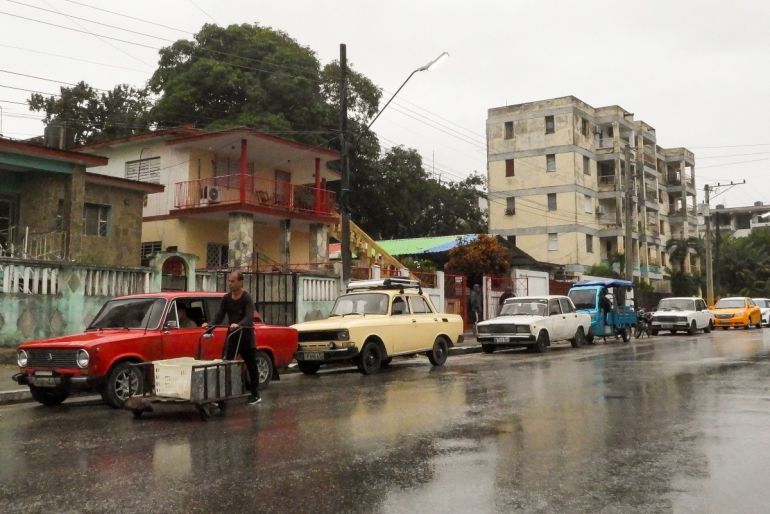
CUBA-OIL-FUEL-SHORTAGE
Cars wait in line to refuel at a gas station in Havana on January 20, 2026. [Adalberto Roque/AFP]

Why isn’t Cuba getting Venezuelan oil any more?

Trump has said that no Venezuelan oil or money will go to Cuba after abducting President Maduro and taking control of Venezuela’s oil industry.

“THERE WILL BE NO MORE OIL OR MONEY GOING TO CUBA – ZERO! I strongly suggest they make a deal, BEFORE IT IS TOO LATE,” Trump wrote on his Truth Social platform on January 11.

“Cuba lived, for many years, on large amounts of OIL and MONEY from Venezuela,” Trump added.

Trump did not elaborate on his suggested deal, but US officials have hardened their rhetoric against Cuba in recent weeks.

However, Cuban President Miguel Diaz-Canel has rejected talks. “We have always been willing to maintain serious and responsible dialogue with the various US administrations, including the current one, on the basis of sovereign equality, mutual respect and the principles of international law,” Diaz-Canel said.

What to know about Trump’s growing rhetoric against Cuba

Following the US attack on Venezuela, the Trump administration has escalated its rhetoric against Cuba, which has been under strict US economic sanctions for decades.

Last week, the US-based Wall Street Journal reported that Trump aims to remove Cuba’s leadership and is actively seeking government insiders in Havana who are willing to make a deal with Washington to “push out the Communist regime”.

Trump on Tuesday said that Cuba is on the brink of collapse. “Cuba is really a nation that’s very close to failing,” he said during a visit to the US state of Iowa.

The US president said that Cuba no longer receives oil and money from Venezuela, a close ally of Havana since the days of former socialist President Hugo Chavez.

Last week, a Cuban diplomat based in Bogota accused the US of “international piracy” over Washington’s blockade of Venezuelan oil.

“The US is carrying out international piracy in the Caribbean Sea that is restricting and blocking the arrival of oil to Cuba,” Carlos de Cespedes, Cuba’s ambassador to Colombia, told Al Jazeera on Saturday, adding that Havana is facing more powerful US threats than it has in the 67 years since the revolution.

Earlier, US Secretary of State Marco Rubio, who is of Cuban descent and is believed to orchestrate policies towards Venezuela and Cuba, has described the government in Havana as a “huge problem”.

About a week after Maduro’s abduction, Trump urged Cuba to make a deal “before it is too late,” without specifying what kind of agreement he was referring to.

In a post on Truth Social, Trump suggested Rubio could become the president of Cuba. “Sounds good to me!” he said.

Relations between Havana and Washington have been tense for decades. The ties were normalised in 2014 under former President Barack Obama, in a major foreign policy shift. But Trump, who succeeded Obama, reversed the decision and reimposed sanctions during his first term.

In 2019, Trump banned cruise ships from visiting Cuba, one of the most popular forms of travel to the island, which earns much-needed revenue from tourism.

Mexico faces its own pressure from Washington, as Trump has threatened to take military action against Mexican drug cartels. Last week, the country transferred dozens of suspected cartel members to the US amid pressure from the Trump administration.

Since Trump’s return to power in January last year, the war on drugs has been at the top of his administration’s agenda. The US said its action against Maduro was justified, based on claims that Venezuela sent drugs to the US. But Caracas is not the main source of drugs coming into US territory.

How has the US policy affected Cuba?

Cuba is enduring its worst economic crisis since Fidel Castro’s 1959 revolution, as fuel shortages have caused prolonged power cuts, water and food supply disruptions.

Analysts say the Cuban economy could collapse completely as Mexican and Venezuelan oil supplies dry up.

A total blockade on oil imports to Cuba is part of possible new tactics by the Trump administration to drive leadership change in the Caribbean country, according to the US-based Politico site.

Al Jazeera could not confirm Politico’s report.

Rising geopolitical tensions with the US have also driven tourists away from Cuba, with the number of visitors dropping by nearly 70 percent since 2018.

For decades, tourism – a source of livelihood for millions of Cubans – generated up to $3bn a year for Cuba. Some 1.6 million tourists visited Cuba last year, significantly lower than the 4.8 million in 2018 and the 4.2 million in 2019, before the COVID-19 pandemic hit.

Havana classic car driver Aldama recalled that he would sometimes work until 9pm. Nowadays, he’s lucky if he takes one or two tourists for a spin in a day.

He used to charge $50 for a drive around the capital. Now, given the lack of demand, he has lowered his price to $25 and even $20 if a tourist insists on bartering.
Hungary charges Budapest mayor for allowing banned pride march

Hungarian prosecutors have charged Budapest Mayor Gergely Karacsony over his role in arranging last year’s gay pride march in the capital city, which attracted hundreds of thousands of people despite a ban.

Prosecutors have “filed charges and seek a fine against the mayor of Budapest, who organised and led a public gathering despite a police ban”, their office said in a statement announcing the case on Wednesday.

Recommended Stories

list of 3 itemsend of list

“The district prosecutor’s office proposed that the court impose a fine on the defendant in a summary judgement without a trial,” the statement added without including the amount of the fine sought against Karacsony.

Since returning to power in 2010, Prime Minister Viktor Orban has been tightening his grip over the country and has targeted groups advocating for human rights.

Orban’s conservative government has also pushed for legislation promoting traditional family values and steadily rolled back LGBTQ rights.

In 2025, his Fidesz party amended laws and the constitution to ban the annual pride march, drawing protests from critics and the European Union.

‘Proud defendant’

After the ban was imposed last year, Budapest City Hall stepped in to co-organise the annual event to try to sidestep the regulations, but police still issued their objections, and Orban warned organisers and attendees of “legal consequences”.

On Wednesday, Karacsony reacted to the charges by saying he went from a “proud suspect to a proud defendant”.

“They don’t even want a trial … because they can’t even comprehend that here in this city, we have stood up for freedom in the face of a selfish, petty, and despicable power,” he said on Facebook.

In a post on X, Ciaran Cuffe, cochairman of the EU’s European Greens party, called the charges “outrageous”.

In a separate post, the European Greens said the party stands with Karacsony, who is a member of Dialogue, the Greens’ party affiliate in Hungary.

Despite the ban on the march, it became “the biggest freedom march in decades”, proving that “love can’t be banned”, the party added.

Facing a year in prison

Karacsony could face up to one year in prison for organising and urging participation in a banned rally.

Participants could also face fines of up to 500 euros (nearly $600) for attending Budapest Pride although police announced in July they would not take action against the marchers.

Organisers of the June march estimated that up to 200,000 people took part in the 30th annual Budapest Pride.

The rally began at Budapest City Hall and wound through the city centre before crossing the Erzsebet Bridge over the Danube River.

The crowds waved rainbow flags and carried signs mocking Orban.

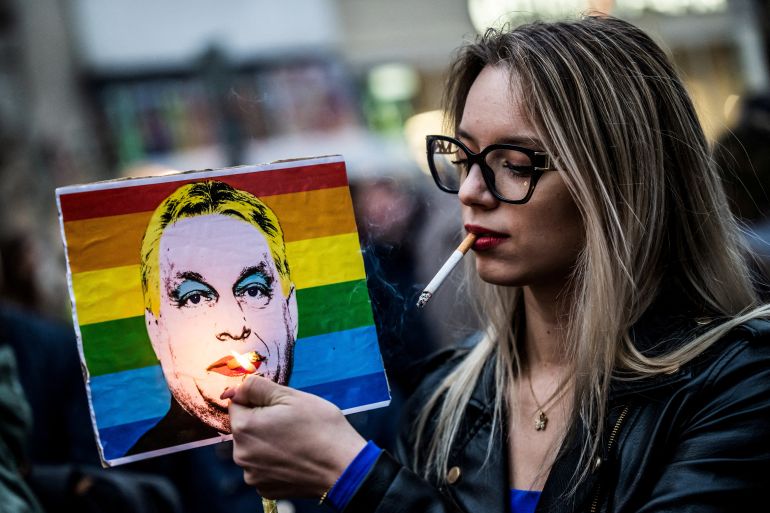
FILE PHOTO: A woman lights a cigarette placed in a placard depicting Hungary's Prime Minister Viktor Orban, during a demonstration, after the Hungarian parliament passed a law that bans LGBTQ+ communities from holding the annual Pride march and allows a broader constraint on freedom of assembly, in Budapest, Hungary, March 25, 2025. REUTERS/Marton Monus/File Photo
A woman lights a cigarette placed in a placard depicting Hungarian Prime Minister Viktor Orban on March 25, 2025, in Budapest during a demonstration after the Hungarian Parliament passed a law that banned the annual pride march [Marton Monus/Reuters]

Trump reiterates threat of military action with demand for Iran deal

DEVELOPING STORY,

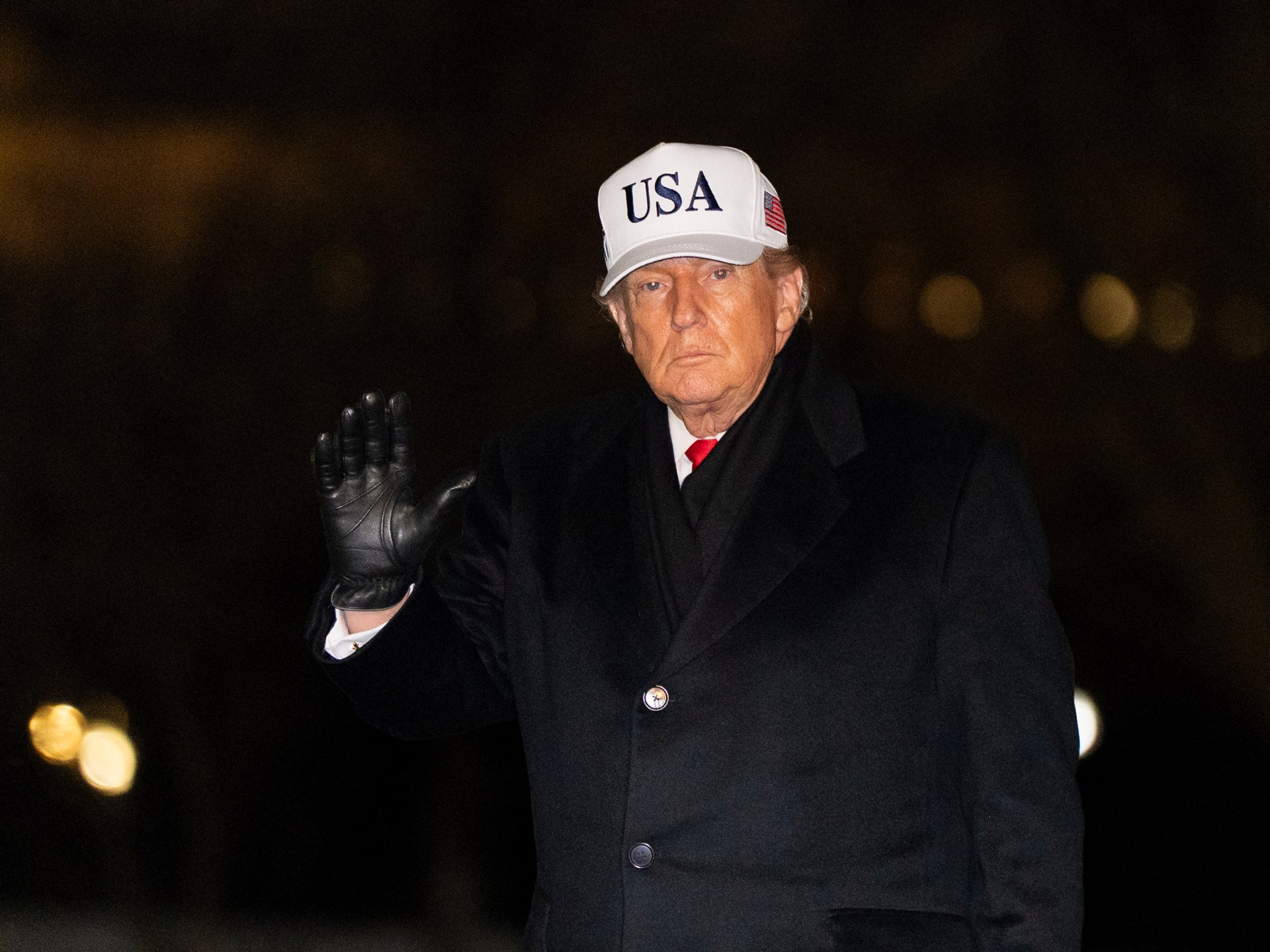
President ⁠Donald Trump ​has revived the threat that the United States is ready to launch a military attack against Iran as he demanded that Tehran make a deal over its nuclear programme.

“A massive Armada is heading to Iran. It is moving quickly, with great power, enthusiasm, and purpose,” he said in a lengthy post on his Truth Social platform on Wednesday.

The US president added that “hopefully Iran will quickly ‘Come to the Table’ and negotiate a fair and equitable deal – NO NUCLEAR WEAPONS – one that is good for all parties. Time is running out, it is truly of the essence! As I told Iran once before, MAKE A DEAL!”

In an apparent reference to the US bombing of three of Iran’s nuclear facilities in June, Trump warned that should Tehran fail to agree a deal, the next attack would ‌be “far ‌worse”.

Trump’s outburst came shortly after Iranian Foreign Minister Abbas Araghchi said his country would not restart negotiations as it is threatened with an attack.

Sara in Southern Lebanon

Her video diary shares her two-year journey of escaping to Beirut, followed by the difficulties of trying to return home.

Israeli plans for Rafah ‘camp’ in Gaza slammed as continuation of genocide

While diplomatic circles welcome the recovery of the last Israeli captive’s remains in Gaza and the imminent partial reopening of the enclave’s Rafah border crossing with Egypt, a quieter, darker reality is taking shape on the ground.

According to comments by retired Israeli General Amir Avivi, who still advises the military, Israel has cleared land in Rafah, an area in the southern Gaza Strip that it had already flattened in more than two years of its genocidal war, to construct an enormous facility to entrench its military control and presence in Gaza for the long term.

Speaking to the Reuters news agency on Tuesday, Avivi described the project as a “big, organised camp” capable of holding hundreds of thousands of people, stating it would be equipped with “ID checks, including facial recognition”, to track every Palestinian entering or leaving.

Corroborating Avivi’s claims, exclusive analysis by Al Jazeera’s Digital Investigations Team confirms that ground preparations for this project are already well under way.

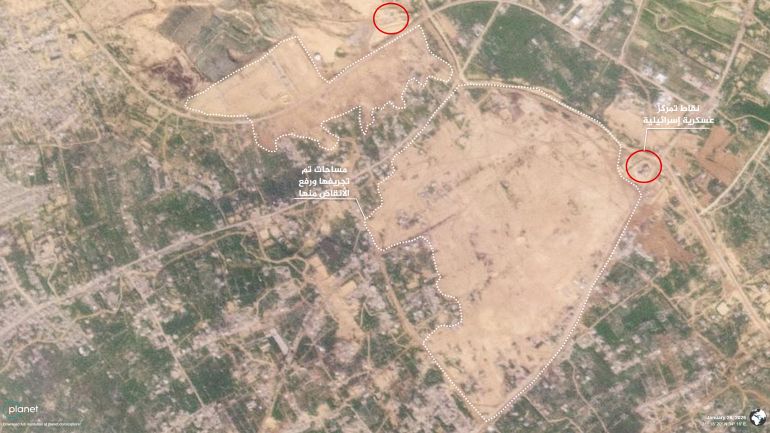
Satellite imagery captured from December 2 through Monday reveals extensive clearing operations in western Rafah. The analysis identifies an area of about 1.3sq km (half a square mile) that has undergone systematic levelling.

According to the investigation, the operations went beyond mere debris removal and involved the flattening of land previously devastated by Israeli air strikes.

The cleared zone is located adjacent to two Israeli military posts, suggesting the new camp will be under direct and immediate military supervision. The satellite evidence aligns with reports that the facility is to act as a controlled “holding pen” rather than a humanitarian shelter.

Recent satellite images reveal that Israel has been conducting rubble removal operations in the south of the Gaza Strip, especially in western Rafah. This has occurred between December 2, 2025 and January 26, 2026.
Recent satellite images reveal that Israel has been conducting rubble removal operations in the south of the Gaza Strip, especially in western Rafah. This has occurred between December 2, 2025 and January 26, 2026. [Planet Labs PBC]

The trap of return

To analysts in Gaza, no humanitarian intent is behind this projected high-tech infrastructure, which they say is in fact a trap for Palestinians.

“What they are building is, in reality, a human-sorting mechanism reminiscent of Nazi-era selection points,” Wissam Afifa, a Gaza-based political analyst, told Al Jazeera. “It is a tool for racial filtering and a continuation of the genocide by other means.”

The reopening of the Rafah crossing, tentatively scheduled for Thursday, according to The Jerusalem Post, comes with strict Israeli conditions. Prime Minister Benjamin Netanyahu has insisted on full “security control”.

For Palestinians hoping to return to Gaza, this means submitting to what Afifa describes as “human sorting stations”.

“This mechanism is designed to deter return,” Afifa said. “Palestinians will face interrogation, humiliation and the risk of arrest at these Israeli-run checkpoints just to go home.”

By leveraging facial recognition technology confirmed by Avivi, Israel is creating a high-risk ordeal for returnees, he said. Afifa argued it will force many Palestinians to choose exile over the risk of the “sorting station”, serving Israel’s longstanding goal of depopulating the Strip.

INTERACTIVE - Gaza map Israel’s withdrawal in Trump’s 20-point plan yellow line map-1760017243
(Al Jazeera)

Permanent occupation within the ‘yellow line’

The Rafah camp is just one piece of a larger puzzle. Israel in effect occupies all of Gaza with a physical military presence in 58 percent of the Gaza Strip. Its forces directly occupy an area within the “yellow line”, a self-proclaimed Israeli military buffer zone established by an October ceasefire.

“We are witnessing the re-engineering of Gaza’s geography and demography,” Afifa said. “About 70 percent of the Strip is now under direct Israeli military management.”

This assessment of a permanent foothold is reinforced by Netanyahu’s own remarks to the Knesset on Monday. By declaring that “the next phase is demilitarisation”, or disarming Hamas, rather than reconstruction, Netanyahu signalled that the military occupation has no end date.

“The talk of ‘reconstruction’ starting in Rafah under Israeli security specifications suggests they are building a permanent security infrastructure, not a sovereign Palestinian state,” Afifa added.

A ‘show’ of peace

For the more than two million Palestinians in Gaza, the hope that the return of the last Israeli captive would bring relief has turned into frustration.

“There is a deep sense of betrayal,” Afifa said. “The world celebrated the release of one Israeli body as a triumph while two million Palestinians remain hostages in their own land.”

Afifa warned that the international silence regarding these “sorting stations” risks normalising them. If the Rafah model succeeds, it would transform Gaza from a besieged territory into a high-tech prison where the simple act of travel becomes a tool of subjugation, he said.