Abuse stopped family coming to games – referee Taylor

To play this video you need to enable JavaScript in your browser.

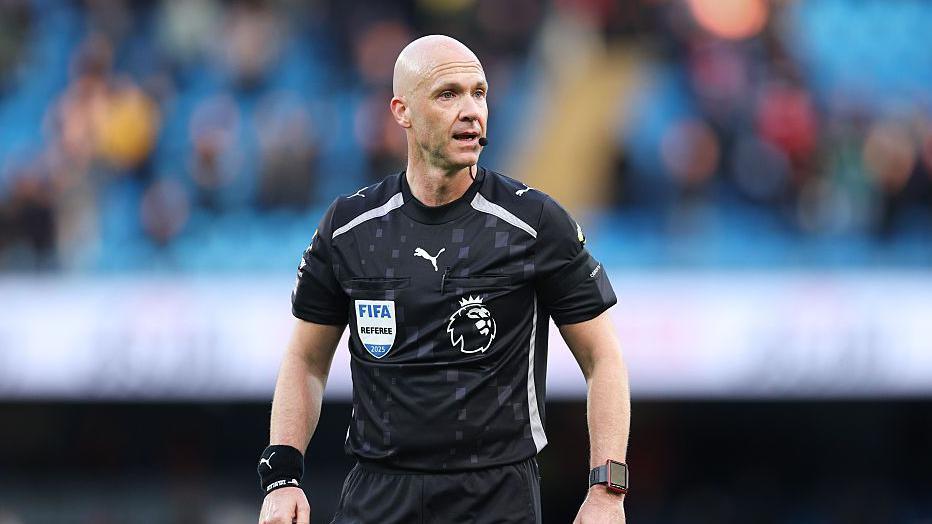
Premier League referee Anthony Taylor has criticised the “expectation of perfection” culture that officials are subject to, and says his family no longer go to his matches because of the abuse he receives.

In an interview with BBC Sport, Taylor speaks publicly for the first time about being targeted by Roma fans as he walked through an airport with his family after the 2023 Europa League final.

The 46-year-old says he is so concerned by attitudes towards referees, there are times he thinks, ‘Is it all worth it?’.

However, he also says being a top-flight official is one of the best jobs in the world.

Taylor has been Premier League referee for almost 15 years, officiated at the Qatar World Cup in 2022 and 2020 European Championship and has overseen the finals of both the European Super Cup final and Nations League.

‘That’s the worst situation I’ve dealt with’

Taylor was confronted by Roma boss Jose Mourinho after his side had lost the 2023 Europa League final on penalties to Sevilla.

The English official showed yellow cards to 13 players during the match, and 25 minutes of added time were played across the full match, including extra time.

Mourinho called Taylor a “disgrace” twice in a post-match news conference before confronting him in a car park – an incident the Portuguese was given a four-match ban for.

Taylor was then shouted at by angry fans as he walked though Budapest Airport with his family.

“That’s the worst situation I’ve dealt with in terms of abuse,” he says.

“Not only because I was travelling with family members at the time, but it also highlights the impact of people’s behaviour on others. Even in a match like that, where there was actually no major mistakes in the game.”

Taylor felt after the match there was an attempt to “shift focus on to somebody to blame.”

He adds: “For me, that’s a great source of disappointment, frustration, anger.

“Why that’s acceptable, I don’t know – because I’m sure those individuals wouldn’t like somebody to turn around and say that to them or their own children.

“It makes you reflect back on whether you made a mistake travelling with your family in the first place. They haven’t been to one [match] since.”

Getty Images

‘Win-at-all costs approach means referees’ mental health can suffer’

Taylor is not on social media as he does not want to “waste time” reading negative comments or opinions.

Last year the Premier League launched an investigation following online abuse directed at the official.

“If you’re continually told you’re not very good, whether that be by people in the media, by pundits, or even ex-officials, then people’s mental health could potentially suffer,” he says.

“The footballing culture in general is, ‘we need to win this game at all costs’.

“The lengths that people go to post-game with a lot of things now to spread false narratives, to spread malicious conspiracy theories… it creates a hugely negative environment for people to operate in.”

Taylor is also concerned by the treatment of officials in grassroots football, adding “every single weekend you can go to any local park across the UK and you can see a parent on the sideline verbally abusing a young referee. That’s not an environment conducive to people getting better. I don’t understand how people think that’s acceptable.”

Asked whether it is fair for top referees to expect a high level of scrutiny given what can be at stake on the pitch, Taylor says: “I wouldn’t argue against scrutiny being there.”

But he adds: “I’m not saying scrutiny isn’t there to be expected, but everybody who watches football always sees a game through the eyes of their team. And the result of a football match and the culmination of a football season is multi-faceted.

“It’s not dependent on one match official decision. It’s not dependent on one player missing one penalty in a game. It’s not dependent on one coach making one tactical error during a game. Playing over 38 games…

“So you say the argument one decision has cost somebody the whole season… it’s just factually not true because there’ll be plenty of other incidents in a game or over that season where the results of games have been affected.

“What I’m saying is that you can have scrutiny and you can have critique. But it’s very rarely balanced. Nobody really talks about the positive side of things a lot of time these days, either.”

VAR creating ‘expectation of perfection’

The video assistant referee (VAR) system was introduced in the Premier League in 2019.

Taylor believes it has created unrealistic expectations and that those who expected it to create a decision-making “utopia” were “way off the mark”.

“The amount of scrutiny and the amount of analysis and chat around Premier League football means everybody has a quest for perfection,” he says.

“In reality, perfection doesn’t exist. We’re expecting referees to get every decision right. It is really important that we actually start to talk about people being fearful of failure or mistakes.

“We have to accept that if we don’t create the right environment for people to thrive, then people will be fearful, and that will have a negative impact on individuals and performance in the long term. Everybody’s an expert.”

Taylor says VAR has “completely shifted” the level of scrutiny.

“It brought this expectation of perfection that it would solve absolutely everybody’s problems and it would be a utopia,” he adds.

“In reality, those people were way off the mark. One week, people will say: ‘We don’t want VAR to be too forensic.’ The next week they’ll be going: ‘How has VAR not intervened in this?’

“People really need to decide what they want. You can’t one week say, ‘we don’t want to get involved because it ruins the flow of the game’ and the next week turn round and say, ‘this is a disgrace that VAR’s not intervened here’.

Heat at the Club World Cup ‘brutal’

Taylor was one of the referees at the Club World Cup in the United States in the summer, when several matches were played in extreme heat.

He says the conditions were on a “completely different level to what you’re normally used to”.

Chelsea manager Enzo Maresca said it was “impossible” to have a normal training session during the tournament while midfielder Enzo Fernandez said he felt “dizzy” while playing in “very dangerous” heat.

“It was absolutely brutal,” Taylor says. “We were really fortunate that we had the opportunity to do some significant preparations before we left the UK using some environmental chamber work.

“The conditions were really challenging.”

Next summer’s World Cup will be held across North America.

‘Best job in the world’

Taylor is in his 17th season as a Premier League referee.

“When it comes down to it, it’s one of the best jobs in the world,” he says. “You’re right in the centre of the action in the most exciting league in the world.”

Asked how much longer he may officiate for, Taylor says: “I don’t know, if I’m honest with you.

“I’m 47 next week, so that’s quite old for somebody to be operating at this level, running around after people a lot younger than you.

Related topics

  • Football

More on this story

    • 15 August
    A graphic of Premier League players from every team in the division in 2025-26 season, with the Premier League trophy in front of them.
    • 16 August
    BBC Sport microphone and phone

Stop expecting perfection from us – top referee

To play this video you need to enable JavaScript in your browser.

Premier League referee Anthony Taylor has criticised the “expectation of perfection” culture that officials are subject to, and says his family no longer go to his matches because of the abuse he receives.

In an interview with BBC Sport, Taylor speaks publicly for the first time about being targeted by Roma fans as he walked through an airport with his family after the 2023 Europa League final.

The 46-year-old says he is so concerned by attitudes towards referees, there are times he thinks, ‘Is it all worth it?’.

However, he also says being a top-flight official is one of the best jobs in the world.

Taylor has been a Premier League referee for almost 15 years, officiated at the Qatar World Cup in 2022, the last two European Championships and has overseen the finals of both the European Super Cup final and Nations League.

‘That’s the worst situation I’ve dealt with’

Taylor was confronted by Roma boss Jose Mourinho after his side had lost the 2023 Europa League final on penalties to Sevilla.

The English official showed yellow cards to 13 players during the match, and 25 minutes of added time were played across the full match, including extra time.

Mourinho called Taylor a “disgrace” twice in a post-match news conference before confronting him in a car park – an incident the Portuguese was given a four-match ban for.

Taylor was then shouted at by angry fans as he walked though Budapest Airport with his family.

“That’s the worst situation I’ve dealt with in terms of abuse,” he says.

“Not only because I was travelling with family members at the time, but it also highlights the impact of people’s behaviour on others. Even in a match like that, where there was actually no major mistakes in the game.”

Taylor felt after the match there was an attempt to “shift focus on to somebody to blame”.

He adds: “For me, that’s a great source of disappointment, frustration, anger.

“Why that’s acceptable, I don’t know – because I’m sure those individuals wouldn’t like somebody to turn around and say that to them or their own children.

“It makes you reflect back on whether you made a mistake travelling with your family in the first place. They haven’t been to one [match] since.”

Anthony Taylor interview

Watch on iPlayer

‘Win-at-all costs approach means referees’ mental health can suffer’

Taylor is not on social media because he does not want to “waste time” reading negative comments or opinions.

Last year the Premier League launched an investigation following online abuse directed at the official.

“If you’re continually told you’re not very good, whether that be by people in the media, by pundits, or even ex-officials, then people’s mental health could potentially suffer,” he says.

“The footballing culture in general is, ‘we need to win this game at all costs’.

“The lengths that people go to post-game with a lot of things now to spread false narratives, to spread malicious conspiracy theories… it creates a hugely negative environment for people to operate in.”

Taylor is also concerned by the treatment of officials in grassroots football.

“Every single weekend you can go to any local park across the UK and you can see a parent on the sideline verbally abusing a young referee,” he says.

“That’s not an environment conducive to people getting better. I don’t understand how people think that’s acceptable.”

Asked whether it is fair for top referees to expect a high level of scrutiny given what can be at stake on the pitch, Taylor says: “I wouldn’t argue against scrutiny being there.”

But he adds: “I’m not saying scrutiny isn’t to be expected, but everybody who watches football always sees a game through the eyes of their team. And the result of a football match and the culmination of a football season is multi-faceted.

“It’s not dependent on one match official’s decision. It’s not dependent on one player missing one penalty in a game. It’s not dependent on one coach making one tactical error during a game.

“The argument one decision has cost somebody the whole season, it’s just factually not true because there’ll be plenty of other incidents in a game or over that season where the results of games have been affected.

“What I’m saying is that you can have scrutiny and you can have critique. But it’s very rarely balanced. Nobody really talks about the positive side of things these days, either.”

VAR creating ‘expectation of perfection’

The video assistant referee (VAR) system was introduced in the Premier League in 2019.

Taylor believes it has created unrealistic expectations and that those who expected it to create a decision-making “utopia” were “way off the mark”.

“The amount of scrutiny and the amount of analysis and chat around Premier League football means everybody has a quest for perfection,” he says.

“In reality, perfection doesn’t exist. We’re expecting referees to get every decision right. It is really important that we actually start to talk about people being fearful of failure or mistakes.

“We have to accept that if we don’t create the right environment for people to thrive, then people will be fearful, and that will have a negative impact on individuals and performance in the long term. Everybody’s an expert.”

Taylor says VAR has “completely shifted” the level of scrutiny.

“It brought this expectation of perfection that it would solve absolutely everybody’s problems and it would be a utopia,” he adds.

“In reality, those people were way off the mark. One week, people will say: ‘We don’t want VAR to be too forensic.’ The next week they’ll be going: ‘How has VAR not intervened in this?’

“People really need to decide what they want. You can’t one week say, ‘we don’t want to get involved because it ruins the flow of the game’ and the next week turn round and say, ‘this is a disgrace that VAR’s not intervened here’.

Getty Images

Heat at the Club World Cup ‘brutal’

Taylor was one of the referees at the Club World Cup in the United States in the summer, when several matches were played in extreme heat.

He says the conditions were on a “completely different level to what you’re normally used to”.

Chelsea manager Enzo Maresca said it was “impossible” to have a normal training session during the tournament while midfielder Enzo Fernandez said he felt “dizzy” while playing in “very dangerous” heat.

“It was absolutely brutal,” Taylor says. “We were really fortunate that we had the opportunity to do some significant preparations before we left the UK using some environmental chamber work.

“The conditions were really challenging.”

Next summer’s World Cup will be held across North America.

‘Best job in the world’

Taylor is in his 17th season as a Premier League referee.

“When it comes down to it, it’s one of the best jobs in the world,” he says. “You’re right in the centre of the action in the most exciting league in the world.”

Asked how much longer he may officiate for, Taylor says: “I don’t know, if I’m honest with you.

“I’m 47 next week, so that’s quite old for somebody to be operating at this level, running around after people a lot younger than you.

Related topics

  • Football

More on this story

    • 16 August
    BBC Sport microphone and phone

Stop expecting perfection from us – top referee

To play this video you need to enable JavaScript in your browser.

Premier League referee Anthony Taylor has criticised the “expectation of perfection” culture that officials are subject to, and says his family no longer go to his matches because of the abuse he receives.

In an interview with BBC Sport, Taylor speaks publicly for the first time about being targeted by Roma fans as he walked through an airport with his family after the 2023 Europa League final.

The 46-year-old says he is so concerned by attitudes towards referees, there are times he thinks, ‘Is it all worth it?’.

However, he also says being a top-flight official is one of the best jobs in the world.

Taylor has been a Premier League referee for almost 15 years, officiated at the Qatar World Cup in 2022, the last two European Championships and has overseen the finals of both the European Super Cup final and Nations League.

‘That’s the worst situation I’ve dealt with’

Taylor was confronted by Roma boss Jose Mourinho after his side had lost the 2023 Europa League final on penalties to Sevilla.

The English official showed yellow cards to 13 players during the match, and 25 minutes of added time were played across the full match, including extra time.

Mourinho called Taylor a “disgrace” twice in a post-match news conference before confronting him in a car park – an incident the Portuguese was given a four-match ban for.

Taylor was then shouted at by angry fans as he walked though Budapest Airport with his family.

“That’s the worst situation I’ve dealt with in terms of abuse,” he says.

“Not only because I was travelling with family members at the time, but it also highlights the impact of people’s behaviour on others. Even in a match like that, where there was actually no major mistakes in the game.”

Taylor felt after the match there was an attempt to “shift focus on to somebody to blame”.

He adds: “For me, that’s a great source of disappointment, frustration, anger.

“Why that’s acceptable, I don’t know – because I’m sure those individuals wouldn’t like somebody to turn around and say that to them or their own children.

“It makes you reflect back on whether you made a mistake travelling with your family in the first place. They haven’t been to one [match] since.”

Anthony Taylor interview

Watch on iPlayer

‘Win-at-all costs approach means referees’ mental health can suffer’

Taylor is not on social media because he does not want to “waste time” reading negative comments or opinions.

Last year the Premier League launched an investigation following online abuse directed at the official.

“If you’re continually told you’re not very good, whether that be by people in the media, by pundits, or even ex-officials, then people’s mental health could potentially suffer,” he says.

“The footballing culture in general is, ‘we need to win this game at all costs’.

“The lengths that people go to post-game with a lot of things now to spread false narratives, to spread malicious conspiracy theories… it creates a hugely negative environment for people to operate in.”

Taylor is also concerned by the treatment of officials in grassroots football.

“Every single weekend you can go to any local park across the UK and you can see a parent on the sideline verbally abusing a young referee,” he says.

“That’s not an environment conducive to people getting better. I don’t understand how people think that’s acceptable.”

Asked whether it is fair for top referees to expect a high level of scrutiny given what can be at stake on the pitch, Taylor says: “I wouldn’t argue against scrutiny being there.”

But he adds: “I’m not saying scrutiny isn’t to be expected, but everybody who watches football always sees a game through the eyes of their team. And the result of a football match and the culmination of a football season is multi-faceted.

“It’s not dependent on one match official’s decision. It’s not dependent on one player missing one penalty in a game. It’s not dependent on one coach making one tactical error during a game.

“The argument one decision has cost somebody the whole season, it’s just factually not true because there’ll be plenty of other incidents in a game or over that season where the results of games have been affected.

“What I’m saying is that you can have scrutiny and you can have critique. But it’s very rarely balanced. Nobody really talks about the positive side of things these days, either.”

VAR creating ‘expectation of perfection’

The video assistant referee (VAR) system was introduced in the Premier League in 2019.

Taylor believes it has created unrealistic expectations and that those who expected it to create a decision-making “utopia” were “way off the mark”.

“The amount of scrutiny and the amount of analysis and chat around Premier League football means everybody has a quest for perfection,” he says.

“In reality, perfection doesn’t exist. We’re expecting referees to get every decision right. It is really important that we actually start to talk about people being fearful of failure or mistakes.

“We have to accept that if we don’t create the right environment for people to thrive, then people will be fearful, and that will have a negative impact on individuals and performance in the long term. Everybody’s an expert.”

Taylor says VAR has “completely shifted” the level of scrutiny.

“It brought this expectation of perfection that it would solve absolutely everybody’s problems and it would be a utopia,” he adds.

“In reality, those people were way off the mark. One week, people will say: ‘We don’t want VAR to be too forensic.’ The next week they’ll be going: ‘How has VAR not intervened in this?’

“People really need to decide what they want. You can’t one week say, ‘we don’t want to get involved because it ruins the flow of the game’ and the next week turn round and say, ‘this is a disgrace that VAR’s not intervened here’.

Getty Images

Heat at the Club World Cup ‘brutal’

Taylor was one of the referees at the Club World Cup in the United States in the summer, when several matches were played in extreme heat.

He says the conditions were on a “completely different level to what you’re normally used to”.

Chelsea manager Enzo Maresca said it was “impossible” to have a normal training session during the tournament while midfielder Enzo Fernandez said he felt “dizzy” while playing in “very dangerous” heat.

“It was absolutely brutal,” Taylor says. “We were really fortunate that we had the opportunity to do some significant preparations before we left the UK using some environmental chamber work.

“The conditions were really challenging.”

Next summer’s World Cup will be held across North America.

‘Best job in the world’

Taylor is in his 17th season as a Premier League referee.

“When it comes down to it, it’s one of the best jobs in the world,” he says. “You’re right in the centre of the action in the most exciting league in the world.”

Asked how much longer he may officiate for, Taylor says: “I don’t know, if I’m honest with you.

“I’m 47 next week, so that’s quite old for somebody to be operating at this level, running around after people a lot younger than you.

Related topics

  • Football

More on this story

    • 16 August
    BBC Sport microphone and phone

UK venue’s bid to host Ryder Cup by creating ‘Augusta of Europe’

Getty Images Ryder Cup European golfer Justin Rose wearing a white short sleeve top and a Ryder Cup hat. His right arm is pointing towards the camera with his thumb up. The Ryder Cup trophy is in silhouette in the background.Getty Images

A golf resort is to undergo a £170m upgrade in a bid to host the prestigious Ryder Cup tournament in 2035.

Luton Hoo Hotel, Golf and Spa has closed to allow for a two-and-a-half-year refurbishment project by owners Arora Group.

The championship golf course on the site is being developed with the help of professional golfers Justin Rose – who has played seven times for Europe in the Ryder Cup – and retired South African golfer Gary Player.

Tony Fisher/BBC A man wearing a suit and a red tie standing in front of a grand piano in a large room with sofas and paintings on the wall.Tony Fisher/BBC

The golf course layout is being carried out by European Golf Design which is the design company of Ryder Cup Europe.

It was behind the designs of Marco Simone golf club in Rome which staged the Ryder Cup in 2023 and Le Golf National near Paris which staged the prestigious tournament in 2018.

“If you want the best you have to bring the best team on board,” said Mr Arora.

“Work has started [on the golf course] and we have chosen contractors Atlantic Golf Construction from Ireland and they also built Adare Manor which is where the next Ryder Cup is (in 2027) so we are not skimping anywhere.”

Carin Thakrar / Arora Group Four men sitting around a table with one man standing behind and leaning over and a woman standing and holding a large notepad. There are glasses and cups on the table.Carin Thakrar / Arora Group

Gary Johnston, 47, designer with European Golf Design, said his company was also behind the design of Celtic Manor in Wales which hosted the Ryder Cup in 2010.

He said they were partly owned by the European Tour, “so we know exactly what is needed for a championship golf course”.

He described Luton Hoo as “a truly special landscape” where they would be “working with some of the features Capability Brown created”.

He said designing a golf course for it “was beyond your wildest dreams really” and it was “very conceivable” the venue could host a Ryder Cup in 10 years’ time.

Tony Fisher/BBC A golf course under construction with a sign saying Tony Fisher/BBC

Mr Arora welcomed the competition from other venues in England which were also vying to host the Ryder Cup in 2035.

The decision is made by the PGA and the European Tour but will also require government backing.

More on this story
Related internet links

Harsh lessons and ‘hurt egos’ for Bellamy’s Wales

Getty Images

World Cup Qualifier: Wales v Belgium

Venue: Cardiff City Stadium Date: Monday, 13 October Kick-off: 19:45 BST

There are certain words that Craig Bellamy doesn’t like; established football concepts that he simply doesn’t use.

Risk is a “horrid word” according to the Wales head coach, who refused to acknowledge there was any risk in choosing England as friendly opponents.

He is similarly dismissive of traditional tactical terminology. “We don’t play formations, we play shapes,” he says.

And as for friendly matches? “There’s no such thing as friendlies.”

Unfortunately for Bellamy and his players, Thomas Tuchel and England seemed to be of the same opinion at Wembley on Thursday.

They launched into this game with the ferocity of a full-blooded qualifier or major tournament fixture, overwhelming their passive visitors with three goals in the opening 20 minutes.

The primary purpose of this match for Wales was to prepare for Monday’s World Cup qualifier against Belgium. If Bellamy picked England to learn how his players would cope against world-class opposition, he got an emphatic answer at Wembley.

“I’d like our egos to be hurt. I’d like us to be annoyed,” he said. “It’s why I wanted this game. We need to see where we are.

“We can play Lithuania if you want, and that’s no disrespect to them, but then we’d have loads of the ball and then try to break them down.

“It’s where do we want to go? Who do we want to be?

“Today, even now, just fills me with motivation but Monday [is] a different game. Learn from this, [learn that] we don’t want this feeling again. You can use it.

    • 4 hours ago
    • 3 hours ago

What the new, calm Bellamy learned about Wales

Bellamy was on something of a charm offensive when he faced the media before this fixture. There was to be a new and bigger English audience to see what the Welsh public had already witnessed: his evolution from a combustible, confrontational player to a controlled, deep-thinking coach.

This was the sternest examination so far of that new image.

He simmered on the Wembley touchline as he watched his team fold obligingly in the face of torrential English pressure.

Bellamy kept his cool on the surface but did he manage such calm in the changing room too?

“I quite enjoyed half-time,” he said.

“I was like, ‘now we see’. What are we going to do?

“When those moments happen, it shows who you are as a coach. You can come in balling and throwing stuff, but to who? It makes no sense. Me, I’m calm.

“This is a moment we need to relish. It’s not gone well for us, [so] how are we going to do something about it? Now we see who we are. I like those moments.”

Bellamy is clear about how he wants his team to play – pressing high, attacking whenever possible – but acknowledged that, on occasions like this against superior opposition, that will not always be possible.

“I look at England, their physical profile, the speed, the duels. Of course, it helps when you’ve got a lot of players playing in the Champions League, but that’s where you want our players to be,” he said.

“[For] the players, it’s ‘this is where we want to be’. But we also know, we have to be at the top of our game to be able to play against these types of nations.

Belgium on Monday ‘a different game’

Much as Bellamy wanted to oversee a first Wales win at Wembley since 1977, his primary focus has undoubtedly been Monday’s World Cup qualifier at home to Belgium.

Bellamy chose England, and Canada last month, as friendly opponents because he wanted to prepare his players for the kind of challenges they will face in high-stakes fixtures.

“That’s why these games are so beneficial,” he said.

Wales will have a better idea of where they stand in their World Cup qualifying group once Belgium have played North Macedonia in Ghent on Friday night.

North Macedonia are top on 11 points, one point ahead of Wales and Belgium, who are above Bellamy’s men on goal difference and have a game in hand on both their rivals.

If Wales are to qualify automatically by winning the group, they need to win all three of their remaining matches and hope Belgium drop points more than once.

Wales’ squad will be watching Friday’s game in their team room after dinner at their training base on the outskirts of Cardiff. Bellamy will already have watched countless hours of previous encounters with Belgium as part of his preparations.

When Monday night comes around, Wales will be prepared – if a little bruised by their trip to Wembley.

“It’s not exactly [as] planned [the result against England] but Monday’s a different game,” said Bellamy.

Related topics

  • Welsh Football
  • Wales Men’s Football Team
  • Football

‘No easy way back for Bellingham as Rogers vindicates Tuchel’s strategy’

Getty Images
  • 98 Comments

Thomas Tuchel may have expressed public displeasure with England’s fans after the emphatic Wembley win against Wales, but the performance of his players will have left him feeling only the warm glow of vindication.

Tuchel delivered a highly-critical and unusually blunt verdict from any coach in the direction of his own “silent” supporters after a 3-0 stroll was effectively wrapped up inside the first 20 minutes.

It was, however, another message delivered by the German manager that will carry wider significance as England gather momentum towards next summer’s World Cup.

Tuchel’s words stretched way beyond the shockwaves that greeted Jude Bellingham’s exclusion when he named his latest England squad.

He made it crystal clear that England’s star system was over, that players in possession could cement their places by sheer weight of performances, the biggest names no longer guaranteed an automatic recall.

England victory in the Wembley friendly must be placed in the context of Welsh opponents with eyes seemingly fixed on their vital World Cup qualifier against Belgium on Monday, but this was still a night with a large measure of satisfaction for Tuchel’s strategy.

Tuchel made it clear he is picking an England team, not individuals. He even stated: “We are not collecting the most talented players. We are trying to build a team. Teams win trophies, no-one else.”

Bellingham’s superstar status meant Tuchel’s selection was laced with risk, even though it was shaped by common sense as he had only started one game for Real Madrid following shoulder surgery.

He may have wanted to be included, but on this occasion Tuchel was happy to do without Bellingham, keeping faith with the players who produced the best result and performance of his reign by winning 5-0 against Serbia in the World Cup qualifier in Belgrade.

And, to add further credibility to Tuchel’s decision-making process, England’s outstanding player against Wales was Aston Villa’s Morgan Rogers, excelling in Bellingham’s number 10 role, as he did in Belgrade.

Rogers, on the evidence of England’s past two games, is fast becoming the poster boy for the new identity Tuchel wants to create.

    • 1 hour ago
England head coach Thomas Tuchel shows his delight after Morgan Rogers scored the opening goal against Wales at Wembley.Reuters

Bellingham will, of course, go to the World Cup but he will be even more aware now that there is no guarantee he will walk back into the team.

He is not indispensable, but Tuchel will be increasingly convinced England can survive without him.

This was a win also achieved without the injured Cole Palmer, with Manchester City’s Phil Foden left out of the squad, and with injured captain Harry Kane watching from the sidelines.

If Tuchel took a gamble, on this occasion it was rewarded.

If England had faltered, Tuchel will have known fingers would be pointed in his direction. They may well still be if they do not get the right result in Riga, but on this night his beaming smile at the final whistle was fully justified.

Tuchel must feel extemely self-assured to take aim at England’s supporters for their lack of backing in his post-match briefing. It may be contentious, but it is also the action of someone increasingly comfortable in his own skin in this exacting job.

And in Rogers, he is getting a symbol for the way he wants to progress.

The powerful 23-year-old set England on the way with his first international goal after only three minutes, a neat finish swept in from close range. He then helped set up the second for Villa team-mate Ollie Watkins eight minutes later before Bukayo Saka completed a devastating opening burst with a spectacular third after 20 minutes.

Rogers also hit the bar in the second half before being substitute to a standing ovation after 69 minutes.

He played 24 passes, 19 successfully, creating two chances as well as scoring his goal.

Tuchel said: “Morgan is what he is. He is a number 10 and he is competing for his place. He is in a good way.

Elliott AndersonGetty Images

‘Not Tuchel’s job to make players happy’

Former England defender Stephen Warnock told BBC Radio 5 Live: “Tuchel has been vindicated. The players named could start a match for England, but he has got big decisions to make.

“His job isn’t to make players happy. His job is to come in and win a World Cup for England. That is the difficult job he has got to do. The difficult part is you’re going to upset people. You’re going to get people in the press asking about your decisions.

“So far, the big decisions he has made have paid off, and it is looking in really good shape for England so far.”

He added: “At the moment it looks fantastic and they might be able to continue that against the best teams in the world. There will come a point when you need a Jude Bellingham, a Cole Palmer, to perhaps have an influence on the game. The great thing is, we’ve got the players.”

Rogers told BBC Radio 5 Live: “Not a bad night for sure. It’s a different team but it’s the same idea. It’s the same mindset. It’s the same thought and the same way we want to play.

“The players that come in, the players that don’t come in, we all know what we are doing and we are feeding off each other and it’s a lovely place to be. It’s a lovely environment and it’s very nice to play for this team.

Nottingham Forest’s Elliott Anderson is another beneficiary of Tuchel’s willingness to look outside the usual inner circle of England stars, producing a third successive top-class display.

Anderson’s constant demands for the ball, his ability to keep England ticking over, are hallmarks of his quality. He played 77 passes, 74 successfully, created two chances and regained possession six times.

Tuchel added: “Morgan and Elliot are humble players and very talented and that is a very good mix.”

The German can now move forward from a position of strength, even stronger than after the win in Serbia. If he can engineer another victory in Latvia, then it will add weight to his conviction that will build a team.

Related topics

  • Football
  • England Men’s Football Team