Live updatesLive updates,
LIVE: Syria marks one year since fall of Bashar al-Assad


A French courtroom on Monday afternoon will be the setting for what could be the final act in the tragic saga of Emiliano Sala.
At a hearing in Nantes, Cardiff City Football Club will argue the case that they are owed more than £100m in damages following the death of a player they believe could have kept them in the Premier League.
It is almost seven years since Sala, a 28-year-old Argentine striker, and pilot David Ibbotson died in a plane crash while travelling over the English Channel to join his new club.
Just days earlier he had been announced as Cardiff City’s record signing after agreeing a £15m deal to join the south Wales club from French side Football Club de Nantes.
There have been bitter accusations and recriminations ever since, including a succession of legal cases, leading to Monday’s hearing at Nantes commercial court – itself having been adjourned from 22 September.

In December 2018, Nantes striker Sala had been identified by Cardiff as a player that could provide the goals to help them in a Premier League relegation struggle.
The following month, on 19 January 2019, a £15m deal between the clubs was announced.
However, two days later as Sala travelled to Cardiff from Nantes, he and pilot Ibbotson died when the plane they were in crashed into the sea near Guernsey.
There has been a dispute between Cardiff and Nantes stretching back to the immediate aftermath of the crash, with the Welsh club initially refusing to pay the first instalment of the transfer fee until investigations into accountability had taken place.
The row eventually led to football world governing body Fifa ordering Cardiff to pay – and the Bluebirds appealing against the decision at the Court of Arbitration for Sport (CAS).
With CAS upholding Fifa’s ruling, Cardiff paid the first instalment in January 2023 – ending an English Football League (EFL) transfer embargo in the process – and subsequently paid the remaining balance.
But the football club have always maintained they were prepared to take further action and in April 2024 lodged a complaint with Nantes commercial court, seeking damages of 120.2m euros (£104m).
The estimate for damages stems from the claimed financial and reputational losses represented by Cardiff’s relegation from the Premier League in 2019.
Cardiff’s team will present evidence from court-approved experts, including a statistical report compiled by football data company FC Analytics, that the club says shows Sala could have given them as much as a 62% greater chance of staying in the Premier League in that 2018-19 season.
In terms of the amount of damages, the sum Cardiff are seeking is based on independent analysis of the loss of income that followed relegation, the subsequent impact on the club’s overall value, as well as the original transfer fee.
Cardiff’s claim is based on their argument that former football agent Willie McKay was working on behalf of Nantes when he arranged the flight via Henderson.
Sala had been offered a commercial flight by Cardiff to return to Wales but he had wanted more time to say his goodbyes in Nantes.
McKay was not a registered agent and has previously claimed he was helping his son Mark – who was the acting agent in the deal – but did charter the flight.
Nantes have previously denied Willie McKay was working on their behalf.
Cardiff brought civil proceedings against Willie McKay for the disclosure of emails and documents relating to the transfer, with an out-of-court agreement made in February 2024.
Fifa’s ruling that Cardiff should pay the transfer fee was based on the fact that contractually the deal had been completed and so payment was due.
CAS agreed and said it could not take into account other aspects, such as the responsibility for the flight or the potential damages, with a further hearing at the Swiss Federal Tribunal agreeing CAS did not have the jurisdiction.
Cardiff believe this will be the first time a judge will listen to the issues the club has with the conduct of the parties in the transfer, saying that little of what will be discussed at this hearing has been examined or considered in the past.
The case will also be heard by consular judges – company owners or directors from business rather than the legal world – elected to the position.

The hearing is expected to begin at 16:00 GMT on Monday.
No witnesses will be called by either party and evidence has already been submitted and seen by judges, with both clubs’ legal teams putting forward their cases.
The judges will then retire to consider their verdict. There are two elements of that decision: the question of liability and then, if necessary, how much of the damages being sought should be paid.
While theoretically the hearing could take only a matter of hours, it is expected to be months before a judgement is handed down.
Indeed, it could be as late as March before the clubs discover the outcome.
Even then, there are avenues of appeal available to both parties.

A French courtroom on Monday afternoon will be the setting for what could be the final act in the tragic saga of Emiliano Sala.
At a hearing in Nantes, Cardiff City Football Club will argue the case that they are owed more than £100m in damages following the death of a player they believe could have kept them in the Premier League.
It is almost seven years since Sala, a 28-year-old Argentine striker, and pilot David Ibbotson died in a plane crash while travelling over the English Channel to join his new club.
Just days earlier he had been announced as Cardiff City’s record signing after agreeing a £15m deal to join the south Wales club from French side Football Club de Nantes.
There have been bitter accusations and recriminations ever since, including a succession of legal cases, leading to Monday’s hearing at Nantes commercial court – itself having been adjourned from 22 September.
In December 2018, Nantes striker Sala had been identified by Cardiff as a player that could provide the goals to help them in a Premier League relegation struggle.
The following month, on 19 January 2019, a £15m deal between the clubs was announced.
However, two days later as Sala travelled to Cardiff from Nantes, he and pilot Ibbotson died when the plane they were in crashed into the sea near Guernsey.
There has been a dispute between Cardiff and Nantes stretching back to the immediate aftermath of the crash, with the Welsh club initially refusing to pay the first instalment of the transfer fee until investigations into accountability had taken place.
The row eventually led to football world governing body Fifa ordering Cardiff to pay – and the Bluebirds appealing against the decision at the Court of Arbitration for Sport (CAS).
With CAS upholding Fifa’s ruling, Cardiff paid the first instalment in January 2023 – ending an English Football League (EFL) transfer embargo in the process – and subsequently paid the remaining balance.
But the football club have always maintained they were prepared to take further action and in April 2024 lodged a complaint with Nantes commercial court, seeking damages of 120.2m euros (£104m).
The estimate for damages stems from the claimed financial and reputational losses represented by Cardiff’s relegation from the Premier League in 2019.
Cardiff’s team will present evidence from court-approved experts, including a statistical report compiled by football data company FC Analytics, that the club says shows Sala could have given them as much as a 62% greater chance of staying in the Premier League in that 2018-19 season.
In terms of the amount of damages, the sum Cardiff are seeking is based on independent analysis of the loss of income that followed relegation, the subsequent impact on the club’s overall value, as well as the original transfer fee.
Cardiff’s claim is based on their argument that former football agent Willie McKay was working on behalf of Nantes when he arranged the flight via Henderson.
Sala had been offered a commercial flight by Cardiff to return to Wales but he had wanted more time to say his goodbyes in Nantes.
McKay was not a registered agent and has previously claimed he was helping his son Mark – who was the acting agent in the deal – but did charter the flight.
Nantes have previously denied Willie McKay was working on their behalf.
Cardiff brought civil proceedings against Willie McKay for the disclosure of emails and documents relating to the transfer, with an out-of-court agreement made in February 2024.
Fifa’s ruling that Cardiff should pay the transfer fee was based on the fact that contractually the deal had been completed and so payment was due.
CAS agreed and said it could not take into account other aspects, such as the responsibility for the flight or the potential damages, with a further hearing at the Swiss Federal Tribunal agreeing CAS did not have the jurisdiction.
Cardiff believe this will be the first time a judge will listen to the issues the club has with the conduct of the parties in the transfer, saying that little of what will be discussed at this hearing has been examined or considered in the past.
The case will also be heard by consular judges – company owners or directors from business rather than the legal world – elected to the position.
The hearing is expected to begin at 16:00 GMT on Monday.
No witnesses will be called by either party and evidence has already been submitted and seen by judges, with both clubs’ legal teams putting forward their cases.
The judges will then retire to consider their verdict. There are two elements of that decision: the question of liability and then, if necessary, how much of the damages being sought should be paid.
While theoretically the hearing could take only a matter of hours, it is expected to be months before a judgement is handed down.
Indeed, it could be as late as March before the clubs discover the outcome.
Even then, there are avenues of appeal available to both parties.
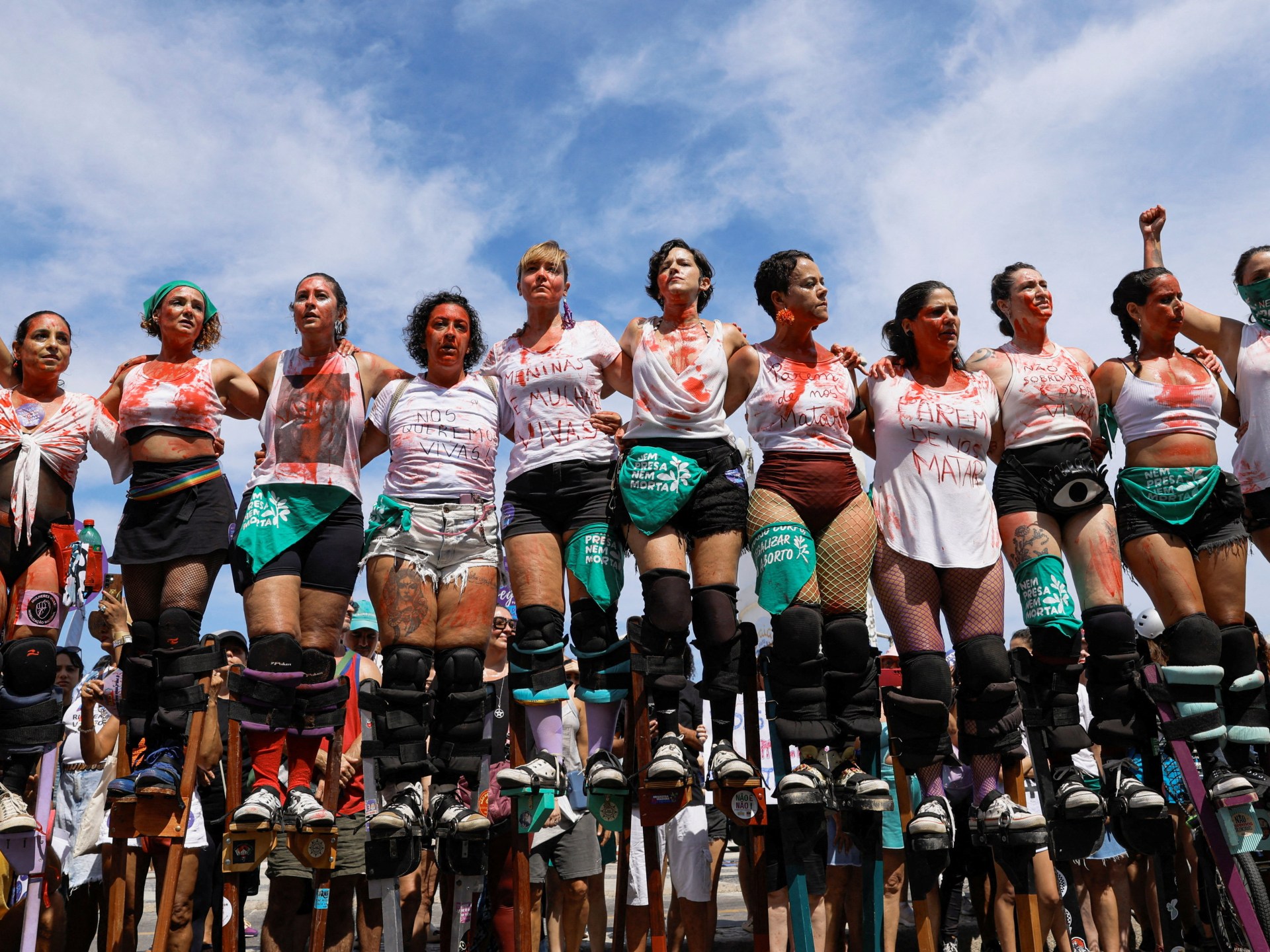
Tens of thousands of women have marched in cities across Brazil, denouncing femicide and gender-based violence, after a series of high-profile cases that shocked the country.
Women of all ages and some men took to the streets in Rio de Janeiro, Sao Paulo and other cities on Sunday, calling for an end to femicide, rape and misogyny.
list of 4 itemsend of list
In Rio, the protesters put out dozens of black crosses, while others bore stickers with messages such as “machismo kills”. And in Sao Paulo, the demonstrators chanted, “Stop killing us”, and held placards that read, “Enough of femicide”.
The protesters in Rio’s Copacabana included Alline de Souza Pedrotti, whose sister was killed on November 28 by a male colleague. Pedrotti said the person who killed her sister, an administrative employee at a school, did not accept having female bosses.
“I’m devastated,” she told The Associated Press news agency. “But I’m fighting through the pain, and I won’t stop. I want changes in the legislation and new protocols to prevent this kind of crime from happening again.”
The protesters also denounced other shocking cases that took place last month in Sao Paulo and in the southern city of Florianopolis. In Sao Paulo on November 28, Taynara Souza Santos was run over by her ex-boyfriend and trapped by the car, which dragged her over concrete for one kilometre (0.6 mile).
The 31-year-old’s injuries were so severe, her legs were amputated.
Video footage of the incident went viral.
And in Florianopolis on November 21, English teacher Catarina Kasten was raped and strangled to death on a trail next to a beach on her way to a swimming lesson.
These recent cases were “the final straw”, said Isabela Pontes, who was on Sao Paulo’s Paulista Avenue. “I have suffered many forms of abuses, and today, I am here to show our voice.”
A decade ago, Brazil passed a law recognising the crime of femicide, defined as the death of a woman in the domestic sphere or as resulting from contempt for women.
Last year, 1,492 women were victims of femicide, the highest number since the law was introduced in 2015, according to the Brazilian Forum on Public Safety.
“We’re seeing an increase in numbers, but also in the intensity and cruelty of violence,” said Juliana Martins, an expert in gender-based violence and institutional relations manager at the Brazilian Forum on Public Safety.
More women are speaking out against violence targeting them, and have gained visibility in the public sphere, Martins said.
“Social transformations seeking equality of rights and representation generate violent responses aimed at reaffirming women’s subordination,” she said.
In Rio, Lizete de Paula, 79, said men who hate women had felt empowered during the term of former President Jair Bolsonaro, who dismantled public policies aimed at strengthening women’s rights.
“Women are increasingly entering new spaces and macho men can’t stand this,” the former architect said.
Joao Pedro Cordao, a 45-year-old father of three daughters, said men have a duty to stand with women by calling out misogyny, not only at protests but in day-to-day life.
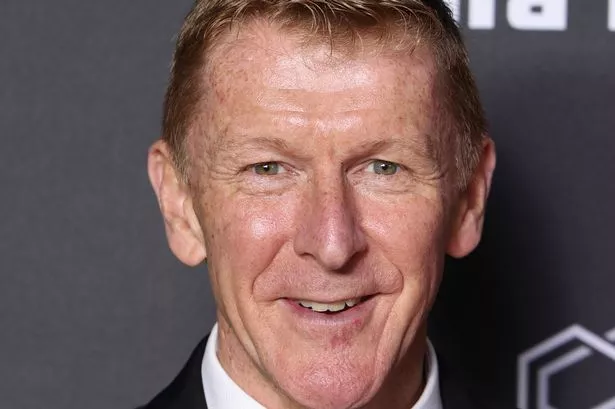
Performing a clumsy but weightless backwards somersault, astronaut Major Tim Peake declared with undisguised glee that life in orbit was “absolutely spectacular.” The first Brit to visit the International Space Station and complete a spacewalk, through him we could all vicariously live out our dreams of becoming astronauts. A decade later, now 53, he’s lost none of the boyish enthusiasm that won our hearts, telling The Mirror: “The extraordinary view of the planet earth is probably by far the most special thing about being in space. It’s awe inspiring, seeing the Milky Way rise – 200 billion stars of our own galaxy that’s incredibly special as well.”
Next Monday at 11.03am – marking the exact moment 10 years ago on December 15 2015 that Tim blasted into space – a mass paper rocket launch will be staged at London’s Science Museum. Schools across the UK will also be invited to join in a lesson with Tim, broadcast live from the museum, following a day of free activities hosted there by the astronaut on Sunday.
READ MORE: NASA astronaut’s wife claimed to be ‘first crime in space’ victim – but she lied
Tim says: “There will be explosive live shows and kids can learn how to send a rocket up into space.” The first astronaut to run the equivalent of the London Marathon in space, Tim recalls blasting off from the launch site in Kazakhstan as if it was yesterday. Waving to the throngs of people who had gathered for the launch, he walked side by side with Russian commander Yuri Malenchko and American NASA astronaut Tim Kopra, before they stepped inside the Soyuz rocket.
But, as the hatch door closed, they were plunged into silence. “There was a real switch going from all that buzz and activity to going up inside the rocket,” says Tim. “Inside the capsule, when the hatch closes – that’s the moment when everything shifts. It’s just three people crammed in like sardines in a tin waiting for the blue touchpaper to light. That’s the time when you shut everything else out and you just focus on what you’ve been training for, for so many years.”
Inside the Soyuz there’s the descent module for launch and re-entry, and the orbital module – a cramped, bell-shaped capsule, providing tightly seated living space for the crew. It took six hours for the 7 tonne Soyuz to reach the 400 tonne Space Station, arriving at 5.33pm.
But the astronauts didn’t open the hatch until 7.58pm. Only once they were sure the connection between the two crafts was airtight, did they enter the Space Station, which would become Tim’s home for the next six months. Orbiting the earth presented Tim – who lives in Chichester with his wife Rebecca, 51, and their sons Thomas, 16, and Oliver, 14 – with a treasure chest of unearthly delights.
His most memorable was undoubtedly the space walk. “I’ll never forget it,” he says. “It’s one thing to dock in space, which is like a moment out of Moonraker, but it’s another to put on a space suit and go outside. The feeling of danger is palpable. You’re in this environment you’re not supposed to be in – but it’s also incredibly beautiful, peaceful and tranquil being surrounded by the universe. To be out there floating around in space is the most special experience ever. Being in space taught me that this planet is the most beautiful planet I’ve ever seen, and set in the backdrop of the infinite universe it makes you realise we need to look after it.”
Taking part in more than 250 scientific experiments during his mission, he also engaged 2 million schoolchildren across Europe in at least 30 projects. Now retired, but still an ambassador for Science, Technology, Engineering and Mathematic (STEM) he is passionate about inspiring the next generation of explorers, engineers and scientists.
Running the London Marathon strapped to the Space Station’s treadmill by a bungee cord attached to a harness, so he didn’t float away, was another intergalactic feat. He completed the virtual course – in support of The Prince’s Trust (now The King’s Trust) – in 3 hours, 35 minutes and 21 seconds, while watching fellow runners pound the London streets below him via video link.
Low gravity meant Tim’s legs only had to carry 80% of his actual weight. “You could say we’re cheating in a way, but the reality is that if you have all that weight on your collarbone it forces you into this forward position,” he explains. “The treadmill was incredibly narrow, which meant I couldn’t run with my normal gait. It’s a bit like when models walk down the catwalk and they have to put one foot in front of the other – you have to run a bit like that.
“For three and a half hours your blood circulation is cut off by wearing this ridiculous harness and you have to really focus on every foot you place being accurate, so you don’t trip up. After about an hour, I was desperate to get off, so I got faster and faster, because I wanted to finish it as soon as possible. I’d say it is harder to run a marathon in space, but being able to watch the live London marathon at the same time really inspired me.”
His muscles also recovered quicker, because he floated off the treadmill without putting his full body weight on his tired legs. But he failed to beat his earthly time. When he ran the London Marathon in 1999 he finished in 3 hours and 18 minutes. Waxing lyrical about wonders he saw from space – including the Sahara desert, the Amazon rainforest and the Himalayas – Tim says the juxtaposition between the awesome views and the everyday was mindblowing.
Tim, who joined the Army at 19, becoming a pilot in the Army Air Corps and then joining the European Space Agency astronaut corps in 2009, says: “There’s almost this disconnect between normality and awe and wonder. On the one hand you’re working really hard and the next you pass by the window and suddenly see Earth beneath you. “You see this magnificent view of the Aurora at night, or a thunderstorm – and it blows your mind.”
Orbiting around 250 miles above Earth, Tim loved looking down at the planet from the space station’s Cupola – a unique observation deck with seven windows – and shared his images and thoughts on social media. “When you see the Aurora and the small strip of atmosphere that protects us from space, it gives you an appreciation of just what our planet is doing to protect us from a harsh environment.”
The strip of atmosphere, while remarkably thin, technically extends thousands of miles – blending into space and gradually fading. “Back in the Apollo era – they said we came all this way to see what’s on the moon – but what we really discovered was planet Earth,” says Tim, who landed back on terra firma on June 18 2016.
Twenty five this year, the International Space Station will be deorbited in 2031. Advanced technology and high maintenance costs mean it will be replaced by multiple commercial space stations. Tim says: “Space tourists have been spending 10 to 12 days on the ISS for the last 10 years. As it gets easier and cheaper to get to space, we’re seeing more and more people doing it.”
But while singer Katy Perry joined an all female crew to go into space in April this year, it will still be a while before ordinary people can fly to the moon and back, as it currently costs more than £40m. In the meantime, there are still serious space missions in the offing. Artemis II is a NASA-led crewed mission that will send four astronauts on a 10-day flight around the Moon and back, with a launch targeted for early 2026. The lunar flyby will be to test systems for future landings. China also has its own space station now.
Tim continues: “I’m a fan of using space for science and space for the benefit of everybody. I don’t think there’s a huge public appetite for just watching people with high net worth having a quick six minutes of weightlessness in space. Having said that, back in the 1920s and 30s, it was only very wealthy people flying across the Atlantic.
“Today it’s affordable for a much larger percentage of the population. In 100 years time we could be seeing a transportation system that would get you from London to Sydney in 45 minutes [via space] and it could be affordable for a large percentage of people. We might look back at rich people and celebrities going to space and think it was just the start.”
Find out more about how to join in with Tim Peake’s activities at The Science Museum on Sunday 14th and Monday 15th December here
READ MORE: ‘I spent three months living on ISS and discovered space has a distinct smell’
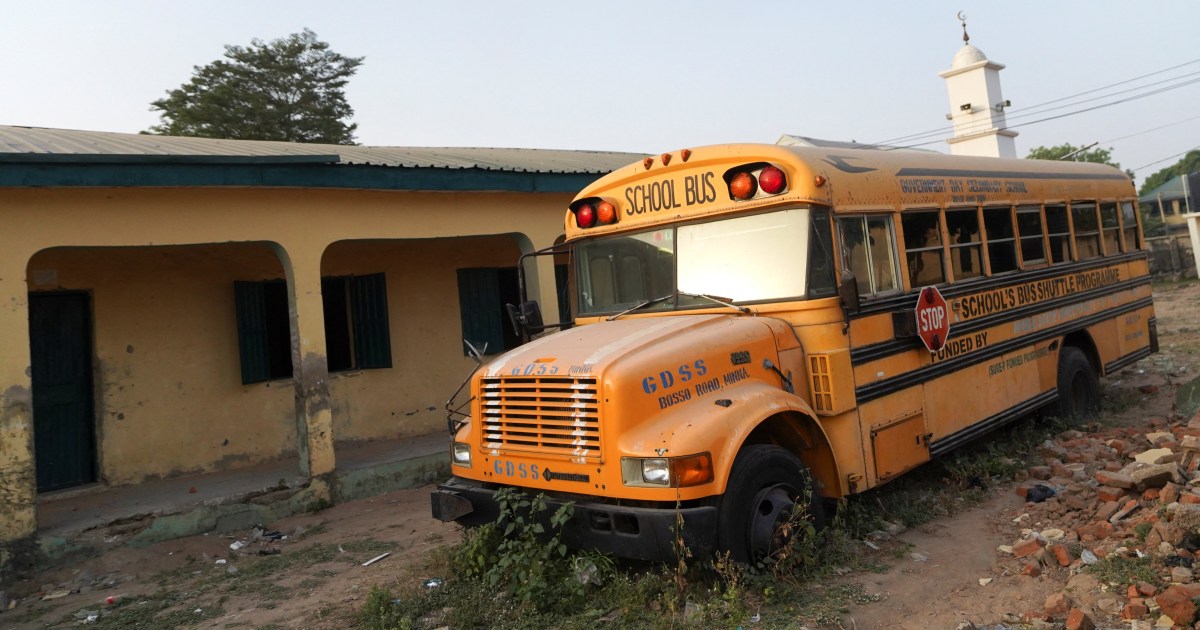
Nigerian authorities have secured the release of 100 children who were among hundreds kidnapped from a Catholic school in northern Nigeria last month, officials and local media have reported.
The 100 children arrived in Nigeria’s capital, Abuja, and are set to be handed over to local government officials in Niger State on Monday, an unnamed United Nations source told the AFP news agency.
list of 4 itemsend of list
“They are going to be handed over to Niger State government tomorrow,” the source told the AFP news agency.
Nigeria’s The Guardian newspaper reported on Sunday that the rescued children were receiving medical evaluations and would be reunited with their families after a debriefing.
Presidential spokesman Sunday Dare also confirmed reports to the AFP that 100 children were being freed.
Armed gunmen kidnapped 303 students and 12 teachers from St Mary’s School in the Papiri community of Niger State’s Agwara district on November 21.
They included both male and female students aged between 10 to 18 years, according to the Christian Association of Nigeria (CAN).
Fifty of the students escaped captivity in the days after they were kidnapped, returning home to their families. Following the release of 100 students on Sunday, 153 students and 12 teachers are believed to remain in captivity.
Days earlier, gunmen abducted 25 schoolgirls from the Government Girls Comprehensive Secondary School in the neighbouring Kebbi State’s Maga town,170km (106 miles) away.
“We have been praying and waiting for their return. If it is true, then it is a cheering news,” said Daniel Atori, spokesman for Bishop Bulus Yohanna of the Kontagora diocese, which runs the school.
“However, we are not officially aware and have not been duly notified by the federal government.”
The latest abductions are the worst seen in Nigeria since more than 270 girls from Chibok town were snatched from their school in 2014.
In total, more than 1,400 Nigerian students have been kidnapped since 2014, in almost a dozen separate incidents.
The most recent kidnappings came soon after United States President Donald Trump said that Nigeria’s Christians are facing genocide, a claim that has been questioned by local officials and Christian groups, who say that people from different faiths have been caught up in ongoing violence in parts of the country.
Kimiebi Imomotimi Ebienfa, a spokesman for Nigeria’s Ministry of Foreign Affairs, told Al Jazeera last month that people of all faiths have been affected by the ongoing violence.
“We’ve continuously made our point clear that we acknowledge the fact that there are killings that have taken place in Nigeria, but those killings were not restricted to Christians alone. Muslims are being killed. Traditional worshippers are being killed,” Ebienfa said.
“The majority is not the Christian population.”
Trump has threatened military intervention in Nigeria, alleging that the country is failing to protect Christians from persecution. He has also threatened to cut aid to Nigeria.
Nigeria, a country of more than 200 million people, is divided between the largely Muslim north and mostly Christian south.
According to Pew Research Center estimates, Muslims make up 56 percent of Nigeria’s population, while Christians make up just more than 43 percent.