US court hands Trump victory against pro-Palestine activist Mahmoud Khalil

An appeals court panel in the United States has moved to dismiss a petition by Palestinian activist Mahmoud Khalil challenging his detention and deportation, handing a boost to the administration of President Donald Trump.

In a two-to-one ruling on Thursday, the judges concluded that the federal court that ordered Khalil’s release last year lacked jurisdiction over the matter.

Recommended Stories

list of 3 itemsend of list

The ruling potentially enables the re-arrest of Khalil, who missed the birth of his first child while he was detained by immigration authorities last year. But the order does not go into effect immediately, and Khalil has signalled that he plans to appeal.

“Today’s ruling is deeply disappointing, but it does not break our resolve,” Khalil said in a statement.

“The door may have been opened for potential re-detainment down the line, but it has not closed our commitment to Palestine and to justice and accountability. I will continue to fight, through every legal avenue and with every ounce of determination, until my rights, and the rights of others like me, are fully protected.”

The Palestinian activist, born in Syria and holding Algerian citizenship, is a lawful permanent resident and married to a US citizen.

Khalil, who was pursuing a graduate degree at Columbia University, is one of dozens of foreign students that the Trump administration has targeted for deportation over their criticism of Israel.

Rights advocates argue that the campaign violates US free speech rights to stifle criticism of a foreign nation.

Khalil’s case was advancing on two tracks: one in federal court through a habeas corpus petition, which argued that his detention was illegal, and another in the administrative immigration courts, which challenged his removal.

The appeals panel sided with the government’s argument that only the immigration courts had jurisdiction over the matter, in accordance with the Immigration and Nationality Act (INA).

“Our holdings vindicate essential principles of habeas and immigration law,” the court said.

“The scheme Congress enacted governing immigration proceedings provides Khalil a meaningful forum in which to raise his claims later on—in a petition for review of a final order of removal. We will therefore VACATE and REMAND with instructions to dismiss Khalil’s habeas petition.”

Trump threatens to use Insurrection Act to end Minneapolis protests

United States President Donald Trump has threatened to invoke a rarely used federal law to deploy troops to the state of Minnesota, where protests are being held against two shootings in the city of Minneapolis within a week related to his immigration crackdown.

“If the corrupt politicians of Minnesota don’t obey the law and stop the professional agitators and insurrectionists from attacking the Patriots of I.C.E., who are only trying to do their job, I will institute the INSURRECTION ACT, which many Presidents have done before me, and quickly put an end to the travesty that is taking place in that once great State,” Trump wrote on social media on Thursday, referring to the Immigration and Customs Enforcement agency.

Recommended Stories

list of 3 itemsend of list

Trump posted the comment a day after a federal agent shot and wounded a Venezuelan ‍man in Minneapolis. The federal agent said two people attacked him with a shovel and broom handle as he wrestled with the Venezuelan, who the Trump administration said was in the US illegally.

Deadly shooting

The incident further stoked tensions a week after an ICE agent fatally shot 37-year-old Renee Good, ⁠a US citizen, in her car in Minneapolis. The killing of the mother of three and the Trump administration’s depiction of her as a “domestic terrorist” sparked global outrage, leading to demonstrations across the US.

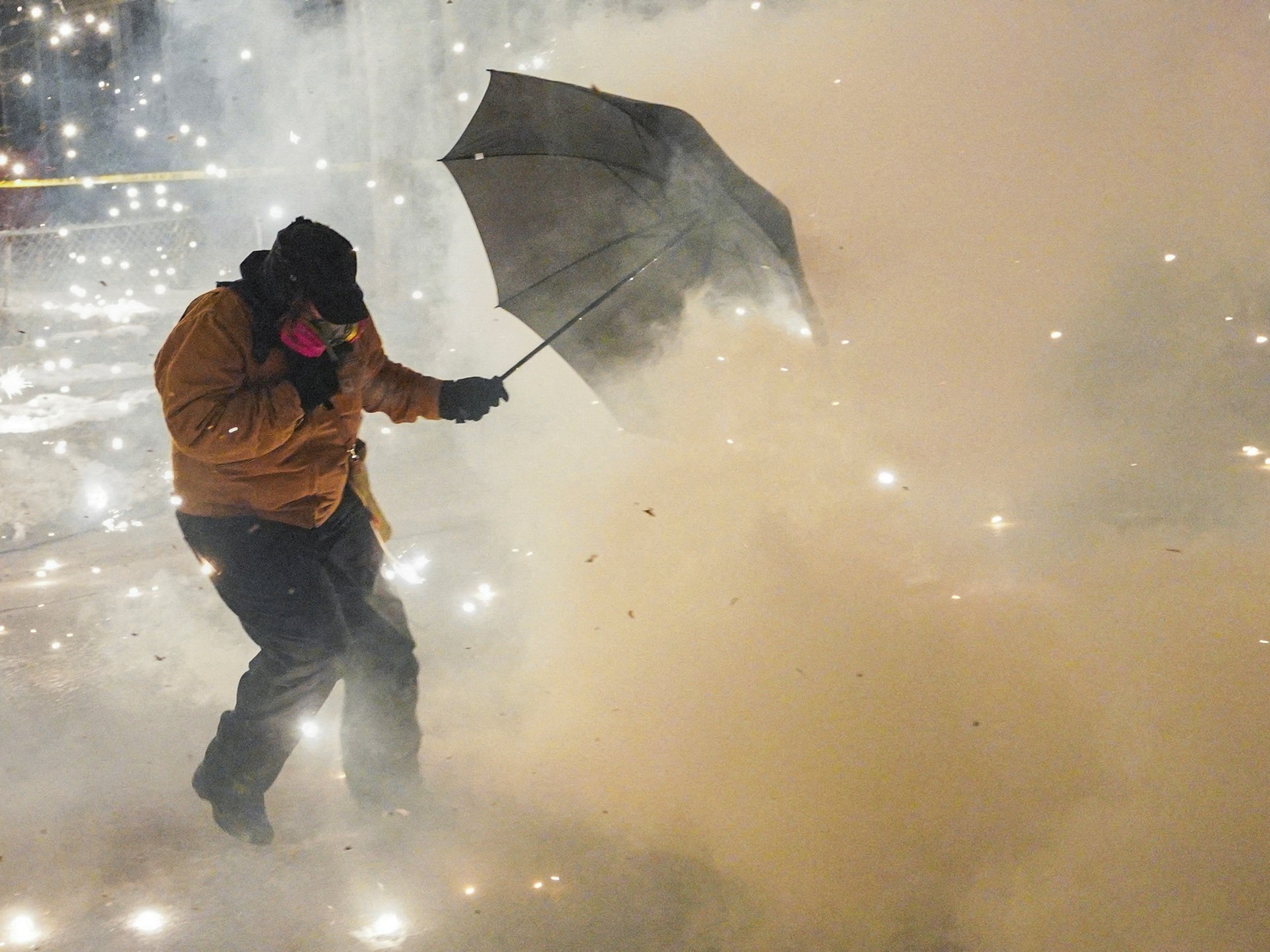
Smoke filled the streets of Minneapolis on Wednesday night near the site of the latest shooting as federal officers wearing gas masks and helmets fired tear gas into a small crowd while protesters threw rocks and shot fireworks.

The US president has repeatedly threatened to use the Insurrection Act to deploy the US military or federalise the National Guard for domestic law enforcement over the objections of state governors.

Minneapolis Mayor Jacob Frey described the situation as not “sustainable”.

“This is an impossible situation that our city is presently being put in, and at the same time, we are trying to find a way forward to keep people safe, to protect our neighbours, to maintain order,” he said.

Frey described a federal force that is five times bigger than the city’s 600-officer police force as having “invaded” the city, scaring and angering residents, some of whom want the local officers to “fight ICE agents”.

At the same time, the police force is still responsible for their day-to-day work to keep the public safe.

Thousands of arrests

The Department of Homeland Security (DHS) said it has made more than 2,000 arrests in Minnesota since early December and is promising to not back down.

The ‍DHS accused Frey and Minnesota Governor Tim Walz, both Democrats, of encouraging resistance to ICE with “hateful rhetoric”, a contention Frey rejected.

Disputing accusations of misconduct, DHS has said its agents have increasingly been subjected to assaults while trying to find and detain immigration violators.

Speaking at a news conference alongside Frey, Minneapolis Police Chief Brian O’Hara urged crowds he described as “engaging in unlawful acts” near the shooting scenes to disperse.

Rejections, depression & promise to his mum – Thiago’s route to top

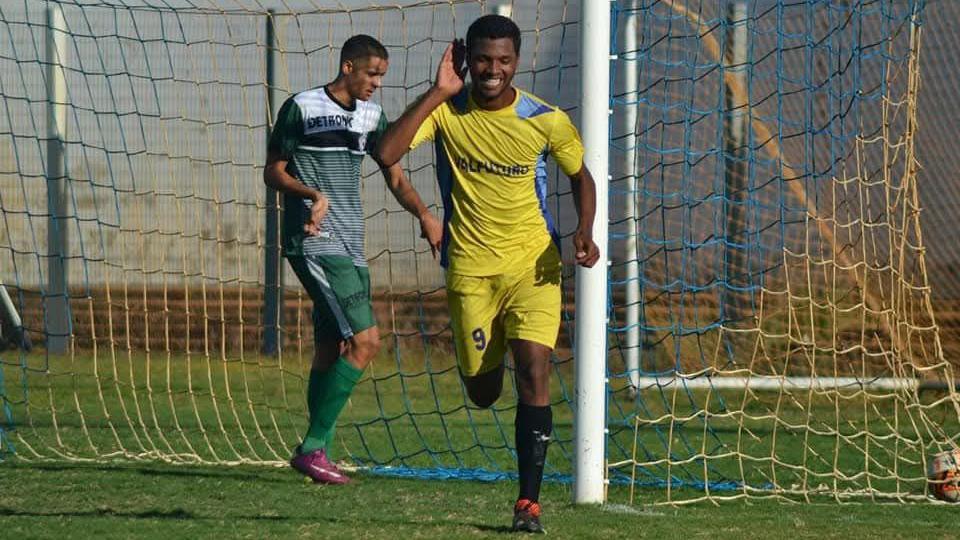
A young Igor Thiago could not have known he would one day break the record for the most goals by a Brazilian player in a Premier League season.

But the Brentford forward has always had one thing clear in his mind – nothing would stop him from becoming a professional footballer.

That is the promise he made to his mother Maria Diva when he was growing up in Cidade Ocidental, a small town in central Brazil.

He has never forgotten the day they went to a family meal where everyone was supposed to bring a dish.

Raising four children on her own and working as a refuse collector on a minimum wage, Diva did not have it easy and arrived empty-handed.

It was then that Thiago heard a close relative say she would only take her children out to eat at other people’s expense. Diva felt humiliated and left in tears.

“From today on, no-one in this life is going to humiliate you any more,” Thiago told her on the way home.

“I’m going to become a footballer, you’ll see. Everyone will know me one day.”

His mother may have thought he did not really know what he was talking about. But he knew.

However, his path to success has not been straightforward.

He had to wait until he was 17 to sign for a club, having faced several rejections at trials around Brazil.

“Thiago would call me late at night in tears to say that football wasn’t for him,” Sergio Goncalves, his mentor from his early years at Gremio Ocidental, a local community football initiative, tells BBC Sport. “But he was born to score goals.”

The 24-year-old has found the back of the net 16 times in the Premier League this season.

He is on target to reach the 20-goal mark once again in his career – having done so in three of his four seasons in Europe, the only exception being his debut campaign with Brentford, which was disrupted by a serious injury.

Sergio Goncalves

‘I don’t want to know about football any more’

Having lost his father prematurely, Thiago found a paternal figure in Goncalves, who mentored him between the ages of eight and 16 – before the striker joined Vere in 2018 then moved to Brazilian giants Cruzeiro a year later.

“People look at him, see how big he is, and think he’s that kind of static centre-forward. But he has a lot to his game because of the time he spent in futsal,” Goncalves says.

“Thiago was born in futsal. It gives you so much dynamism, such quick thinking. A lot of scouts who came through here now call me to say ‘Sergio, I missed out on Thiago’.”

Thiago did not take long to make an impact for Cruzeiro, going on to score in his senior debut in Belo Horizonte. But that was it.

He probably could not have had a more challenging first-team experience.

That side is remembered as the worst Cruzeiro team ever – they finished their Serie B campaigns in 11th and 14th place in 2020 and 2021.

“The pressure was everywhere – it affected all the players and the coaching staff. It was a very difficult period for the club – delays in paying wages, problems with transfer ban,” former Brazil international Mozart Santos, who had a brief spell as head coach, says.

“Younger players tend to feel it more. So one of the reasons Thiago maybe didn’t perform better in Brazil was this turbulence.”

Such was the situation that Thiago fell into depression, questioning himself and even whether he should continue as a professional footballer.

“There are things no-one knows that I went through. I went through a period of depression,” he said in an interview with Futebol no Mundo podcast from ESPN.

“There were nights when I thought about giving up. Even though I was already a professional at Cruzeiro, I didn’t want to know about football any more.

‘The sky’s the limit’

At the start of 2022, Thiago told his agents it was time to move elsewhere.

Bulgarian champions Ludogorets, who had tried to sign him the season before, returned with another offer and secured a deal.

“In football, a lot of people try to define paths and limits for others. You often see a player going through a difficult period and being labelled as a certain type of player and that label becomes a kind of ceiling. I fight strongly against that,” former Ludogorets assistant coach Rafael Ferreira, currently at Atromitos in Greece, said.

“I believe everyone has room to grow as long as they’re in an environment that allows it. And Igor Thiago fits into a very interesting profile because he has a very strong mentality.

“In his early period, he didn’t get many minutes. And what does he do? He asks to play for the second team. He wants to play. That shows you his mentality – not sulking because he isn’t playing but looking for alternatives. When you work with that type of player, we usually say the sky’s the limit.”

Thiago’s mentality also stands out with his team-mates.

“What I really liked about him was that when he arrived, he was always asking the older players what they thought he could improve. That’s what I found different about him, special even,” says Cauly, a former Ludogorets midfielder who now plays for Bahia in Brazil.

“He already had that worker’s mentality, that desire to keep improving. And a player with his physical attributes… we already knew that, one way or another, it had to work out for him as a striker.”

It was no surprise that, following only one full season and 20 goals later, he was on his way to Club Brugge in Belgium.

Sergio Goncalves was Thiago's early mentor in his boyhood days in BrazilSergio Goncalves

‘His dream was to play in the Premier League’

Thiago scored 29 goals in his first and only season with Club Brugge.

Brentford then anticipated competition for his signing and paid a club record £30m for him. The forward arrived as a replacement for Ivan Toney, who was sold to Saudi club Al-Ahli.

“I remember he always said his dream was to play in the Premier League. He was always speaking very highly of Erling Haaland. And now, today, he’s competing with him for the Premier League’s top scorer,” Cauly says.

“That makes me really happy to see. I’m proud of him. He’s someone who truly deserves it – a genuinely good person, with a big heart, and he deserves to be where he is.”

With Brazil desperately looking for a number nine before the summer’s World Cup, there is a growing expectation head coach Carlo Ancelotti will include him in his March squad.

“For me, in this next list – which is the last one before the tournament – he has to be in. If he isn’t, then it won’t be justice,” Goncalves says.

“Brazil is missing a proper striker, and I believe this is his moment. And when he gets there, I think he’ll make the difference.

Related topics

  • Insight: In-depth stories from the world of sport
  • Brazil
  • Brentford
  • Premier League
  • Football

More on this story

  • Brentford Community Stadium
  • Ask Me Anything logo

Trump’s bluffs: Why US strike on Iran remains real threat

After threatening to attack Iran for days in support of protesters challenging the government in Tehran, United States President Donald Trump appeared to dial back the rhetoric on Wednesday evening.

The killings in Iran, Trump said, had stopped, adding that Tehran had told his administration that arrested protesters would not be executed.

Recommended Stories

list of 4 itemsend of list

Trump did not rule out an attack on Iran, but in effect, negated the rationale for such an attack.

Still, as Trump closes in on the completion of the first year of his second term in office, his track record suggests the possibility of US military strikes against Iran in the coming days remains a real threat.

We take a look:

Maduro abducted – amid diplomacy and limited strikes

Since August, the US had positioned its largest military deployment in the Caribbean Sea in decades.

The US military bombed more than 30 boats that it claimed – without providing evidence – were carrying drugs to the United States, killing more than 100 people in these strikes. For months, Trump and his team accused Venezuelan President Nicolas Maduro of leading mass-scale narcotics smuggling operations, again without evidence. Amid the boat bombings, Trump even said that the US might strike Venezuelan land next.

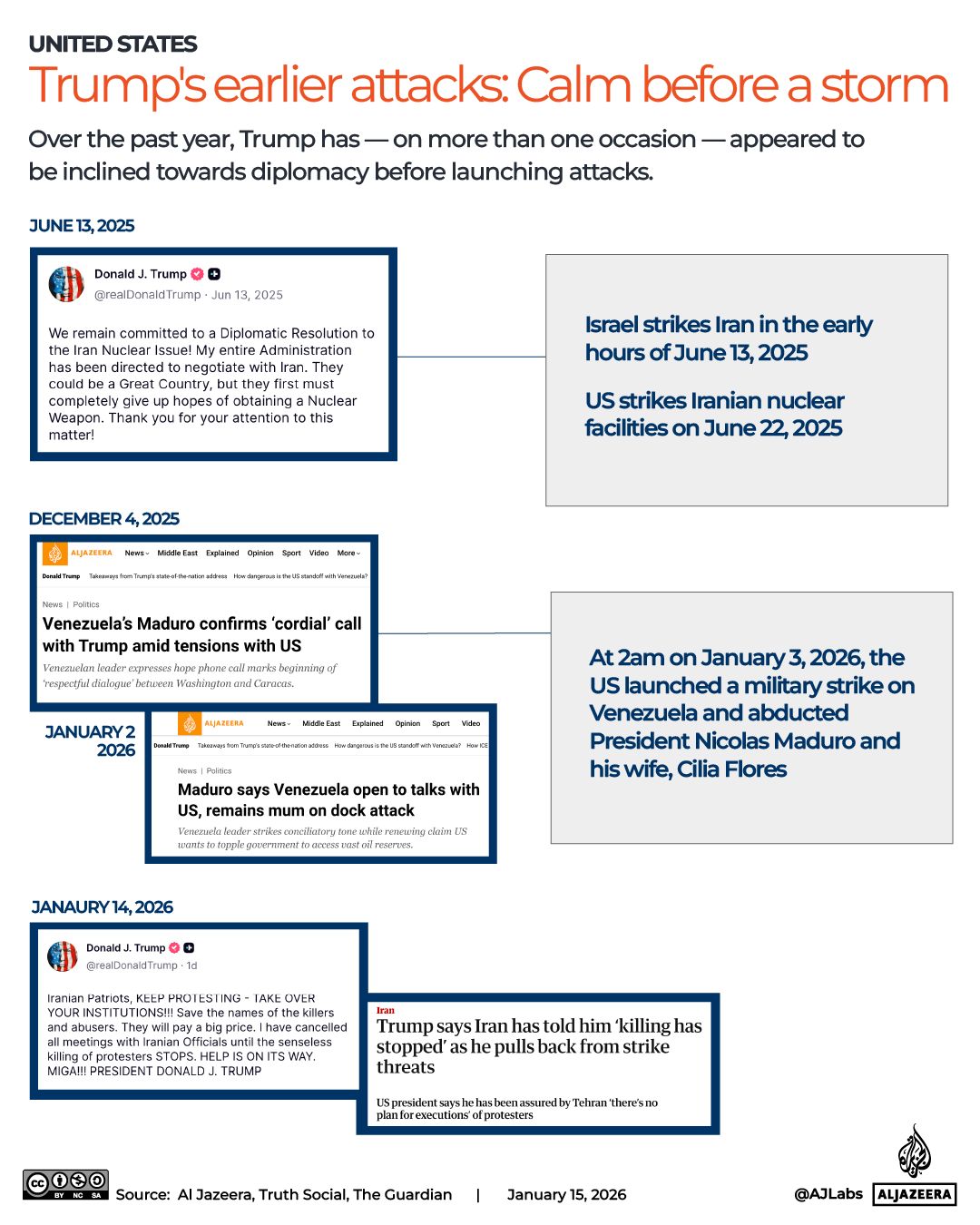
But in late November, Trump revealed to reporters that he had spoken to the Venezuelan leader. A few days later, the call was confirmed by Maduro himself, who described it as “cordial”.

The US then hit what Trump described as a docking facility for alleged drug boats in Venezuela. After that, on January 1, Maduro offered Trump an olive branch, saying he was open to talks with Washington on drug trafficking and even on enabling US access to oil. Trump appeared to be getting what he ostensibly wanted – access to Venezuelan oil and blocks on drugs from the country.

Yet only hours later, US forces targeted the capital, abducting Maduro and his wife on charges of narcotics trafficking and transporting them to the United States.

Iran bombed – when ‘two weeks’ of diplomacy appeared imminent

Venezuela was not the first time Trump launched a dramatic attack at a time when diplomacy appeared to be taking hold.

In June, Iran learned the hard way that Trump’s words and actions do not match.

Amid rising tensions over US accusations that Iran was racing towards enriching uranium for nuclear weapons, Washington and Tehran engaged in weeks of hectic negotiations. Trump frequently warned Iran that time was running out for it to strike a deal, but then returned to talks.

On June 13, he wrote on Truth Social that his team “remain committed to a Diplomatic Resolution to the Iran Nuclear Issue.”

His “entire” administration, he said, had been “directed to negotiate with Iran”.

But barely hours later, US ally Israel struck Iran. Most experts believe Israel would not have attacked Iran without Trump’s approval.

As Israel and Iran traded fire in the subsequent days, Trump faced questions over whether the US would bomb Iran.

On June 20, White House press secretary Karoline Leavitt quoted Trump as saying that he would “make my decision whether or not to go within the next two weeks”.

Far from utilising the full two weeks he gave himself, Trump made his decision in two days.

In the early hours of June 22, US B-2 Spirit bombers dropped fourteen bunker-busting bombs on Iran’s Fordow nuclear facility, buried deep inside a mountain near Qom. The US also bombed nuclear facilities in Natanz and Isfahan using the most powerful conventional bombs in the US arsenal.

The attack shocked many observers, in part because of what appeared to have been an elaborate diplomatic ruse preceding it.

Iran protest calculus: What’s Trump’s plan?

Now, all eyes are on Iran again, where demonstrations against the government have been under way for the past two weeks, before calming down earlier this week.

As the unrest turned deadlier last week, Trump urged Iranians to continue demonstrating.

“Iranian Patriots, KEEP PROTESTING – TAKE OVER YOUR INSTITUTIONS!!!… HELP IS ON ITS WAY,” Trump said in a post on Truth Social on January 13, without elaborating on what form that help might take.

But within 24 hours, during a meeting with reporters in Washington, DC, Trump said he had been assured that the killing of protesters in Iran had stopped.

“They’ve said the killing has stopped and the executions won’t take place – there were supposed to be a lot of executions today, and that the executions won’t take place – and we’re going to find out,” Trump said on Wednesday.

Iranian Foreign Minister Abbas Araghchi, in an interview with Fox TV, also denied that Tehran planned to execute antigovernment protesters. “Hanging is ‌out of the ‌question,” he said.

Which other countries is Trump threatening?

Beyond Iran and Venezuela, longstanding US rivals, Trump’s aggression has increasingly extended towards Washington’s own allies, including Canada and Greenland.

The most striking example is Trump’s eagerness to take over Greenland, a Danish territory, which has evolved from a campaign talking point into a focal element of his administration’s Western Hemisphere strategy.

On January 5, the State Department posted a black-and-white image of Trump on social media, declaring: “This is OUR Hemisphere, and President Trump will not allow our security to be threatened.”

The president has refused to rule out the use of military force, with administration officials openly discussing US interest in Greenland’s strategic location and mineral resources.

Denmark has categorically rejected any sale, while Greenland’s leadership insists the territory is not for sale.

But experts such as Jeremy Shapiro, research director at the European Council on Foreign Relations, argue that Trump uses threats to intimidate adversaries and typically employs force only against weaker targets.

In a paper published last May titled, The bully’s pulpit: Finding patterns in Trump’s use of military force, Shapiro suggested that Trump frequently invokes military threats but often fails to follow through.

According to Shapiro, Trump is more likely to act when threats carry “low escalation risk”, while threats against nuclear-armed or militarily strong states largely serve rhetorical purposes. The most extreme or theatrical warnings, he argues, tend to function as tools of “political signalling rather than precursors to real military action”.

“Trump often deploys grandiose threats but only accepts limited, low-risk military operations. He uses foreign policy as political theatre, aiming threats as much at his domestic base and media cycle as at foreign adversaries,” Shapiro writes.

Calculated unpredictability?

Some analysts believe Trump’s approach offers tactical advantages.

“The intent is to keep opponents off balance, heightening psychological pressure and extracting maximum strategic leverage,” a Pakistani government official told Al Jazeera, speaking on condition of anonymity because he was not authorised to speak to the media. “Even his European allies are not always certain what to expect.”

Others remain sceptical. Qandil Abbas, a specialist on Middle East affairs at Quaid-e-Azam University in Islamabad, described Trump’s behaviour as erratic, citing his repeated threats against multiple countries.

“Look at his threats against Cuba, or Iran, or Venezuela, and yet this is the same president who also wants to win a Nobel prize and is desperate for it,” Abbas told Al Jazeera.

So is Trump actually pulling back from the prospect of attacking Iran – or is he bluffing?

According to Abbas, Trump’s apparent change in tone might be the result of feedback from US allies in the region “that attacking Iran is not smart”.
Alleged Defamation: Court Sets Date To Hear Gov Sule’s Suit Against Benue Varsity VC

A Federal Capital Territory High Court sitting in Abuja has fixed January 19 for the hearing of an alleged defamation suit filed by the Nasarawa State

Governor, Abdullahi Sule, against the Vice-Chancellor of the University of Mkar, Gboko, Benue State, Professor Zachary Gundu.

Justice Hamza Muazu adjourned the matter following a request by counsel to the governor for additional time to respond to three pending applications filed by the defendant.

Governor Sule is seeking ₦100.5 billion in damages, alleging that Professor Gundu made defamatory statements accusing him of providing a haven to Fulani herdsmen who allegedly carried out attacks on communities in Benue State.

The alleged statements were said to have been made on July 10, 2025.

READ ALSO: Court Strikes Out Defamation Suit Against Senator Natasha After Discontinuance By FG

During proceedings, counsel to the defendant, Sebastine Hon, SAN, opposed the request for adjournment, arguing that the claimant had sufficient time to respond, noting that the applications had been filed since November last year.

Hon further informed the court of his intention to withdraw two of the applications already before it, stating that the move was aimed at clearing procedural obstacles to allow the substantive matter to proceed.