ICE officer shoots Venezuelan immigrant in Minneapolis: What we know

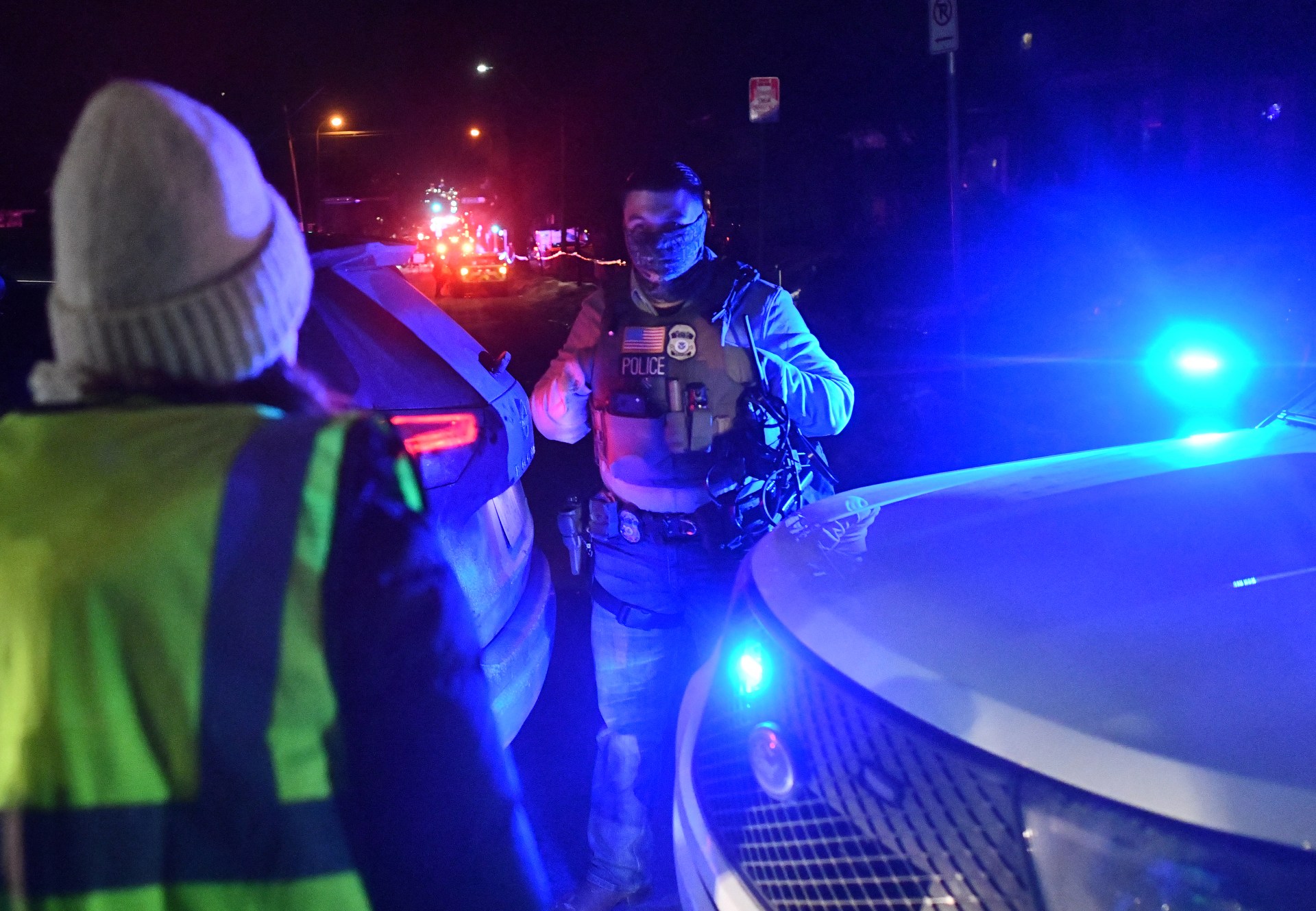
A federal officer in the United States has shot a Venezuelan man in the leg in Minneapolis, Minnesota. Officials say officers had tried to stop a car to arrest the man and opened fire after two people attacked one of them with a “snow shovel and broom handle”.

Protests broke out in the city after the incident.

Recommended Stories

list of 4 itemsend of list

Wednesday’s shooting comes exactly a week after a US Immigration and Customs Enforcement (ICE) officer shot and killed local resident Renee Nicole Good in her car in Minneapolis during an immigration raid.

What happened?

In an X post on Wednesday, the US Department of Homeland Security (DHS) wrote that at 6:50pm (00:50 GMT on Thursday), federal law enforcement officers were stopping “an illegal alien from Venezuela who was released into the country by [former President] Joe Biden in 2022”.

The DHS added that the man had tried to evade the officers, crashing his car into another parked car and then fleeing on foot. It said one of the officers caught up with the immigrant on foot “when the subject began to resist and violently assault the officer”.

The department’s post said that while the immigrant and the officer were struggling on the ground, two people came out of a nearby apartment and began to strike the officer with a snow shovel and a broomstick. It further said, “The original subject got loose and began striking the officer with a shovel or broom stick.”

“Fearing for his life and safety as he was being ambushed by three individuals, the officer fired a defensive shot to defend his life. The initial subject was hit in the leg,” the DHS wrote.

It added that the immigrant and the two people who had come out of the apartment ran back inside the apartment and barricaded themselves in.

The immigrant and officer who was attacked were taken to hospital, and the other two people who attacked the officer are in custody, DHS wrote.

Who was Renee Nicole Good and what happened to her last week?

On the morning of January 7, Jonathan Ross, an ICE officer, fatally shot Good while she was in her car in Minneapolis.

Local officials said Good, 37, was acting as a legal observer during protests against US President Donald Trump’s immigration crackdown.

Legal observers are usually volunteers who attend protests to watch police-demonstrator interactions and record any confrontations or possible legal violations.

Good’s killing sparked outrage and protests in Minnesota and nationwide.

In a joint statement released after she was shot dead, Minneapolis City Council President Elliot Payne and council members wrote: “Renee was a resident of our city who was out caring for her neighbors this morning and her life was taken today at the hands of the federal government. Anyone who kills someone in our city deserves to be arrested, investigated, and prosecuted to the fullest extent of the law.”

After Good was shot, the Republican Trump administration clashed with local authorities, including Democratic Governor Tim Walz and Minneapolis Mayor Jacob Frey.

Trump and administration officials claimed that Good had deliberately hit the ICE officer with her SUV and he had shot her in self-defence.

US Homeland Security Secretary Kristi Noem described Good’s actions as “domestic terrorism”.

She said Good had refused to obey orders to get out of her car, “weaponise[d] her vehicle” and “attempted to run” over the officer. Minnesota officials disputed Noem’s account, citing videos showing Good trying to drive away.

Footage from the incident shows Good’s car slowly reversing and then trying to move forwards. As the car moves forwards, an agent is seen walking around in front of it. He opens fire while standing in front of the driver’s side of the SUV.

Speaking about the shooting on Wednesday, Trump told the Reuters news agency: “I don’t get into right or wrong. I know that it was a tough situation to be in. There was very little respect shown to the police, in this case, the ICE officers.”

What have local authorities said about the latest shooting?

Walz wrote in an X post on Wednesday that state investigators have been to the scene of the shooting.

“I know you’re angry. I’m angry. What Donald Trump wants is violence in the streets,” Walz wrote.

“But Minnesota will remain an island of decency, of justice, of community, and of peace. Don’t give him what he wants.”

In a series of posts on X on Wednesday, Frey wrote: “No matter what led up to this incident, the situation we are seeing in our city is not sustainable.”

He added that there are 600 local police officers working in Minneapolis, and the Trump administration has sent in 3,000 federal officers.

“I have seen conduct from ICE that is intolerable. And for anyone taking the bait tonight, stop. It is not helpful. We cannot respond to Donald Trump’s chaos with our own chaos.”

What is ICE doing in Minnesota?

The DHS launched Operation Metro Surge, which includes Minneapolis, in December. The Trump administration said the operation aims to root out and arrest criminals and undocumented immigrants.

The Trump administration escalated its immigration operation in Minneapolis on January 6. In an X post, ICE announced it planned to deploy 2,000 additional agents to the northern Midwestern city.

“A 100% chance of ICE in the Twin Cities – our largest operation to date,” the post said, referring to Minneapolis and the adjacent city of St Paul.

Todd Lyons, the acting director of ICE, told local news media that ICE is “surging to Minneapolis to root out fraud, arrest perpetrators and remove criminal illegal aliens”.

On Monday, the state of Minnesota filed a lawsuit against the Trump administration, arguing that the operation is an unconstitutional “federal invasion”.

The population of Minnesota is more than 5 million people, and according to numbers from the Migration Policy Institute from 2023, the number of undocumented immigrants in the state is 100,000.

Republicans have made disparaging remarks particularly targeting the state’s Somali population.

Noem said on Tuesday that Trump intends to end temporary deportation protections and work permits for some Somali nationals in the US.

“Country conditions in Somalia have improved to the point that it no longer meets the law’s requirement for Temporary Protected Status,” Noem said in a statement. “Further, allowing Somali nationals to remain temporarily in the United States is contrary to our national interests. We are putting Americans first.”

In December, ICE launched a raid in Columbus, Ohio, which also has a large Somali population. In late November, ICE agents were deployed in New Orleans, Louisiana. Similar raids were launched in Charlotte, North Carolina, the same month.

How many Venezuelan immigrants are in the US?

As of 2023, there were about 770,000 Venezuelan immigrants in the United States, making up just under 2 percent of the country’s 47.8 million foreign-born population, according to the Migration Policy Institute.

The institute estimated that in 2023, 486,000 Venezuelan immigrants were not authorised to be in the US, accounting for 4 percent of a total of 13.7 million unauthorised immigrants.

Since 2014, about 7.7 million Venezuelans, comprising 20 percent of the population, have left the country, mostly to seek better opportunities abroad as the economy has faltered and the government has cracked down on the political opposition. While the vast majority have moved to neighbouring countries, some have gone to the US.

On January 3, US forces abducted Venezuelan President Nicolas Maduro, whom the Trump administration describes as a “narcoterrorist”. He currently faces charges related to weapons and drug trafficking in New York.

During a national address on January 3, Trump stated: “Maduro sent savage and murderous gangs, including the bloodthirsty prison gang, Tren de Aragua, to terrorise American communities nationwide.”
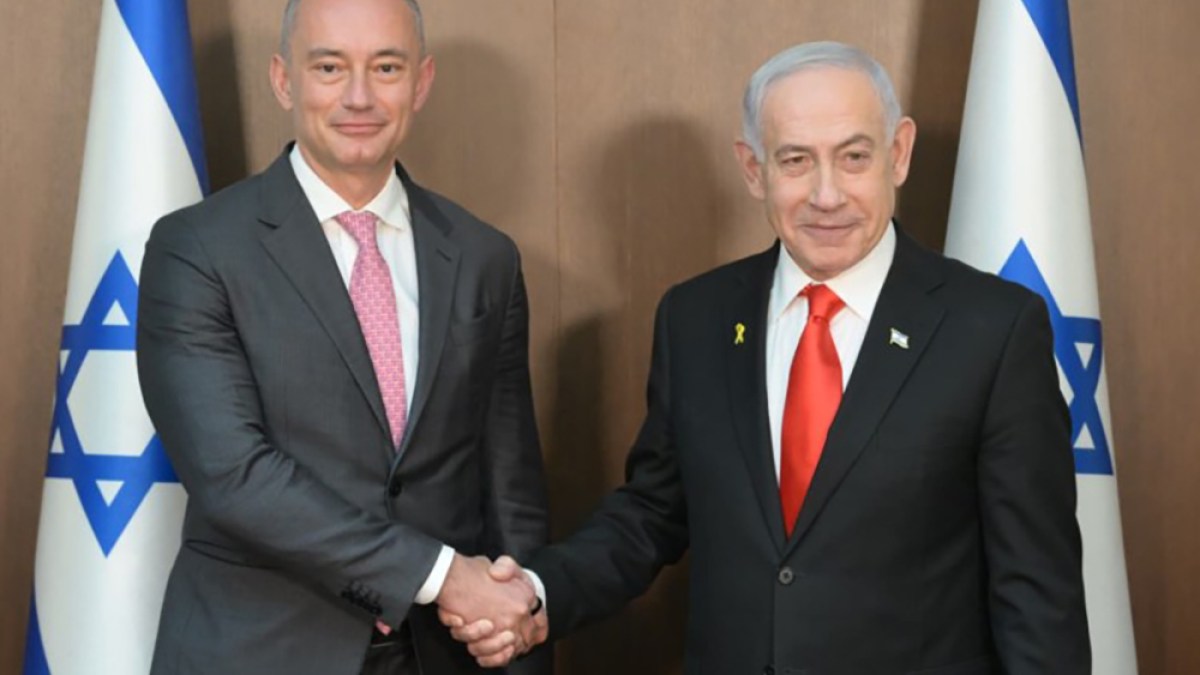
Who is Nickolay Mladenov, the diplomat tasked with ‘disarming Gaza’?

The search for a figure to lead post-war Gaza, which lies in ruins from Israel’s genocidal war, has moved from diplomatic backrooms to the negotiating tables in Cairo.

Following the Arab veto of the regionally toxic former British leader Tony Blair, Washington has deployed its Plan B, Nickolay Mladenov, as the push for phase two of the fragile ceasefire gains some momentum.

The 53-year-old former Bulgarian foreign minister and defence minister is no longer just a nominee; he is arguably the most critical figure in the newly launched phase two of the ceasefire, which Israel has violated on a daily basis since October 10.

Mladenov has been confirmed as the director-general of the United States-proposed “Board of Peace”. His mandate is to oversee the transition from Hamas rule to a new technocratic administration led by Ali Shaath, a former Palestinian Authority (PA) deputy minister.

For five years from 2015-2020, Mladenov served as the United Nations’ top envoy to the region, earning a reputation as a “firefighter” who could talk to everyone.

Now, he returns with a far more fraught and potentially explosive mission: Implementing a US-designed plan that explicitly calls for the “disarmament of all unauthorised personnel” – a euphemism for ending Hamas’s military power while Israel continues its occupation.

The mediator’s test

Mladenov’s immediate challenge is not just reconstruction, but high-stakes mediation. His itinerary, which includes meetings with leaders of Palestinian factions in Cairo, highlights why he was chosen: He is one of the few international figures who retains lines of communication with all sides while holding the trust of Washington and Israel.

While US special envoy Steve Witkoff has framed phase two as an effort to “create the alternative to Hamas”, Mladenov’s role is to make that alternative function on the ground.

He is tasked with supervising the new “technocratic committee” headed by Shaath, which will manage daily life for two million war-battered Palestinians who have lost family members, their homes, hospitals and schools in relentless Israeli bombardment.

However, this structure will face a crisis of legitimacy. Mladenov must navigate a landscape where Israel controls a “buffer zone” in the east, more than 50 percent of the whole territory, and refuses to withdraw fully – all while he attempts to sell a governance plan to the very factions he is tasked with disarming.

A ‘technocrat’ in a war zone

Mladenov’s appointment signals Washington’s preference for a managerial solution to a military and political crisis.

In his recent post-UN career, Mladenov has championed a “new model” for the Middle East, defined by “cutting-edge innovation” and technological partnerships. He has spoken enthusiastically about the region shifting from “oil barrels to silicon chips”.

Critics, however, argue that this worldview presents a mismatch for Gaza’s current reality. As the Strip enters the second phase, the needs are existential, not technological. The displaced population is living in flimsy tents in extreme weather, dependent on humanitarian aid that Israel largely blocks, and navigating a landscape of rubble.

There is a concern among humanitarian experts that Mladenov’s mandate – tied to high-level “Board of Peace” politics – may be divorced from the gritty requirements of a starving population. The risk is of an administrator focused on a “Davos-style” future while the present remains mired in catastrophe.

A shift in alignment

While Mladenov is often cited as a “fair broker” trusted by both Israel’s Prime Minister Benjamin Netanyahu and the PA, his post-UN career suggests a subtle but significant realignment.

Since 2021, he has served as director-general of the Anwar Gargash Diplomatic Academy in Abu Dhabi. In this capacity, he has become a vocal proponent of the “Abraham Accords” – the normalisation agreements between Israel and several Arab states – framing them as a “supercharge” for regional stability.

This perspective places him firmly within the strategic orbit of some Gulf states and US President Donald Trump’s administration. While this connection may help secure funding for reconstruction, it complicates his standing on the Palestinian street, where the accords are often viewed as the diplomatic architecture that allowed Palestinians’ plight to be sidelined.

The mandate: Neutrality vs enforcement

The specific nature of phase two could make Mladenov’s job nigh impossible.

In his previous role, Mladenov reported to the UN secretary-general and was bound to uphold international law. In his new role, he answers to a US-led board that heavily leans into the Israeli narrative of its “security demands”, specifically the “disarmament of all unauthorised personnel”.

Mladenov must now persuade Palestinian factions to engage with a “technocratic” promise of governance, overseen by a diplomat who has spent the last few years advocating for Arab-Israeli normalisation.

‘Nearly severed my spine’ – Olympic hopeful’s journey back to judo

To play this video you need to enable JavaScript in your browser.

  • Comments

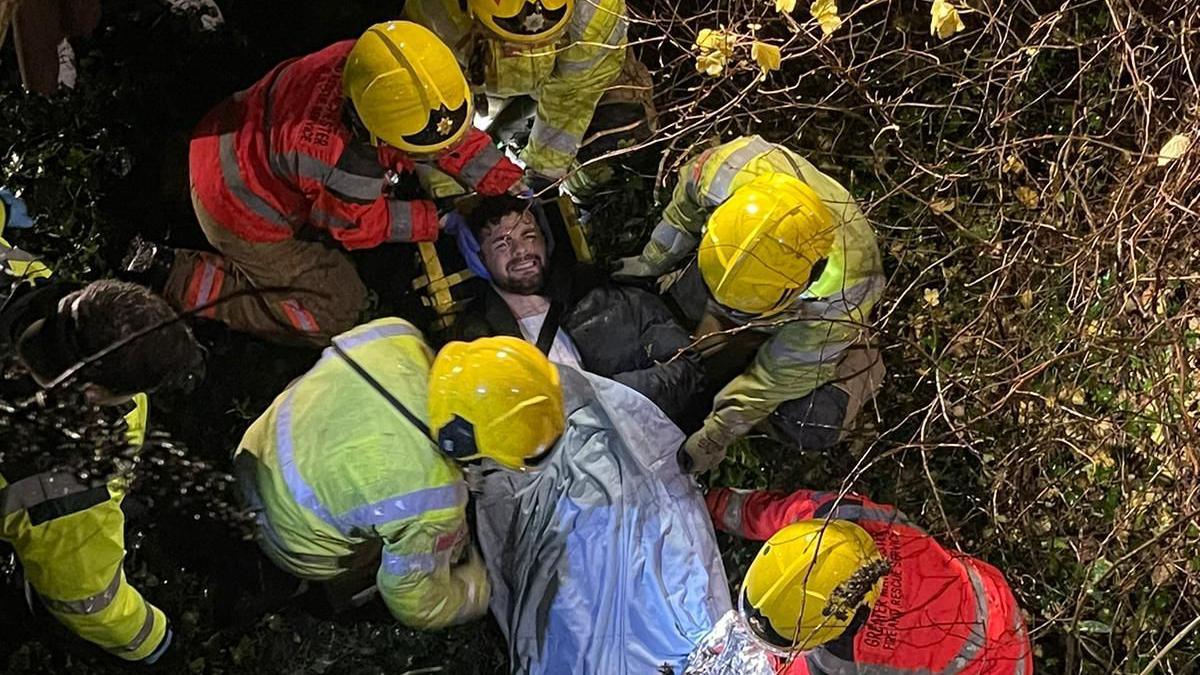
After falling from a bridge, Olympic judo hopeful Eric Ham broke his back in two places, narrowly avoiding severing his spinal cord and never walking again.

But within two years of the life-threatening accident, he was competing again on the international stage for Great Britain.

Ham had emergency surgery after the incident on Christmas Eve 2023, having metal rods and screws inserted to stabilise his spine after suffering a double fracture.

Doctors and surgeons were surprised he could even feel his legs.

As someone who survived a near 20-foot fall, having tipped backwards off it after sitting on a ledge, Ham readily admits he had a “lot of luck on my side that night”.

“Everyone around me kept telling me how serious it was and how close I was to never walking again,” the 28-year-old told BBC East Midlands Today.

“I nearly severed my spine in two different places. Looking back, it was a very close call to a very different path in life. It was really millimetres, centimetres of a difference, between high performance sport and not walking.

Eric Ham

The surgery Ham underwent – what he explains to be a “riskier” procedure that could give him the “best chance” of being involved in sport again – and a rehabilitation programme that was initially designed just to get him back on his feet, gave him hope of one day getting back on the judo mat.

It is a fierce determination not to have his sporting career ended in such a horrific way that has him once again grappling with opponents.

“No-one ever knew if I would be back at all,” Ham added.

“I considered it many times, just packing it up and just moving on with life, trying to find a job. But I just think there was something inside me that wanted to keep going and to see where I could get back to.

“You’d have to do the rehab regardless, just for general health, but I think there was a fire inside me.

“Because I wasn’t able to finish the sport on my own terms, I don’t think I could have lived with that. I had to try to get back to wherever I could.

Eric Ham in action in a judo competitionBritish Judo

Before the bridge fall, Ham had been targeting Team GB selection for the Paris Olympics in 2024.

The athlete from Glossop, the market town on the northwestern edge of the Derbyshire Peak District, was part of British Judo’s world-class performance programme and had competed at both world and European championships during his senior career.

After nearly two years out, and endless hours dedicated to a rehab programme that evolved from having him walking again to laying opponents out on the mat, Ham made his first competitive appearance in November’s Oceania Open on Australia’s Gold Coast – where he won one of his three fights.

Training for the tournament and battling in competition, for all the agony and strain it put on his body at times, brought “mixed feeling” after such a physically and emotionally taxing road to recovery.

“The fighting, the throwing, the same things that causes all this pain and agony is the exact reason why you love doing it,” Ham said.

“The competition gave me a fresh start and a mental reset to continue with the rehab. I tried to keep the fun of the sport, because that often gets put to the back of your mind when you get to high performance.

“That was kind of the goal. My mum, dad and girlfriend were out there as well, and that was special.

“The result wasn’t what I wanted, but what I could probably expect after having two years out. I’ve done it now, put that behind me and I can carry on the rehab for my next one, which hopefully I’ll be in a better position for.”

Competing with the world’s best and aiming for a place at the Olympics was where Ham got himself to as an athlete before he plunged from that bridge.

And while he was carried away on a stretcher that day, he has managed to rise from the life-altering incident and climb back on to the judo mat to prove something to himself.

What comes next, Ham says, is just as impossible to predict as all he has been through already.

“I’m still pretty uncertain what the future holds,” he said.

“I’m going to keep trying. Whether I get to the same level or, hopefully, a better level than I was before is still unknown.

Related topics

  • Judo

Lebanese fear US has given green light for Israeli escalation

Beirut, Lebanon – Fears are rife in Lebanon over another Israeli military escalation, similar to the one in 2024 that killed more than 4,000 people and displaced around a quarter of the country’s population.

The intensification comes amid growing pressure by the United States and Israel on Lebanon to ensure the Shia group Hezbollah disarms. The decision to bring Hezbollah’s weapons under state control is popular in Lebanon outside of the group’s traditional support base. But analysts also fear internal tensions could lead to violence if Israel continues to attack the country without impunity and disarmament is pushed through by force.

Recommended Stories

list of 3 itemsend of list

Tensions are also growing after a meeting in Florida between US President Donald Trump and Israel’s Prime Minister Benjamin Netanyahu on December 29, when the latter was reportedly given a green light to begin a new offensive against Hezbollah in Lebanon.

Despite an ongoing ceasefire since November 2024, Israel has attacked Lebanon almost daily. Tens of thousands of Lebanese are still displaced from their homes along Lebanon’s southern border.

And now the fear is that military action will ramp up. On Sunday alone, Israel launched around 25 attacks on south Lebanon, leaving many in the country worried about further widespread attacks. The United Nations says Israel has violated the ceasefire more than 10,000 times since November 2024.

Continued violations

Almost a year into the conflict that began in October 2023, Israel escalated its war on Lebanon, launching a devastating series of strikes between September and November 2024.

Every region in Lebanon was hit by some kind of Israeli attack, including air strikes or drone strikes. However, the areas primarily targeted, the south, eastern Lebanon’s Bekaa Valley, and Beirut’s southern suburbs (known as Dahiyeh), are predominantly inhabited by Shia Muslims, the sect from which Hezbollah derives the majority of its domestic support.

Among the dead in the attacks was the long-time leader of Hezbollah, Hassan Nasrallah.

Then in October, Israeli troops invaded south Lebanon and fought Hezbollah on Lebanese territory. When the ceasefire was agreed in November, Israel was supposed to withdraw all its troops from Lebanese territory within two months.

For its part, Hezbollah was to retreat to north of the Litani River and the Lebanese Army would deploy to south Lebanon.

Attacks from both sides would also cease.

In the last year, however, Israel has continued to attack Lebanon almost daily. Hezbollah has largely avoided responding militarily, and the Lebanese Army has also dismantled Hezbollah’s infrastructure in south Lebanon, according to Lebanese government and military officials.

Israel withdrew most of its troops, but kept hold of five areas inside Lebanon, under the guise of ensuring its security.

“You can’t only trust international guarantees or borders. You have to be wherever there is danger. This is the main lesson from October 7,” Amit Segal, an Israeli journalist who is familiar with Israel’s Netanyahu administration, told the New York Times in October, referring to the Hamas-led attack on southern Israel in 2023.

Trump’s threats

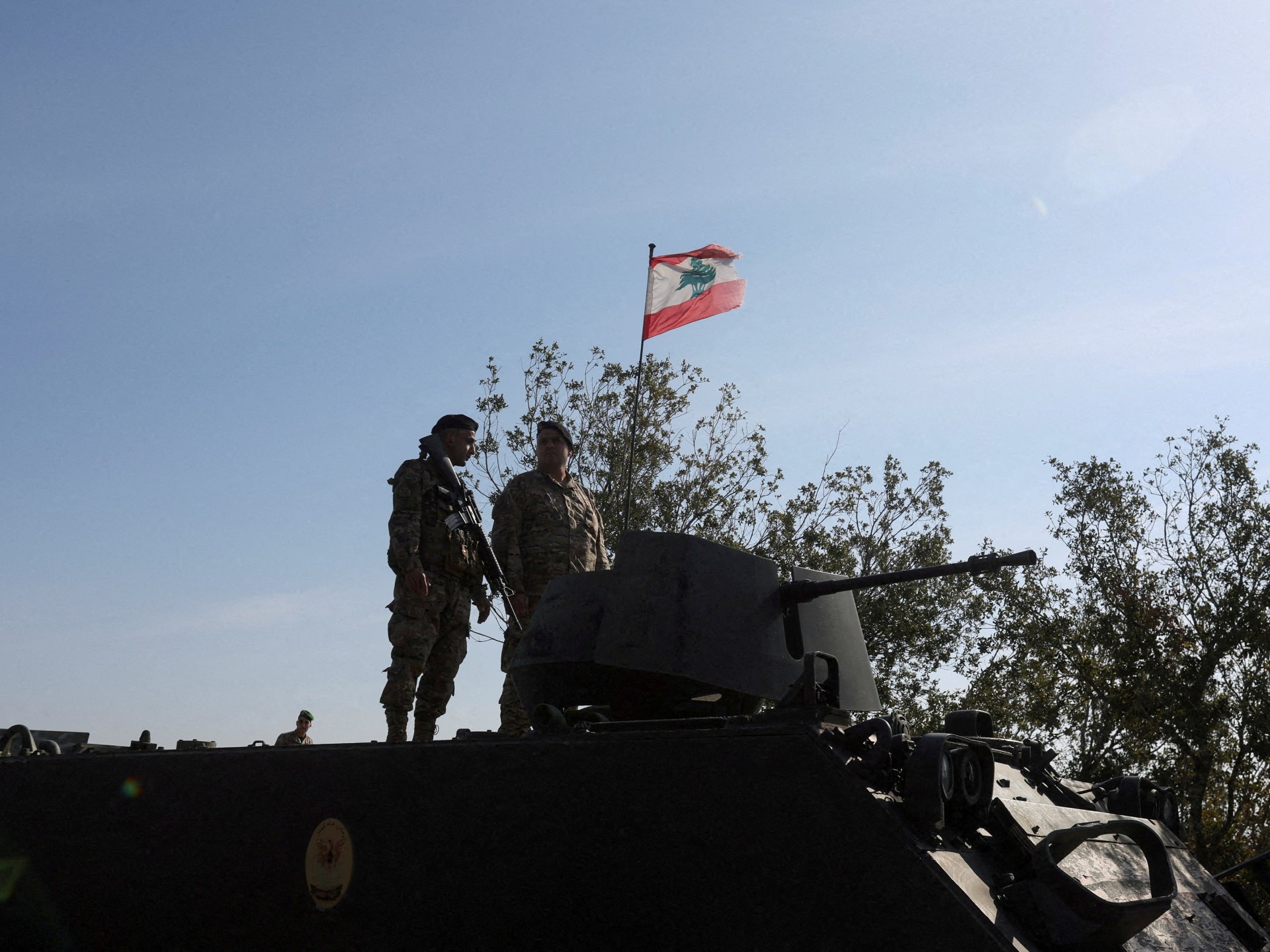
On January 8, the Lebanese Army announced it had completed its mission of disarming Hezbollah south of the Litani.

But Israel’s Foreign Ministry doesn’t agree, saying “extensive Hezbollah military infrastructure still exists south of the Litani River”.

“Hezbollah is rearming faster than it is being disarmed,” it said, accusing the Lebanese Army of collaborating with Hezbollah, without providing evidence.

Commander of the United Nations Interim Force in Lebanon (UNIFIL) Diodato Abagnara said there was no sign of Hezbollah regrouping in the south, and analysts told Al Jazeera late last year that the group was weakened to the point that it could not threaten Israel.

Regardless of the evidence put forward by Lebanese or UN officials, Israel doesn’t seem to be convinced. Analysts believe that Israel can only be stopped from attacking by one power: the United States.

Trump restrained Israel from a follow-up attack on Iran last July. But the US president has largely emboldened Netanyahu to continue his militaristic agenda in Lebanon and elsewhere in the Middle East.

Following the Florida meeting between Trump and Netanyahu, Arab and Israeli media suggested that the Israeli prime minister had received a green light from the US president to go after Hezbollah and intensify attacks in Lebanon again.

“Hezbollah must be completely disarmed,” Trump is alleged to have said, according to the Jerusalem Post.

“If the Lebanese Army doesn’t succeed in disarming them, and Israel believes an action is the necessary thing to do [then the US backs Israel].”

Bombing reconstruction

Residents in south Lebanon have gotten used to the attacks, but aren’t sure what to expect next.

“The situation is calm,” a local named Hussein Salman told Al Jazeera, adding without any sense of irony, “One day there’s an attack, another there isn’t. It’s calm”.

Kamel Jaber, a journalist from the southern town of Nabatieh, told Al Jazeera that the situation remained tense.

“Sometimes several days pass with nothing happening,” Jaber said. “Sometimes a single day passes, and the Israelis, through their warplanes, carry out a series of fire attacks or a series of successive raids on specific locations.”

“Sometimes they say they have eliminated Hezbollah’s missile capabilities, and then a little while later they escalate their attacks on the Lebanese state, claiming that Hezbollah’s weapons are still present and active,” Jaber said.

Many in Lebanon are now convinced that what happens next will depend on Israel’s agreements and calculations with the US, rather than anything the Lebanese government does.

And for many in the south – including Ali Attieh, the head of a farmers’ cooperative in the village of Kfar Hamam – the reason is simple.

Freddie Mercury’s secret daughter’s life – raised by pal, covert visits and death

As Freddie Mercury’s secret daughter dies aged 48 The Mirror takes a look at the hidden life of the woman known only as B, from her xxx to her xxx

Freddie Mercury lived his life on the stage – but he still had his secrets.

Last year The Queen icon’s ‘secret’ daughter, known only as B, was revealed ahead of the release of a bombshell book titled Love, Freddie. The lovechild spoke to author and music journalist Lesley-Ann Jones to reveal her link to the rock star – but her real name and identity were never made public. Now, her family has confirmed her tragic death aged 48.

The news was confirmed by her family, who said she died “peacefully after a long battle with chordoma, a rare spinal cancer, leaving two sons aged nine and seven”. A statement from her widower, named Thomas, added to the Daily Mail: “B is now with her beloved and loving father in the world of thoughts. Her ashes were scattered to the wind over the Alps.”

Meanwhile, Lesley-Ann Jones, who penned the book, shared her heartbreak over the news as she told the publication: “I am devastated by the loss of this woman who became my close friend, who had come to me with a selfless aim: to brush aside all those who have had free rein with Freddie’s story for 32 years, to challenge their lies and their rewriting of his life, and to deliver the truth.”

READ MORE: Heartbreaking reason Freddie Mercury’s daughter couldn’t prove identity before she died

Lesley-Anna also added: “At the end of her life, it was all that mattered to her. She was very ill throughout the 4 years that we worked together. But she was on a mission. She put herself and her own needs last.”

Last year, the author revealed Freddie had secretly fathered a child during an affair in 1976. She said at the time: “Having spent a quarter of a century researching and writing books about Freddie Mercury, and having covered Queen’s performances on the road, I thought I knew virtually all that there was to know about him. I was wrong. Working with his only child and next of kin over several years to create the book that tells his true story in his and his daughter’s own words has been the greatest privilege of my professional life. I could never have imagined this hidden Freddie. Yet he was real.”

Meanwhile, in the light of her death Lesley-Ann has revealed more details about the rock icon’s secret daughter, claiming he called her ‘Bibi’, ‘trésor’, which translates into treasure from French, and his ‘little froggie’.

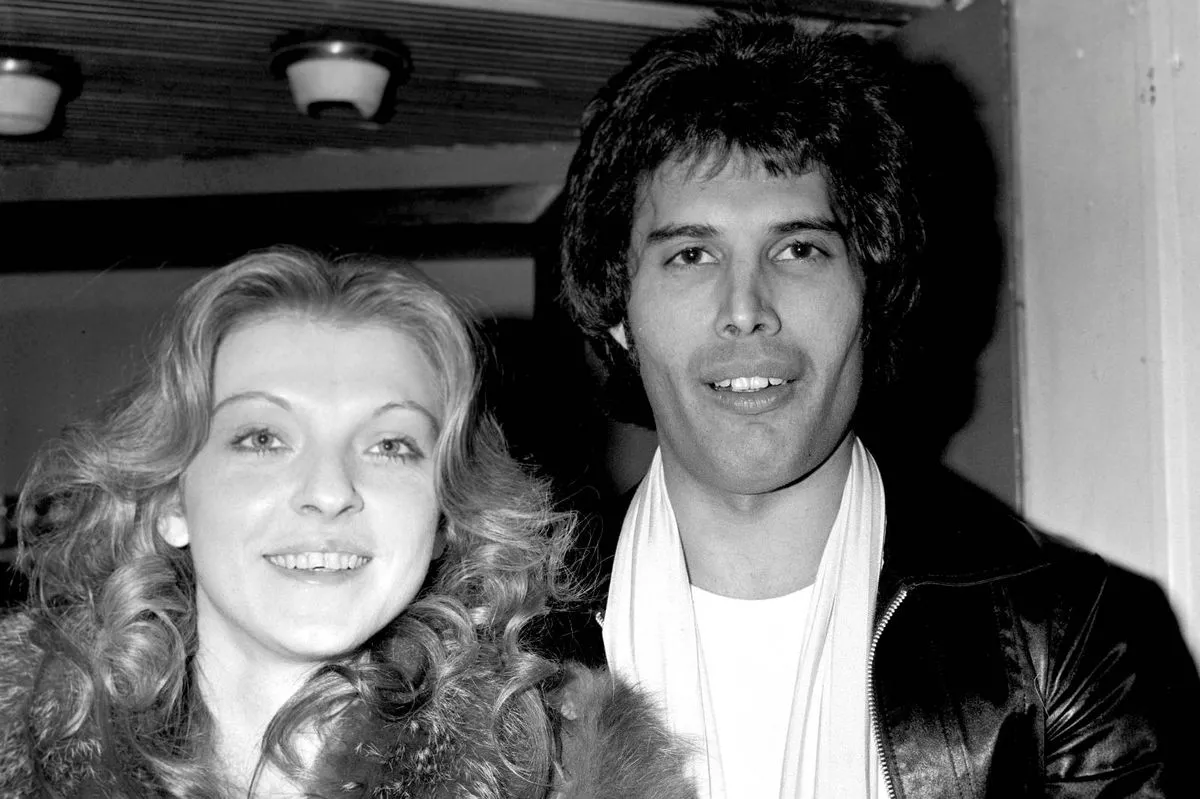
Queen’s songs Don’t Try So Hard and Bijou are said to have been written about his secret lovechild, whom the singer is said to have had a close bond with up until he died. We Will Rock You star Freddie is said to have fathered his daughter after a brief, unexpected liaison in 1976 with the wife of one of his close friends. While the child was as closely-guarded secret a select few knew the truth including his parents, sister, bandmates and longtime confidante Mary Austin.

For 48 years, B has led a ‘normal’ life. Between her mum, step-dad and Freddie, it was agreed that B would be brought up by her mother and her husband, though Freddie remained incredibly close to B. He even had his own bedroom at the family home, popping round for visits on a regular basis.

While Freddie’s daughter’s identity wasn’t made public some details about her were revealed – including the fact she lived in Europe, was a healthcare professional and had two children. As her link to Freddie was explosively revealed, she detailed how she was raised by a loving family but always knew the music icon was her dad. Before he died of pneumonia caused by Aids in 1991, Freddie gave his daughter 17 volumes of his personal journals.

Her choice to unveil excerpts from his private writings came from wanting to dispel falsehoods and rumours that swirled for decades. B explained: “After more than three decades of lies, speculation and distortion, it is time to let Freddie speak.” She continued: “He entrusted his collection of private notebooks to me, his only child and his next of kin, the written record of his private thoughts, memories and feelings about everything he had experienced.”

B further revealed that whilst his management team and close mates were aware the notebooks existed, they’d been left in the dark about their whereabouts – until now. A handwritten letter penned by B features in the book, reflecting on her special relationship with Freddie, she wrote: “We had a very close and loving relationship from the moment I was born and throughout the final 15 years of his life.”

She continued: ” He adored me and was devoted to me. The circumstances of my birth may seem, by most people’s standards, unusual and even outrageous.” She also declared that her choice to step into the limelight “in my own midlife is my decision and mine alone.”

“The life I live with my husband and our family in another country is intensely private. We want things to stay that way. We cherish our peaceful and anonymous life, and we want nothing to disturb it. Nobody needs to know who I am.”

Article continues below