Atletico want Wolves’ Gomes – Thursday’s gossip

Skip image gallery

Wolves midfielder Joao Gomes is wanted by Atletico Madrid, while Everton and Nottingham Forest are keen on signing striker Youssef En-Nesyri.

Atletico Madrid are targeting Wolves’ Brazil midfielder Joao Gomes, 24, after the Spanish club sold England international Conor Gallagher to Tottenham on Wednesday. (Marca – in Spanish)

Meanwhile, Wanderers’ Zimbabwe midfielder Marshall Munetsi, 29, is poised to join Paris FC on loan. (L’Equipe – in French)

Everton have sent an official bid to Turkish side Fenerbahce for Morocco striker Youssef En-Nesyri, 28. Negotiations are under way for an initial loan move with a £17m option to buy. (Fabrizio Romano)

Nottingham Forest are also in the race for En-Nesyri but Fenerbahce’s feeling is that he favours a move to Everton. (Florian Plettenberg)

Everton are also interested in a deal for striker Callum Wilson, 33, who is in talks to end his contract with West Ham. (Athletic – subscription required)

The Toffees, along with Werder Bremen and Ajax, are monitoring Ukraine right-back Yukhym Konoplya. The 26-year-old’s contract with Shakhtar Donetsk expires in the summer. (Florian Plettenberg)

West Ham will hold an internal meeting with their shareholders this weekend to discuss lowering the asking price for midfielder Lucas Paqueta, 28, who is wanted by Flamengo in his native Brazil. (ESPN)

Santos defender Souza, 19, is expected to have his Tottenham medical in London on Thursday, as Spurs finalise a £13m deal to sign the Brazilian left-back. (Sky Sports)

Brentford are closing in on a £15.6m deal for Lazio and Italy attacker Matteo Cancellieri, 23. (Gazzetta dello Sport – in Italian)

Crystal Palace are in talks with Ligue 1 club Angers over French forward Sidiki Cherif. The 19-year-old, who can play through the middle and out wide, has two and a half years left on his contract. (Sky Sports)

Roma will pay a £2m loan fee for Aston Villa forward Donyell Malen, 26, with the deal including a £25m clause to sign the Netherlands international on a permanent basis. (Fabrizio Romano)

Related topics

  • European Football
  • Premier League
  • Football

More on this story

    • 17 October 2025
    A graphic of Premier League players from every team in the division in 2025-26 season, with the Premier League trophy in front of them.
  • Quiz logo

Child rights org says Google undermines parental control of child accounts

A child rights advocacy organisation in the United States is accusing Google of bypassing parental authority by allowing children to disable parental supervision over Google accounts after they turn 13.

Melissa McKay, president of the Digital Childhood Institute, stated on LinkedIn that Google sent her 12-year-old an email that will unlock additional tools once he turns 13, posting screenshots of the email.

Recommended Stories

list of 4 itemsend of list

In Google’s frequently asked questions, it shows that children can disable tools that allow parents to supervise accounts once they are what is known as the minimum age in their country, which is often 13 in many countries.

Among the changes, once children turn the age of 13, they can turn off supervised experiences on YouTube and can add payment methods to Google Pay. Parents will no longer be able to block apps, turn on location sharing without the permission of the child user or block access to payment features.

“Google is asserting authority over a boundary that does not belong to them. It reframes parents as a temporary inconvenience to be outgrown and positions corporate platforms as the default replacement,” McKay said in a post on LinkedIn.

Parents are able to supervise Google accounts through a programme called Family Link up until age 13.

“In nearly ten years as an online safety advocate, this is among the most predatory corporate practices I have seen,” she added.

McKay first raised the complaint in October, in a letter to the Federal Trade Commission (FTC).

“Enabling minors at this critical stage of development to terminate parental oversight, even when parents expressly seek to maintain such protections, constitutes a clear breach of duty of care,” McKay said in the letter shared with Al Jazeera.

McKay told Al Jazeera she had met with then FTC chairman Andrew Ferguson and said she had spent 45 minutes with him and his staff to walk through the complaints prior to sending the letter.

The 50-page document alleges that the Silicon Valley tech giant violated the Children’s Online Privacy Protection Act (COPPA), which is a law that puts limits on how tech companies can collect and use personal data from children under the age of 13.

The letter also alleges a violation of the 2014 FTC Consent Decree on in-app purchases, which requires platforms like Google to get parental permission before allowing such purchases by children.

Other parental rights activists echoed McKay’s worries.

“Our concern is that messaging like Google’s – telling a 13-year-old they can now remove parental supervision – sends the signal that parents are barriers to freedom, rather than partners in growth. This type of corporate language accelerates tech independence without any built-in safety net, education, or emotional readiness. We’re worried it normalises the idea that kids should ‘go it alone’ online just because they’ve reached an arbitrary age,” Joanne Ma, cofounder of DigiDefendr, a new platform that helps teach kids about safe practices online, told Al Jazeera.

Representatives for Alphabet, Google’s parent company, did not respond to Al Jazeera’s request for comment.

The FTC did not respond to Al Jazeera’s request for comment.

The Utah State Attorney General’s office, the state in which McKay is based, as well as Senator Mike Lee of Utah, who has been behind several pushes for age verification laws in the US – including regarding social media use and access to adult explicit material, did not respond to a request for comment.

A risky environment

Google has long been under the microscope for the relationship between kids and teens and their slate of tools. A lawsuit in 2025 alleged that the tech giant harvested data on Chromebooks used by students for schoolwork in public school systems around the US. Another report in 2024 alleged that Google sales representatives advised potential advertisers about how to target teens on YouTube.

In 2019, the tech giant also settled a lawsuit with the New York State Attorney General for collecting the personal data of children using YouTube. It paid $136m in fines to the FTC and another $34m to New York.

Even beyond Google platforms, the online landscape has been an increasingly volatile place for children and teens, and 48 percent of teens reported that social media usage had a negative impact on their mental health, according to a survey last year by the Pew Research Center.

As cellphone and technology use, especially among younger people, escalates, including the rising use of chatbots like ChatGPT, online safety experts are flashing warning signs. About 72 percent of the US teens say they use ChatGPT, for instance, and a report from the Center For Counting Digital Hate found that the OpenAI-owned chatbot lacked sufficient safeguards like age verification tools.

The report also assessed if the chatbot would encourage dangerous behaviours by creating personas showing tendencies for substance abuse, suicidal ideation and eating disorders, with 53 percent of responses to prompts deemed as harmful.

Trump administration to suspend immigrant visa processing for 75 countries

The United States says it will suspend immigrant visa processing for 75 countries around the world, as US President Donald Trump’s administration continues its wide-reaching crackdown on immigration.

The Department of State said on Wednesday that visa processing would be paused for countries “whose migrants take welfare from the American people at unacceptable rates”.

Recommended Stories

list of 3 itemsend of list

“The freeze will remain active until the US can ensure that new immigrants will not extract wealth from the American people,” it said, adding that the measure would affect “dozens of countries”, including Somalia, Haiti, Iran and Eritrea.

Trump has pursued a hardline, anti-immigration agenda since he returned to office in January 2025, promising to carry out the largest deportation operation in US history.

Over the past year, he has announced curbs to several US visa programmes and drastically slashed the number of planned refugee admissions into the US.

His administration has also deployed heavily armed immigration officers to major US cities to detain and deport people accused of being in the country illegally.

The State Department said earlier this week that it has revoked more than 100,000 visas since Trump’s return to the White House, a one-year record.

The Department of Homeland Security last month said the Trump administration has deported more than 605,000 people, while 2.5 million others left the US on their own.

The State Department did not immediately release a full list of the countries that will be subjected to the freeze on immigrant visas on Wednesday.

The AFP news agency, citing an unnamed US official, said Brazil, Egypt, Thailand, Nigeria, Iraq and Yemen would be among those affected.

Meanwhile, a State Department spokesman said the freeze on immigrant visa processing would begin on January 21.

The move will not apply to applicants seeking non-immigrant, or temporary tourist or business, visas.

David Bier, the director of immigration studies at the Cato Institute, said the Trump administration “has proven itself to have the most anti-legal immigration agenda in American history”.

“This action will ban nearly half of all legal immigrants to the United States, turning away about 315,000 legal immigrants over the next year alone,” Bier said in a statement.

Aaron Reichlin-Melnick, a senior fellow at the American Immigration Council, said Wednesday’s announcement, when combined with previously announced US travel bans, means the Trump administration “has now banned or suspended immigrant visas for 90 different countries”.

Tinubu Eyes $30bn Annual Investment, Green Finance For Energy Transition

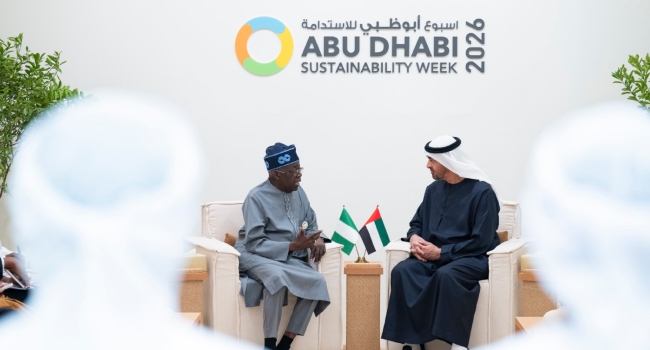
In a shift from oil dependence to climate capital, the Federal Government says green finance will anchor Nigeria’s energy transition. President Bola Tinubu has announced plans for a $2 billion climate fund to reduce emissions and unlock wider access to energy.

The President said at the Abu Dhabi Sustainability Week summit on Tuesday that Nigeria’s Climate Investment Platform would mobilise $500 million for climate-resilient infrastructure. He added that the National Climate Change Fund is targeting a $2 billion capitalisation to support projects that reduce emissions and strengthen climate resilience.

At the summit, Tinubu also announced that Nigeria and the United Arab Emirates had signed a Comprehensive Economic Partnership Agreement (CEPA).

The agreement is expected to boost trade and investment across multiple sectors, including renewable energy, aviation, logistics, agriculture, digital trade, and climate-smart infrastructure, strengthening Nigeria’s access to Gulf capital and global markets.

Net-Zero By 2060

Nigeria’s climate and environmental challenges remain significant, particularly in reducing gas flaring and methane emissions. These efforts form part of the country’s Energy Transition Plan, which targets net-zero emissions by 2060 while delivering universal energy access.

Green finance, the government says, is the bridge between climate ambition and economic inclusion in Africa’s largest economy. Tinubu said Nigeria’s green bond programme continues to attract strong investor interest.

A ₦50 billion ($38 million) sovereign green bond issued in 2025 drew ₦91 billion in subscriptions, while Lagos State’s green bond was oversubscribed by nearly 98 per cent.

According to the President, the government is now working to unlock $25–$30 billion annually in climate finance. A new Climate and Green Industrialisation Investment Playbook will help private investors navigate manufacturing policy and Nigeria’s regulatory landscape.

Impact On Nigerians In The Diaspora

For Nigerians abroad, the shift toward green finance opens new channels for engagement beyond remittances.

Diaspora professionals and investors can participate in green bonds, climate funds, renewable energy ventures, and infrastructure projects tied to dollar-linked or naira-backed returns. 

As Nigeria attracts more climate capital, the expectation is for improved power supply, cleaner cities, and more stable operating conditions—factors that directly affect families, property investments, and businesses back home.

A stronger climate-finance framework could also reduce pressure on foreign exchange, helping stabilise the naira and protecting the value of diaspora remittances sent home.

The new initiatives build on earlier efforts, including the Nigeria Sovereign Investment Authority’s $500 million Distributed Renewable Energy Fund, launched in March 2025 to catalyse local financing for clean energy projects.

“These reforms show Nigeria is ready for business,” Tinubu said, adding that non-oil exports have grown by 21 per cent, while investment commitments now exceed $50 billion across key sectors.

The President said Nigeria is prioritising technology partnerships to modernise the national grid and deploy artificial intelligence for efficiency. He added that pilot projects are underway in electric mobility and green industrialisation, signalling long-term demand for skills in engineering, data science, climate finance, and project management—areas where diaspora expertise is especially relevant.

Nigeria’s $200bn Energy Transition Opportunity

In September 2025, Vice President Kashim Shettima presented Nigeria’s $200 billion energy transition opportunity to investors at the United Nations General Assembly in New York.

At a roundtable hosted by the Business Council for International Understanding (BCIU), he emphasised the need for partnerships to unlock investment at scale.

“With 210 trillion cubic feet of gas reserves and one of the highest solar irradiation levels in Africa, Nigeria offers a 200-billion-dollar energy transition opportunity,” said Shettima.

Three Palestine Action activists end UK hunger strike

Three detained British activists who spent weeks refusing food have ended their hunger strike, citing a report that a United Kingdom-based subsidiary of a major Israeli weapons company was denied a UK government contract.

The Prisoners for Palestine group said in a statement on Wednesday that hunger strikers Kamran Ahmed, Heba Muraisi and Lewie Chiaramello ended their strike after one of their “key” demands was achieved.

Recommended Stories

list of 3 itemsend of list

“Our prisoners’ hunger strike will be remembered as a landmark moment of pure defiance; an embarrassment for the British state,” the group said.

Several people affiliated with the proscribed group Palestine Action had refused food in UK prisons since November in protest of their detention and the British government’s support for Israel as it wages a genocidal war against Palestinians in Gaza.

The activists’ relatives and friends had warned that their prolonged hunger strike put them at risk of serious health problems and even death.

The Times reported on Tuesday that Elbit Systems UK, a subsidiary of the Israeli arms manufacturer of the same name, had failed to win a $2.69bn contract to help train British soldiers.

Citing an unnamed UK Ministry of Defence “insider”, the news outlet said the department instead chose to award the contract to a rival consortium led by Raytheon UK.

“The abrupt cancellation of this deal is a resounding victory for the hunger strikers, who resisted with their incarcerated bodies to shed light on the role of Elbit Systems, Israel’s largest weapons manufacturer, in the colonisation and occupation of Palestine,” Prisoners for Palestine said.

For years, Palestinian rights activists have called on countries to divest from Elbit Systems over its role in supplying the Israeli military with weapons used in alleged war crimes in the occupied Palestinian territory.

That includes the war-ravaged Gaza Strip, where Israel’s military assault has killed more than 71,000 Palestinians since October 2023.

The Palestine Action hunger-strikers were jailed over their alleged involvement in break-ins at the UK subsidiary of Elbit Systems in Filton near Bristol in 2024.

The British government proscribed Palestine Action in June of last year under the country’s Terrorism Act 2000, making it illegal for people to join or express support for the group under penalty of up to 14 years in prison.

Since then, scores of people have been detained at protests across the UK for expressing support for the group in what critics say is a draconian crackdown on freedom of speech and assembly.

On Wednesday, Prisoners for Palestine said a total of seven activists had started to eat again after ending their hunger strikes.

British MP John McDonnell hailed the hunger strikers’ “dedication” in a social media post.

UK prosecutors seek to reinstate ‘terrorism’ charge against Kneecap rapper

British prosecutors have sought to reinstate a “terrorism” charge against a member of Irish rap group Kneecap for allegedly displaying a flag of Lebanese group Hezbollah during a gig in London, after a judge threw out the case last year.

The Crown Prosecution Service (CPS) launched a High Court challenge on Wednesday, arguing that a chief magistrate erred in September when he dismissed the case against Liam O’Hanna, also known as Liam Og O hAnnaidh in Irish, over a technical error.

Recommended Stories

list of 3 itemsend of list

O’Hanna, who performs under the name Mo Chara, was charged with displaying the flag at a November 21, 2024, concert in London, breaching the United Kingdom’s 2000 Terrorism Act.

In written submissions unveiled in court, the CPS “submits that the Learned judge was wrong to find that the proceedings … were not instituted in the correct form”.

Kneecap – known for their politically charged lyrics and support for Palestinian rights – have said the case is an attempt to distract from what they described as British complicity in Israel’s genocide against Palestinians in the Gaza Strip.

The band has called the attempted prosecution of O’Hanna a “British state witch-hunt”.

“Today more Palestinians were murdered by Israel,” Kneecap wrote in a social media post on Wednesday after the court hearing.

“More homes demolished and more children dead due to cold and lack of aid not permitted to enter by Israel. That is the ONLY thing about this whole witch-hunt worth talking about,” the band said, denouncing the legal proceedings as “a waste of public time and public money”.

Supporters of Irish rap group Kneecap band member, Liam O'Hanna, who performs under the stage name Mo Chara, hold placards as they gather outside the Royal Courts of Justice ahead of the singer's arrival in London on January 14, 2026.
Kneecap supporters rally in defence of O’Hanna on January 14, 2026 [AFP]

O’Hanna was charged in May after a video emerged from the London concert in which he allegedly displayed the Hezbollah flag, an offence he has denied.

Kneecap previously said the flag was thrown on stage during their performance and that they “do not, and have never” supported Hezbollah.

The charge against O’Hanna was thrown out in September after a court ruled it had originally been brought without the permission of the director of public prosecutions and the attorney general, as well as one day outside the six-month statutory limit.

But CPS lawyer Paul Jarvis told London’s High Court on Wednesday that permission was only required by the time O’Hanna first appeared in court, meaning the case can proceed.

O’Hanna did not attend the hearing.

But his bandmate, JJ O Dochartaigh, better known by the stage name DJ Provai, was in court alongside the band’s manager, Dan Lambert, and its lawyers.

About 100 Kneecap supporters also turned up at the court to show their support, holding Irish and Palestinian flags, singing songs and listening to speeches.