Corruption, mismanagement in spotlight as Iran dissolves major private bank

In a move that highlights Iran’s deeply troubled economy and puts pressure on average citizens further, authorities have merged one of Iran’s largest private lenders into the country’s largest state-run bank.

The central bank on Thursday announced that Ayandeh Bank, privately owned by one of Iran’s wealthiest families, would be dissolved and merged with Bank Melli, the government-run national bank, and that Ayandeh branches across the country would be transformed into Bank Melli branches by Sunday.

Recommended Stories

list of 3 itemsend of list

Customers were told their accounts and deposits are safe, and all contracts remain under the same conditions. Ayandeh’s bailout won’t leave Iranians without harm because it has been riddled with losses on a scale that has had an impact on Iran’s macroeconomics for years and has resulted in murky operations and central bank interventions.

What brought us here?

Ayandeh began amid a crisis in the 2010s caused by corruption and lack of regulatory supervision over the ailing banking system, experts told Al Jazeera, at a time when Iran was reeling from United Nations sanctions over its nuclear programme.

Hundreds of unlicensed financial institutions spread across the nation as parastatals, military, or religious foundations.

In many instances, they allegedly did not return deposits, leaving thousands of investors without access to their deposits for years because they offered exorbitant interest rates to entice cash withdrawals from the banks.

The government and the central bank finally took over and completed the process of outlawing the unlicensed institutions by 2017, a year after they managed to take control of over 25 percent of the country’s entire money supply.

After being taken over, the institutions had little money in their pockets as a result of insider loans and property sunk.

The institutions had to print money to cover the majority of the skyrocketing debt, leading to rising inflation and rising living costs for average Iranians.

Ayandeh was established in 2013 via the merger of Tat Bank with two state-linked financial entities, the Salehin Credit Institution and Aatee Credit Institution.

The 63-year-old business tycoon Ali Ansari, who is credited with founding both Ayandeh and Tat, owned the majority of the shares in both financial institutions along with family members and close friends. His family is thought to be among Iran’s wealthiest.

Ansari has served on the boards of Tehran’s Esteghlal football club, as well as other business and influence-building initiatives, and has owned and led large-scale real estate projects.

Just how big are the numbers?

The bank has received years of state funding.

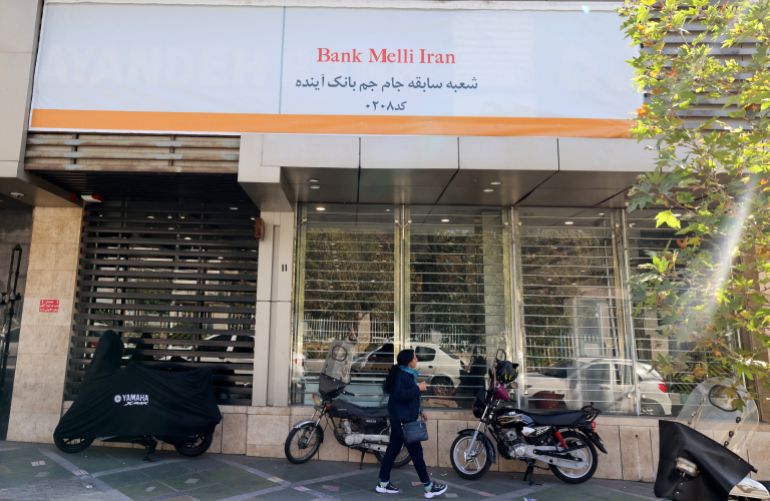
A woman from Iran passes a bank branch in Tehran on October 25, 2025, with the phrase “This former Ayandeh Bank branch is now part of Melli Bank” on the facade.

Two years ago, as Ayandeh racked up losses and more money had to be printed, the central bank revoked shareholder voting rights on more than 60 percent of the company’s stock and gave it to the Ministry of Economic Affairs and Finance.

The bank continued to borrow money from the central bank and the government to keep afloat, but that did not help.

The central bank reported that Ayandeh had a staggering 5 quadrillion rials ($4.67 billion using the current open market exchange rate) in debt and had 2.5 quadrillion rials ($2.3 billion) in people’s deposits by the time of its forced dissolution last week.

Ayandeh was legally allowed to dole out up to 200 trillion rials ($187m) in loans based on its proven capital, but the central bank said the lender paid about 10 times that amount to individuals and entities over the years.

A small number of people and businesses that are closely connected to Ayandeh and its internal projects received up to 1.3 quadrillion rials ($1.21 billion), according to the central bank. Authorities have declined to reveal the identities of the individuals who stole the funds.

Iranians online have also been widely reacting to news of Ayandeh’s bankruptcy. Pedram Soltani, a businessman from the private sector, was one of those who demanded accountability.

Translate: Ayandeh Bank’s list of overdue, doubtful, and toxic loans and assets is public! &nbsp, People must know whose costs have been imposed on their pockets.

The majority of Ayandeh’s loans have been overdue for a year or longer, and they are regarded as unlikely to be recovered.

All Iranian banks have a sizable volume of non-performing loans (NPL) in their books, according to Bijan Khajehpour, an economist and managing partner of Eurasian Nexus Partners Consulting.

“These NPLs are a consequence of loans having been extended to customers without the due process of assessing their collateral based on corrupt transactions between networks of power”, he told Al Jazeera.

It “reveals a lot about the extent of corruption and how political favoritism undermines business activities.”

According to the central bank, Ayandeh was in charge of an incredible 42% of all overdrafts made by banks from the central bank and 41% of all capital imbalance in the troubled Iranian banking sector.

It had a capital adequacy ratio (CAR) of minus 600 percent, whereas a bank must have a bare minimum ratio of 8 percent under Basel II international standards that are also accepted by Iran.

The banking sector’s average CAR has increased since its elimination, increasing it from 1.36 percent to about 5 percent.

Ayandeh is not a singular case; it merely highlights Iran’s systemic woes that are so dispersed around the world.

At least five other banks, including state-run Bank Sepah, which in 2020 had five other sinking banks merged into it in the largest banking consolidation in Iran’s history, are flagged by the central bank as being highly imbalanced.

Corruption and conflict in politics

One day prior, ultraconservative cleric Gholamhossein Mohseni-Ejei, Iran’s judiciary chief, directly threatened Mohammad-Reza Farzin with legal action, the announcement regarding Ayandeh’s dissolution came.

“Mr Farzin, you have sufficient legal mandate to make any decision about Ayandeh Bank. Do your legal obligations otherwise we will enter and cost you more,” he wrote in a post on X.

Ejei claimed that the central bank’s accumulated losses increased by up to tenfold in the span of seven years despite the central bank’s involvement in running Ayandeh, including appointing and firing the board of directors and CEO.

No arrests or indictments, or any other form of legal reproach, have been announced by the judiciary despite the billions of dollars in losses.

Hardline politicians affiliated with the Paydari Front, who have been gaining influence in the parliament, the Islamic Revolutionary Guard Corps (IRGC), and state media, have consistently been the most vocal critics of the private bank.

Women shop at Tajrish Bazaar in the Iranian capital Tehran on October 25, 2025.
The Ayandeh bailout will have an impact on Iranians. Here, shoppers crowd the Tajrish Bazaar in Tehran on October 25, 2025]AFP]

The hardliners opposed the bank, which earned them points for posing as anti-corruption, along with reformers who support liberalizing and opening the Iranian economy to the West and discrediting political and economic rivals in the technocratic camp.

Mohammad Bagher Ghalibaf, the speaker of the parliament and former IRGC commander, described Ayandeh’s dissolution as “a great success for the country’s decision-making and governance system” in a Saturday statement.

How Iranians will end up paying the price

Ayandeh’s demise also gives its assets, many of them in the real estate sector, complete state control, but selling them will be time-consuming and challenging.

The central bank has made it clear that Bank Melli will transfer all of Ayandeh’s assets, but not “any of the imbalances,” and that Melli will manage and sell them in order to make up for some of the losses.

The crown jewel of the assets is Iran Mall, the largest mall in the world in terms of total constructed floor area, located in western Tehran.

The deposit guarantee fund, which covers bank deposits up to a certain cap through the central bank’s auspices, will also have to cover the cost.

The top shareholders in Ayandeh’s company will be required to pay some of the money, according to the central bank, but it is unclear how much, when, and exactly in what form they will be required to pay.

However, due to the large volume of accumulated losses, Iranian media estimate that in an optimistic scenario, the state and Bank Melli will have to account for about two-thirds of the debt.

Printing more money, which has long been cited as the main factor in Iran’s inflation, which is currently at over 40% despite reinstated UN sanctions, and consistently among the highest in the world over the past ten years, will have to be done.

In plain English, tens of millions of Iranians will be liable for the cost as a result of declining purchasing power over the coming months and years.

Household items have already seen another major price jump in the aftermath of the 12-day war with Israel and the US in June, with food items like chicken, red meat, eggs and peas experiencing the sharpest increases.

In a statement released on Friday, Ayandeh’s Ansari claimed that the bankruptcy resulted from “agreements and practices that were beyond the bank’s control,” adding that the bank has “left behind valuable legacies and lasting assets.”
Exactly when Tesco’s Christmas delivery bookings open in November 2025

Over 260 new items are included in Tesco’s Christmas 2025 collection, which includes a number of customer favorites.

It’s that time of year again when Christmas shopping might start to cross your mind. Although Halloween and Bonfire Night are still to come, many retailers have already opened their festive delivery slots, enabling shoppers to secure all the essentials before December 25.

While Sainsbury’s, ASDA and Morrisons are among several supermarkets that have already made these spaces open to the public, Tesco’s opening is yet to come. This year’s slots will be available from 6am on November 4 for Delivery Saver customers who already subscribe to receive regular shopping deliveries.

Other customers without this membership will then subsequently receive access to Christmas slots from 6am on November 11 – just one week later. Over 260 new items are included in Tesco’s Christmas 2025 collection, which includes a number of customer favorites., many of which began appearing on shelves as early as September 1.

Earlier this year, Breige Donaghy, Tesco Director or Product Development & Innovation, explained: “Christmas is the ultimate moment of the year for so many of our customers, and at Tesco, we’re here to make every bite count!

We’ve gone the extra mile and added a whopping 268 new products to our Christmas line because we know how much our customers enjoy the holiday season. There’s something for everyone’s taste and budget, from indulgent showstoppers from our Finest collection to clever twists on classic favorites.

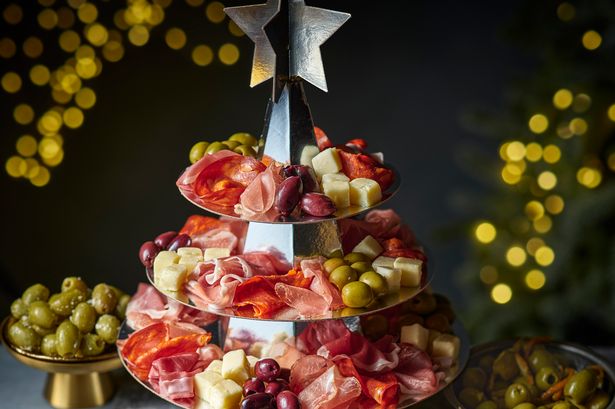
A crusty baguette, crunchy cornichons, and a honey and rosemary drizzle are some of the new items on Tesco’s new menu items, including an Alpine-inspired grazing platter with smoked prosciutto, salami Milano, salami Ungherese, and rich Gruyère and Emmental baking cheese.

Even an impressive “Build you own Charcuter-tree,” which includes a delectable selection of Kalamata olives, black garlic chorizo, lomo, Ibérico cheese, manzanilla, and serrano ham, is up for grabs.

The deadline is 11:45pm on December 14 if you want to schedule a Tesco Christmas order starting in November. The delivery dates for Northern Ireland will be December 20 through December 24 or December 21 through December 23.

Although the majority of stores will offer December 24 slots, specific slots will vary between stores. We’ve got you covered, says Ms. Donaghy in her July statement, “whether you’re planning a lavish Christmas Day feast, stock up on nostalgic nibbles, or throwing a party where you want to wow without the fuss.” It’s all about delicious memories and effortless magic this year.

For more information on how to order, head to Tesco’s website here.

Continue reading the article.

Get all the hottest shopping deals, cash-saving tips and money news straight to your phone by joining our new WhatsApp Community – The Money Saving Club. Just click this link to join https://crnch.it/eutplxS1

Additionally, we and our partners present special offers, promotions, and advertisements to our community members. You can check out our community at any time if you prefer.

Hong Kong court gives trio lengthy jail terms over bomb plots

In 2019 and 2020, a Hong Kong court handed down three people maximum prison sentences of up to 18 years.

Judge Johnny Chan cited Lukas Ho, 41, as having an “inflated ego” and showing no remorse, which would “risiko public safety,” as evidenced by his Monday sentence to an 18-year sentence.

Ho claimed to be the mastermind, showed no regrets, and lacked any justifications for a shorter sentence. He claimed that he had given a four-month reduction for Lee and Cheung after they had both committed a first-time offense.

According to Chan, “the court must provide sufficient deterrence, so the need for defendant’s rehabilitation is less significant than the original point.”

There is no way to talk about rehabilitation and correction if remorse is limited or superficial.

Lee Ka-pan and Cheung Ka-Chun, Ho’s co-defendants, each received 16 years and eight months in prison.

The three men were led away by guards while remaining implacable throughout the sentencing and grinning to friends and family in the audience.

The trio is accused of being connected to a homemade bomb that detonated in a hospital toilet in January 2020 and explosives discovered at a railroad station the following month.

No injuries were reported from the two incidents.

Prior to the pandemic, the court was informed that the plot was a result of a press release urging Hong Kong to impose its borders.

US, China hail progress in trade talks as Trump and Xi set to weigh deal

Malaysian capital Kuala Lumpur – At their first meeting since 2019, Donald Trump and Xi Jinping have hailed the results of trade talks in Malaysia.

As they wrapped up a weekend of negotiations on the sidelines of the ASEAN summit in Kuala Lumpur on Sunday, US and Chinese officials said the parties had made significant progress toward a deal.

Recommended Stories

list of 4 itemsend of list

Trump and Xi will meet on Thursday on the sidelines of the APEC summit in Gyeongju, South Korea. This is their first direct encounters since the US president’s abrupt departure from office and global trade.

The parties have a “framework” for Trump and Xi to discuss in South Korea, according to US Secretary of State Scott Bessent, who spoke to reporters in Kuala Lumpur.

In a subsequent interview with NBC News, Bessent stated that he anticipated a deal that would defer China’s threatened export restrictions on rare earths and prevent a 100 percent tariff on Chinese goods.

Bessent added that Beijing had agreed to make “substantial” purchases of US agricultural products, which the Treasury Secretary claimed would “feel very good” for US soya bean farmers in an interview with ABC News.

Beijing’s top trade negotiator, He Lifeng, the country’s vice premier, claimed there was “a fundamental consensus” between the parties regarding “arrangements to address each side’s concerns.”

According to a readout from China’s Ministry of Commerce, he claimed they had “proceeded with domestic approval processes” and that they had “finalized specific details.”

In an effort to lessen US-China tensions, Asian stock markets rose on Monday.

Shortly after midday local time, the benchmark indexes rose about 2.1 percent and 2.3 percent, respectively, to record highs for Japan’s Nikkei 225 and South Korea’s KOSPI.

Hong Kong’s Hang Seng also experienced significant gains, rising by about 0.85%.

Trump will meet with newly sworn-in Japanese Prime Minister Sanae Takaichi on Monday after he attended the ASEAN summit.

On Wednesday, the US president will make a trip to South Korea.

Trump has threatened to impose higher levies on China than anywhere else, despite imposing significant tariffs on almost all of its US trade partners.

Countries have been anxiously awaited a resolution to the conflict, hoping Washington and Beijing can stop a full-fledged trade war that could seriously harm the world economy.

Beijing announced earlier this month that it would require businesses from all over the world to obtain a license to export rare earth magnets and some semiconductor materials that have even trace amounts of minerals from China or are produced using Chinese technology, in a significant escalation of US-China tensions.

Concerns are being raised by the proposed regulations, which are scheduled to go into effect on December 1.

The production of numerous high-tech products, including smartphones, electric cars, and fighter jets, is dependent on rare earths, a group of 17 minerals that includes holmium, cerium, and dysprosium.

Trump threatened to impose a 100 percent tariff on Chinese goods starting November 1 in response to Beijing’s action.

F1 Mexico City: Norris wins GP to take world championship lead from Piastri

Lando Norris, a McLaren driver, fought back from early mayhem to clinch the Mexico City Grand Prix title on Sunday, beating teammate Oscar Piastri by one point.

After a thrilling chase, Australia’s Piastri, who finished seventh and 14 points clear of the Briton, was denied a chance to finish fourth.

Recommended Stories

list of 3 itemsend of list

Ferrari’s Charles Leclerc finished second, just 0.33 seconds behind Norris, while Red Bull’s reigning champion Max Verstappen came in third, just 0.07 behind the Monegasque driver.

With only three rounds left, Verstappen leads with 321 and Norris, who started from pole position and led every lap. He now leads Piastri with 357 points, compared to 356 for the season.

What a race, ya know. Norris, who was booed by the home crowd for reasons that were unknown, simply kept his eyes on the task at hand.

“A fairly straightforward race for me, which is what I was looking for. I could move forward with a strong first lap, a strong launch, and a good start.

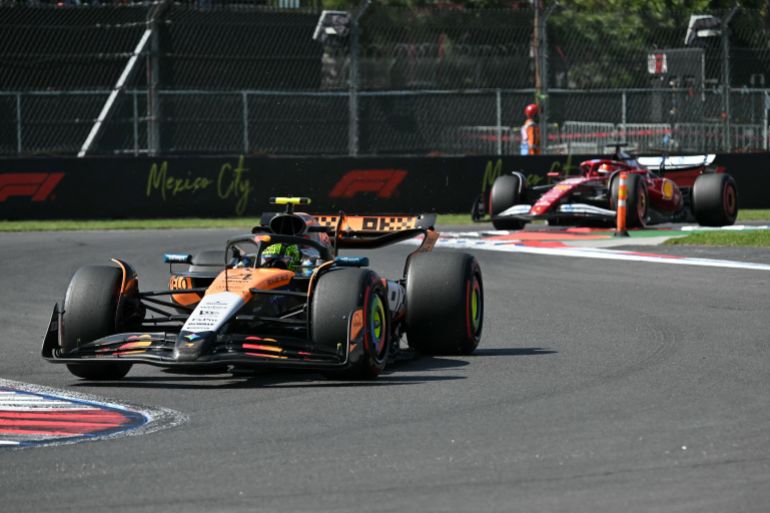
Lando Norris of McLaren leads the Mexico City Formula One Grand Prix ahead of Charles Leclerc of Ferrari.

Norris becomes the frontrunner for the championship.

Norris last won the drivers’ standings in April, ending a 189-day losing streak. He had not won a race since Hungary’s early August debut. His tenth career victory came on Sunday, one shy of Piastri’s sixth.

“It seemed to me like I was struggling with the dirty air the entire race. Piastri said, “That was a little challenging.

“Today was about trying to limit the damage while also trying to learn some things about that,” he said. I’ll be happy if I’ve made some progress in that regard.

At a chequered flag waved by former heavyweight champion boxing champion Evander Holyfield, Oliver Bearman placed fourth for Haas, which was the best result for both the British and US-owned team.

The rookie remarked, “I held off Max in the first stint, I held off the Mercs in the second, and I held off the McLaren in the third one.”

“I looked in my rearview mirrors more often than I did the front.” But that’s occasionally the way it should be.

After being dropped from third place in a 10-second penalty and denying his hopes of a first podium for the team he joined in January, Kimi Antonelli finished sixth for Mercedes, teammate George Russell placed seventh, and Lewis Hamilton placed eighth for Ferrari.

Gabriel Bortoleto of Sauber won the final spot while Esteban Ocon of Haas finished with two points.

Oliver Bearman reacts.
Oliver Bearman, a Haas driver, placed fourth overall at the Mexico City Grand Prix [via Reuters]

Ferrari regains second place.

The top three drivers pitted twice, followed by Bearman, Piastri, and the Mercedes-Benz drivers, who all had one-stop racing.

In a constructors’ championship that McLaren had already won but in a close race for the runner-up spot, Ferrari reclaimed second place, one point ahead of Mercedes.

Verstappen cut the corner and bumped over the grass, but Norris made a straight start from pole when the lights went out.

Verstappen moved up to fourth place due to Russell’s intense annoyance, while Leclerc then cut turn two, reclaiming Norris, who had emerged from the chaos ahead.

Verstappen remarked on the team radio that Russell, who had started fourth, had sworn in vain to give the spot back, saying, “I got squeezed like crazy.”

In a frightful incident, Racing Bulls’ Liam Lawson, who had a new front wing installed on lap three, accelerated as two marshals raced across the track in front of him.

Verstappen and Hamilton, who was third overall, made contact on lap six as they crossed the turn one corner while Hamilton was trying to pass him.

Hamilton was penalized for leaving the track and taking an advantage after cutting back across the grass at turn four.

Bearman, on the other hand, rose to fourth place from ninth place at the start and appeared to be on the podium after Hamilton’s penalty on lap 24 was taken, but Verstappen did it.

After making his first stop, Piastri had to fight back from a low of 11th, passing Antonelli in the pits and Russell on the track.

After Carlos Sainz, Williams’s winner for Ferrari last year, spun and stopped on track on the final lap, causing smoke to come out of it, the virtual safety car was deployed.

Lando Norris reacts.
[Eloisa Sanchez/Reuters] Norris celebrates winning the Mexico City Grand Prix.