First GB athletes named for Winter Paralympics

Getty Images

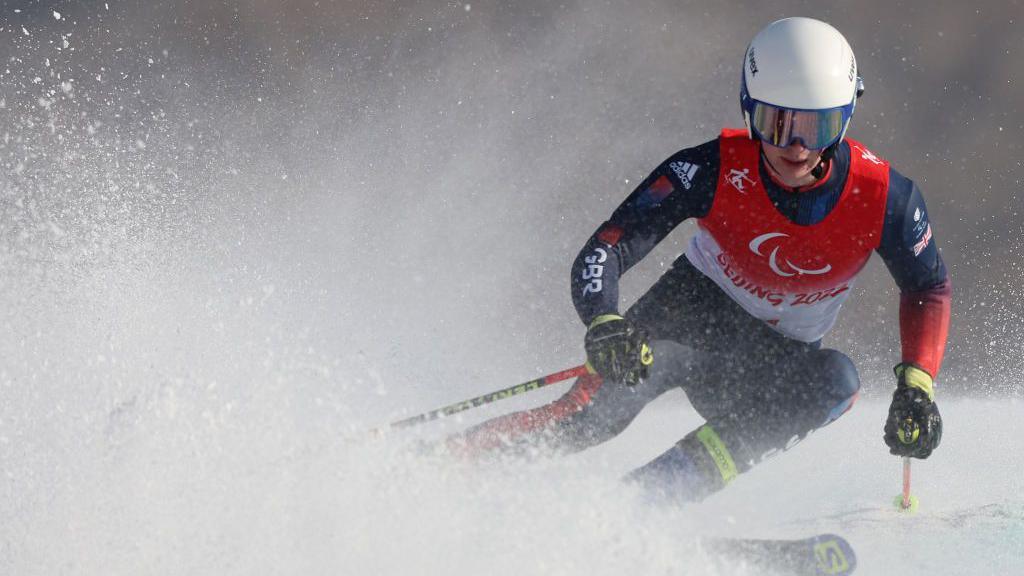
Defending Paralympic champion Neil Simpson leads the first wave of athletes named in the Great Britain squad for next year’s Winter Games in Italy.

Para-Alpine skier Simpson, who won Super-G gold and Super combined bronze in Beijing in 2022, will be guided by his brother Andrew in the speed events in Milan-Cortina, and Rob Poth in the technical events.

Scott Meenagh, the first British athlete to win a Para-Nordic World Championship medal when he took silver in the 12.5km individual biathlon in 2023, will compete at his third Paralympics.

Para-snowboarders James Barnes-Miller and Ollie Hill complete the line-up of the first wave of selections from snow sports, with more athletes to be selected in February.

“With less than 80 days to go before the Games begin, I’m absolutely delighted to see the first names on the ParalympicsGB team sheet for Milano Cortina 2026,” said chef de mission Phil Smith.

“With the winter season now under way there is a real sense of excitement of what is to come in Italy next year.

“All six athletes bring with them a wealth of experience and I cannot wait to see them in action knowing they will do all they can to deliver incredible performances to make the nation proud.”

Next year’s Games mark the 50th anniversary of the first Winter Paralympics and will run 6-15 March.

Wheelchair curling mixed doubles is the only new medal event that has been added to the programme.

At the last Winter Games in Beijing, Great Britain won six medals, including Simpson’s gold – the nation’s first gold medal on snow at either a Paralympics or Olympics.

Related topics

  • Winter Sports
  • Disability Sport

More on this story

    • 23 October
    A skier in front of the Olympic and Paralympic logos for the Milano Cortina Winter games

Fukofuka appointed Scotland women head coach

Getty Images

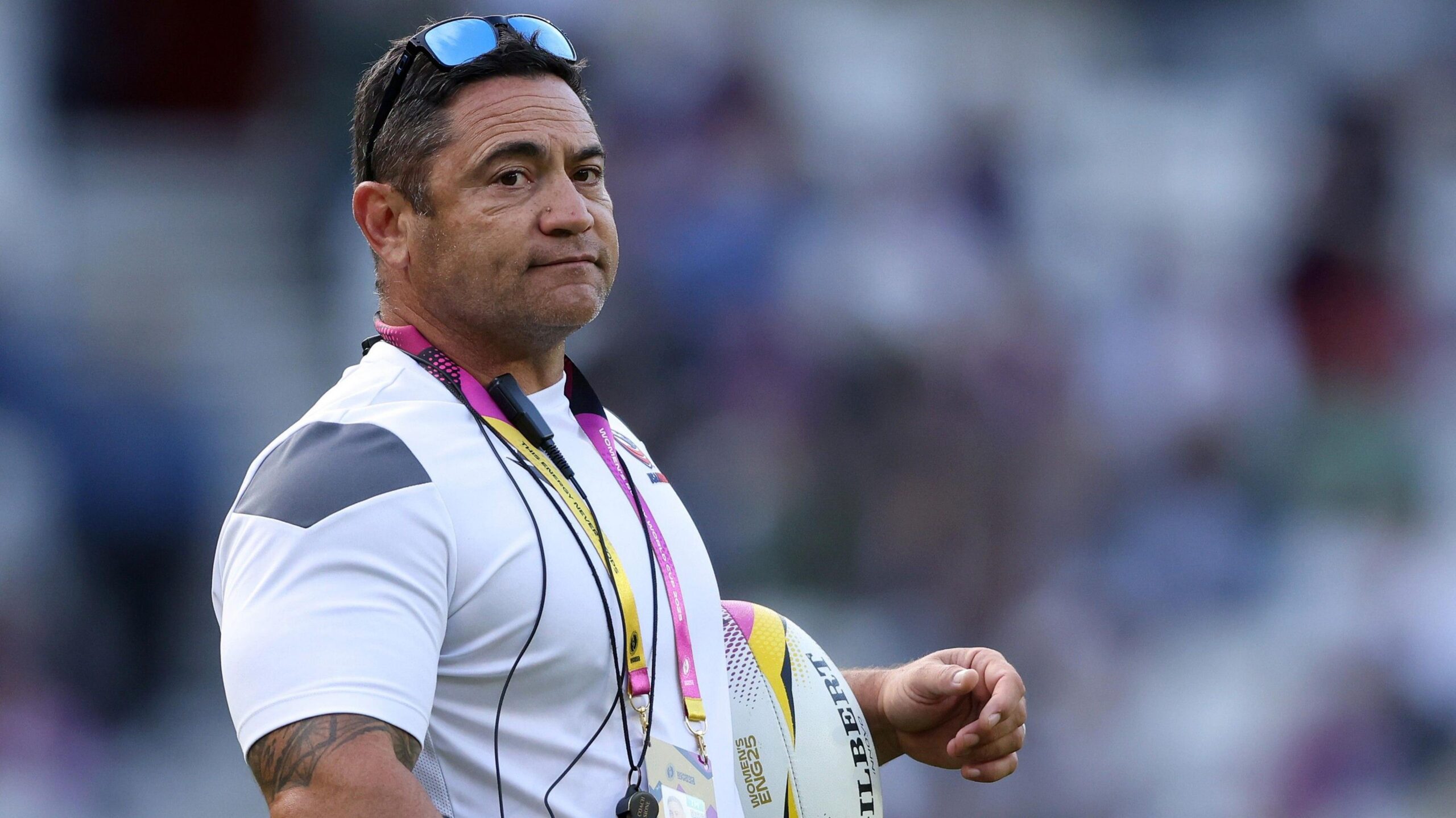
Australian Sione Fukofuka has been appointed head coach of Scotland women.

The former United States women head coach replaces Bryan Easson, who led the side for around five years and oversaw Scotland’s run to this year’s Women’s Rugby World Cup quarter-finals.

Fukofuka was previously Australia women assistant and Queensland Reds women attack coach.

On his watch, USA narrowly missed out on the World Cup knockouts.

Scotland open their Women’s Six Nations campaign away to Wales on 11 April and will also face Italy (25 April) and Ireland (17 May) on the road, with home matches against holders England (18 April) and France (9 May).

“An aligned domestic pathway and emphasis on the increasing professionalism of the senior programme through the Celtic Challenge and the senior Scotland Women team is exciting,” Fukofuka told Scottish Rugby.

Related internet links

    • 14 November
    • 25 September
    • 16 September

Scottish Rugby say Fukofuka’s appointment is subject to a visa and he will be based in Edinburgh.

Chief executive Alex Williamson commented: “Sione brings many years of experience within women’s international rugby and we want to build the strongest possible coaching set up to take us forward at this crucial time.

“With head of women’s performance and pathways, Andy Rhys Jones, also starting in the new year, we now have a highly talented leadership group for the whole women’s game for the first time.”

Related topics

  • Scottish Rugby
  • Rugby Union

Harry Potter star Jessie Cave reveals ‘awful’ time and secret split with comedian beau

Harry Potter actress Jessie Cave has opened up with brutal honesty about a ‘terrible’ two years with boyfriend Alfie after their secret split, amid fears they might ‘not be a couple forever’

Harry Potter star Jessie Cave has bared her soul over an ‘awful’ two years with boyfriend Alfie Brown after their secret split. The actress-turned-author’s candid confession comes after she launched a brand new podcast which sees her dig deep into their personal life – as she revealed her fears that they could end up breaking up again.

The 38-year-old, who shares four children with Alfie, said the ‘terrible’ time also ‘massively affected her career and self confidence’, in a lengthy and emotional Instagram message.

Jessie, who played Lavender Brown in the Harry Potter films, launched the podcast with her other half Alfie, also 38, who is a stand-up comedian known for his Next Up Comedy series.

READ MORE: Foodie tries Aldi’s £1.69 festive puff pastry slices and is ‘surprised’ by taste

Alfie, son of composer Steve Brown and impressionist Jan Ravens, was “cancelled” in 2023 after old footage which showed him using a racist slur in 2015 came to light, something the performer later apologised for.

He and Jessie – who has her own OnlyFans account, secretly split earlier this year, and Jessie has now opened up on the details of that rocky time. Posting a snap of their son watching Alfie’s stage show on TV followed by other pictures of life at work, she began her caption: “My boyfriend was what is/was called ‘cancelled’ in 2023 on the day our youngest son Becker turned one.”

She went on to reveal, “It was the beginning of a terrible year, two years, actually longer…. I won’t make this about me and tell you how AWFUL it has been to watch the person you love most in the world go through so much pain, public shaming and humiliation…

“Or even how it has massively affected my career and self-confidence too – because he has just put his comedy special about it the whole thing out on YouTube, and it’s getting a brilliant and entirely well deserved response… though it’s not been easy at all to get it out there.”

She added: “I’ve watched him hide away and overthink, lose himself. I watched him do Edinburgh shows in tears at midnight, as he first worked the show out, a few months after everything disintegrated.

“I’ve watched his whole life change in the last three years, losing not only his career but with the shocking deaths of his great friend and director Adam Brace and his wonderful dad Steve Brown… two of the most vital and supportive people to him.“

Her emotional post continued: “I’ve watched as people we thought we could trust betray him. I’ve watched as the theatre we used to love and who we both worked with for over a decade cover up posters of him and act like cowards. I’ve stood by him for it all as I will stand by him forever. But I think the saddest thing of all is that I’ve watched him shy away from gigs when it used to be that being onstage was the most natural thing in the world to him.

“I tried to pick photos from during that time for this post but they were all too bleak. But I like the ones I’ve chosen as he looks so uncertain and scared, yet determined to find a way forwards onstage, telling jokes.” But Jessie, who is also a comedian, then revealed that life is a lot better now, with her other half’s show The Last Cancelled Comedian show now available for free on YouTube.

She explained, “Everything is much better now. He’s back onstage again, we are close to happy (if you listen to our podcast you might know what I mean). I find the show very hard to watch, though I’ve seen it over 10 times. I think it’s incredible and I would love people to watch it. Thank you if you already have. I love you Alfie.”

The pair first met in 2012, when they were both doing stand-up shows at the Edinburgh Fringe Festival, and two years later went on a date after a mutual friend set them up.

After going home together, they didn’t see each other again until four months later, when Jessie realised she was expecting Alfie’s child – Donnie, who arrived in October 2014, followed by their daughter two years later. But in 2018 the couple went through a brutal break-up, which they revealed on their new podcast, Before We Break Up Again (BWBUA)

Speaking with The Sunday Times, Jessie revealed that she’s not sure if the pair “will remain a couple for ever”. In October 2020, they had a second son, and in December 2021 announced they were expecting baby number four.

Article continues below

PHOTOS: NLC Protests Over Rising Insecurity In Nigeria

The Nigeria Labour Congress (NLC) on Wednesday staged a protest over the spate of insecurity in different parts of the country.

READ ALSO: UPDATED: NLC Protests Over Rising Insecurity In Nigeria

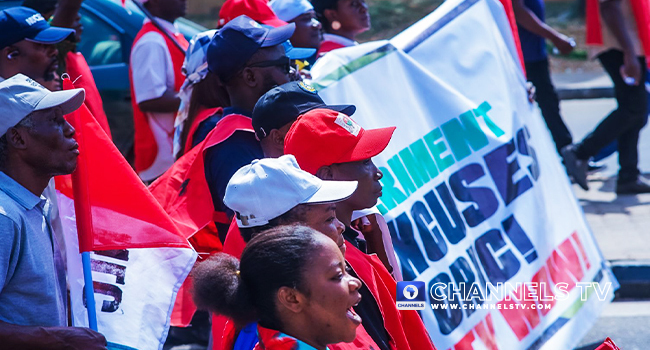
The NLC was joined by different civil society organisations, who carried placards calling for urgent actions to address the security problems.

The NLC was joined by different civil society organisations.

Demonstrations were recorded in Abuja, the Federal Capital Territory (FCT), Niger, Taraba and Lagos states, under the watchful eyes of security agents.

Members of the NLC called for more government measures to address the spate of insecurity in Nigeria.

But the Edo State council of the NLC withdrew from the nationwide protest against insecurity, saying that the timing of the protest was not appropriate.

Members of the NLC called for more government measures to address the spate of insecurity in Nigeria.

​It explained that the state serves as a major transit route to several parts of the country, especially during this period of increased travel.

Demonstrations were recorded in Abuja, the Federal Capital Territory (FCT), Niger, Taraba and Lagos states, under the watchful eyes of security agents.

​It also noted that the Oba of Benin, Oba Ewuare II, was currently marking the annual Igue festival, which had attracted a large influx of visitors to Benin City.​

See more photos from the protest below:

The NLC was joined in the protest by several civil society organisations on Wednesday.
Members of the NLC called for more government measures to address the spate of insecurity in Nigeria.
The NLC was joined in the protest by several civil society organisations on Wednesday.

Nigeria must not become America’s next battlefield

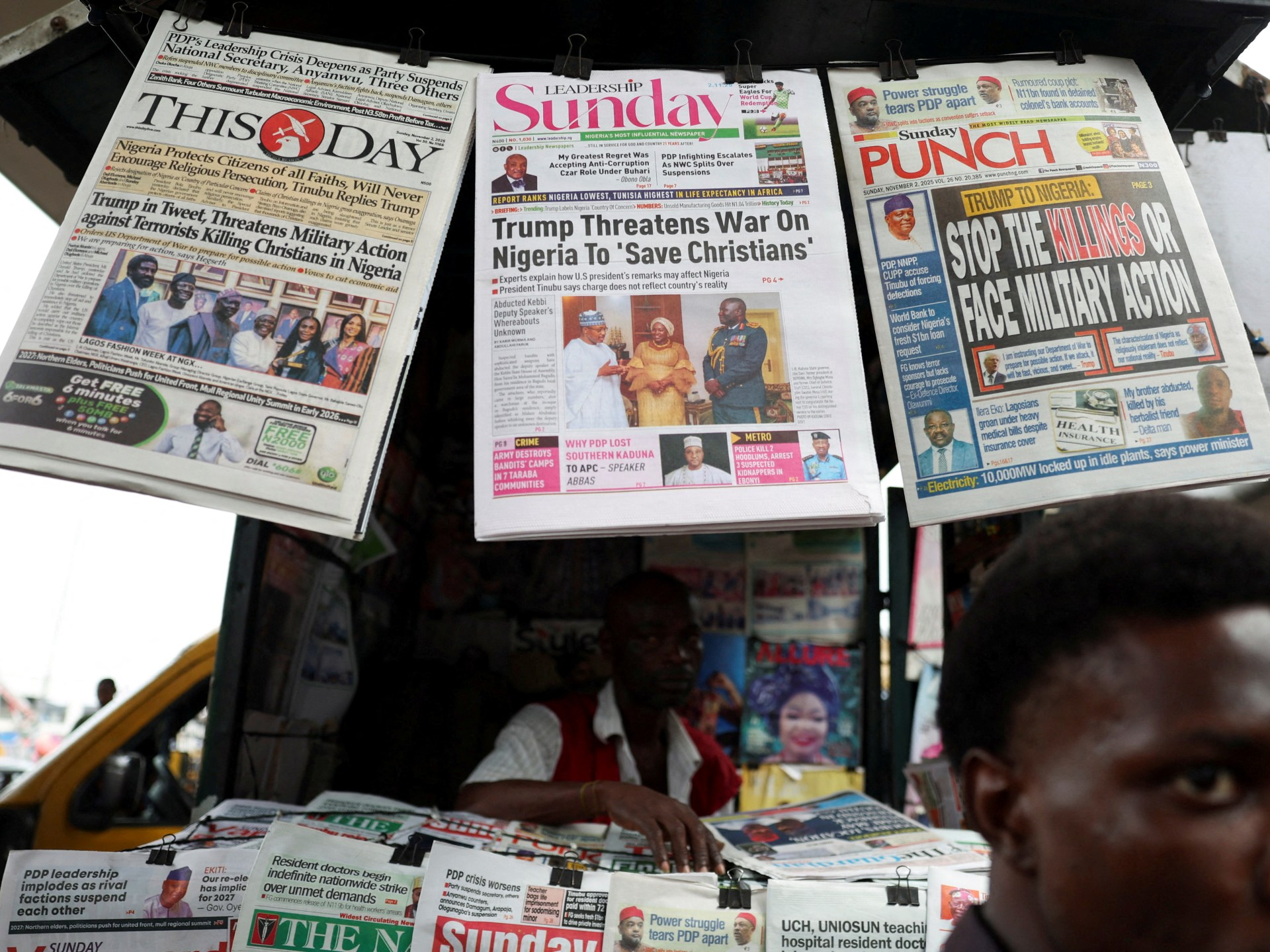
In early November, United States President Donald Trump declared that “Christianity is facing an existential threat in Nigeria”. In a series of posts on his Truth Social platform, he accused “radical Islamists” of “mass slaughter” and warned that the US “may very well go into that now disgraced country, guns-a-blazing“.

The claim rested on a familiar assumption: that violence in Nigeria is driven by religious ideology, with Christians targeted by Islamist militants.

In mid-November, a new wave of school abductions revealed how perilous parts of northern Nigeria have become for children of all faiths. On November 17, armed men raided Government Girls Comprehensive Secondary School in Maga, Kebbi State, killing a vice principal and abducting 25 students. The school was state-run, and the victims were Muslim girls. One escaped, and the remaining 24 were later rescued.

Days later, in the early hours of November 21, gunmen stormed St Mary’s Catholic Primary and Secondary School in Papiri, Niger State, abducting pupils and teachers. While some captives later escaped or were released, many remained missing into mid-December, leaving families in agonising uncertainty. Parents continue to wait without answers, their desperation and anguish hardening into anger as official assurances fade.

Taken together, these attacks do not reflect a campaign of religious persecution. They follow a pattern that has become increasingly familiar across northern Nigeria: mass kidnapping for ransom, striking opportunistically rather than along religious lines.

Trump’s remarks do more than misdiagnose this violence. They reimagine it. With a few lines of incendiary rhetoric, a country grappling with criminal insecurity and institutional collapse is recast as a front line in a civilisational struggle — a place where force, not reform, becomes the implied solution.

Once framed that way, Nigeria is no longer a society in need of protection and repair, but a battlefield-in-waiting.

That shift matters. When violence is described as religious war rather than organised crime, responsibility moves outwards, solutions become militarised, and foreign intervention begins to sound not reckless but righteous.

This pattern is hardly surprising.

American power has a habit of transforming complex foreign crises into apocalyptic moral dramas, and then acting on the story it has told itself.

Nonetheless, Nigerian church leaders, who know the terrain and the people intimately, reject Washington’s narrative. The Catholic Bishop of Sokoto, Matthew Kukah, a leading figure in Nigeria’s peacebuilding efforts, for example, cautioned against interpreting the violence as religious warfare, pointing instead to criminal motives and state failure.

Analysts concurred, emphasising that attacks fall on Christians and Muslims alike and often follow patterns of banditry and ransom rather than theology.

In Kebbi State, the victims were Muslim schoolgirls taken from a state-run boarding school. In Niger State, the targets were pupils and teachers at a Catholic mission school. Across Zamfara, Katsina, Sokoto, Kaduna, Niger and Plateau states, villages have been raided, farms abandoned and populations displaced.

This violence is driven primarily by profit-driven criminal violence rather than religious belief.

Chronic poverty, rural neglect and youth unemployment — with about 72 percent of rural Nigerians living in multidimensional poverty — fuel recruitment into criminal and armed networks.

True to Bishop Kukah’s analysis, ideology accounts for far less of this violence than predatory criminal behaviour and opportunism. What flourishes instead is organised crime in areas where the state barely functions. The principal threat now stems from armed “bandit” networks rather than a single ideologically driven insurgent movement.

These criminal militias kidnap schoolchildren and commuters for ransom, rustle cattle, extort villages, attack highways and, according to multiple reports, increasingly tap into illegal mining economies, often operating from forest bases across the northwest.

At the same time, Nigeria is not confronting one armed threat but several. Across the northeast, Boko Haram and the ISIL (ISIS) affiliate in West Africa Province (ISWAP) remain active. In the northwest and north-central regions, armed bandit networks dominate. Further south, in the middle belt, militia violence feeds on land disputes and communal tensions.

The outcome has been mass displacement and civilian death on a devastating scale.

Amnesty International estimates that more than 10,000 civilians were killed in armed attacks in the two years after May 29, 2023, when President Bola Tinubu took office. Hundreds of villages have been destroyed or emptied. Thousands of children have abandoned school. In parts of the northwest, attacks are reported to occur weekly and, at times, even daily. More disturbingly, kidnapping now reaches highways and commuter routes in and around the capital, Abuja.

To treat this catastrophe as religious persecution is not just inaccurate but profoundly dangerous. This false framing transforms organised crime and state collapse into a myth of religious war, one that obscures causes and invites disastrous cures.

That is why language matters: it shapes intent and consequences.

When Washington defines domestic collapse as moral failure, Nigeria ceases to be seen as a country in need of reconstruction and starts to look like an international threat to be managed from outside.

Global attention shifts from strengthening local institutions towards employing financial leverage, coercive tools and military force.

Communities become talking points in US politics.

In the process, Nigerian citizens are reduced to abstractions rather than treated as living human beings with rights, and localities like Kebbi and Niger are recast as conflict zones instead of places in need of urgent repair.

When powerful states define a crisis, they begin shaping the outcome.

History offers no reassurance.

From Iraq to Libya, US-led interventions have ushered in untold devastation, leaving in their wake public institutions in ruins and wars without end.

Crucially, every military campaign promised peace and stability. Over time, every mission has killed thousands of civilians and left entire countries in ruins.

If US forces entered Nigeria, even in small numbers, foreign troops would quickly become magnets for attack and targets for retaliation, turning villages and forest communities into potential battlefields.

Communities would be squeezed between bandits and foreign firepower, as criminal networks splinter, rebrand and adapt to the new battlefield.

This is the architecture of the US’s war cycle: an excuse first, force second, and civilian lives last.

Nigeria should not assume immunity from this great power logic, as countries do not become warzones overnight. They are first described as failures, then reframed as threats, before being treated as acceptable targets.

Nigeria’s institutional weakness is no accident. It is rooted in years of protecting assets instead of people, while neglecting policing, justice and basic services.

Colonial and post-colonial rule built systems for natural resource extraction rather than citizen protection. For many decades, often under military rule, securing oil revenue and political control mattered more than effective governance, public welfare or human security.

In the Niger Delta, this approach has meant environmental ruin, loss of livelihoods and institutional neglect — the true cost of protecting wealth before people.

Today, that systemic design persists: the state still defends assets more effectively than lives, while inequality and neglect have deepened civilian exposure.

Even so, Nigeria still has options.

In late November, Tinubu declared a nationwide security emergency, ordered the recruitment of 20,000 additional police officers as part of a broader expansion plan, redeployed VIP escorts to front-line duties, and authorised the deployment and expansion of DSS forest guards to hunt bandits and rebels.

Whether these moves produce results depends not on announcements but on enforcement and extensive reform.

Police and intelligence services must be strengthened and reoriented towards community protection, with proper oversight and resourcing, not merely expanded on paper.

Only about 15 percent of Nigerians say they trust the police, while many view officers as corrupt or violent, leaving communities fearful of both criminals and law enforcement.

Courts and financial regulators need the capacity to dismantle ransom and extortion networks as business systems, not only to chase their gunmen.

Regionally, Nigeria must push for serious cooperation on intelligence sharing, border control and joint operations, or armed groups will continue to move freely across borders with near-total impunity.

From Washington, Nigeria does not need troops or threats.

It requires support to rebuild the institutions that keep citizens safe: forensic capacity, actionable intelligence, training and diplomatic backing that strengthens Nigerian sovereignty instead of overriding it.

With about 61 percent of Nigerians reporting that they have felt unsafe in their communities in recent years, this must be a national wake-up call for Nigeria’s political class.

Only a comprehensive solution can deliver peace and protect besieged communities in northern Nigeria.

Trump must de-escalate. Tinubu must act decisively.

What will determine Nigeria’s future is not foreign firepower, but whether its institutions are rebuilt to protect citizens rather than assets.