Rivers Governor, Siminalayi Fubara, has expressed optimism that his administration’s delivery of infrastructure across the state will reinforce public trust and translate into increased support for President Bola Tinubu.
Governor Fubara spoke on Tuesday during the commissioning of the 5.94-kilometre Ihuowo–Ihuama Road in Ahoada East Local Government Area, a project awarded in October 2024.
He said the road project underscores his government’s commitment to responsive governance and addressing the pressing needs of the people. He described the intervention as a basic responsibility of any people-oriented administration.
The governor noted that the road had previously served as a death trap and an epicentre of crime and kidnapping, adding that its completion would significantly improve security and safety in the area.
READ ALSO: APC Formally Registers Gov Fubara As Party Member
Governor Fubara believes that his administration remains focused on service delivery to improve the living conditions of residents across Rivers State.
According to him, while every administration has a definite lifespan, his government will beremembered for its simplicity, openness to public concerns and prompt response to the needs of the people.
The governor also assured the traditional ruler of the area that requests for additional roads and other infrastructure would be granted, pledging sustained development interventions.
When armed soldiers in the small West African nation of Benin appeared on national television on December 7 to announce they had seized power in a coup, it felt to many across the region like another episode of the ongoing coup crisis that has seen several governments toppled since 2020.
But the scenes played out differently this time.
Recommended Stories
list of 4 itemsend of list
Amid reports of gunfire and civilians scampering to safety in the economic capital, Cotonou, Beninese and others across the region waited with bated breath as conflicting intelligence emerged. The small group of putschists, on the one hand, declared victory, but Benin’s forces and government officials said the plot had failed.
By evening, the situation was clear – Benin’s government was still standing. President Patrice Talon and loyalist forces in the army had managed to hold control, thanks to help from the country’s bigger neighbours, particularly its eastern ally and regional power, Nigeria.
While Talon now enjoys victory as the president who could not be unseated, the spotlight is also on the Economic Community of West African States (ECOWAS). The regional bloc rallied to save the day in Benin after their seeming resignation in the face of the crises rocking the region, including just last month, when the military took power in Guinea-Bissau.
This time, though, after much criticism and embarrassment, ECOWAS was ready to push back against the narrative of it being an ineffective bloc by baring its teeth and biting, political analyst Ryan Cummings told Al Jazeera.
“It wanted to remind the region that it does have the power to intervene when the context allows,” Cummings said. “At some point, there needed to be a line drawn in the sand [and] what was at stake was West Africa’s most stable sovereign country falling.”
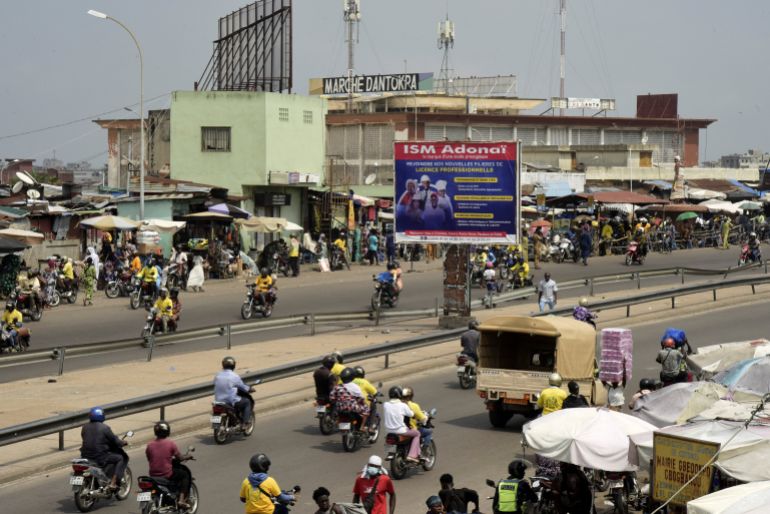
People gather at the market of Dantokpa, two days after Benin’s forces thwarted the attempted coup against the government, in Cotonou, December 9, 2025 [Charles Placide Tossou/Reuters]
Is a new ECOWAS on the horizon?
Benin’s military victory was an astonishing turnaround for an ECOWAS that has been cast as a dead weight in the region since 2020, when a coup in Mali spurred an astonishing series of military takeovers across the region in quick succession.
Between 2020 and 2025, nine coup attempts toppled five democratic governments and two military ones. The latest successful coup, in Guinea-Bissau, happened on November 28. Bissau-Guineans had voted in the presidential election some days before and were waiting for the results to be announced when the military seized the national television station, detained incumbent President Umaro Sissoco Embalo, and announced a new military leader.
ECOWAS, whose high-level delegation was in Bissau to monitor the electoral process when the coup happened, appeared on the back foot, unable to do much more than issue condemnatory statements. Those statements sounded similar to those it issued after the coups in Mali, Burkina Faso, Niger, and Guinea. The bloc appeared a far cry from the institution that, between 1990 and 2003, successfully intervened to stop the civil wars in Liberia and Sierra Leone, and later in the Ivory Coast. The last ECOWAS military intervention, in 2017, halted Gambian dictator Yahya Jammeh’s attempt to overturn the election results.
Indeed, ECOWAS’s success in its heyday hinged on the health of its members. Nigeria, arguably ECOWAS’s backbone, whose troops led the interventions in Liberia and Sierra Leone, has been mired in insecurity and economic crises of its own lately. In July 2023, when Nigeria’s President Bola Ahmed Tinubu was the ECOWAS chair, he threatened to invade Niger after the coup there.
It was disastrous timing. Faced with livelihood-eroding inflation and incessant attacks by armed groups at home, Nigerians were some of the loudest voices resisting an invasion. Many believed Tinubu, sworn in just months earlier, had misplaced his priorities. By the time ECOWAS had finished debating what to do weeks later, the military government in Niger had consolidated support throughout the armed forces and Nigeriens themselves had decided they wanted to back the military. ECOWAS and Tinubu backed off, defeated.
Niger left the alliance altogether in January this year, forming the Alliance of Sahel States (AES) with fellow military governments in Mali and Burkina Faso. All three share cultural and geographic affinities, but are also linked by their collective dislike for France, the former colonial power, which they blame for interfering in their countries. Even as they battle rampaging armed groups like Jama’at Nusrat al-Islam wal-Muslimin (JNIM), the three governments have cut ties with French forces formerly stationed there and welcomed Russian fighters whose effectiveness, security experts say, fluctuates.
Sierra Leone’s President Julius Maada Bio, who chairs ECOWAS, walks with Guinea-Bissau’s transitional president, Major-General Horta Inta-A, during a meeting in Bissau, Guinea-Bissau, on December 1, 2025 [Delcyo Sanca/Reuters]
But Benin was different, and ECOWAS appeared wide awake. Aside from the fact that it was one coup too far, Cummings said, the country’s proximity to Nigeria, and two grave mistakes the putschists made, gave ECOWAS a fighting chance.
The first mistake was that the rebels had failed to take Talon hostage, as is the modus operandi with putschists in the region. That allowed the president to directly send an SOS to his counterparts following the first failed attacks on the presidential palace at dawn.
The second mistake was perhaps even graver.
“Not all the armed forces were on board,” Cummings said, noting that the small group of about 100 rebel soldiers had likely assumed other units would fall in line but had underestimated how loyal other factions were to the president. That was a miscalculation in a country where military rule ended in 1990 and where 73 percent of Beninese believe that democracy is better than any other form of government, according to poll site Afrobarometer. Many take particular pride in their country being hailed as the region’s most stable democracy.
“There was division within the army, and that was the window of opportunity that allowed ECOWAS to deploy because there wasn’t going to be a case of ‘If we deploy, we will be targeted by the army’. I dare say that if there were no countercoup, there was no way ECOWAS would have gotten involved because it would have been a conventional war,” Cummings added.
Quickly reading the room, Benin’s neighbours reacted swiftly. For the first time in nearly a decade, the bloc deployed its standby ground forces from Nigeria, Ghana, the Ivory Coast, and Sierra Leone. Abuja authorised air attacks on rebel soldiers who were effectively cornered in a military base in Cotonou and at the national TV building, but who were putting up a last-ditch attempt at resistance. France also supported the mission by providing intelligence. By nightfall, the rebels had been completely dislodged by Nigerian jets. The battle for Cotonou was over.
At least 14 people have since been arrested. Several casualties were reported on both sides, with one civilian, the wife of a high-ranking officer marked for assassination, among the dead. On Wednesday, Beninese authorities revealed that the coup leader, Colonel Pascal Tigri, was hiding in neighbouring Togo.
At stake for ECOWAS was the risk of losing yet another member, possibly to the landlocked AES, said Kabiru Adamu, founder of Abuja-based Beacon Security intelligence firm. “I am 90 percent sure Benin would have joined the AES because they desperately need a littoral state,” he said, referring to Benin’s Cotonou port, which would have expanded AES export capabilities.
Nigeria could also not afford a military government mismanaging the deteriorating security situation in northern Benin, as has been witnessed in the AES countries, Cummings said. Armed group JNIM launched its first attack on Nigerian soil in October, adding to Abuja’s pressures as it continues to face Boko Haram in the northeast and armed bandit groups in the northwest. Abuja has also come under diplomatic fire from the US, which falsely alleges a “Christian genocide” in the country.
“We know that this insecurity is the stick with which Tinubu is being beaten, and we already know his nose is bloodied,” Cummings said.
Revelling in the glory of the Benin mission last Sunday, Tinubu praised Nigeria’s forces in a statement, saying the “Nigerian armed forces stood gallantly as a defender and protector of constitutional order”. A group of Nigerian governors also hailed the president’s action, and said it reinforced Nigeria’s regional power status and would deter further coup plotters.
Nigerian ECOWAS Ceasefire Monitoring Group (ECOMOG) soldiers guard a corner in downtown Monrovia during fighting between militias loyal to Charles Taylor and Roosevelt Johnson in Liberia in 1996. Between 1990-2003, ECOWAS successfully intervened to help stop the Liberian civil war [File: Reuters]
Not yet out of the woods
If there is a perception that ECOWAS has reawakened and future putschists will be discouraged, the reality may not be so positive, analysts say. The bloc still has much to do before it can be taken seriously again, particularly in upholding democracy and calling out sham elections before governments become vulnerable to mass uprisings or coups, Beacon Security’s Adamu said.
In Benin, for example, ECOWAS did not react as President Talon, in power since 2016, grew increasingly autocratic, barring opposition groups in two previous presidential elections. His government has again barred the main opposition challenger, Renaud Agbodjo, from elections scheduled for next April, while Talon’s pick, former finance minister Romuald Wadagni, is the obvious favourite.
“It’s clear that the elections have been engineered already,” Adamu said. “In the entire subregion, it’s difficult to point to any single country where the rule of law has not been jettisoned and where the voice of the people is heard without fear.”
ECOWAS, Adamu added, needs to proactively re-educate member states on democratic principles, hold them accountable when there are lapses, as in the Benin case, and then intervene when threats emerge.
The bloc appears to be taking heed. On December 9, two days after the failed Benin coup, ECOWAS declared a state of emergency.
“Events of the last few weeks have shown the imperative of serious introspection on the future of our democracy and the urgent need to invest in the security of our community,” Omar Touray, ECOWAS Commission president, said at a meeting in the Abuja headquarters. Touray cited situations that constitute coup risks, such as the erosion of electoral integrity and mounting geopolitical tensions, as the bloc splits along foreign influences. Currently, ECOWAS member states have stayed close to Western allies like France, while the AES is firmly pro-Russia.
Another challenge the bloc faces is managing potential fallout with the AES states amid France’s increasing closeness with Abuja. As Paris faces hostility in Francophone West Africa, it has drawn closer to Nigeria, where it does not have the same negative colonial reputation, and which it perceives as useful for protecting French business interests in the region, Cummings said. At the same time, ECOWAS is still hoping to woo the three rogue ex-members back into its fold, and countries like Ghana have already established bilateral ties with the military governments.
“The challenge with that is that the AES would see the intervention [in Benin] as an act not from ECOWAS itself but something engineered by France,” Adamu said. Seeing France instigating an intervention which could have benefitted AES reinforces their earlier complaints that Paris pokes its nose into the region’s affairs, and could push them further away, he said.
Shoppers can snap up Amanda Holden’s ‘fabulous’ shearling-trimmed coatigan for 20% less thanks to Karen Millen’s limited time sale
This article contains affiliate links, we will receive a commission on any sales we generate from it. Learn more
View 2 Images
Amanda Holden has proved her style credentials yet again and wowed us with another stylish look (Image: Instagram @noholdenback)
Amanda Holden has proved her style credentials yet again and wowed us with another stylish look that’s perfect for the festive season.
Described by the TV and radio presenter as “fabulous”, Amanda raved about her chic coatigan from Karen Millen. The coat/cardigan hybrid is currently 20% off, reducing the price from £299 to £239.20.
The Viscose Blend Compact Knit Shealing Cuff Belted Coatigan is the kind of piece that instantly elevates an outfit by combining the polish of a tailored coat with the warmth and comfort of a cardigan.
What makes it perfect for Christmas and party season is the shearling-trim cuffs, which add a playful yet fashionable twist without feeling too over the top.
READ MORE: Ugg’s stylish clogs ‘keep feet so warm’ and are now 70% off in flash sale
READ MORE: Stacey Solomon says her under-£20 hand warmers are her ‘best discovery of 2025’
Perfect for slipping over an evening look or dressing up jeans and a simple knit, Amanda couldn’t rave about the cardigan enough calling it “super warm and very Christmassy”.
Available in black and cream, Amanda opted for the black colour and kept it simple with a monochromatic look.
Although on the pricier side at over £200, this is an investment piece that you can come back to time and time again, thanks to its clean, timeless silhouette and classic colour.
Plus, with Amanda Holden’s stamp of approval and a £60 discount, shoppers are already snapping this piece up with sizes selling out in both colourways.
Article continues below
Amanda may have also found the perfect Christmas party dress for adding a sparkle to your holiday occasion wear. Taking to social media last week to show off her festive look, Amanda looked glamorous in a structured gold mini dress she described as a “Christmas bauble dress”.
Undefeated UFC lightweight champion Ilia Topuria has explained his withdrawal from the UFC 324 title bout, alleging he is addressing an extortion attempt and will return to the cage at the appropriate time.
“Over the past several weeks, I have made the difficult decision to temporarily step away from defending my title. This was not a decision I took lightly. However, when circumstances arise that threaten your personal integrity, your family, and your reputation, there comes a point when you must address them directly,” Topuria said in a statement posted to Instagram on Monday.
Recommended Stories
list of 4 itemsend of list
Topuria (17-0) is not on the UFC 324 card. An interim lightweight championship bout between Justin Gaethje and Paddy Pimblett headlines the January 24 event in Paradise, Nevada.
The 28-year-old Georgian had already denied that an injury forced him out of a title defence. On Monday, Topuria said he wanted to address rumours and speculation about his absence from the sport since November.
“In recent months, I have been subjected to severe and unacceptable pressure, including threats to disseminate false allegations of domestic abuse unless financial demands were met. These allegations are entirely unfounded. The truth is not a matter of opinion – it is a matter of evidence. All relevant evidence has been carefully preserved and documented, including audio recordings, written communications, witness statements, and video material. This evidence has been submitted to the appropriate judicial authorities in order to pursue legal action for attempted extortion, falsification of evidence, misappropriation of funds and personal property, and multiple threats.”
Topuria has two knockout wins to defend the belt since he won it from Alexander Volkanovski in February 2024 with a knockout victory.
His most recent fight was a June 28 knockout victory against Charles Oliveira at UFC 317, which made him the first undefeated two-division champion in UFC history.
Topuria has won UFC titles in two weight classes – flyweight and lightweight – and has been ranked as the number one pound-for-pound UFC fighter in the world [File: Gary A Vasquez/USA TODAY Sports via Reuters]
A new wave of Israeli policies is changing the reality and boundaries on the ground in the occupied West Bank.
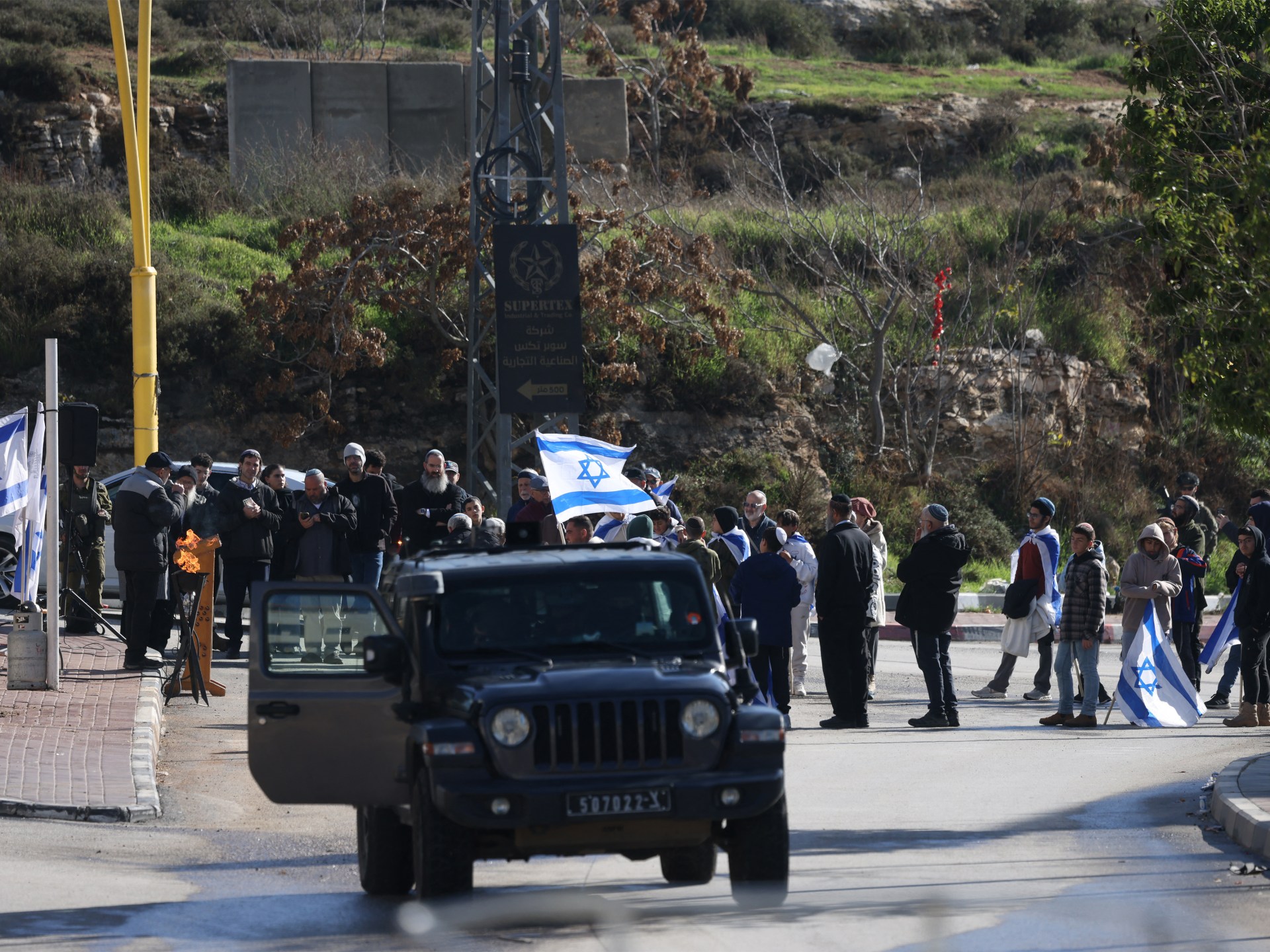
The Israeli government has approved the formalisation of 19 so-called settlement outposts as independent settlements in the occupied West Bank. This is the third wave of such formalisations this year by the government, which considers settlement expansion and annexation a top priority. During an earlier ceremony of formalisation, Finance Minister Bezalel Smotrich said, “We are advancing de facto sovereignty on the ground to prevent any possibility of establishing an Arab state in [the West Bank].”
Settlement outposts, which are illegal under international law, are set up by a small group of settlers without prior government authorisation. This does not mean that the settlers, who are often more ideological and violent, do not enjoy government protection. Israeli human rights organisations say that settlers in these so-called outposts enjoy protection, electricity and other services from the Israeli army. The formalisation opens the door to additional government funds, infrastructure and expansion.
Many of the settlement outposts formalised in this latest decision are concentrated in the northeastern part of the West Bank, an area that traditionally has had very little settlement activity. They also include the formalisation of two outposts evacuated in 2005 by the government of Israeli then-Prime Minister Ariel Sharon.
While these government decisions may seem bureaucratic, they are in fact strategic in nature. They support the more ideological and often more violent settlers entrenching their presence and taking over yet more Palestinian land, and becoming more brazen in their attacks against Palestinians, which are unprecedented in scope and effect.
The Israeli human rights organisation B’Tselem estimates that settler attacks against Palestinians have forcibly displaced 44 communities across the West Bank in the past two years. These arson attacks, vandalism, physical assault and deadly shootings are done under the protection of Israeli soldiers. During these settler attacks, 34 Palestinians were killed, including three children. None of the perpetrators has been brought to justice. In fact, policing of these groups has dropped under the direction of Israel’s national security minister, Itamar Ben-Gvir, who is a settler himself.
United Nations Secretary-General Antonio Guterres recently sounded the alarm about Israel’s record-breaking expansion of illegal settlements in the West Bank and the unprecedented levels of state-backed settler violence. In a briefing to the UN Security Council, Guterres reminded states that all settlements are illegal under international law. He also warned that they erode Palestinian rights recognised under this law, including to a state of their own.
In September, United States President Donald Trump said he “will not allow” Israel to annex the West Bank, without offering details of what actions he would take to prevent such a move.
But Israel is undeterred. The government continues to pursue its agenda of land grab, territorial expansion and annexation by a myriad of measures that fragment, dispossess and isolate Palestinians in the West Bank, including East Jerusalem, and continues its genocidal violence in Gaza.
More than 32,000 Palestinians have been forcibly displaced from their homes in three refugee camps in the occupied West Bank for nearly a year. The Israeli army continues to occupy Nur Shams, Tulkarem and Jenin refugee camps and ban residents from returning. Meanwhile, Israeli forces have demolished and damaged 1,460 buildings in those camps, according to a preliminary UN estimate. This huge, destructive campaign has changed the geography of the camps and plunged more families into economic and social despair.
This is the state hundreds of thousands of Palestinians across the West Bank find themselves in because of Israeli restrictions, home demolitions and land grabs. The Israeli army has set up close to 1,000 gates across the West Bank, turning communities into open-air prisons. This has a direct and devastating effect on the social fabric, economy and vitality of these communities, which live on land that is grabbed from under them to execute the expansion of illegal settlements, roads and so-called buffer zones around them.
According to the UN Conference on Trade and Development, Israeli practices and policies over the past two years have cost the Palestinian people 69 years of development. The organisation recently reported that the Palestinian gross domestic product (GDP) has shrunk to 2010 levels. This is visible most starkly in Gaza, but it is palpable in the West Bank as well.
The New York Knicks will attempt to find a way past the imposing 7ft 4in (2.23m) frame of San Antonio Spurs prodigy Victor Wembanyama on Tuesday as they bid to end their 52-year trophy drought in the NBA Cup final in Las Vegas.
The Knicks head into Tuesday’s final at the T-Mobile Center brimming with confidence after polishing off Eastern Conference top seeds Orlando with ease in Saturday’s semi-finals.
That win has left the New York franchise within touching distance of a first piece of silverware since the team’s 1973 NBA Finals victory over the Los Angeles Lakers.
Blocking their path, though, is the fit-again Wembanyama, the 21-year-old French giant who was instrumental in helping San Antonio upset the in-form Oklahoma City Thunder in Saturday’s Western Conference semi-final.
Wembanyama played limited minutes in the defeat of Oklahoma City, appearing from the bench in the second quarter to haul San Antonio back into contention after they had trailed by 11 points at the end of the first quarter.
Knicks talisman Jalen Brunson said New York would attempt to drag Wembanyama out of position defensively.
“You’ve got to find ways to pull him away from the basket, and you’ve got to obviously be smart,” Brunson said of Wembanyama. “You can’t just go in there and think no one is going to come and affect the shot.
“He’s great at what he does, and we’ve just got to be smart as a team, playing off two feet and reading where he is and just trying to get the best shot as possible.”
READ ALSO: Chris Paul Axed By Los Angeles Clippers
Team Effort
Karl-Anthony Towns echoed Brunson’s assessment of Wembanyama.
“He’s (7-4), and he’s very talented,” Towns said. “For us, we’re going to have to do a good job of executing our defensive game plan and offensively, as well.”
Karl-Anthony Towns #32 of the New York Knicks talks to the media during the 2025 Emirate NBA Cup Practice and Media Availability on December 15, 2025, at T-Mobile Arena in Las Vegas, Nevada. (Photo by TOM O’CONNOR / NBAE / GETTY IMAGES / GETTY IMAGES VIA AFP )
Knicks coach Mike Brown said neutralising Wembanyama would require a team effort.
“You’re not going to be able to guard a guy like that one-on-one,” Brown said. “You try to put length, size, physicality at the point of attack when it comes to him, but it’s got to be five guys guarding the basketball at all times.
“We have some pretty good defenders with length, and hopefully they can try to make it as difficult as possible with him, knowing that they have help behind them.”
Wembanyama’s introduction from the bench on Saturday sent a surge of excitement rippling through the T-Mobile Arena crowd, who later showered the Frenchman with chants of “M-V-P.”
Wembanyama, meanwhile, said San Antonio’s defeat of Oklahoma City augured well for the chances of the Spurs emerging as genuine rivals to the Thunder in the Western Conference.
Victor Wembanyama #1 of the San Antonio Spurs talks to the media during the 2025 Emirate NBA Cup Practice and Media Availability on December 15, 2025, at T-Mobile Arena in Las Vegas, Nevada . (PhotbyBy TOM O’CONNOR / NBAE / GETTY IMAGES / GETTY IMAGES VIA AFP )
“I think we’re not quite there yet, but it’s a good sign that people see that it’s possible,” Wembanyama said. “I don’t think anybody right now can claim to have a rivalry with them in the league. They’re in their own tier.
“But in the future, if we can provide a stage this good and we reach that level, of course, it would be great to have a rivalry because if you’re at the top and you have a rivalry, it means you’re in the best position to win titles.”
Wembanyama said while a San Antonio victory on Tuesday would “not be e super significant step,” it would still carry some significance.
“It’s a high-stakes game that both teams are going to be very invested in winning,” Wembanyama said.
“It just shows that we are preparing and we will pass the next step for more significant games in the playoffs.”